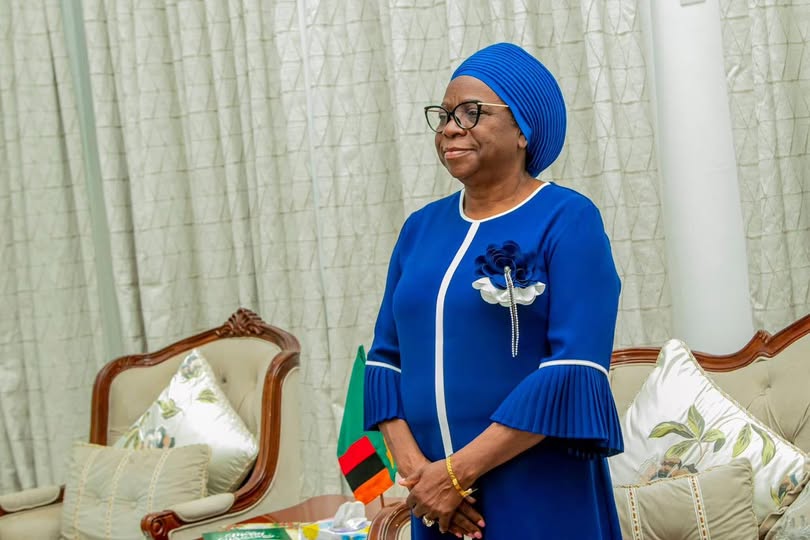
Vice President Mutale Nalumango has reiterated governments commitment to supporting the water and sanitation sector as a key enabler of national development.
Mrs Nalumango notes that this commitment is reflected in the government’s continued investment in water and sanitation infrastructure across the country.
She explained that Zambia has zero-rated tax on water treatment chemicals, which has reduced costs for utilities and ensured more affordable access to safe drinking water.
“We are reviewing legislation such as the water supply and sanitation act, so as to strengthen governance and the regulatory frameworks aimed at improving efficiency as well as ensuring equitable service delivery,” she added.
Mrs Nalumango was speaking today during the official opening of the 14th Zambia Water Forum Exhibition (ZAWAFE), held under the theme: “From Commitment to Action: Accelerating Integrated Resilience Solutions for Vision 2030 and the Sustainable Development Goals (SDGs)” in Lusaka.
She highlighted that the government is equally providing support for commercial water utilities to expand coverage and improve service quality, as well as promoting Public-Private Partnerships to mobilise resources and accelerate innovation.
Mrs Nalumango however stressed that despite efforts made, Zambia continues to face challenges caused by climate variability, droughts, floods, rapid urbanisation and rising demand for water and sanitation services.
“In response, my office through the Disaster Management and Mitigation Unit has worked closely with cooperating partners and has supported service providers to rehabilitate damaged water supply and sanitation infrastructure,” she added.
She implored the gathering to commit to embracing emerging technologies and scientific research, strengthening partnerships as well as mobilising resources for integrated and climate resilient infrastructure.
Mrs Nalumango also said the theme is both timely and urgent as it challenges government and stakeholders to move beyond pledges and declarations towards focusing on implementing concrete, measurable solutions that strengthen resilience in communities, ecosystems and institutions.
Speaking at the same event, ZAWAFE Organising Committee Chairperson, Imasiku Nyambe said ZAWAFE provides a platform to share experiences on water challenges and try to provide solutions.
Prof Nyambe also seized the moment to caution the gathering on the impending El Nino.
“We are likely to experience the El Nino. Starting October, 2026 to January 2027, which will pose a risk to agriculture and energy. Let us not sell all our maize. Let us wait for the rains,” added Prof Nyambe.
And Finish Ambassador to Zambia, Saana Halinen, called for urgent structured and cooperative governance regarding transboundary water bodies so as to provide for peaceful, equitable and sustainable transboundary water cooperation.
Ms Halinen pointed out that Finland aims to elevate the implementation of international law and support a transparent, inclusive and science based preparatory process.
Speaking at the same event, German Head of Development Cooperation in Zambia, Andreas Pletziger, observed that there are increased challenges threatening water security like climate change and pollution, as well as damaged ecosystems due to unsustainable practices and thus putting water security in danger.
Mr Pletziger reiterated Germans commitment to working with government and stakeholders in achieving progress in Zambia’s water sector and in realising Vision 20230.
Meanwhile, UNICEF Country representative, Saja Farook Abdullah, in a speech read on her behalf by UNICEF Deputy Country Representative, Tinkhani Msonda, stated that water, sanitation and hygiene (WASH) are foundations to human capital development.
He noted that when WASH systems fail, the consequences are immediate and far reaching, affecting every aspect of a child’s life, adding that WASH remains the most critical driver of child mortality.