
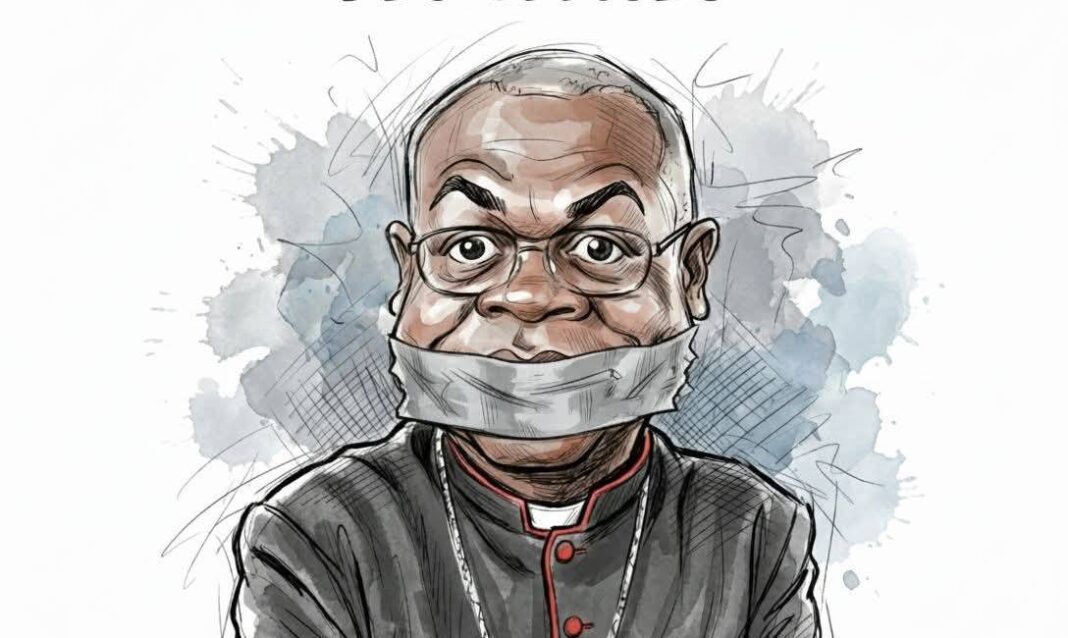
Silent Bishop
The silence of Archbishop Alick Banda has become louder than any press conference. In a political season already strained by mistrust, institutional fatigue, and sharpening rhetoric ahead of the August 2026 polls, that silence now sits at the centre of a national conversation about power, restraint, law enforcement, and the fragile boundary between investigation and intimidation.
What unfolded around the Archbishop was never merely about a motor vehicle or a procedural appearance before the Drug Enforcement Commission. It became symbolic, almost instantly. A stress test of how authority is exercised, how institutions communicate, and how quickly legal processes can be pulled into partisan narratives in an election cycle.
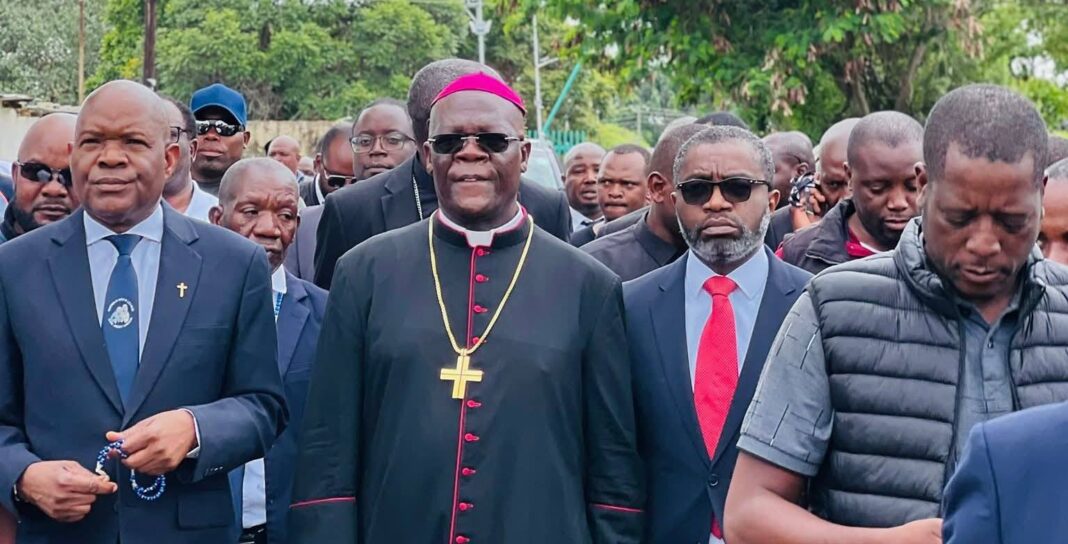
The Archbishop did not issue statements. He did not trade accusations. He did not address the nation. Yet it would be inaccurate to suggest that he stood alone or unaccompanied. Hundreds of Catholics gathered outside in prayer and solidarity, defying police warnings not out of political mobilisation, but out of identity and faith. That distinction matters. The Archbishop himself did not call them. He did not direct them. Their presence was organic, emotional, and rooted in collective memory rather than instruction. His silence, therefore, was not absence. It was restraint.
That restraint deserves qualification. Silence here was neither evasion nor arrogance. It was legal strategy, institutional discipline, and moral positioning. Under Zambian law, every citizen, cleric or otherwise, has the right to remain silent during questioning. In high-profile matters, silence is often advised to avoid self-incrimination, protect third parties, and preserve the integrity of process. Within church tradition, silence also guards confidentiality, particularly where donors and benefactors are involved. This was not defiance. It was principle.
Yet facts were quickly overwhelmed by noise.
One of the most damaging distortions was the claim that the vehicle in question was donated by the Zambia Revenue Authority or the government. That claim is false. It is not supported by available documentation, and its repetition has poisoned public understanding.
The facts, as they stand, are straightforward. The Toyota Hilux was auctioned by the Zambia Revenue Authority. It was purchased by a private Zambian citizen, Mulopa Kaunda. After the auction process, ZRA issued a receipt of sale and a gate pass authorising the release of the vehicle upon payment. That confirms a completed auction transaction, not a government donation. Mulopa Kaunda is said to have later donated the vehicle to the Archbishop, who then registered it in his own name. Whatever questions arise, they do not arise from a government or ZRA gift. They arise from an individual donation.
This distinction is not cosmetic. It is central. Whether the auction was conducted procedurally, whether the price reflected market value, and whether disposal rules were followed are internal matters for the Zambia Revenue Authority. They are questions of institutional compliance, not prima facie criminal conduct by a recipient who was not the auction buyer.
Yet the matter was politicised with speed and ferocity.
Those aligned with the ruling party framed the episode as evidence of wrongdoing by a cleric allegedly sympathetic to former President Edgar Lungu. Figures within the Church and sections of civil society interpreted it as retaliation for Archbishop Banda’s past criticism of the administration, including his opposition to recently passed constitutional changes touching on constituency delimitation, the proposed increase of parliamentary seats by 113, and the removal of term limits for mayors. In this crossfire, facts became optional and motive became everything.
The escalation did not occur in a vacuum. Tensions between Church and State had already been simmering. They deepened when President Hakainde Hichilema donated cattle and other items to the Catholic Church, which the Archbishop declined. His reasoning was explicit and cautious: he did not want a future president to accuse him of receiving goods that may later be questioned for legality. That refusal, intended to protect institutional integrity, was read by some as political hostility. Memory lingered.
Into this context stepped the Drug Enforcement Commission.
Through its Anti–Money Laundering Investigations Unit, the DEC issued a formal warning and caution to Archbishop Banda, citing alleged unlawful possession of the vehicle under Section 319(a) of the Penal Code. The public statement emphasised that when given an opportunity to explain how he came into possession of the vehicle, the Archbishop chose to remain silent. Legally accurate, yes. But institutionally explosive.
Law enforcement works best in quiet competence. Its legitimacy rests on process, not performance. When investigative agencies move from inquiry to public narration before charges are laid, they risk shifting perception from neutrality to pre-judgment. The moment suspicion is aired publicly without resolution, the matter ceases to be technical and becomes political.
This is why the silence of the Archbishop proved stabilising while the speech of the state inflamed tension.
A widely circulated civic commentary by Mwewa, “The Voice from Chifwema,” captured this moment with clarity. He framed the episode not as a church fight or a political fight, but as a civic conversation about institutions, rights, and national direction. He reminded the public that silence is a constitutional right, that prayer processions are part of Catholic identity, and that people were reacting less to a vehicle case than to history, memory, and perceived institutional disrespect.
He also highlighted why senior lawyers rushed to associate themselves with the case. This is no longer just an inquiry. It is a constitutional moment. It tests due process. It probes church–state relations. It sets precedent for how power is exercised against moral institutions in an election cycle.
As August 2026 approaches, symbolism will matter as much as legality. Governments rarely lose legitimacy through illegality alone. They lose it through accumulated moments where power appears performative, defensive, or indifferent to restraint. A bishop summoned publicly is not read as an ordinary citizen questioned. It is read as a moral authority challenged. That perception cannot be legislated away.
There was a better path. Quiet summons. Clear procedure. No public insinuation beyond evidence. No press briefing until facts demanded it. If wrongdoing exists, it will survive scrutiny. If it does not, restraint would have spared the nation unnecessary division.
The lesson of the Silent Bishop is not about clerical privilege. It is about institutional wisdom. Silence can be strength. Process can be protection. And restraint, in a season of suspicion, is not weakness. It is leadership.
As Zambia edges toward August 2026, the defining question for government is not whether it can enforce the law. It is whether it can do so without performing power, politicising process, or eroding trust. How this moment is remembered will depend not on who spoke loudest, but on who exercised the greatest discipline.



Guilty! You bet he is also abusing those catholic altar boys, he should be investigated for that also.
Guilty without trial? Is that the new dawn of injustice? Worst government we have ever had.
I wholeheartedly agree with @Malete.
That’s why he and his followers are trying to create diversions.
Additionally, my appeal to Zambians is, don’t allow another priest to lead you all like those in Rwanda did and start killing each other.
Catholic priests are insidious characters.
Maybe, he’s hanging on a cobweb stride.
Guilty as hell. The pope should ex communicate this thieving PF cadre.
From what I understand, there were 22 vehicles which were auctioned. Why is this one vehicle the only one being investigated?
Read up to “he did not call them”. Writer is biased. The Bishop did say he would hold mass on Monday before appearing before DEC.
Then the sheep accompanied the Shepherd there. How Zambians never get it that anything gotten illegally is stolen from them is beyond me.
Silence is never golden when you need to exculpate yourself. He had his fingers in the honey put screaming from his silence.
So you ignore the facts as stated, & only focus on the bit where he called for mass, & go on to call the author biased?????
Indeed, “the Pot calling the Kettle Black!!” Go figure!!
UPND propaganda machine in full gear. They have created a moribund portfolio headed by Mweetwa which is paying off social media posters of malicious gossip which is abounding here.
They know We can’t audit ministry of media so our tax money is just being misused. They want us to forget loadshedding, unemployment their corruption and witchcraft.
Italy only knew peace when tgr vatican was created
For God’s sake wake up !! Why has this come up now before elections
So it’s not about innocence or being guilty
This grz is desparate to win at any cost
Good move to keep quiet