
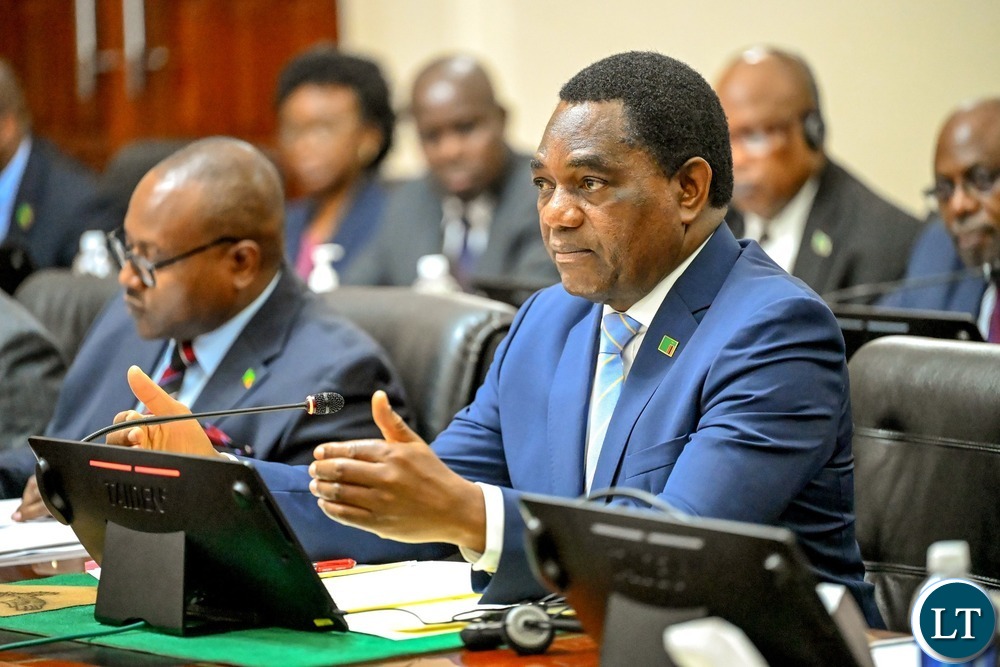
President Hakainde Hichilema has acknowledged receiving a formal letter from a group of opposition political leaders outlining concerns related to the current constitutional reform process under Bill 7. The communication was delivered to State House earlier this week and has since been confirmed by Chief Communications Specialist Clayson Hamasaka, who stated that the President had taken note of the issues raised and would consider them within the broader context of national consultations.
Mr Hamasaka explained that State House had already provided general clarification on aspects of the reform process in recent public statements, but the letter from the opposition would still form part of the documentation being reviewed as government prepares for wider engagement. He said the President valued dialogue that contributes to strengthening national governance, even where views differ on the direction or pace of reforms.
The opposition leaders, whose identities were not listed in the front-page summary, argued in their letter that the reform process required deeper consultation and should reflect broader national consensus rather than be driven by the Executive alone. They expressed concerns about transparency, timing, and the level of public participation available so far. According to the letter, they believed that more inclusive mechanisms were necessary to protect the integrity of constitutional changes.
Mr Hamasaka stated that the President had no objection to receiving the letter and maintained that all voices, including the opposition, would be taken into account. He noted that President Hichilema had consistently encouraged constructive engagement, particularly on matters of national importance such as constitutional reform. He added that the government was committed to ensuring that submissions from different stakeholders were recognised and processed appropriately.
The Chief Communications Specialist stressed that State House viewed the reform process as part of a broader dialogue that should involve not only political groups but also civil society organisations, religious bodies, professional associations, and institutions with an established interest in governance. He said the President had repeatedly emphasised the need for sincerity and civility in national discussions, particularly where constitutional matters are concerned.
The letter reportedly proposed alternative pathways to managing amendments, including a phased approach that would allow for deeper public education, targeted consultations and a summary of consensus points before any bill is taken through Parliament. It also urged State House to ensure that submissions already made by various groups, especially civic organisations, were not overlooked.
Mr Hamasaka reiterated that the President believed engagement must be open and transparent but also realistic in terms of time and legislative procedures. He said the opposition’s concerns would be examined together with other submissions from groups that had met the President in recent weeks. These include clergy representatives, youth organisations, civic associations and professional bodies, many of whom have publicly shared their positions on the pace and substance of the amendment process.
The Chief Communications Specialist stated that although disagreements were expected, there was value in acknowledging the role of the opposition in democratic governance. He added that the President had always encouraged political leaders to participate meaningfully rather than limit themselves to commentary without offering solutions. In his view, structured dialogue could reduce tensions and provide clarity on areas where political actors diverged.
Mr Hamasaka also highlighted that government had continued to emphasise the importance of respecting institutional procedures. He said constitutional amendments required careful handling because they involved the fundamental legal framework that guides the operations of the state. The administration, he noted, intended to ensure that whatever amendments are ultimately presented to Parliament reflect a fair consideration of the positions expressed by stakeholders.
He added that although public debate had intensified around certain provisions, the reform process remained open and would accommodate further submissions. He urged all political actors and interest groups to use recognised channels to make their contributions so that the conversation remains organised and reflective of national priorities.
The President’s response, according to Mr Hamasaka, aligns with his ongoing message of promoting constructive engagement and national cohesion. He said that while disagreements over constitutional matters were normal, the goal should always be to advance Zambia’s governance framework rather than deepen political divisions. State House, he emphasised, remained committed to ensuring that the reform process is conducted with professionalism and sensitivity to the expectations of citizens.
The Chief Communications Specialist underscored that the President viewed the receipt of the letter as part of the ongoing democratic process, not as an adversarial confrontation. He encouraged political leaders to focus on substance rather than rhetoric and to engage in dialogue that produces outcomes beneficial to the country. He concluded by noting that the President would continue to welcome constructive submissions as the amendment process progresses.



They failed to critically the Bill 7, read to them like a 4th grader.
Starting to eat humble piee ?
None of the opposition parties know what they are opposing.
But because they know that the majority of Zambians are semi-literate, illiterate, ill-educated and or are ignorant, they are coming forward with their nonsense.
Bill 7 is for the benefit of Zambians.