
By Kapya Kaoma
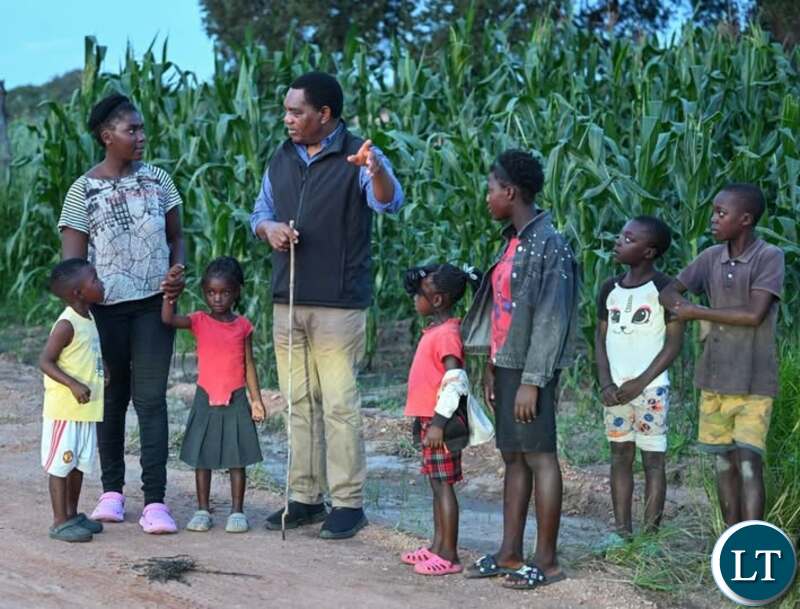
Many opposition figures are fixated on President Hakainde Hichilema’s extended stay in Southern Province. I am not. If anything, his presence there is entirely rational—indeed necessary—if he hopes to secure a second term. Southern Province is not merely his political home base; it is the electoral engine he must command to offset growing national discontent.
By now, most Zambians recognize a troubling pattern in Hichilema’s politics: casual dishonesty deployed as strategy. This is why the arrest of Miles Sampa for allegedly lying about the Chawama elections is ironic. Has Hichilema himself not repeatedly made demonstrably false claims? Among them, the assertion that Tongas are routinely attacked at Lusaka’s Inter-City Bus Station simply for coming from Choma or Dudumwenzi. Or his exaggerated depictions of educational deprivation in Southern Province.
It took a courageous Tonga woman from Livingstone to publicly challenge the President, demanding evidence. She pointed to the existence of long-established great schools, and reminded him that he is hardly the first Tonga to navigate Lusaka’s streets. Her rebuke was blunt and unambiguous: Mr. President, stop lying. Stop demeaning your own people for political gain. That such a challenge came from within his own ethnic community is telling. When leaders distort the lived realities of their base, legitimacy is already eroding.
This brings us to the real question: why Southern Province, and why now?
Hichilema already has his core “farming votes” locked in for August 13. His continued presence there is not about persuasion; it is about control—and, ultimately, rigging. For the opposition, therefore, the strategic task is not to “win” Southern Province, but to police it. Elections are not won by popularity alone; they are won through institutions, oversight, and presence.
Every parliamentary seat must be contested. Every council race entered. Opposition participation is what justifies the deployment of polling agents across the province. Without that infrastructure, polling stations are effectively ceded to the ruling UPND and the Electoral Commission of Zambia. This is the terrain Hichilema is shaping now—deciding the rules of the game before a single vote is cast.
Southern Province is his vote reservoir, and he intends to harvest it aggressively, calculating—correctly—that opposition attention will be dispersed elsewhere. This is textbook African incumbency: rig the strongholds to compensate for losses in competitive, closely monitored regions.
The narrative already works in his favor. Southern Province is treated as an unquestionable UPND bastion. On this basis, inflated claims—such as the assertion that 1.4 million new voters were registered there—circulate with little scrutiny. The implicit message is clear: over two million votes will emerge from Southern Province, and no one should be surprised if 2.5 million appear on voting day. This is not neutral commentary; it is the pre-emptive normalization of a manipulated outcome.
There is, however, a deeper layer to Hichilema’s strategy. His prolonged stay in Southern Province provides ethnic insulation for an ethnic political project. Publicly, the slogan remains “One Zambia, One Nation.” Privately, a different message circulates.
Political science is clear: identity-based mobilization, especially when framed as grievance or threat, is a powerful electoral tool. Scholars describe this as affective polarization—voters mobilized less by policy than by perceived cultural or ethnic antagonism. This is why campaigns deploy specific figures to speak to specific communities, using shared language and cultural cues to frame elections as existential contests: us versus them.
Among his own, Hichilema speaks Tonga. He signals who belongs—and who threatens. Chiefs and influential local figures are mobilized to reinforce this message, because if it were delivered openly from Community House, it would provoke national backlash. In Southern Province, however, the meaning is unmistakable. The election is framed as a question of what “we, as a people,” stand to gain—or lose. Carefully cultivated grievance becomes a mobilizing force.
But the urgency of this strategy simply reflects the President’s vulnerability. His 12 percent victory over Edgar Lungu was not a blanket endorsement but a fragile coalition of hope. Millions voted not out of conviction, but out of a willingness to “give him a chance.” That coalition has since fractured. Youth support has thinned. Disillusionment has set in. Campaign promises have collapsed under the weight of lived reality.
This leaves Hichilema with a narrow path: rig even in Southern Province. For he knows that even there, cracks are visible. When a leader begins lying to his own people—and when those people start calling him out publicly—the situation is already dire. His relocation to Choma may be less a show of strength than an act of political desperation.
Will it work?
Kaya.
But one thing is clear: this election will be decided by vigilance, organization, and a refusal to surrender any province—stronghold or not—to unchecked power and lies. There is work to be done.




People aren’t that easily misled these days are they ?
Tikki that’s the more the reason politicians since Independence have worked continuously to keep the larger Zambian population below average enlightened. It’s to their advantage
Tikki that’s the more the reason politicians since Independence have worked continuously to keep the larger Zambian population below average enlightened. It’s to their advantage
If the bus comes from choma ba ng’wang’wazi loot it? Tulo! They should have been camping at the Railway station. Or just waited for fake investors of HH’s privatisation tricks
What is the population of SP? It can cultivate more than 2.5m votes? Oh, yes. In the 2021 elections, it had in excess of 85% turnout. Next time this figure will actually increase with reduced ballots spoilage. Opposition presence there is strategically important, but mustn’t expend energy and resources where it least matters.
You are missing the point of the article. If they rig in Southern province, then they win. The opposition will need to watch them.