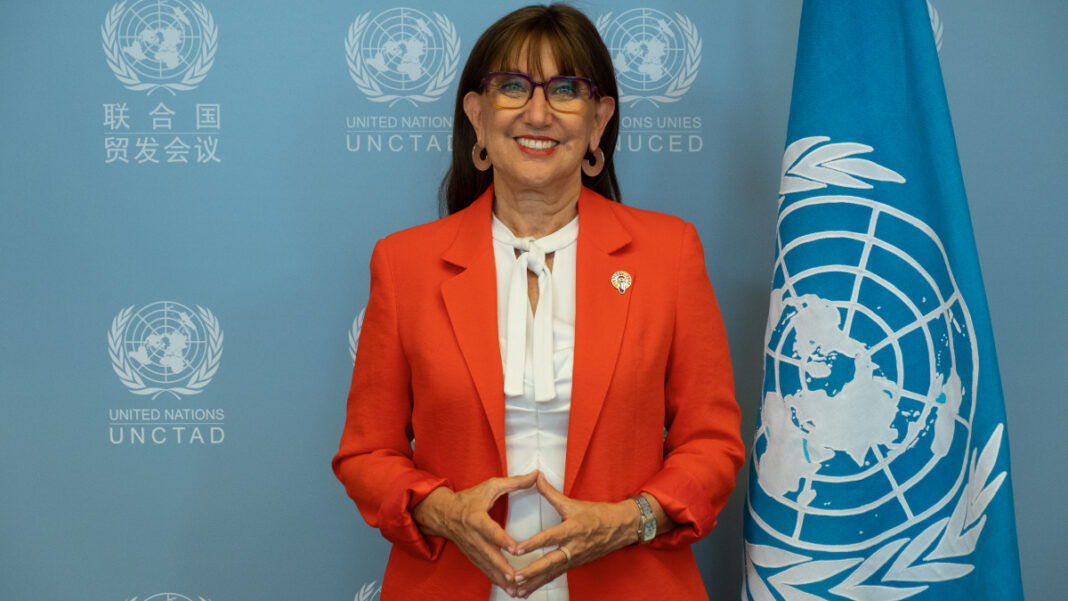
The Secretary-General of the United Nations Conference on Trade and Development, Rebeca Grynspan, has praised Zambia’s economic transformation agenda, describing the country as strategically positioned to drive trade, energy and development growth within Africa.
Ms Grynspan has noted that Zambia has successfully turned its landlocked status into a land-linked advantage, positioning itself as a key trade and energy corridor within the African Continental Free Trade Area.
Speaking during a bilateral meeting at State House today, Ms Grynspan said Africa will play a central role in the two major global transitions, noting that the same critical minerals required for clean energy systems are equally essential for sustainable economic growth.
Ms Grynspan has further commended Zambia’s strong participation of women in the economy, citing a rate of about 75.8 percent, which she said is above the global average and a critical driver for inclusive growth and economic diversification.
She has disclosed that UNCTAD, in collaboration with the Zambian government and the private sector, has conducted a practical study on critical energy transition minerals, resulting in the country specific recommendations aligned with Zambia’s development priorities.
Ms Grynspan has also emphasised that the approach is demand-driven, aimed at responding to Zambia’s real needs, rather than externally imposed solutions.
The UNCTAD Secretary-General also acknowledged Zambia’s leadership in climate change adaptation discussions and its role in the global borrowers platform, noting that Zambia’s experience has become a reference point for other developing countries.
She highlighted progress in data and digital management systems, revealing that experts from other countries are already learning from Zambia’s model.
“We are here to support Zambia in capital mobilisation, revenue enhancement and digital transformation. The technology group working with yours will be a model followed in the years to come,” she said.
Ms Grynspan expressed optimism about Zambia’s future, praising the leadership of President Hakainde Hichilema and the country’s Vision 2030, saying Zambia has the capacity, entrepreneurship and natural resource base to build a sustainable and dynamic economy.
“Africa will be key in the two major transitions that the world is going through. The same minerals needed for the energy transition will be needed for the development transition,” Ms Grynspan said. “Your responsible leadership and long-term vision will be key to making that happen.”
Responding to the Secretary General, President Hakainde Hichilema has reaffirmed Zambia’s commitment to institutional reforms and digital transformation, stating that the country is focused on delivering measurable outcomes that place it firmly on the path to self-sufficiency.
President Hichilema has commended UNCTAD’s support in strengthening Zambia’s policy and regulatory frameworks, particularly in digital strategy, competition law and e-commerce.
“We are grateful to UNCTAD and other UN agencies for their continued partnership and support. Your guidance has helped us strengthen policy, digital strategy, and governance frameworks,” President Hichilema said.
The President has revealed that the digital reforms currently being implemented will enhance efficiency in public service delivery, improve private sector transactions, strengthen revenue collection and promote transparency.
The Head of State has emphasised that Zambia’s reform agenda is focused on harmonisation, coordination and outcome based implementation, adding that policies must translate into tangible results for citizens.
He has stressed that digital platforms will help curb inefficiencies and irregularities while improving governance systems.
And President Hichilema has further underscored the importance of production and value addition, noting that Zambia must move beyond exporting raw materials and instead invest in manufacturing and regional value chains.
He said African countries must work together to create aggregated economic benefits that generate jobs for young people, while reducing irregular migration.
“We must move from exporting raw materials to value addition. Production and regional value chains are key to creating jobs for our young people,” he said.
He has reiterated that Zambia’s economic transformation programme is anchored on partnerships with knowledge institutions and international organisations, adding that the country is determined to accelerate progress and leave a positive legacy through sustainable reforms.
“This collaboration with UNCTAD and the broader international community is critical as we continue to implement reforms that deliver tangible results for our people,” he said.
The President has also underscored progress in digital strategy, competition law and e-commerce, noting that these initiatives will improve service delivery, enhance transparency and strengthen revenue collection systems.
The Head of State also highlighted Zambia’s commitment to economic diversification, climate resilience, and knowledge partnerships, saying the country aims to leverage its natural resources, entrepreneurial capacity and institutional reforms to create sustainable growth.
The bilateral meeting reaffirmed Zambia’s partnership with UNCTAD in advancing structural reforms, economic diversification, and sustainable development while positioning the country as a model for trade, energy and digital transformation in Africa.