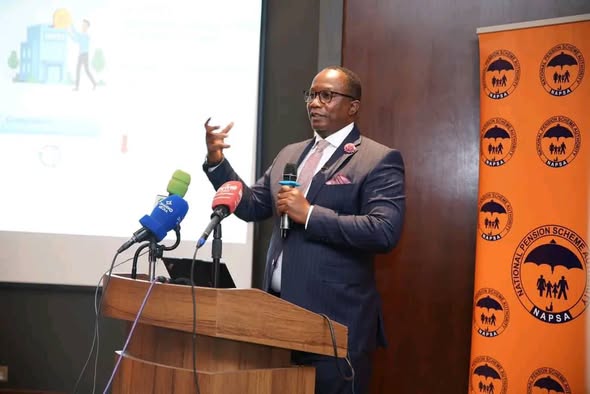
The National Pension Scheme Authority (NAPSA) says its investment portfolio has grown to K113.5 billion in 2025, while benefits payouts reached K2.4 billion during the same period.
However, the Authority has disclosed that employers still owe about K30 billion in outstanding pension contributions.
Director General Muyangwa Muyangwa said during a media engagement that the investment portfolio increased from K95 billion recorded in 2024, keeping the institution on course to reach its 2026 target of K133 billion.
“The steady growth is anchored on a robust investment approach aimed at delivering an average annual return of above 12 percent for the 2022–2026 strategic period,” he said.
Muyangwa added that contribution income also exceeded expectations, with K10.4 billion collected against a target of K10 billion.
At the same time, he revealed that unpaid employer contributions have accumulated penalties amounting to K1.5 billion.
“I encourage employees to engage their employers and ensure that NAPSA obligations are met to avoid challenges when accessing retirement benefits,” he said.
Muyangwa urged employers to take advantage of available penalty waivers to settle their outstanding balances and secure workers’ future benefits.
On payouts, the Authority reported that 32,422 pensioners and beneficiaries received K1.06 billion in monthly pensions, while K643 million was paid as pre-retirement lump sums to 38,560 active members.
Retirement, survivor and invalidity benefits accounted for another K995 million in payments.
“In the same year, NAPSA beat its investment portfolio target of K95 billion to K113.5 billion, in readiness for an additional 10 percent partial withdrawal,” Muyangwa said.
Looking ahead, NAPSA plans to grow its net assets to K133 billion in 2026, increase contributions to K12.5 billion, achieve investment returns above 14 percent and maintain administrative costs within 13.5 percent of total contributions.
The Authority has so far financed investments worth about US$700 million and plans to open parts of its portfolio to allow Zambians to own shares in some of its assets.