
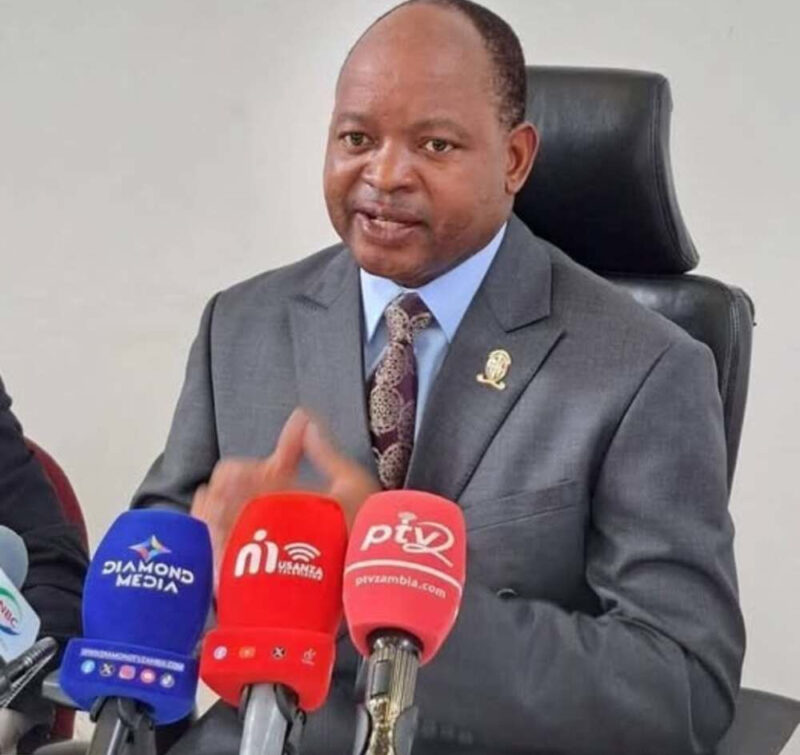
Government has approved the extension of business and operating hours to 24 hours for business premises, markets and bus stations to stimulate economic growth, create jobs and improve service delivery.
The decision was made during the Third Cabinet Meeting held on March 16, 2026, chaired by Hakainde Hichilema.
Speaking in Lusaka, Cornelius Mweetwa said the move demonstrates government’s commitment to boosting productivity and supporting business expansion.
Mr Mweetwa also announced that Cabinet approved in principle the repeal of the Parliamentary and Ministerial Code of Conduct Act and the National Assembly (Powers and Privileges) Act, which will be replaced with updated legislation aimed at enhancing transparency, accountability and parliamentary integrity.
He further revealed that Cabinet approved key legislative reforms, including the Education (Amendment) Bill of 2026, which seeks to entrench free education from early childhood to secondary level.
In addition, Cabinet approved 38 Bills to amend laws governing appointments to boards and committees, with the aim of increasing private sector participation and promoting gender balance, youth inclusion and representation of persons with disabilities.
Mr Mweetwa said Cabinet also approved the Resettlement Management Bill of 2026, which will provide a legal framework for managing resettlement schemes, compensating affected persons and promoting sustainable development.
Meanwhile, Cabinet resolved to establish public universities in Eastern, Luapula, Northern, Southern and Western Provinces, in addition to North-Western Province, in order to expand access to higher education across the country.





Universities are not what Zambia needs. Learn from South Africa whose Universities are benign because they aren’t feeding industrial growth. Most African countries including Zambia need technicians and craftsmen. There’s already enough Universities producing more than enough intellectuals
Mr. Vladimir Choongo. Please delete your comment. What type of thinking is that? Absolutely backwards thinking. Ati, “Learn from South Africa whose Universities are benign because they aren’t feeding industrial growth”, the same South Africa that is the most industrialized and technologically advanced country on the continent. And the biggest economy in Africa.
The challenges SA faces in industrialization right now is government policies and people like you who think Universities are not critical.
Why should I delete it?
Why do you wanna shut me up when you can offer a counter argument? Thats what educated people do. Like South Africa, Zambia has enough universities. It presently doesn’t need more.
One of the reasons why we dont need more universities in our underperforming country is that
the only thing universities do in Zambia is to create superiority complexes that don’t take us anywhere 60 years after independence.
That’s why some of you are obsessed with announcing your qualifications but not developing your country
Yes, South Africa has the biggest industrial development in Africa but that’s not because of universities. South Africa developed because of slave labour.
An elite class exploited black labour to create industry for the benefit and comfort of white settlers.
Afterwards its new leadership has continued along the white masters path thus falling into the bourgeois trap of producing university graduates that the local industry doesn’t need.
That’s one of the reasons why it now has 30 percent unemployment rate- Africa’s highest. Yes higher than even Zambia.
Like South Africa, Zambia has enough universities. It doesn’t need more. Look at Asia and see how the education system supports local industry. That kind of education is, unlike Zambia’s, not for bloating egos but for development.
An elite class exploited black labour to create industry for the benefit and comfort of white settlers.
Afterwards its new leadership has continued along the white masters path thus falling into the bourgeois trap of producing university graduates that the local industry doesn’t need.
By the way South Africa is no longer the biggest economy on the continent. It’s been overtaken by Nigeria.