
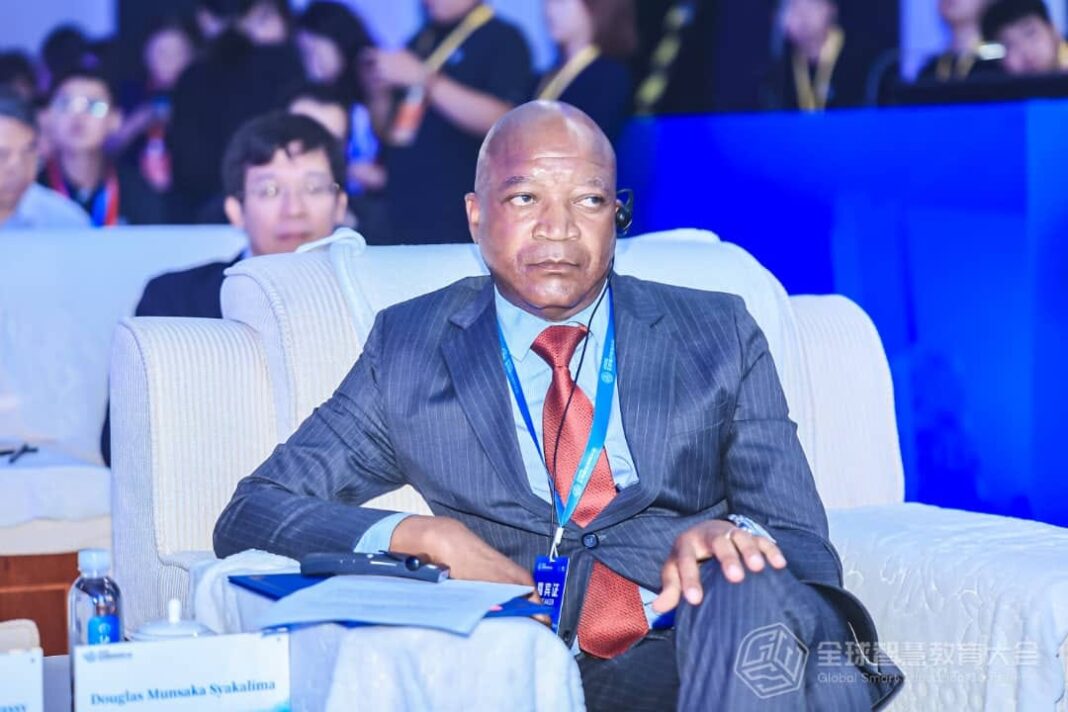
Education Minister Douglas Syakalima has tabled the Education Amendment Bill in Parliament, moving the free education programme into a legislative phase where its structure, delivery and long-term sustainability will come under closer scrutiny.
The bill seeks to guarantee free education for every child enrolled in a public institution, covering early childhood, primary and secondary levels. Its introduction marks a shift from policy direction into law, placing the proposal within a framework that requires clear definition, debate and alignment with existing systems.
The move places immediate attention on capacity. Expanding access will increase enrolment across public schools, raising pressure on classrooms, infrastructure and learning materials. The system will need to absorb this demand without weakening delivery.
Teacher availability is expected to feature prominently in the discussion. Expanding access requires a corresponding increase in qualified educators to maintain classroom balance and learning standards. Without that, the system risks strain that could affect outcomes.
Funding remains central. Providing free education at all public levels requires sustained financial support, and the legislative process will examine how the programme will be maintained over time. The focus is not only on rollout, but continuity.
For many families, the measure carries immediate significance. Education costs remain a key household burden, and removing fees changes access for a wide segment of the population. This is one of the reasons the bill has drawn strong public attention.
Bringing the programme into law also raises expectations. Once enacted, the provisions will carry legal force, shifting responsibility from policy intention to enforceable obligation.
The legislative stage introduces wider participation. Stakeholders within the education sector are expected to contribute through submissions and consultations, shaping how the framework is implemented in practice.
The policy places the education system at a critical point. Expanding access must be matched with maintaining quality, making balance the defining factor in how the programme performs.
What follows in Parliament will determine how the right to free education is applied and whether the system can carry increased demand without losing structure.





Without losing structure ?? Please explain what structure ???
Most can see through these last minute decisions
Was this article really written by Lusaka Times editor?
If it was, then it shows how ignorant he is.
The issues he raises as possible reasons to reject the bill are just frivolous nonsense.
Guaranteeing the right of every child to free education In a civilised society should not be open to debate.
Does this so-called editor know, that in the last 4.5 years, that over 40,000 teachers have been recruited, 100’s of schools have been built, 1000’s of desk’s has been procured and over 2.4 million learners have been enrolled in schools. Doesn’t future generations have a right to continue expecting this?
@Man you are having an unnecessary tiff with the editor’s ai article. In a normal society all that it states is done before the bill becomes law. But in Zambia its being done backwards therefore the editor’s propaganda piece is misplaced. What is syakalima arguing for when his poor quality free education has already been effected?
@Check all Local, you say “poor quality free education”
How could it be poor when Zambia has recorded its highest level grade 12 ever pass EVER.
You need to check your facts before you publish such a crass statement.
70% is NOT poor quality
“It’s highest level grade 12 ever pass ever”
I see I need to be very elementary in my response given you cant even notice the nonsensicalness of that statement.
Firstly, You cant certify your own creation as high standard. It is not objective. Unless you just want to fool yourself.
Secondly Ask yourself why are Zambian academic qualifications being revised by many other institutions in the past two decades? Because they are poor. Even your national university’s first degree has been revised by many international institutions.
Thirdly, yes 70 percent of my household has eaten my lunch (as compared to?) doesn’t mean the food is excellent. It may just mean they have a stronger stomach for crap
“It’s highest level grade 12 ever pass ever”
I see, I need to be very elementary in my response given you cant even notice the inanity of that statement.
If you keep dropping the pass rate obviouly the percentage goes up this was done is SA and is now happening now
If you are an employee you will realise this, also this applies to uni grades
Bring in markers from outside
Research before passing such comments
Politicians are strangers to the truth
Thank you Tikki. My response to Man has been censored but you’ve captured my argument photographically.kkkkkkkkk!