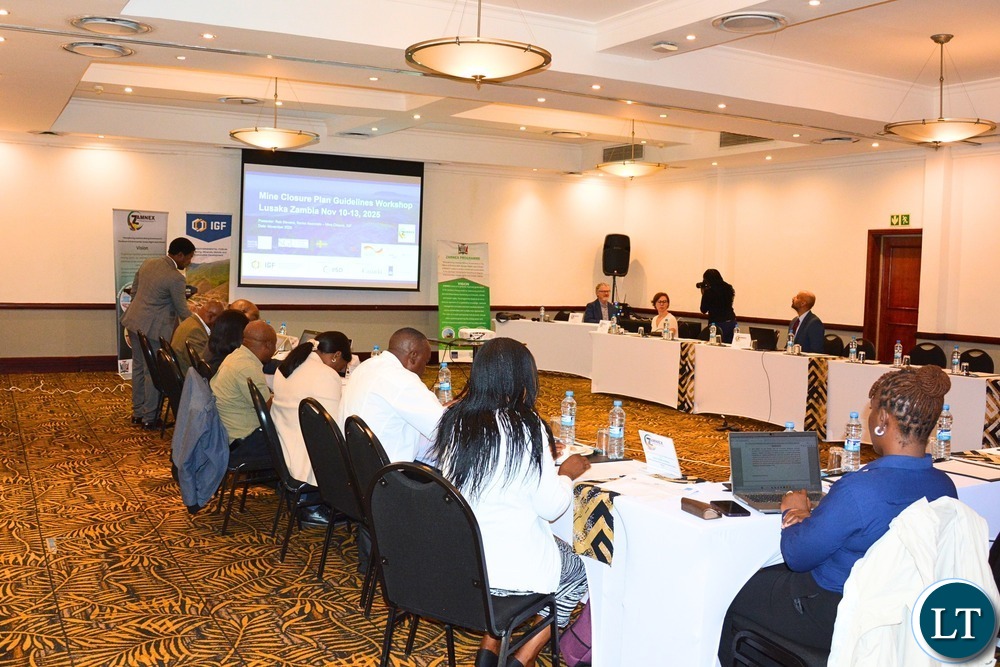
A technical team engaged by the government under the Zambia Mining and Environmental Remediation and Improvement Project (ZAMNEX) has arrived in Northwestern Province to support the development of national mine closure guidelines.
The team will consult local communities and traditional leaders to understand how mine closures may affect people whose livelihoods depend on mining.
Mine Closure Work Coordinator and Senior Geologist Anna Apler said during a courtesy call on the Provincial Administration in Solwezi that inadequate mine closure planning can lead to long‑term environmental damage and prolonged socio‑economic challenges for mining‑dependent communities.
“We are here in Northwestern Province to listen to the views of as many people as possible because mine closure may mean different things to different people,” she said.
Dr Apler noted that with several mines in the province approaching mid‑ to late‑life stages, this is an opportune moment to assess how mine closure is currently planned and governed.
“There is a need to explore pathways for post‑mining transitions that are environmentally sound, socially inclusive and economically sustainable,” she said.
She added that the case study will contribute to national efforts to strengthen Integrated Mine Closure (IMC) approaches, with particular focus on social aspects such as livelihoods, service provision, land use and long‑term community resilience. The findings will help inform the development of comprehensive National Mine Closure Plan (MCP) guidelines.
Meanwhile, Northwestern Province Deputy Permanent Secretary Luckson Mulumbi said mine closure planning is a critical component of mining operations.
Mr Mulumbi emphasised that the province plays a major role in Zambia’s mining sector, contributing significantly to national copper production.
Welcoming the case study, Mr Mulumbi stressed the importance of preparing for life after mining.
“We understand that every mine has a lifespan. So what happens to the people in mining areas after the minerals are depleted? What happens when we no longer see excavators in the pits or trucks transporting copper? What happens to communities when there is no income from mining?” he asked.
He said it is essential to develop a scientific understanding of the implications of mine closures and to put guidelines in place to support affected communities.
Mr Mulumbi added that government has a vested interest in ensuring a smooth transition while protecting citizens’ rights in line with the Constitution.
He also highlighted the need to prioritise environmental protection, noting that tailings dams may contain hazardous materials that pose long‑term risks if not properly managed.
Mr Mulumbi urged ZAMNEX to ensure mine closure planning considers how other sectors such as tourism, manufacturing and agriculture can continue to grow after mining ends.
He warned against over‑reliance on a single sector, saying poorly managed mine closures can have consequences that last for decades.