
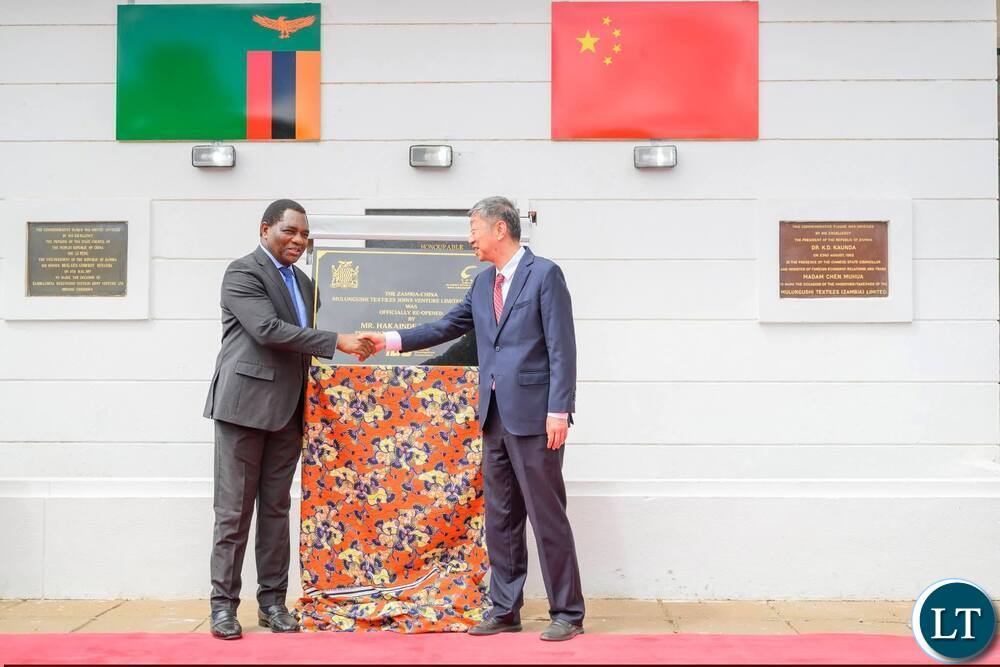
By Frank Mwansa
The reopening of Mulungushi Textiles Limited represents a critical milestone in Zambia’s pursuit of structural transformation and industrial revitalization. From a development economics perspective, it reflects a deliberate shift away from overdependence on primary commodities, particularly copper, toward a more diversified and value-added industrial economy. Zambia’s historical vulnerability to external shocks arising from fluctuations in global copper prices has underscored the need for economic diversification. In this context, the revival of Mulungushi Textiles is aligned with broader strategies such as import substitution industrialization and export diversification, which are essential for achieving sustainable economic growth and resilience.
One of the most immediate economic benefits of reopening Mulungushi Textiles is employment creation. The company is expected to generate hundreds of direct jobs while also stimulating indirect employment across related sectors such as agriculture, transport, and retail. From a Keynesian standpoint, this expansion of employment has multiplier effects within the economy, as increased household incomes lead to higher consumption levels, thereby stimulating demand for goods and services. This is particularly significant for Kabwe, a town that experienced economic decline following the closure of major industries. The reopening of the textile plant therefore contributes not only to job creation but also to the revitalization of local economic activity.
In addition to employment generation, the reopening strengthens industrial linkages within the Zambian economy. Backward linkages are enhanced through the integration of the textile industry with the cotton sector, providing a stable market for thousands of small-scale farmers. This promotes agricultural productivity and supports rural livelihoods. At the same time, forward linkages emerge as textile production feeds into garment manufacturing and retail sectors, thereby fostering the development of a complete value chain from raw cotton to finished clothing. Such inter-sectoral linkages are crucial for deepening industrialization and minimizing economic leakages.
The reopening of Mulungushi Textiles also contributes significantly to import substitution and foreign exchange conservation. Zambia has long relied on imported textile products, resulting in substantial outflows of foreign currency. By producing textiles locally, the country can reduce its import bill and improve its balance of payments position. Furthermore, the potential to produce export-quality textiles creates opportunities for foreign exchange earnings, thereby strengthening the country’s external sector and enhancing macroeconomic stability.
At the macroeconomic level, the revival of the textile industry plays a vital role in economic diversification and risk mitigation. By expanding the manufacturing sector, Zambia reduces its dependence on the mining industry and enhances its capacity to withstand external economic shocks. This aligns with key development theories such as the Lewis Dual Sector Model, which emphasizes the transition from a predominantly agrarian economy to an industrialized one, as well as the Prebisch-Singer hypothesis, which highlights the long-term disadvantages of relying heavily on primary commodity exports.
Regionally, the reopening of Mulungushi Textiles has important spatial economic implications, particularly for Kabwe. Historically an industrial hub, Kabwe suffered significant economic decline due to deindustrialization. The revival of the textile plant repositions the town as a center of manufacturing activity, stimulating growth in supporting sectors such as transportation, housing, and small-scale enterprises. This process of regional regeneration contributes to balanced economic development and reduces spatial inequalities within the country.
Moreover, the reopening has positive socio-economic externalities, including skills development and human capital formation. The textile industry requires technical expertise in areas such as machinery operation, production management, and quality control. As a result, the revival of Mulungushi Textiles contributes to the development of a skilled workforce, which is essential for long-term industrial growth. It also promotes the growth of small and medium-sized enterprises, particularly in tailoring, distribution, and logistics, thereby fostering entrepreneurship and innovation.
Despite these benefits, several challenges may constrain the long-term impact of the reopening. High production costs, particularly those associated with energy and transportation, may reduce the competitiveness of locally produced textiles. In addition, competition from cheaper imported textiles, especially from Asian markets, poses a significant threat to the sustainability of domestic production. Addressing these challenges will require consistent industrial policies, investment in infrastructure, and supportive trade measures to protect and nurture the local industry.
In conclusion, the reopening of Mulungushi Textiles Limited represents a strategically significant development for Zambia’s economy. It offers a wide range of economic benefits, including employment creation, strengthened industrial linkages, import substitution, foreign exchange savings, and regional economic revitalization. Furthermore, it supports the country’s broader industrialization agenda and contributes to inclusive economic growth. However, the realization of these benefits in the long term will depend on the government’s ability to address structural constraints and maintain a conducive environment for industrial development.





Does this man know that Livingstone town had 32 textile companies during KKs time making different fabrics including blankets(for clarity and avoidance of doubt, thirty two textile companies)
Imagine, Clutching to the straw, some people are excited naka ka modzi ka Mulungushi textile, the new government SURELY coming in and taking over in August must also come and revive ka modzi ka Kafue textiles
There’s nothing for ever and ever. In Britain, there are many closed textile mills in towns such as Bradford, Manchester, Nottingham, etc but economic life continues as people have moved to new industries.
This guy has never been to mulungushi textiles and doesnt know what his talking about. There are less than 20 people employed at mulungushi because that is all that is required to operate the printing machine which has been inaugurated just to print a pattern on plain cloth. There is no indirect jobs involved as there is nothing to supply there. All the raw blank cloth comes from china and is merely printed there. There is no manufacturing there so they can’t purchase cotton or anything else for that matter.
You are in Zambia but you don’t know that this season farmers have been given loans to grow cotton and supply to Mulungushi?Am talking about 200 farmers.If you think supplying military uniforms, police uniforms,nursing uniforms,industrial and school uniforms takes about 20 people to do that job,think again.Lets just learn to appreciate. Zambia has been importing military uniforms at a very exorbitant price through fake contract
Ba Frank Mwansa are you looking for a job from HH? Why bore us with banal analysis that tell us nothing save for political sloganeering?