
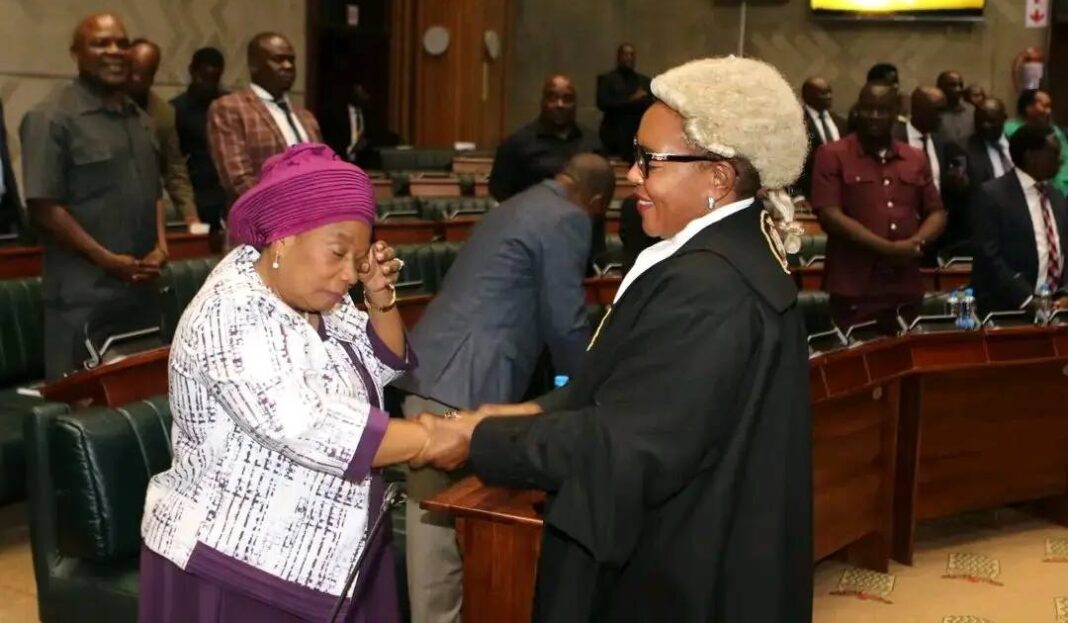
70-plus bills passed in final session; free education enshrined in law; Bill 7 expands parliament to 280 seats; former ministers bid farewell; legal body warns on transition governance
Zambia’s 13th National Assembly dissolved on May 15, 2026, bringing to a close four years and eight months of legislative activity that produced one of the most far-reaching packages of constitutional, electoral and social policy reforms in the country’s post-independence history, while also attracting scrutiny over the independence of the Speaker, the conduct of ruling party MPs and the passage of a proportional representation law that opponents said could strengthen the ruling party’s parliamentary position.
The dissolution took effect automatically under Article 81(3) of the Zambian Constitution, which requires Parliament to dissolve 90 days before a general election. Speaker Nelly Mutti, the first woman to hold the office in Zambia’s history, addressed lawmakers during a final sitting marked by emotional farewells from members on both sides of the House. Mutti said she hoped lawmakers seeking re-election in August would return to preserve institutional memory, noting that significant legislative capacity had been built during the assembly’s five-year tenure.
The legislative record remains significant on multiple fronts. The assembly passed the Access to Information Act No. 24 of 2023, granting citizens, media institutions and civil society organisations the legal right to access public information, delivering a reform successive administrations had failed to implement. The Education Amendment Bill of 2026 made free public education from early childhood to secondary school a legally enforceable right. The National Pension Scheme Amendment Bill of 2023 allowed eligible citizens to make a one-off pre-retirement withdrawal of 20 percent of their pension contributions. Lawmakers also repealed the 2021 Cyber Security and Cyber Crimes Act and replaced it with two separate laws: the Cyber Security Act No. 3 of 2025 and the Cyber Crimes Act No. 4 of 2025.
The most contentious legislative measure was the passage of what became known as Bill 7, which introduced a Mixed Member Proportional Representation system, increased parliamentary constituencies from 156 to 226 and created 40 reserved seats for women, youths and persons with disabilities. The incoming 14th National Assembly will now have 280 members, up from the 167 who served in the 13th Assembly. Opposition parties said the law would primarily increase the number of seats available to the ruling United Party for National Development. Speaker Nelly Mutti’s visible celebration on the floor of the House immediately after the bill passed also attracted criticism from opposition lawmakers who argued it undermined the neutrality expected from her office. Legal practitioners also noted that the full voting record showing how individual MPs voted on the bill had not been publicly released.
The 13th Assembly also recorded two major institutional losses. Levy Mkandawire, the United Party for National Development Member of Parliament for Kabwata, died in a road accident in November 2021. Clerk of the National Assembly Roy Ngulube also died during a work trip in Tashkent, Tashkent in 2025. Nine parliamentary by-elections were held during the life of the assembly.
The constitutional transition now places significant administrative authority in the hands of permanent secretaries. Former Secretary to Cabinet Leslie Mbula publicly urged permanent secretaries to exercise restraint and prudence in the use of public resources during the transition period. Governance advocate Isaac Mwanza backed that call, urging permanent secretaries to consult the Attorney-General and Solicitor-General on major policy decisions instead of acting independently. Former ministers including Jack Mwiimbu, Cornelius Mweetwa and Robert Lihefu used farewell events to make final public appeals for professionalism, peace and continuity.
The 14th National Assembly will consist of 280 members elected under a hybrid model combining 226 constituency seats and 40 proportional representation seats. Parliamentary nominations close on May 20, 2026. Campaigns officially open on May 23 and run until August 12, with Zambians heading to the polls on August 13, 2026.



Mmmm that picture. Dropping a tear for parly’s manna.
That’s how sweet the sitting allowances at Parliament are. Just imagine not having them for a month! Or is it forever? Votani imwe bantu!
It is indeed sad to lose 300 jobs
You mean there will be 300 jobless ex MPs? Loitering Cairo Road, and President Avenue in Ndola? But this government has created jobs!
Who is the next speaker?
How about choosing someone outside Parliament? Like a university lecturer, priest, school principal or a lawyer? Parliament isn’t democratic with a partisan speaker.
How can you expect her to rule against her party? That’s a big joke. Us duping ourselves that the speaker is objective is like North Korea declaring it’s elections are free and fair.
I fully and heartily concur
Yes they are censoring me all the time