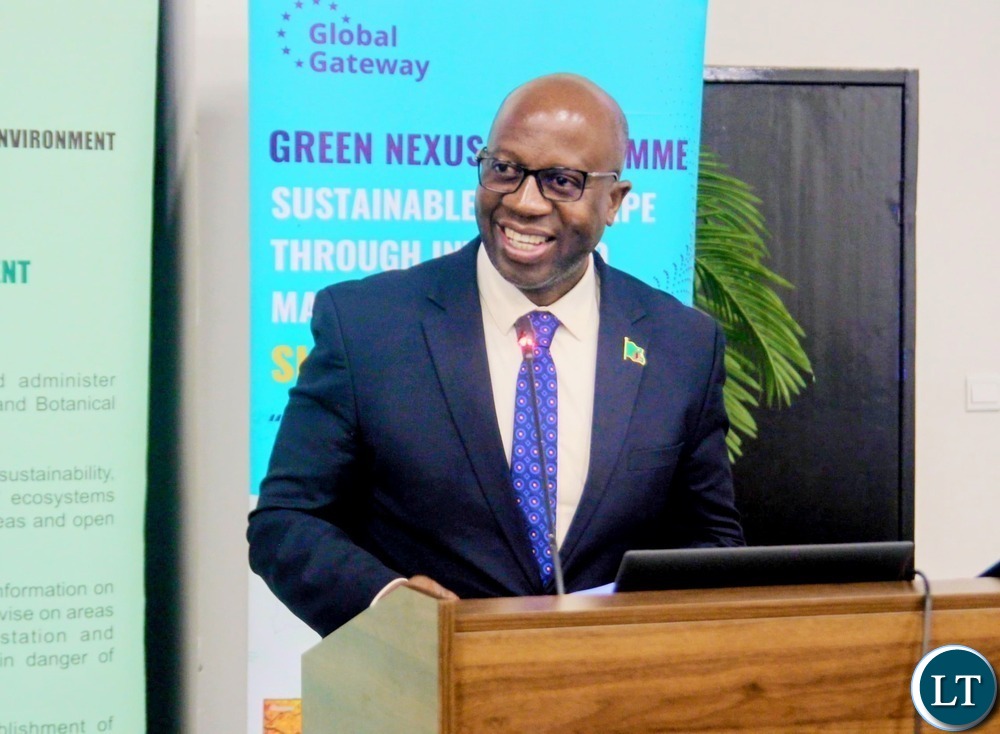
The government has reaffirmed its commitment to addressing unsustainable charcoal production and promoting clean energy alternatives under the EU–Zambia Forest Partnership.
Ministry of Green Economy and Environment Permanent Secretary, Douty Chibamba, says charcoal production has become a growing challenge that requires strong enforcement and the creation of viable alternative livelihoods.
The media reports that Dr Chibamba has explained that government is currently reviewing the Forest Act to incorporate innovative strategies aimed at reducing deforestation and promoting sustainable forest management.
“We have seen truckloads of charcoal being transported for commercial sale. That is no longer subsistence. We must tighten enforcement and provide viable alternatives if we are to protect our forests,” he said.
He emphasised that maintaining standing forests could allow Zambia to earn billions of dollars through carbon trading and other green economy opportunities.
And Director of Energy at the Ministry of Energy, Mafayo Ziba, said government is promoting improved charcoal production methods and modern technologies to ensure sustainability.
Mr Ziba said through the EU–Zambia Forest Partnership, Zambia has committed to sustainably managing over 21 million hectares of forest land, guided by key institutional instruments such as the recently approved Forest Policy and the ongoing review of the Forest Act.
He noted that despite these efforts, unsustainable charcoal production continues to drive forest degradation, biodiversity loss and greenhouse gas emissions.
“Charcoal remains a critical source of energy and an important livelihood for many rural communities. It is therefore imperative that we strike a balance between meeting the country’s energy needs, supporting local livelihoods and ensuring long-term sustainability of our forests,” Mr Ziba said.
Meanwhile, EU Delegation Representative Zutelija Lana said the partnership between Zambia and the European Union is among the six global initiatives aimed at reducing deforestation, promoting renewable energy and creating green jobs.
Ms Lana said the EU is supporting Zambia’s energy transition through investments in modern cooking solutions, including 110,000 clean cooking stoves that have already benefited over 550,000 Zambians.
“Charcoal has long supported livelihoods and energy needs, but it has also contributed to climate degradation. We must align charcoal production with environmental stewardship and economic resilience,” she said.
The EU–Zambia Forest Partnership, signed in 2022, seeks to promote forest protection, sustainable land use and the creation of green jobs by 2030.