
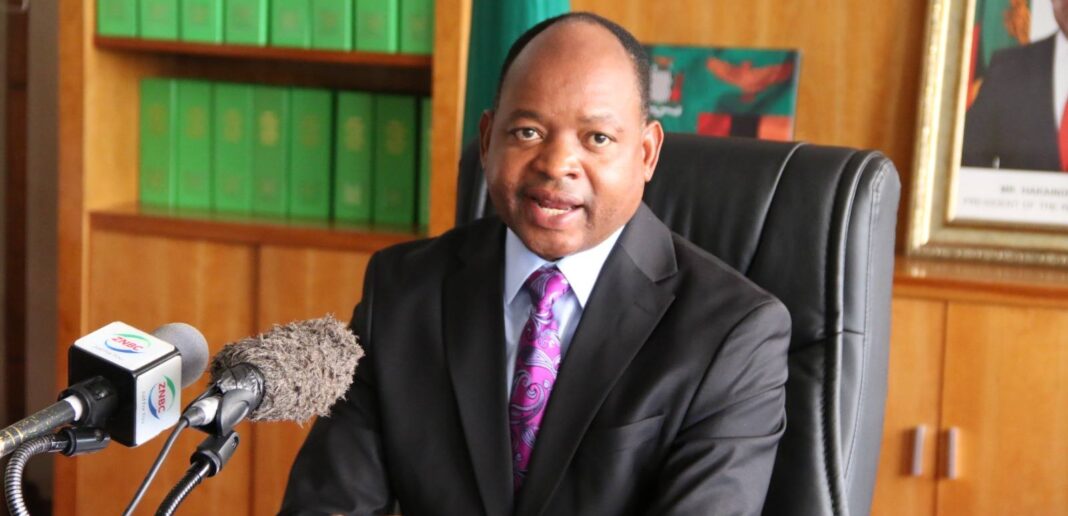
Government has responded to the latest corruption perception findings with a dual message, acknowledging public concerns raised by the report while also questioning aspects of the methodology used to measure governance performance.
Speaking during a press briefing in Lusaka, Information and Media Minister Cornelius Mweetwa said the administration views the rating as a reminder that the fight against corruption remains ongoing, but insisted that several structural reforms introduced since 2021 demonstrate measurable progress. The report reflected a drop in Zambia’s score from 39 to 37, placing the country below the global average.
During the briefing, Mweetwa outlined reforms implemented under President Hakainde Hichilema’s administration, including the establishment of the Financial and Economic Crimes Court, which he described as a key mechanism for accelerating corruption-related cases. He said the specialised court has reduced delays that previously allowed investigations to stretch for years, adding that both convictions and acquittals have taken place as part of strengthening judicial credibility.
Government also highlighted asset forfeitures and prosecutions involving public officials as evidence that enforcement agencies are operating without political shielding. According to the minister, the administration’s anti-corruption strategy is focused on institutional independence rather than targeting individuals, arguing that accountability must apply across all levels of public service.
At the same time, the minister used the briefing to challenge aspects of the perception index itself, questioning whether international surveys accurately capture the realities of reforms underway in Zambia. He noted that different global institutions often produce contrasting ratings and asked what empirical tools were being used to sustain lower scores despite visible legal changes and enforcement actions.
Mweetwa argued that perception indicators sometimes rely heavily on opinion-based surveys, which may not fully reflect structural reforms or ongoing prosecutions. He said government remains open to dialogue with civil society organisations contributing to the index, emphasising that constructive engagement could help clarify how ratings are determined and how Zambia’s progress is measured.
The minister also addressed issues that may have influenced public perception during the reporting period, including revelations from forensic audits into procurement practices within the health sector and concerns surrounding misuse of constituency development funds. He said exposure of such issues demonstrates institutional transparency rather than weakness, arguing that systems willing to confront wrongdoing publicly should not be viewed solely through a negative lens.
During the briefing, authorities rejected suggestions that oversight institutions operate under political pressure. Mweetwa stated that independence must be assessed through the actions of courts and enforcement agencies rather than assumptions tied to appointments or funding levels. He added that financial constraints facing oversight bodies reflect broader economic realities rather than deliberate interference.
Government further urged citizens to support anti-corruption efforts by resisting narratives portraying legal proceedings as persecution. According to the minister, maintaining public confidence requires a collective commitment to lawful processes and national development goals. He reiterated that constitutional provisions remain the only basis for immunity from prosecution, stressing that no individual is shielded from accountability.
Despite pushing back against certain aspects of the perception index, the administration acknowledged the importance of continuous improvement. Mweetwa said government aims to strengthen institutional capacity, expand oversight mechanisms and deepen collaboration with civic organisations to address governance challenges. Officials have set a target of reaching a CPI score of 40 by 2026, presenting the goal as part of a broader commitment to improving transparency.
The press briefing reflected a balancing act between defending progress and engaging with criticism. On one hand, government sought to reassure citizens that reforms and prosecutions demonstrate tangible action against corruption. On the other, it questioned whether international perception tools fully capture developments on the ground.



@Honorable Mweetwa, this burying your head in the sand will not help your govt in the coming elections.
Every Zambian in the land of work and joy(including children) knows that there is corruption everywhere in Zambia. No international perception is necessary.
Arguments against empirical findings do not help government. Rather, such arguments damage government’s standing. Fight against corruption needs to focus on prevention. Illicit flows and collusion silence damage national standing
It does not help if the President can’t even disclose assets, business interests snd how much income he has made since 2021 and sources.