
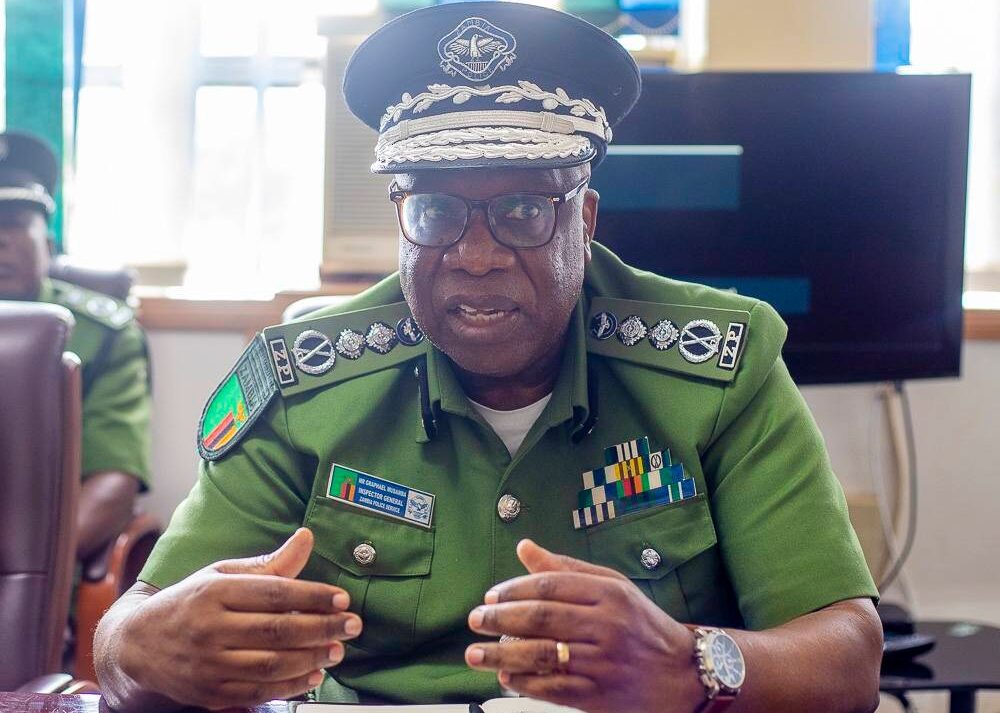
President Hakainde Hichilema has again directed police to investigate cases thoroughly before making arrests, reinforcing a long-standing position on evidence-led enforcement as pressure builds on the justice system to tighten standards.
The instruction restates a sequence that places investigation ahead of detention, signalling concern that arrests made without sufficient groundwork continue to weaken cases and erode confidence in legal processes. It also aligns with wider efforts within the justice system to ensure that prosecutions are built on solid evidence rather than assumption.
The position is not new. Hakainde Hichilema has raised similar concerns since his time in opposition, consistently questioning arrest practices built on weak or incomplete investigations. The continuation of that message into his presidency underscores a long-standing stance on evidence-led policing. Its repeated reappearance, however, points to a gap between instruction and practice, where directives are issued but not fully absorbed within enforcement structures.
The directive comes at a time when enforcement practices are under closer scrutiny. Questions have been raised about cases that reach court without adequate preparation, prolonged detentions that struggle to meet evidentiary thresholds, and prosecutions that fail to hold under judicial examination. In that context, the renewed emphasis signals an attempt to recalibrate how cases are built from the outset.
Arrest remains one of the most consequential powers exercised by the state. It affects individual liberty, reputation and the direction of legal proceedings. When used prematurely, it transfers pressure onto investigations that should have been completed beforehand, often resulting in cases that lack the strength required to succeed in court.
The President’s position is reinforced by guidance from Director of Public Prosecutions Gilbert Phiri, who has warned that only cases supported by strong evidence should proceed. Together, these signals suggest a tightening of standards across the justice chain, from investigation through to prosecution, with each stage expected to reinforce the next.
At operational level, the directive introduces practical challenges. Investigations require time, coordination and resources, while enforcement agencies often face pressure to act quickly, particularly in high-profile or politically sensitive matters. The instruction effectively sets a boundary, requiring that action be justified by evidence rather than urgency.
Recent disciplinary developments have added weight to the issue. Cases involving allegations of police misconduct and excessive force have brought attention to how authority is exercised on the ground. Findings against individual officers in some instances have reinforced concerns about procedural lapses and the need for stronger oversight.
Public perception plays a decisive role in shaping the impact of such directives. Arrests carry immediate consequences beyond the courtroom. Individuals who are detained face reputational damage that may persist even when charges are later withdrawn or dismissed. When cases collapse due to weak evidence, the effect extends beyond the individual to the credibility of the entire justice system.
The directive therefore operates at two levels. At one level, it is procedural, setting out how cases should be built. At another, it is institutional, addressing the relationship between state power and individual rights. Evidence becomes the threshold that distinguishes lawful enforcement from arbitrary action.
Consistency will determine whether the directive produces measurable change. A standard applied unevenly risks becoming symbolic. A standard embedded in daily practice reshapes how cases are handled across different regions and levels of the policing system.
There is also a broader implication for efficiency. Stronger investigations reduce the number of cases that fail in court, easing pressure on judicial resources and improving overall case outcomes. The focus shifts from the volume of arrests to the quality of cases presented.
The directive does not diminish the role of enforcement. It refines its application. Crime response remains necessary, but the method of response is being recalibrated to prioritise legality, preparation and evidentiary strength.
What remains uncertain is how consistently the message will be implemented. The repetition of the directive suggests that earlier instructions have not fully translated into practice, leaving a gap between policy and execution.
For now, the position from State House remains clear and unchanged: arrests must follow evidence, not precede it.




This does not even require a Presidential directive. It is just common sense that an arrest should only be effected after investigations. Whether the President says it or not is inconsequential, unless he is just emphasising the point or he has seen that his people are doing wrong things
His people are doing the wrong things yes.
LT should stop mixing hard news stories with commentary or editorial. Stick to what HH has said and leave the opening to a column. Otherwise you are trying to play with the reader’s mind
*… and leave the opining to a columnist
How many times. This is clearly a window dressing stunt by BMW.
When he says arrest, they over arrest because they have to impress the boss with their loyalty to him.
They don’t even investigate thoroughly because they are in a hurry to impress the boss so he can see them responding to his instructions.
Then tomorrow Mweetwa will tell the nation HH doesn’t interfere in police operations
When is the convention
That hopefully will bring in sanity and hope
We all long for the day he orders them to stop the lunch money scam as well
Ba Kapokola are used to the old ways and the next generation of kapokolas does not offer any hope at all.A money living society is what we are in,no honour or discipline.
Does it mean police don’t know that? Isn’t that part of the curriculum at Lilayi and other briefings they have with officers at every station? Tekubuta uku nomba?
If he means it he should fire the IG for not following procedure.
Itizi tulu
One can only weep. We will never recover a morally straight police force after the low we have sank.
What is the “AGAIN” doing in the headline? It’s just confusing some of us
Hichilema orders police to investigate before arrests AGAIN.
Hichilema has to order our police. They can’t do it on their own. In other words, they have no initiative.