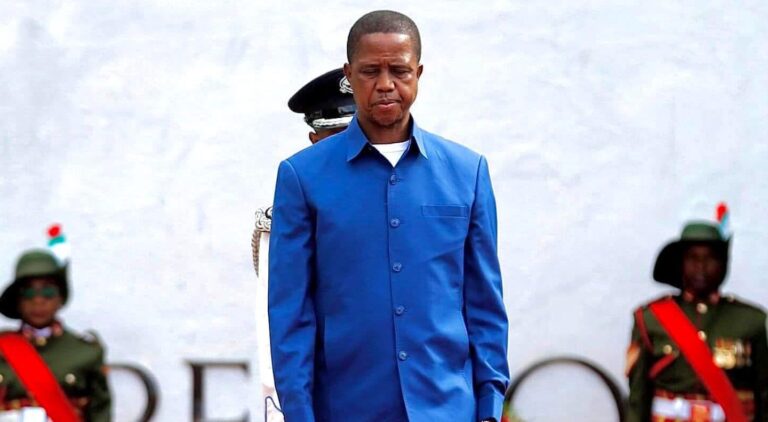
South African police have begun investigating allegations that former Zambian president Edgar Lungu may have been poisoned before his death, reopening a sensitive issue that has remained unresolved nearly a year after his passing and amid a continuing legal standoff over his burial.
Lungu died on June 5, 2025, in South Africa. His body has not yet been laid to rest, as court proceedings continue between the Zambian government and his family over funeral arrangements and the handling of his remains. The latest development adds a new legal and political layer to an already protracted dispute.
The investigation follows public claims made months earlier by Patriotic Front official Raphael Nakachinda, who suggested in a televised interview that foul play could not be ruled out in Lungu’s death. At the time, Nakachinda said investigations would eventually determine whether the former president died of natural causes or as a result of poisoning.
In response to the renewed focus on the allegation, lawyers representing the Lungu family firmly rejected the claims. In a letter dated February 11, 2026, Machele Attorneys described the poisoning narrative as unfounded and unsupported by credible evidence, maintaining that Lungu died naturally.
The family’s legal team confirmed that South African authorities had issued a subpoena to Two Mountains Funeral Services, the facility currently holding Lungu’s remains, directing that the body be released into the custody of the South African Police Service. The lawyers said the move was troubling and legally flawed, given existing court orders governing custody of the remains.
According to the family, those court orders place possession and control of Lungu’s body with the funeral home until all legal proceedings are concluded. They also noted that leave to appeal has already been granted by the Supreme Court of Appeal, meaning the matter is still active before the courts.
The lawyers warned that, in the absence of a new judicial order authorising the removal of the body, no individual or institution is legally permitted to act in a manner inconsistent with the standing directives. They further stated that the family would pursue legal action should any attempt be made to override the court’s authority.
The police interest has reignited public debate both in Zambia and South Africa, particularly over the timing of the investigation. Critics and commentators have questioned why law-enforcement attention has intensified many months after Lungu’s death, especially when the matter was already publicly discussed shortly after he died.
The development has also renewed national attention on the unresolved burial of Zambia’s sixth Republican president. Each update serves as a reminder that the country remains without closure on the funeral of a former head of state, a situation that continues to divide opinion.
Family spokesperson Makebi Zulu has previously addressed speculation surrounding the former president’s remains, stating that only a limited number of people have viewed the body. He has consistently maintained that Lungu is deceased and that claims suggesting otherwise are false.
The burial dispute has been marked by deep mistrust between the family and the state, with disagreements extending beyond legal custody to broader questions surrounding funeral arrangements and protocol. Among the unresolved issues is whether President Hakainde Hichilema should be present at any burial proceedings, a condition the family has previously opposed.
Efforts at mediation have so far failed to yield agreement, with the matter now firmly in the hands of the courts. Religious leaders, regional figures and former heads of state have previously attempted to broker a settlement, but without success.
With appeals still pending and legal positions hardening, the question of whether South African authorities will be permitted to examine the body now rests squarely with the courts. Until a ruling is delivered, Edgar Lungu’s remains will stay where they are, and the broader questions surrounding his death and burial will remain unresolved.