By Edward Chisanga
Introduction
The basis of any plan is economic growth. Therefore, if the economy is not growing, or growth is slow, it then implies that any plan such as Africa’s Agenda 2063 cannot claim to be moving forward. And the truth is that Agenda 2063 or ‘The Africa we want’ is not going the path anticipated by its authors and leaders behind it. Adopted in 2013, and perhaps implementation beginning the same year, performance of Agenda 2063’s economic part has been abysmal.
Africa’s Vision 2030
The foregoing statements are backed by the disappointing behavior, over the last two decades of Africa’s Vision 2030. It must be recalled that then, most African leaders went into a frenzy of assembling what they referred to as, “Vision 2030” or broader and long-tern development plans that includes economic growth. I have assessed Vision 2030 of many countries, including Zambia, my own, South Africa, Namibia and others, and have made one conclusion, that they’ll not deliver the expected overly-ambitious goals largely because economies are not growing robustly. In some cases, they’re not even growing or are in fact negatively doing so.
If the economy, as the foundation of all development plans such as manufacturing, industry, agriculture, human capital, technology, health, gender, and other components of Vision 2030, and others, is asthenic, how can it carry them on its shoulders, to a successful destination? Just as the reliable chassis carries the vehicle to its successful destination, a reliable economy too does. And conversely, in the case of Vision 2030, as the economic part is weak, it leads to weak delivery or none at all.
The dream, the expectation
The so-called ‘Africa’s blueprint and master plan for transforming Africa into the global powerhouse of the future’ ambitiously projects as its target, “Annual GDP growth at least of 7% which’s what the conversation in this article is about. The assumption then is that if this were to take place annually, in the next five decades, since its inception in 2013, the continent would be transformed into the global powerhouse. According to a dictionary, global powerhouse is defined as, “A country, organization, or entity that has significant influence, strength, or dominance on a worldwide scale, particularly in political, economic, or cultural contexts.” That’s the dream. That’s the expectation.
Problem
Africa’s economy is largely driven by rentier states of Nigeria, Angola, South Africa, Sudan, Ghana, Gabon, Equatorial Guinea, DRC, Congo, Egypt, Algeria, Libya, Botswana, Namibia, Zambia, Guinea, Morocco, Mozambique, and Zimbabwe, which together account for almost 70% of Africa’s total GDP. Some of these produce both oil and minerals. Only one country is manufacturing-oriented. The problem is that economic growth of rentier states is largely and stubbornly dependent on decisions made not by themselves but someone else abroad.
It means, any so-called economic growth is dominantly driven by high global prices of primary commodities in rich nations. When Nigeria exports more oil during this period of boom, it proclaims high economic growth. Zambia too, Angola, Ghana and all these rentier states shout the same self-approbation proclamation. Even the so-called global pundits and proclaimed experts on Africa shout, “Africa, fastest growing continent”, “Africa projected to outpace Asia as world’s fastest growing region. (Mo Ibrahim Foundation.”
But let me tell Mo Ibrahim Foundation that Asia’s growth is dependent on electrical machinery, equipment, computers, electronics, optical, technical, medical apparatus, or largely processed goods while Africa’s growth is driven by exports of unprocessed goods. Growth dependent on manufactured goods is exempted from external shocks while that on primary commodities is the main culprit. That growth is not sustainable and lacks quality.
Argues UNCTAD, “But entrenched reliance on these primary products-long been of global concern-hinders industrial development and threatens countries’ fiscal stability when global prices go volatile. It’s value addition that holds the key to more diverse and resilient economies. The world has a long way to go in breaking commodity dependence, a situation where a country makes more than 60% of its merchandize export earnings from commodities.”
Reality
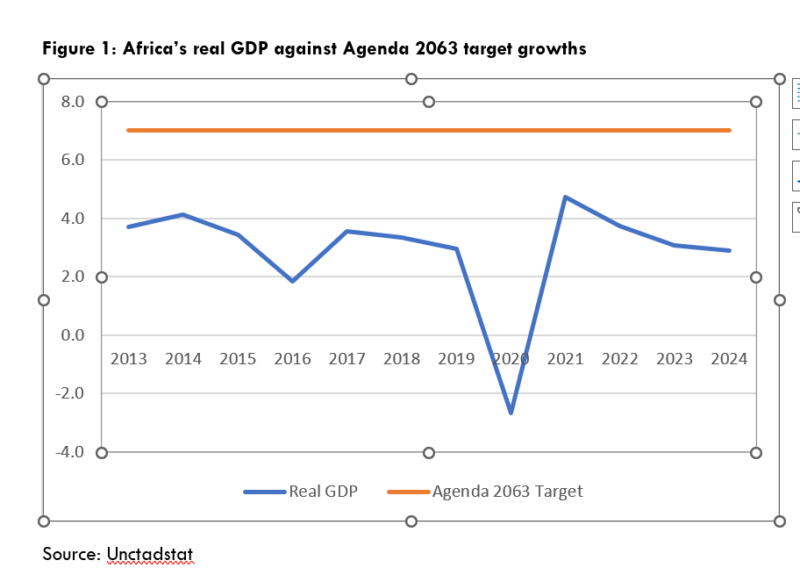
Since implementation began in 2013, according to a report by the African Union official website, or thereabout, the projected GDP annual growth of 7% has remained constant while trends of real GDP growth depict downturn results shown in Figure 1 below. Real economic growth rate only improved slightly, only in 2021 when it reached 4.7% from 3.7% when implementation began. The period 2014-2019 witnessed growth less than when implementation began. In 2022, growth even slipped to minus 2.7%. Even though it rebounced to 4.7% in 2021, growth again spiraled down to growth of 2.9% in 2024.
Perhaps more importantly is the variance between Agenda 2063’s annual target growth of 7%, on the one hand, and, on the other, the pattern of real GDP growth. While for obvious reasons the target remains constant, the corresponding growth path of real GDP shows a wide parallel line. At no year does real GDP growth near the target.
In other words, real GDP growth, on annual basis falls far below the target of Agenda 2063 of 7% growth. It means that we can easily project that if this pattern continues, achievement of Agenda 2063 will remain nothing but an illusion. In my mind, I do not see African countries, whose economies are largely driven by exports of primary products, (and these are the majority), make a robust contribution towards the ambitious goal of 7% annual growth.
Let me give an example of what’s happening in reality. In 2013 when Agenda 2063 began, Nigeria the largest oil exporting economy in the continent exported, according to Unctadstat data, $90.5 billion and the following year $103.1billion. But in 2020, export earnings dropped significantly to $35.6 billion and in 2024 it only upped to $53.3 billion, meaning the drop of 2014 has not been recovered. In 2013, Angola exported $68.2 billion but this shrank to $22.1 billion in 2020 although picking up to $39.4 billion in 2024. One message that comes out is that it’s difficult to plan in Africa. In 2014, Nigeria’s income from exports is $103 billion. So, economic planning would take this into account and they may project future exports of $150. Yet, in 2020 exports drop to $35.6 billion. How will planning be undertaken in such an unpredictable environment?
I can do the same for all fifty-five African countries and find significant similarities in performance variations. The main point is that this is not the kind of economic performance, driven by rentier states that can contribute to achievement of Agenda 2063.
Concluding
The conclusion then is that, founded on an impuissant economy, Agenda 2063 is nothing but a dud that must be abandoned. Second, the planning narrative in Africa ought to change. Broad and integrated planning should be replaced by narrow and specific planning. It means that Agenda 2063 covering all aspects of development, from health to gender, agriculture to manufacturing, energy to environment, democracy to GDP growth, politics to culture as well as the titles, “The Africa we want; a prosperous and middle-income continent; and other superfluous planning titles must be dropped.
As no single country in Africa, even combined ones into the fifty-five nations have not enough money to develop, it makes no sense to plan the way we do. Instead, I suggest that planning, at national and continental levels, focuses on selected few key factors that drive development. It’s more realistic to plan for development of infrastructure, human capital with cognitive function, manufacturing and two other important foundations for development, as opposed to a wholesome approach that has never worked anywhere in Africa.
Finally, long-term planning of 30-50 years of Vision 2030 and Agenda 2063 is unrealistic. Many leaders who planned Vision 2030 are no longer available. The ones who takeover but were not an integral part of preparing these plans pay little or no attention. Unlike soon after independence, today’s civil servants do not necessarily continue with the system. Today’s politicians no longer respect continuity. They employ their own who begin afresh.