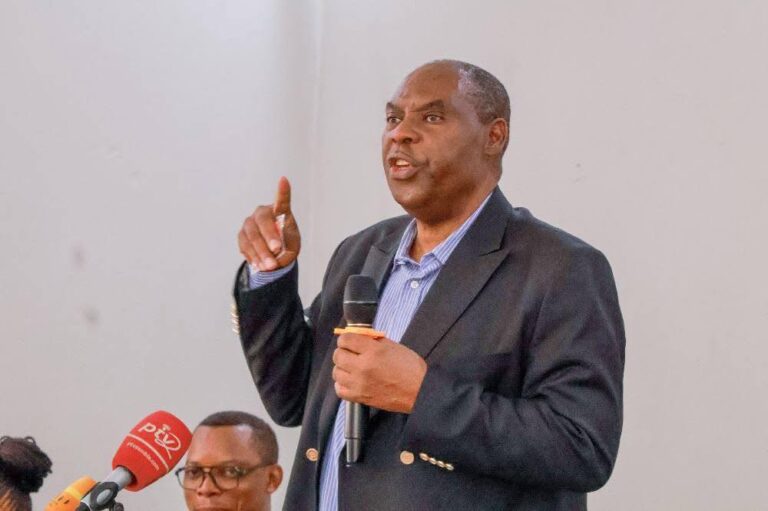
LUSAKA — New Heritage Party (NHP) president Chishala Kateka has called for the immediate revival of a dormant criminal prosecution file against United Party for National Development (UPND) secretary general Batuke Imenda, accusing the state of enforcing the law selectively and shielding ruling party officials from accountability.
Kateka was responding to Imenda’s public statement made during a press briefing on May 28, 2023, in which he referred to Lusaka Archbishop Dr Alick Banda as the “Lucifer of Zambia.” The remark was recorded, widely circulated across multiple media platforms, and was never withdrawn or apologised for.
Despite the public nature of the statement, the matter failed to proceed after the Director of Public Prosecutions declined to grant consent for prosecution when the case came before Magistrate Chanda on March 4, 2024. The DPP cited insufficient evidence, a decision that effectively stalled the matter. Since then, no further legal action has been taken.
Kateka described the inaction as a stark illustration of double standards in the administration of justice, arguing that speech by ruling party officials is treated with leniency while critics of government are subjected to aggressive prosecution.
She said the contrast became more pronounced following the recent summons of Archbishop Banda by the Drug Enforcement Commission over a donated Toyota Hilux vehicle. In her view, the swift mobilisation of investigative machinery against the cleric stood in sharp opposition to the reluctance shown in pursuing a hate speech complaint against a senior ruling party figure.
According to Kateka, the imbalance sends a dangerous signal to the public that the law is applied based on political alignment rather than principle. She maintained that criticism of government attracts punitive responses, while derogatory language directed at religious leaders by those aligned to power is effectively tolerated.
The NHP leader argued that Imenda’s remarks went beyond mere insult and crossed into hate speech, given the position held by Archbishop Banda and the broader social role of the church in national discourse. She said the language used was deliberately dehumanising and intended to discredit a moral authority that has consistently spoken on governance, social justice, and economic accountability.
Kateka further noted that in other politically sensitive cases, courts and prosecutors have shown decisiveness, particularly where opposition figures are concerned. She said comparable or even lesser speech-related offences have resulted in arrests, prolonged court processes, and custodial sentences when the accused are outside the ruling party.
She accused the prosecutorial decision-making process of reflecting what she termed institutional capture, where constitutionally independent bodies operate in ways that appear aligned with executive interests. She extended this criticism to law enforcement agencies, arguing that their enforcement patterns demonstrate selective enthusiasm, acting swiftly against perceived critics while exercising restraint when allies are implicated.
“The matter is not dormant because there is no evidence,” Kateka said. “It is dormant because of political convenience.”
She warned that when the law ceases to operate uniformly, it loses legitimacy and becomes an instrument of power rather than justice. In such circumstances, she said, public confidence in democratic institutions is steadily eroded, creating long-term risks for civic trust and constitutional governance.
Kateka said the continued failure to act on the Imenda case reinforces perceptions that statutes exist in form rather than substance, applied rigorously against some citizens and ignored when politically exposed individuals are involved.
She called on the Director of Public Prosecutions to reopen the file and subject the matter to judicial scrutiny, insisting that equality before the law must be demonstrated, not merely proclaimed.
At the centre of the controversy, she said, are three interconnected developments: the stalled prosecution over Imenda’s remarks, the active deployment of investigative agencies against Archbishop Banda, and the broader pattern of selective application of criminal justice mechanisms.
Her demand, she stressed, was straightforward: revive the case, apply the law evenly, and restore public confidence in the rule of law.