Edward Chisanga
Prologue
Zambia welcomed President Daniel Chapo of Mozambique last week and I hope Foreign Direct Investment (FDI), not necessarily between the two countries, was discussed because this article is about Mozambique and Zambia’s role in attracting global FDI. I wish it had come out during Mr. Chapo’s presence in Zambia.
A few months ago, I posted an article in which I asked, “Where do citizens go if they wish to have a conversation with government officials on the economy? “I have no answer up to now. I asked because, my preference is to share my ideas about the Zambian economy quietly with government instead of posting them in newspapers. But, as I continue to brood where to go, I have to unfortunately resort to what’s available. Notwithstanding, I earnestly implore overly-ambitious social media bloggers with an insatiable appetite for turning professional articles into politicking to refrain. Sometimes, we must simply discuss economic issues without dressing them in political cloak. Simply join the conversation and spew your own professional ideas.
Why Cabinet meetings must compare Zambia’s performance with other African countries
So, today, I share a conversation with the reader on Zambia’s competitiveness in attracting foreign direct investment (FDI) with other SADC member states. My advice to government is that every economic step we make must be accompanied by comparison with what other African countries are doing. If I were to advise, this must be an integral part of all Cabinet meetings. We cannot simply stop at saying, “GDP grew by 5% when in Rwanda it’s at 8%, 10%, etc. Neither must we simply say, “Value addition” when in Tunisia, exports of manufactured goods as a percentage of total, to the world is almost 80% compared with Zambia’s 15%.
SADC constitutes 16 member states including Zambia. Of these, five are top beneficiaries of inward FDI flows while the majority individual members’ inflows are really far from being competitive with the former group. So, my conversation in this article focuses on DRC, Mozambique, Namibia, Tanzania and Zambia, as top five nations attracting the most inward FDI. I deliberately omit South Africa for obvious reasons: that it’s too far ahead of other SADC members in inward FDI flows.
First, FDI has been proven to be an essential builder of manufacturing, technology and overall economic development. In my opinion, Zambia should first build a strong local private sector capable to attract FDI. You see, elsewhere like in Asia, FDI flocked to those countries as a result of vibrant local private sectors. Foreign investors want to work with progressive local private sectors. An exciting local private sector can single-handedly attract plenty of FDI. Therefore, the fact that our nation cannot boast of that private sector may be the single most important explanation why we’re not attracting sufficient FDI.
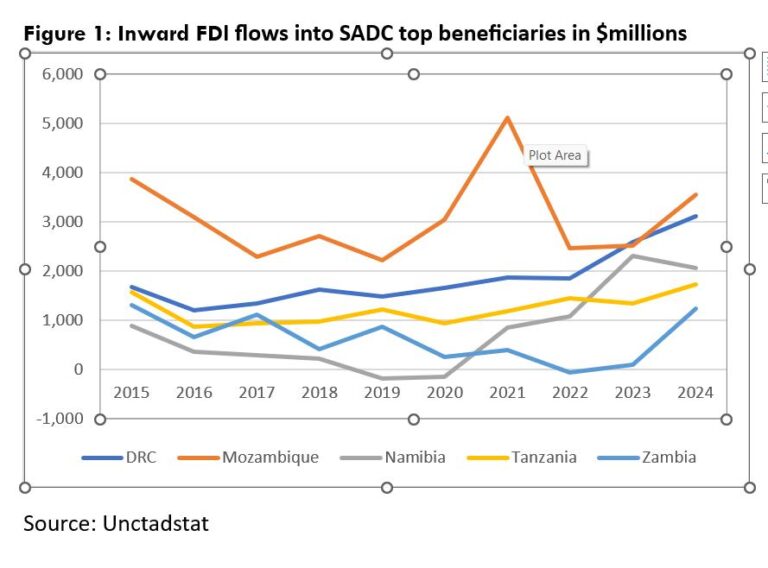
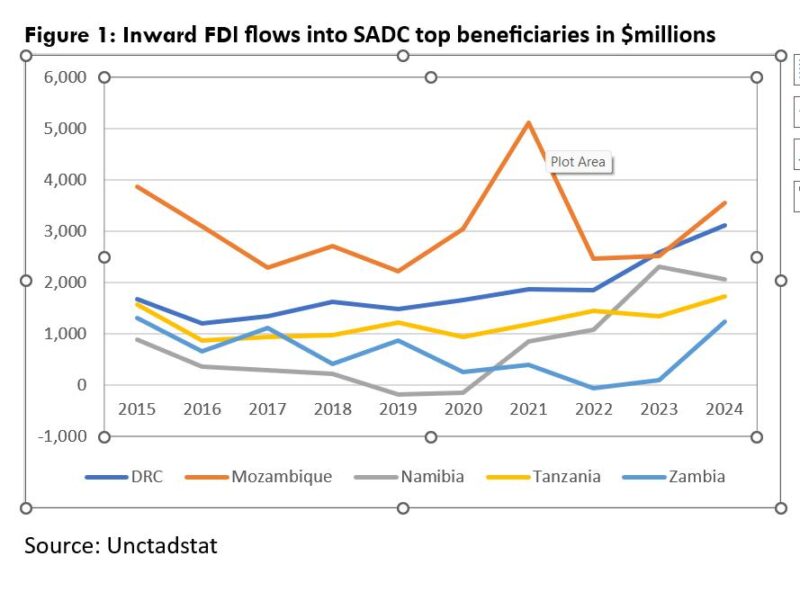
Second, follow Figure 1 below and you’ll see that the line showing Zambia is the one at the bottom in light blue with annual average flows of about $1 million. Follow the other countries whose FDI flows are above Zambia. Why is Mozambique, the top line attracting more FDI than Zambia? In 2024, Mozambique received total FDI of $ 3.6 billion in comparison with Zambia’s $1.2 billion. Why are the other countries getting more FDI than Zambia?
According to MozambiqueExpert, “Mozambique continues to stand out as a significant destination for Foreign Direct Investment (FDI) within Southern Africa, attracting investors due to its abundant natural resources, strategic geographic location, and ongoing government initiatives aimed at improving the investment climate.” With its towering supremacy over familiar names like Zambia, DRC, Namibia and Tanzania for many years as Figure 1 shows, true, Mozambique has made a huge, consistent and repeated leap.
Of course, there has been an improvement in Zambia’s inward FDI flows between 2022-2024 as shown in Figure 1, and, at national level, we will be right to celebrate. But competitively, at regional level, I get back to where we came from, namely, that the country must do better. The choice is ours. We can either simply sit in cabinet meetings and continue to burst in self-approbation or learn to include on our economic agenda, competition and competitiveness. That’s what successful nations do.
Third, but Mozambique possesses FDI challenges coequal with all but one African nation. While South Africa attracts reasonable size of FDI in manufacturing way above others, and countries like Mauritius, Morocco and Tunisia are trying to follow suit, the rest of the fifty African countries are hopelessly wedged into attracting resource-based FDI that creates infinitesimal or no jobs at all and equally contributes infinitesimal or nothing to wealth creation and expansion.
What’s likely to, is investment in manufacturing. It creates more jobs, expands business, creates more wealth and is repels possibilities of fluctuations in global prices that resource-based exports continue to suffer from. So, although Mozambique stands as a superstar among these countries, that position is still vulnerable. Global exports of Mauritius, Morocco and Tunisia are largely influenced by FDI in manufacturing. ZAWYA staff writer, Agency Tunis Afrique press on Tunisia states, “The sectoral breakdown of FDI shows a predominance of manufacturing industries (62.9%).”
For Mozambique, according to the Embassy of Switzerland in Mozambique, “FDI surged by 41.6% in 2024, led by extractive industries, underscoring investor interest in Mozambique’s resource potential despite prevailing risks.” From the statement, I can only assume that the report is perhaps about Swiss FDI to Mozambique, not global FDI. In other words, of total Swiss inward FDI to Mozambique, 41.6% goes into extractive industries. Additionally, Mozambique Expert lists “Energy (oil gas, and renewables), -40% of FDI; Mining 78.9% and Industry and manufacturing–15%.”
The story is similar for Zambia. As a rentier state, extractive industries, largely the copper mines always attract the largest proportion of global inward FDI. Unctad’s World Investment Report of 2024 states, “FDI remains dominated by large mining investments from Canada, Australia, the United Kingdom, China, and the United States, in addition to alrge infrastructure and other projects pefromed almost entirely by Chinese companies.” Despite repeated calls from public officials for manufacturing or value addition since independence, robust and dynamic inward flows of FDI in manufacturing contiues to elude the nation.
How do successful nations attract dynamic and productive FDI in manufacturing?
I have an idea. Look at Table 1 below and tell me why in 2022 Malaysia’s FDI was $17 billion compared to Zambia’s minus $65 million? Tell me why Viet Nam’s FDI in 2024 was almost twentyfold that of Zambia. Remember that once upon a time, Viet Nam, embroiled in war with the US, in the 70s, was almost extirpated from this world. Yet, Africa without such devastating experience has never been anywhere near this. No wonder, Professor Lumumba refers to Africa’s economies as mickey mouse economies.
Yet, today, Viet Nam stands out as a shining example of the once upon a time poor nation that has overtaken fifty-five African countries in global exports of manufactured goods largely generated from FDI. Ironically, the US has, for many years been one of Viet Nam’s main sources of FDI in the manufacturing sector.
Table 1: Inward FDI for Zambia compared with Asian Nations in $Millions
| |
2022
|
2024
|
| Malaysia |
17,136
|
11,259
|
| Viet Nam |
17,900
|
20,170
|
| Zambia |
-65
|
1,238
|
Source: Unctadstat
Unctad, the United Nations I worked for, in its same report lists “Strong and Weak Points” to answer the foregoing question. Government of course is providing some of these strong points, including incentives, Zambia being one of the most open trade environments in Africa, businesses in Zambia benefit from from one of the lowest profit taxes in the region, etc.
But, perhaps it’s the weaker points that matter most although governments don’t want to hear about them. And they’re many. They need to be addressed too. To bring them to the attention of the public and government is not to unfairly censure government. It’s to help. They include corruption. But I have my own solution. President Hichilema says that do not just list problems, list solutions too. My point is that anything that we do is simply a short-term solution, if not simply symptoms of the main problem.
Long-term solution
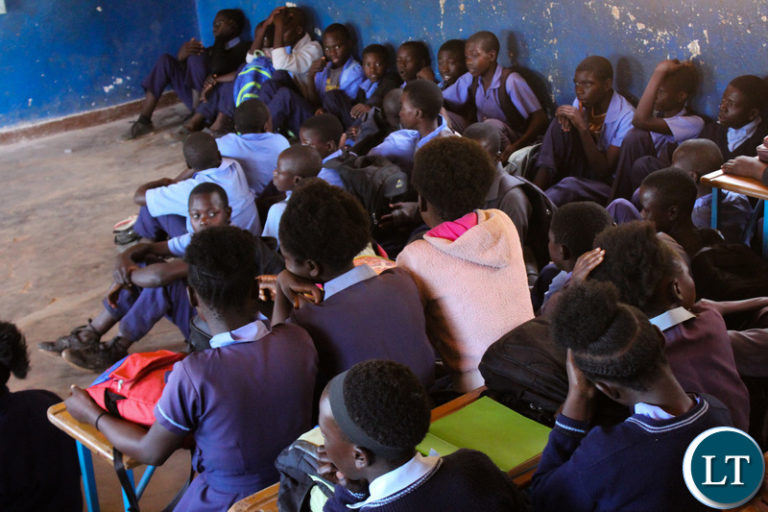
The long-term solution is to invest in Early Child Development (ECD), in order to create a new Zambian. Cognitive function that enables nations like those in developed world and emerging economies in Asia to create so much wealth, reduce poverty, solve complex problems and industrialize is what I’m talking about. At ages between 1 and 4, children in these nations develop a brain capable of critical thinking and solving complex problems. It will solve problems like some dark mindset, attention lapses, industrialization, FDI, etc.
I have studied this in Mauritius, Tunisia and Morocco and I think they’re seriously moving towards that. I know that Zambia is working on a policy but am not sure about what’s going on on the ground apart from work by UNICEF. Needless to say, policy cannot replace commitment to start work on investing in ECD. Policy is the easier part. Action is the way. This is an important topic that must find its place on cabinet meetings agenda.
Concluding
I conclude with these words. Until they create a new African equipped with the rigth cognitive function skills, no African country, including Zambia, excluding South Africa will attract FDI to the level we see in Asia. Today’s leaders who eventually create this new Zambian may not benefit from the investment because they’ll have long gone. But, they’ll leave the best legacy and foundation on which wealth similar to that in the US, Viet Nam, and simialr well-to-do nations is created. That’s what great and developmental leaders do. And, that’s what they benefit even if no dead man benefits.
Of course we must build a strong, attractive and dynamic private sector, in particular, indegenous private sector.