Minister of Finance and National Planning Situmbeko Musokotwane says reforms implemented by the government in the last four years have significantly contributed to the growth of the country’s economy.
Dr Musokotwane cited mining, manufacturing and energy as some of the sectors that have been impacted positively with the reforms carried out by the government.
He said Zambia has become a preferred destination for investment due to reforms and friendly policies put in place by the government.
The Minister said this during the 2026 first quarter budget, economic performance and outlook, town hall meeting in Lusaka.
Dr Musokotwane stressed that government reforms have greatly assisted in resuscitating the mining sector, which was on the verge of collapsing.
He explained that through reforms, the government has managed to turn around the situation with copper production rising from 700, 000 metric tons to 900,000 metric tons by the end of 2025.
The Minister hoped that this year, Zambia would be able to reach the projected one million metric tons of copper production following the conducive environment created in the mining sector.
“The country’s attractive investment environment can be attributed to the friendly policies that the government has been enacting in the last four years.
Zambia is now better off than it was when UPND took over the government, owing to the reforms carried out by the government across the economy,” Dr Musokotwane said.
He reaffirmed the government’s commitment to continue implementing reforms aimed at building a resilient economy.
He noted that the improvement of the economy is evident as seen in the stabilisation of the exchange rate and increased investments in the mining sector.
Dr Musokotwane added that the far-reaching reforms carried out by the government have also opened up the power sector.
He explained that the reforms implemented in the energy sector by the government were designed to attract private sector participation in power generation.
The Minister said if the government only relied on the public sector investment, Zambia would have continued grappling with power deficit.
On the manufacturing side, Dr Musokotwane noted that previously, Zambia was a net importer of fertilisers, but today the country is a major exporter of locally produced fertiliser.
Dr Musokotwane also indicated that Zambia was performing well in the exporting of ceramic towels.
Meanwhile, Secretary to the Treasury Felix Nkulukusa said that following the suspension of excise duty and zero-rating VAT on petrol and diesel for three months from April, to June,2026 the government will lose revenue close to four billion kwacha.
Mr Nkulukusa explained that the suspension of excise duty and VAT on petrol and diesel is meant to cushion the citizens against the impact of the high cost of fuel on the global market.
He bemoaned that should the war in the Middle East continue, then tax expenditure will increase on the part of the government.
Mr Nkulukusa projects that if the war continues to the end of the year, then the government will lose about 12 billion kwacha.
And speaking at the same event, Bank of Zambia Governor Denny Kalyalya disclosed that inflation in 2026 and the first three quarters of 2027 is projected to go down.
Dr Kalyalya further indicated the projection by the Bank of Zambia on inflation in the three quarters of 2027, at 6.3 percent, adding that chances are high of inflation further going down.
The Bank Governor however, said the ongoing geopolitical tension may have an opposite effect on the country’s inflation rate.
And he disclosed that the Central Bank has managed to mop up 97 percent of the old currency, which was in circulation, revealing that the country has in circulation about K21 billion of the new currency.
At the same event, Zambia Revenue Authority (ZRA) Commissioner General Dingani Banda disclosed that ZRA has improved in the collection of domestic taxes.
Mr Banda stated that the authority managed to collect 20 percent of domestic taxes, an achievement he described as a milestone.
He indicated that ZRA is determined to improve the collection of domestic taxes, as Zambia aspires to be like South Africa, whose collection of domestic revenue stands at 25 percent.
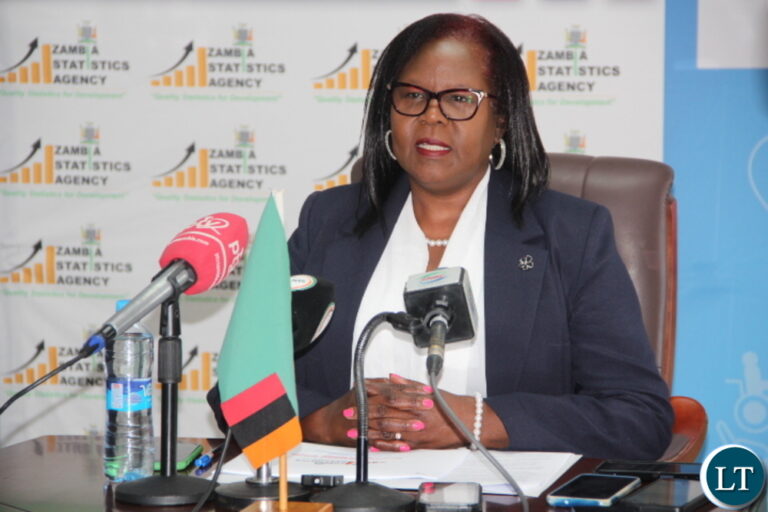
And making a presentation earlier, Zambia Statistics Agency (ZamStats) Statistician General Sheila Mudenda disclosed that the youth unemployment rate has dropped from 18.4 percent in 2021 to 14.2 percent in 2025.
She said the data collected by ZamStats shows that the youth unemployment rate has dropped in all the ten provinces.
ACCESS Bank Zambia Managing Director Iheanyi Nwogu commended government for the economic stability witnessed in the first quarter of 2026.
Dr Nwogu said the government has shown discipline and stability in the management of the country’s economy.
He said the Kwacha has finally found its footing following the prudent policies that the government is implementing.
Dr Nwogu said the conducive environment being created by the government has created investor confidence.
He however implored the government to ensure the gains achieved are sustained so as to foster economic growth.