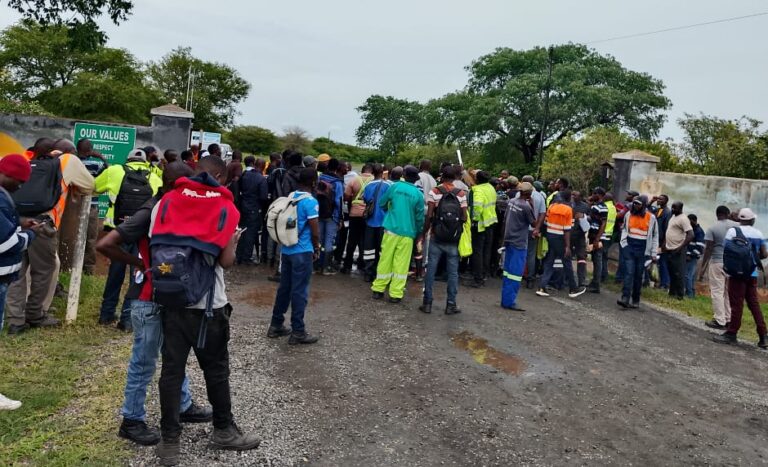
Former employees of Munali Nickel Mine have intensified their appeal for intervention over unpaid salaries, pension contributions and other outstanding obligations, with a named worker detailing how the situation unfolded on the ground.
The workers say the mine, currently under care and maintenance, still owes them several entitlements despite the appointment of a liquidator and repeated attempts to resolve the matter through official channels. They maintain that deductions were made from their earnings but were not remitted to the relevant institutions.
In a formal appeal, the former employees listed outstanding obligations that include three months’ unpaid salaries, pension contributions under Saturnia, unpaid National Health Insurance Management Authority contributions and gratuities. They state that these obligations remain unsettled.
The case is now reinforced by testimony from one of the affected workers, Moses Musonda, who identified himself as a former employee at Munali Nickel Mine in Mazabuka, Kafue. His account provides a sequence of events that aligns with the broader complaint raised by the workers.
“I’m Moses Musonda, I’m one of Mazabuka employees at Munali Nickel Mine in Mazabuka, Kafue. What is happening at the ground, they haven’t paid us our terminal benefits,” he said.
Musonda said the situation dates back to June last year, when workers were informed of financial difficulties at the mine. He stated that the company indicated it did not have the capacity to continue operations under the prevailing conditions.
“It started last year in June. They were saying they don’t have the money to run the company,” he said.
He explained that the company was later placed under liquidation, with assurances that employees would be paid their terminal benefits. According to his account, those assurances have not been fulfilled.
“Then later on, they put the company on liquidation and they choose a liquidator. After choosing the liquidator, they told us that we are going to be paid our terminal benefits. Up to now, they haven’t paid our terminal benefits.”
Musonda said the company attributed its financial position to market conditions linked to commodity pricing and operational costs. He added that workers were informed of plans to secure new investment.
“They were saying the nickel price on London Metal Exchange was down according to the operation cost challenges they are having at the mine. They will find a new partner to pump in the capital to run the mine. Up to now, they haven’t given us a concrete position.”
He further stated that prior to the liquidation process, workers were placed on administrative leave with assurances that salaries would continue to be paid. According to his account, that arrangement did not materialise in practice.
“Before it started, they forced us on administration leave, they told us, go home, we’ll be paying you monthly when you are at home,” he said.
Musonda stated that although payslips continued to be issued, the corresponding payments were not made. He added that statutory deductions were still reflected despite not being remitted.
“We received payslips, but they were not depositing our salaries or remitting them, even our NHIMA, NAPSA and our pension schemes, they were not remitting, but they were deducting us through the payslip.”
He said the situation persisted until November 2025, when termination letters were issued to the workers. That marked the end of employment without settlement of the outstanding obligations.
“Until last November, last year in November 2025, they sent us our termination letters.”
The broader group of former employees states that despite the appointment of a liquidator, there has been limited progress in resolving the matter. They say engagement efforts have not yielded satisfactory outcomes.
Attempts to seek intervention from the Ministry of Labour and Social Security, through the Labour Commissioner’s office, have also not resulted in a resolution. The workers indicate that the matter remains unresolved despite these approaches.
They describe the impact as significant, stating that the situation has placed financial and emotional strain on affected individuals and their families. The outstanding obligations, they maintain, involve earnings already deducted or owed under contractual arrangements.
The workers are now calling for urgent attention to ensure that the obligations are settled. They are also seeking wider visibility for the matter, expressing hope that this will prompt action from relevant authorities and stakeholders.