
Hichilema Calls for Public Clarity on New Constitutional Law
President Hakainde Hichilema has called for nationwide public education on the newly enacted Constitutional Amendment Act, urging civic and community leaders to ensure citizens fully understand its provisions and intended benefits.
The President made the remarks upon arrival in Choma, where he is spending a working holiday at his Harmony farm, weeks after assenting to the Constitutional Amendment Act, commonly referred to as Bill No.7 of 2025.
Hichilema said widespread understanding of the law was essential to counter misinformation and misinterpretation, particularly given the scale of the changes introduced by the amendment. He stressed that the reforms were enacted in the national interest and were not designed to benefit a select group.
The Constitutional Amendment Bill No.7 was passed by the National Assembly on December 15, 2025, after securing a two-thirds majority vote. The legislation introduces a mixed-member proportional representation electoral system, increases the number of constituency seats, and refines several legal definitions within the Constitution.
Hichilema said the amendment should be viewed as a foundation for broader governance reforms, adding that its success would depend on how well citizens understood both its structure and purpose. He tasked community leaders, civic educators, and political actors with explaining the law’s interpretation, meaning, and value at grassroots level.
The President linked the constitutional changes to his administration’s development agenda, placing emphasis on service delivery across key sectors. He reiterated the government’s commitment to the free education policy, saying transparency and efficiency were critical in the procurement and distribution of school supplies.
He said public confidence in government reforms depended not only on policy design but also on execution, particularly in areas that directly affect households. Education, he said, remained a cornerstone of national development and social mobility.
Hichilema also highlighted women empowerment programmes, noting that the constitutional amendment provided an opportunity to strengthen gender inclusion in national development processes. He said inclusive participation was necessary for sustained economic and social progress.
Turning to the management of the Constituency Development Fund, the President warned against substandard project implementation, saying public resources must deliver tangible value. He outlined what he described as a three-point benchmark for all CDF projects: the right quality, the right price, and timely delivery.
He said failure to meet these standards undermined public trust and weakened the developmental impact of decentralised funding. He urged local authorities and implementing agencies to enforce accountability at all stages of project execution.
On the political front, Hichilema described the August 2026 general elections as competitive and cautioned against complacency. He said electoral success would require clear strategy, strong mobilisation, and effective grassroots party structures.
The President said political parties and civic actors had a responsibility to engage citizens constructively and ensure that constitutional reforms were not distorted for partisan advantage. He stressed that informed participation was central to democratic stability.
He also commended youths for their continued contribution to national development, encouraging them to play an active role in civic education efforts around the new law. He said understanding constitutional changes was a collective responsibility and that no citizen should be left behind.
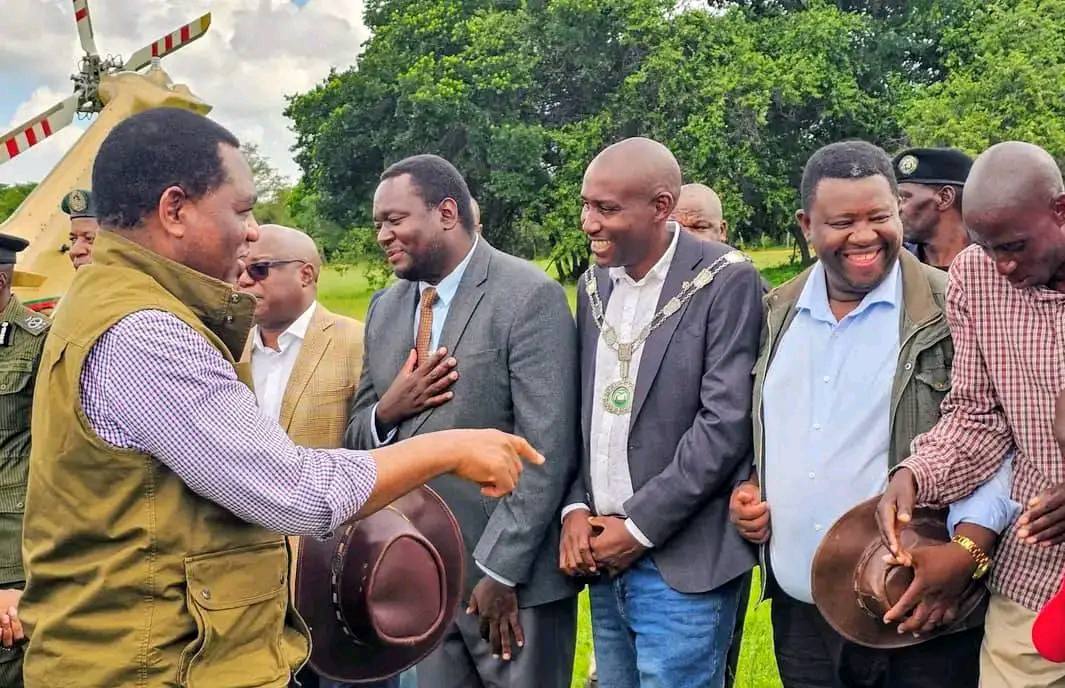
Upon arrival in Choma, Hichilema was received by Namani Monze, Chief Government Spokesperson Cornelius Mweetwa, Choma Mayor Javen Simoloka, and Members of Parliament Edgar Sing’ombe and Joseph Munsanje, alongside other senior government and party officials.
The President said continued engagement between leaders and communities would be critical as the country implements the new constitutional framework.




Education?
or national brainwashing? The law has been forced on the people by power hungry politicians. First action by next government will be to remove it.
This is an opportunity for Makeba Zulu to shine: break down the Constitutional Amendment Act into clear points how it changes representation, who benefits, how it affects governance, and what citizens should watch for in the coming months. People deserve plain language and concrete examples, not political theatre. Let’s see a straightforward, public facing breakdown from our leaders, not smoke and mirrors.
This article shows the incumbent dodging responsibility. The president should tell us what to expect from Bill No. 7, not shift the job of education to others. If the law is meant for the people, the president must explain its real impacts now. Transparency, not excuses. Makeba Zulu should break it down clearly for everyday citizens.
Why is he asking for us to explain his own opinionated ideas?
Bill 7 should have had a clause compelling Presidents to be declaring their assests. It should also have had a clause compelling the President to be having dialogue with political opponents 2 or 3 times a year. Just as the President went to preach dialogue in Tanzania, we surely need it here as well. This country is definitely on a wrong path
Protecting HH by all means. That’s all why they were in a hurry to pass it amongst the yes bwanas in their parliament. UPND syncomphants could see which dangerous clauses had been deliberately ignored by not passing the bill through the people.
Scripture warns: ‘Woe to those who make unjust laws, to those who issue oppressive decrees.’ (Isaiah 10:1)
Hello there. When the drumbeat change, the dance changes just as when the bay grows, the crying changes. Zambia as a nation is trying to survive and every path right now carries risk, but change is inevitable. You cannot stop building something just because the nail has broken. Only fools believe in pretending and denying themselves change.