
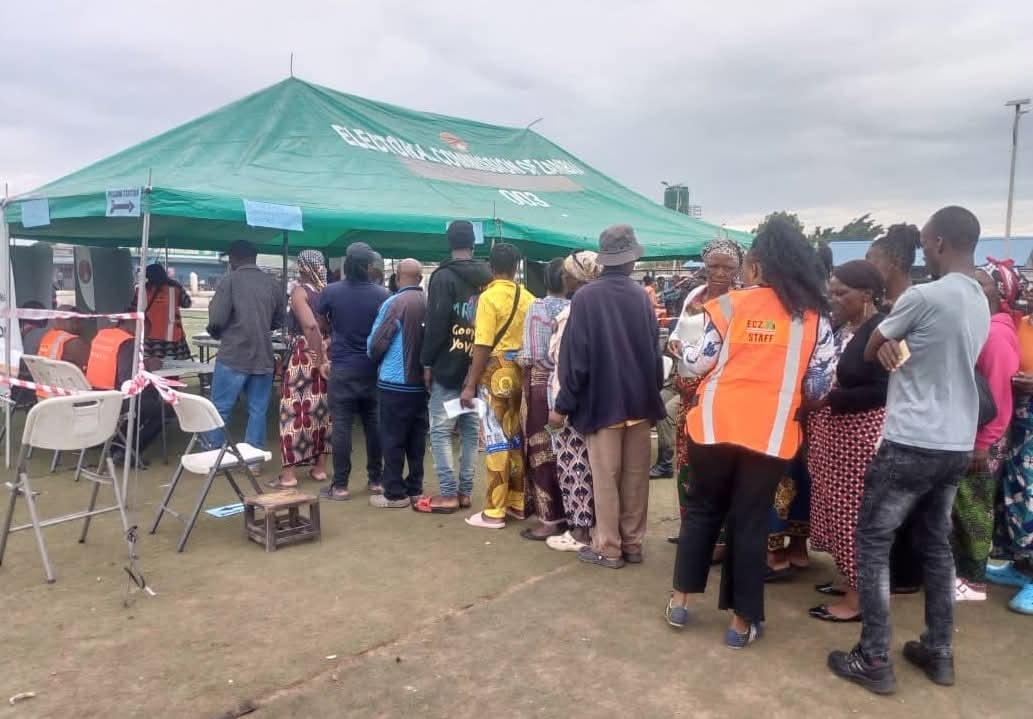
Voters in Chawama Constituency are today choosing their new Member of Parliament in a by-election that, beyond the outcome itself, carries broader significance for Zambia’s political climate ahead of the August General Election. Regardless of who emerges victorious, the process has already revealed notable gains in the conduct of politics, gains that should not be dismissed or overshadowed by partisan outcomes.
Several developments stand out.
The most striking feature of the Chawama by-election has been the peaceful nature of the campaign period. This contrasts sharply with the 2001 Chawama parliamentary by-election, which was characterised by violence, intimidation, and the destruction of property. In the current contest, political parties campaigned freely, held roadshows across the constituency, and even interacted openly without incidents of clashes or vandalism.
Campaign vehicles moved through Chawama without being attacked, rallies were conducted without disruption, and supporters of rival parties coexisted in shared spaces. This calm environment reflects a maturity that has been absent in many past by-elections and demonstrates that competitive politics does not have to descend into disorder.
Such conditions create space for credible candidates, including women and young professionals, to participate without fear. If sustained, this type of political engagement strengthens democracy and broadens the pool of individuals willing to contest public office. Chawama has demonstrated that peaceful competition is possible and desirable.
Equally significant has been the conduct of the Zambia Police Service during the campaign period. Police officers provided security to all political players without selectively cancelling rallies or restricting meetings under the guise of public safety. The approach was measured, professional, and even-handed.
This was not an isolated occurrence. In recent days, similar professionalism was observed when large crowds gathered in Lusaka to escort Archbishop Alick Banda, with police maintaining order without confrontation. Such conduct builds public trust and reduces tension during politically sensitive moments.
When law enforcement acts impartially, it removes one of the most common triggers of electoral conflict. Chawama benefited from this approach, and it should serve as a reference point for future by-elections across the country.
Another notable development has been President Hakainde Hichilema’s decision to stay away from this parliamentary by-election. After actively campaigning in earlier contests such as Kabwata, Kabushi, and Kwacha, the President has allowed party functionaries to take the lead in subsequent by-elections, including Kawambwa, Mbambashi, Lumezi, Petauke, Mfuwe, and now Chawama.
This restraint matters. Presidential visits to constituencies often come with heavy security deployments that restrict movement, delay opposition activities, and distort the campaign environment. By remaining absent, the President created space for a more balanced contest.
It also reflects the constitutional reality that the President serves all citizens, including those represented by Members of Parliament from different parties. Parliamentary by-elections are distinct from general elections, where the President is himself a candidate. Recognising that distinction contributes to fair play and strengthens institutional norms.
As Chawama votes, a broader question remains unresolved. Why do by-elections in rural constituencies so often descend into skirmishes, while urban contests like this one proceed peacefully? Rural communities are generally cohesive and orderly, yet election periods frequently introduce violence that appears foreign to local social dynamics.
The pattern raises legitimate concerns about the role of imported cadres, external mobilisation, and campaign logistics that transplant urban political behaviour into rural settings. Chawama’s experience suggests that when such influences are absent or restrained, voters are capable of engaging peacefully and independently.
Today’s vote will produce a winner, but the larger achievement lies in how the process unfolded. Chawama has shown that campaigns can be competitive without being hostile, that policing can be firm without being oppressive, and that leadership restraint can enhance rather than weaken democracy.
The challenge now is ensuring that these standards are not the exception, but the norm, as Zambia approaches the August General Election.




The winners of this bye election are the people of Chawama. By their peaceful conduct they have shown how they daily live their lives when there are no campaigns, no political activities. They have shown that they are neighbours who genuinely love each other. In doing so they have set a high standard for the rest of the Country to follow as we approach August elections and beyond.
Indeed correct
Remember that the by-election of 2001 in the same Chawama constituency was violent. It could the people of Chawama have matured politically, or something externally has changed. In the same violence was the norm when the ruling party “exports” cadres in the campaign. It’s also important that HH has silently refrained from campaigning for UPND in by-elections, giving leverage to promotion of real democracy as a national leader. To say the least, by-elections have been peaceful since HH took over
…….” ,……In the current contest, political parties campaigned freely, held roadshows across the constituency, and even interacted openly without incidents of clashes or vandalism…”
Just for archiving this………
Just give the Bally until he himself wants to retire by himself ……….
That’s why the opposition can only try to talk about tribalism, everything else……….
Ni Kwenyu………
We are here, the winning team
FWD2041
Kkk wina azalila