
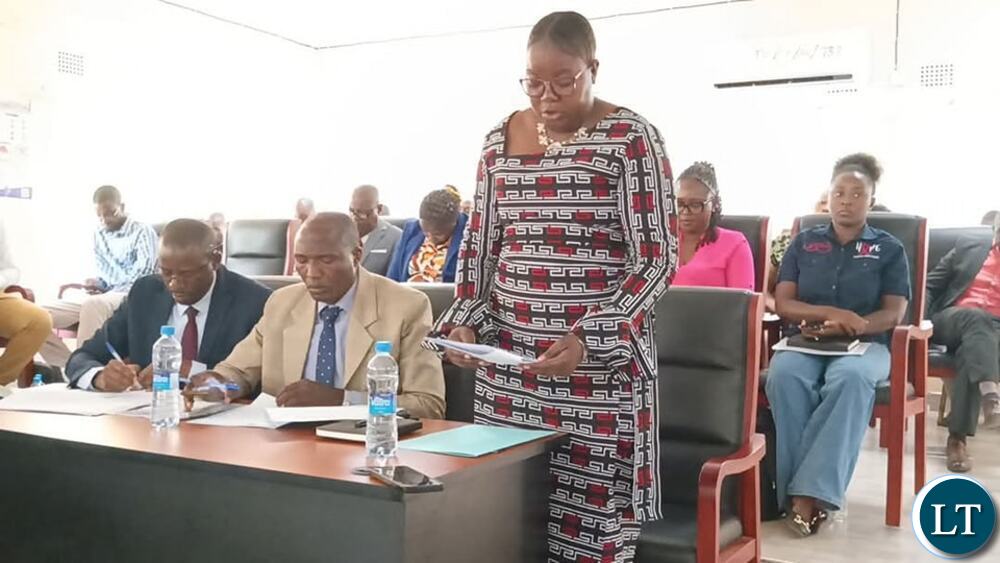
Presenting a report before the National Assembly of Zambia, Chairperson of the Parliamentary Select Committee on Local Governance, Housing and Chiefs’ Affairs Twaambo Mutinta warned that persistent irregularities in councils were exposing public resources to abuse and waste.
Mutinta highlighted several concerns, including unsupported payments, unretired imprest, irregular procurement practices, weak internal controls, delayed completion of projects, failure to remit statutory obligations and poor management of public assets in councils.
He said the continued weaknesses were negatively affecting service delivery and accountability in the management of public funds.
“The Committee strongly urges all Controlling Officers and local authorities across the country to ensure strict adherence to the provisions of the Public Finance Management Act Number One of 2018, the Public Procurement Act Number Eight of 2020, and other relevant laws and regulations governing public resource management,” Mutinta said.
He further called for stronger supervision, improved enforcement of internal controls and timely implementation of audit recommendations to strengthen accountability and prudent use of public resources.
Mutinta also raised concern over inadequate staffing levels in finance, engineering, procurement and legal departments in many councils, stating that the shortage of qualified personnel had affected project supervision, financial reporting, contract management and legal compliance.
He urged the Treasury, the Local Government Service Commission and the Ministry of Local Government and Rural Development to speed up the recruitment and deployment of essential staff in local authorities.
At the same time, Mutinta acknowledged government initiatives aimed at improving revenue mobilisation and decentralisation through programmes such as the Smart Zambia Institute and the Zambia Devolution Programme.
He said the initiatives had the potential to improve efficiency, transparency and accountability in councils but stressed the need for harmonisation and integration of ICT systems across local authorities.
Among the committee’s recommendations was the recruitment of personnel to fill 4,370 vacant positions in councils countrywide.
Mutinta also urged the Local Government Service Commission to stop deploying workers to councils with full establishments and instead prioritise councils facing critical staff shortages.
Meanwhile, Christopher Kang’ombe questioned how public funds were being utilised, citing unretired imprest amounting to K435,000, irregular payments and delayed disbursement of funds.
He said stronger internal audit departments could help reduce irregular payments and improve accountability in councils.
“If we had very effective internal audit departments, irregular payments would not be made and officers would not fail to retire imprest,” Kang’ombe said.
Contributing to the debate, Mutotwe Kafwaya highlighted additional concerns, including failure to collect revenue, unaccounted-for fuel, poor maintenance of council properties and failure to settle statutory obligations amounting to K6 million.
Kafwaya stated that failure to retire imprest suggested deliberate misuse or misapplication of public funds.
And Stephen Kampyongo said local authorities should no longer operate without accountability for misuse of public resources.
“It should not be business as usual. We’re talking about public resources that are misappropriated year in and year out. What are the controlling officers doing?” Kampyongo asked.
The House has since adopted the Report of the Committee on Local Governance, Housing and Chiefs’ Affairs on the Auditor General’s Audit of Accounts of Local Authorities for the financial year ended December 31, 2024.
Earlier, Parliament also adopted the report of the Zambian delegation to the 152nd Inter-Parliamentary Union Assembly held in Istanbul from April 15 to 19, 2026.



we even have persons who cannot account for the money they now have