
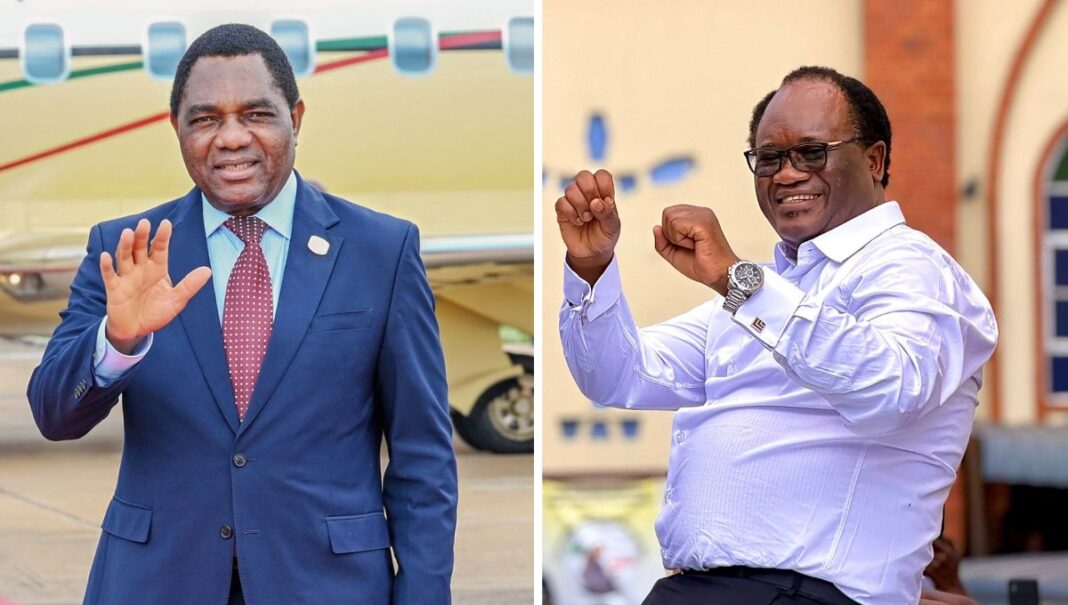
Former Zambia ambassador to Ethiopia Emmanuel Mwamba says the August 13 general election is increasingly taking the shape of a direct contest between President Hakainde Hichilema and Tonse-Pamodzi Alliance presidential candidate Brian Mundubile, arguing that recent political developments have elevated the opposition alliance into the front rank of the campaign.
Speaking on his EMV Podcast on Monday night, Mwamba said the Tonse-Pamodzi ticket of Mundubile and running mate Makebi Zulu had gained noticeable visibility since nominations closed and was now competing for public attention alongside the ruling UPND ticket led by President Hichilema and Vice-President W.K. Mutale Nalumango.
“It’s beginning to look like a two-horse race that is going to be between President Hakainde Hichilema and WK Mutale Nalumango, and Brian Mundubile and Makebi Zulu,” Mwamba said.
He stressed, however, that his assessment should not be interpreted as dismissing the role of other presidential contenders, including Citizens First leader Harry Kalaba, Socialist Party president Dr Fred M’membe and Zambia Must Prosper leader Kelvin Fube Bwalya.
According to Mwamba, the shift he is observing is based on campaign activity and public engagement witnessed over the past several weeks.
“From an analytical point of view, you can see that in the last three weeks, and from the time nominations were filed, Brian Mundubile and Makebi are now there, head-to-head with President Hakainde Hichilema,” he said.
The former diplomat said the central question facing the Tonse-Pamodzi Alliance is no longer whether it has generated momentum, but whether it can maintain that momentum through the remaining weeks of the campaign.
“Can they sustain the momentum in the next 60 days? Because we’ve done 30 days and the campaigns are only gathering momentum,” he said.
Mwamba pointed to a series of recent appearances by Mundubile and Zulu which, in his view, have contributed to the alliance’s growing profile.
Among the events he highlighted was the pair’s visit to Chipata during the funeral of the late Paramount Chief Mpezeni IV, which he said attracted significant public interest and support.
He also cited subsequent political activities in Kitwe and Kabwe, describing them as further evidence that the alliance was gaining traction in different parts of the country.
At the same time, Mwamba raised concerns about what he described as unequal treatment of opposition figures by law enforcement agencies.
He referred to incidents linked to political violence in Chawama, where security personnel attached to Mundubile and Zulu were arrested and charged, while, in his view, individuals associated with the ruling party were not subjected to similar action.
On campaign mobilisation, Mwamba said recent rallies organised by the alliance had demonstrated its ability to attract public participation even under challenging circumstances.
He pointed to the Kitwe rally at the Playing Fields, saying it was organised at relatively short notice but still attracted a large turnout.
“So we saw the momentum from Chipata. Over the weekend, at short notice, they held that massive rally at Kitwe Playing Fields and the UPND were caught off guard,” he said.
He offered a similar assessment of the alliance’s rally in Kabwe, which proceeded after uncertainty surrounding police clearance.
According to Mwamba, supporters still turned up in large numbers at Comet Grounds in Makululu. “You could see a mass of people from left to right,” he said.
Despite his positive assessment of the alliance’s recent performances, Mwamba cautioned against treating crowd sizes alone as a reliable predictor of electoral outcomes.
He noted that Zambia’s political history contains numerous examples where campaign attendance and election results did not always move in the same direction.
Drawing on past campaigns involving former presidents Kenneth Kaunda, Frederick Chiluba, Michael Sata and Rupiah Banda, he argued that seasoned political actors often distinguish between crowds that gather organically and those assembled through organised mobilisation.
For Mwamba, the significance of recent campaign events lies less in the numbers themselves and more in what they may reveal about voter enthusiasm, political energy and the ability of parties to sustain engagement over time.
With the campaign entering a more intense phase, he said the coming weeks will provide a clearer indication of whether the Tonse-Pamodzi Alliance can convert its recent visibility into lasting electoral momentum or whether the race will evolve in a different direction as polling day approaches.
What remains certain, according to his assessment, is that the campaign landscape is continuing to shift, and that both the ruling UPND and its challengers still face the task of persuading voters during the decisive final stretch before Zambia heads to the polls on August 13.



Only observesation, how can the artists and their song be banned for supporting the opposition, I ought to say what a song by Mr Rich and co. Are they scared? I watched the rally in Kitwe and Kabwe, what a turn out, all along after being told that there was opposition
i
After all along being told that there was no opposition
Let’s wait to see rallies for New dawn to
Gauge which way the balance will tilt
On 13th August.