
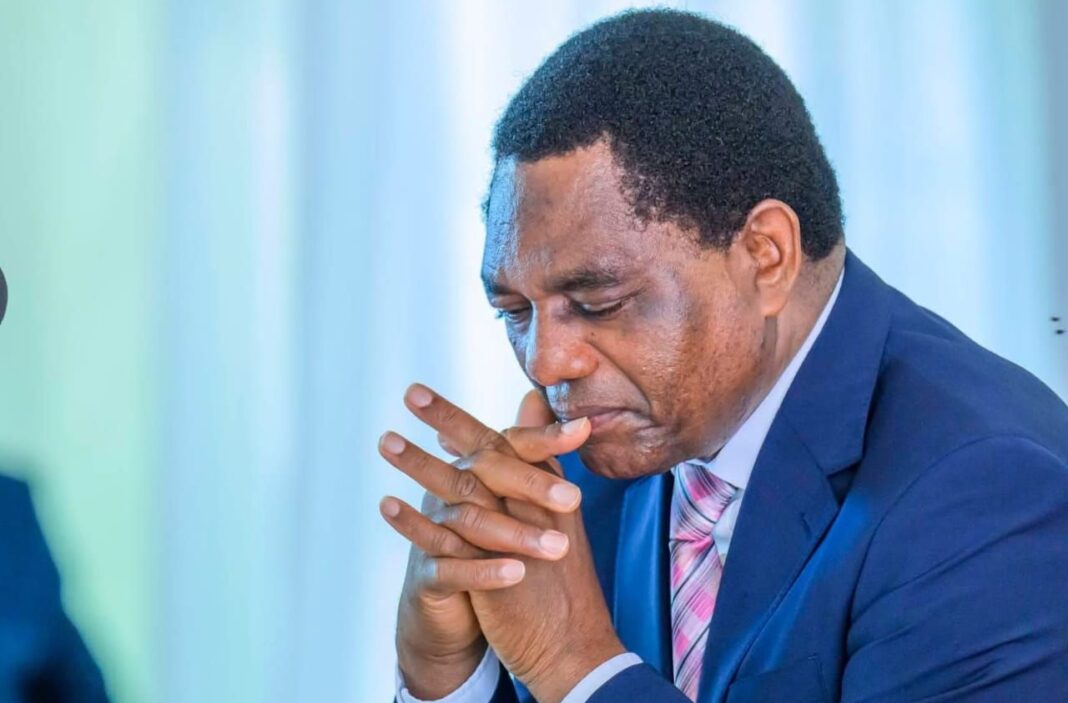
Zambia Ends 2025 Between Progress and Pressure
From the Inbox
Zambia closes 2025 under the weight of sharply competing realities. Official optimism, festive goodwill messages, and endorsements of government performance sit alongside audit red flags, economic strain, governance disputes, and public unease that has not dissipated with the calendar year.
At community level, traditional leadership has openly expressed satisfaction with the direction of government policy, particularly in social welfare, education access, and decentralised development. Expanded social cash transfers, community development projects, and increased local participation in decision-making have been cited as evidence that public policy is no longer confined to Lusaka but is increasingly visible in rural and peri-urban Zambia. These assessments present a picture of a state regaining relevance in everyday life.
However, this optimism is sharply counterbalanced by institutional findings that raise serious questions about financial discipline and administrative capacity. Recent audit reviews show that 17 local authorities executed procurement transactions valued at more than K68 million without obtaining mandatory tax clearance. The transactions involved goods and services procured under public funds, yet bypassed procedures meant to ensure compliance, transparency, and accountability.
The findings have brought renewed scrutiny to the management of decentralised funds, especially at a time when allocations under the Constituency Development Fund have increased significantly. While communities may see visible infrastructure and empowerment projects, the absence of strict compliance mechanisms exposes the system to misuse, inefficiency, and potential abuse. The issue is not the existence of development, but whether it is being delivered within the law.
The contradiction between policy praise and procedural failure underscores a deeper governance challenge. Development delivery and institutional discipline are advancing unevenly, creating a situation where progress in one area is undermined by weakness in another. This tension has become a defining feature of the current governance environment.
Economic indicators add further complexity. Official figures show that the economy recorded moderate growth in the third quarter of the year, while inflation closed at just over 11 percent. These figures have been presented as evidence that stabilisation efforts are beginning to take effect following prolonged economic distress.
Yet the lived experience of households tells a different story. Food prices remain high, electricity supply is unreliable, and alternative energy sources such as charcoal have become increasingly expensive. Salaries for many workers have stagnated, while deductions, loan repayments, and statutory obligations consume a large share of monthly income. For many families, disposable income has effectively disappeared.
The Christmas season has magnified this reality. Traditionally a period of relief and social cohesion, the festive season has instead been marked by restraint. Households have reduced travel, simplified meals, and postponed celebrations altogether. Markets are stocked, but purchasing power is weak. Traders watch goods remain unsold, while consumers calculate survival rather than celebration.
This economic pressure has wider implications. Informal traders and small businesses that rely on festive spending to stabilise cash flow have been hit hard. The slowdown in consumption reinforces income insecurity, creating a feedback loop that limits recovery at community level despite positive macroeconomic signals.
Political and governance debates have also intensified. The enactment of recent constitutional amendments has been framed by authorities as a historic step toward inclusive governance and broader representation. Supporters highlight provisions related to proportional representation and expanded participation as milestones in democratic development.
However, critics argue that the process was rushed, insufficiently consultative, and dismissive of earlier judicial guidance on public participation. The result has been a polarised national conversation focused not only on the content of the amendments, but on the legitimacy of how they were adopted. Rather than closing debate, the amendments have entrenched it.
Electoral integrity concerns have further sharpened the political climate. With by-elections looming and the general elections approaching, warnings have been raised against the misuse of public resources, inducements disguised as development, and blurred boundaries between governance and campaigning. These concerns reflect longstanding anxieties about fairness and neutrality in the electoral process.
Public anxiety has also been fuelled by crime, court cases, and social justice concerns that have dominated recent reporting. Allegations involving abuse of authority, violent crime, and domestic disputes have placed renewed pressure on law enforcement and the justice system to demonstrate impartiality and effectiveness. These cases contribute to a broader sense of institutional strain.
Meanwhile, public commentary sections have revealed a citizenry that is increasingly vocal, divided, and sceptical. Letters and opinion pieces reflect frustration over economic hardship, governance conduct, foreign relations, civil registration processes, and unresolved national disputes. While opinions differ sharply, they share a common thread of demand for accountability, clarity, and dignity in public life.
Taken together, the year-end picture is one of a country balancing aspiration with anxiety. Welfare programmes are expanding, yet compliance failures persist. Economic growth is recorded, yet households remain under strain. Constitutional reform is enacted, yet legitimacy is contested. Festive goodwill exists, yet public confidence remains fragile.
As Zambia approaches 2026, the central challenge is no longer whether policies exist, but whether institutions can enforce rules, translate growth into relief, and align political reform with public trust. The year closes not with resolution, but with a clear test before the state: to ensure that progress is not only announced, but sustained, accountable, and felt where it matters most.



It has been said again and again and even Dangote said it there is no growth without energy in any country, the reason this propaganda must be detected quickly by Zambians. Constitution amendment will never ever bring prosperity but industrialisation will. Ati CDF is a game changer, which game has even changed when Zambians are surely worse off since 2021
The most incompetent government since independence is the one we have now. Even asking cheekly which country we live in, we are in Zambia and we were economically better by far under PF. I even apologise to PF here for kicking them out when we were cheated by the current failures who we put in goverment
Zambians are worse off under UPND with the opposition not offering any hope. The opposition is fragmented and therefore impotent to rescue Zambians from UPND clear mediocrity
The following parties which just exist on paper must disband and stop wasting our time
EF – talks about ECL instead of real issues
ZMP – claiming to be king makers but no followers
Leadership Movement – very loose and general plans
PAC – no tangible economic turn around plan
PEP – one man show
WOZA – dead on arrival
SP – Leaders with no humility, as can be seen in interviews, no tangible plan
CF – false confidence, no real economic turn around strategy
EF – talks about ECL instead of real issues
ZMP – claiming to be king makers but no followers
Leadership Movement – very loose and general plans
PAC – no tangible economic turn around plan
PEP – one man show
WOZA – dead on arrival
SP – Leaders with no humility, as can be seen in interviews, no tangible plan
CF – false confidence, no real economic turn around strategy
The same coward inadequate man writing under different names………..
Wachepa sana….
We are here
FWD2041
Everyone is entitled to their opinion you are very insistant on here and its accepted
most can see where the trouble lies yet your party is still steadfast putting the same forward
Find a challenger and let’s all be one
Inbox it is “Zambia Ends 2025 Between loadshedding and lies”