
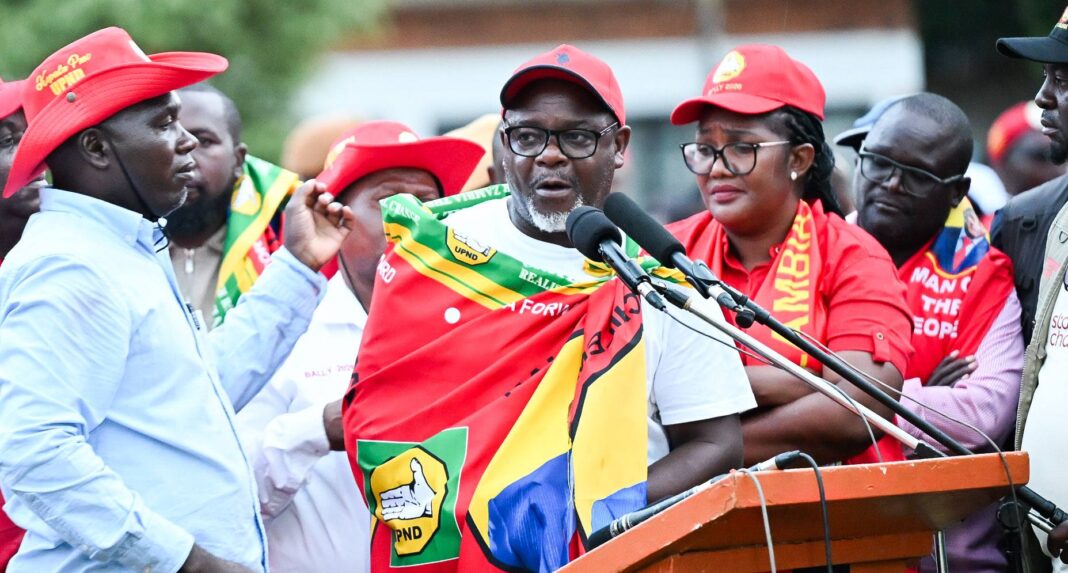
A wave of political defections involving mayors and councillors has shifted local government dynamics ahead of Zambia’s August 2026 general elections, with multiple leaders moving to the United Party for National Development.
Five mayors and about 20 councillors have crossed over to the ruling party, reflecting a widening realignment within local structures as the electoral cycle approaches. Among those who defected are Kitwe Mayor Mpasa Mwaya and Chipata Mayor George Mwanza, alongside councillors from Milenge, Chembe, Lundazi and other districts.
The movement of local government leaders into the ruling party marks a significant development in the political landscape, where influence at council level often shapes grassroots mobilisation and voter engagement. Councillors and mayors serve as key connectors between national policy and local communities, making their alignment politically consequential in the run-up to elections.
President Hakainde Hichilema, addressing the development, directed existing party members to welcome the new entrants, stating that unity within the party remains essential as the country prepares for the polls. He described the party as a platform for inclusive governance and development, emphasising the need for cohesion in strengthening its national presence.
The defections come at a time when political positioning is intensifying across parties, with alliances, endorsements, and internal structures increasingly shaping campaign strategies. Movement of elected officials, particularly at local authority level, often signals shifting confidence and strategic recalibration among political actors.
In parallel reporting, similar developments have been observed involving additional political figures, including a Member of Parliament and mayors from key urban centres. These movements collectively point to an ongoing reconfiguration of political alignments, extending beyond isolated cases to a broader pattern of transition.
The implications extend beyond party membership numbers. Control and influence within local authorities can affect campaign logistics, messaging reach, and the visibility of political programmes at community level. Councils play a central role in implementing development initiatives, including projects funded under the Constituency Development Fund, placing local leaders at the forefront of service delivery narratives.
The consolidation of support within the ruling party also intersects with electoral strategy. By absorbing leaders from different regions, the party strengthens its presence in constituencies where local structures influence voter turnout and mobilisation efforts.
At the same time, defections introduce questions around party stability and internal cohesion within opposition structures. Movement of elected officials may reflect strategic repositioning or dissatisfaction within existing party frameworks, though individual motivations often vary.
Political realignments of this nature are not uncommon in the period leading to elections, where shifting alliances reflect both strategic calculations and evolving political dynamics. The scale and distribution of the current defections, however, indicate a more pronounced restructuring at local government level.
The developments also highlight the central role of local leadership in shaping electoral outcomes. While national campaigns often dominate public attention, councillors and mayors remain key actors in influencing voter perceptions through direct engagement with communities.
As the election date approaches, further shifts cannot be ruled out, with political actors continuing to assess positioning, alliances, and strategic advantage. The current wave of defections provides an early signal of how political ground may be shifting ahead of the polls.




The reality of the unemployment crisis in Zambia.
This is a clear manifestation of the unemployment situation in the country.
Of course, people are looking for jobs. The defections have got nothing to do with service or popularity of UPND.
But any way it is within their right to parade themselves like that in front of a totally failed administration
Of course, you kill the PF, people are uncertain whether the PF will be on the ballot.
The easiest course of action is to defect where it is certain, not that the UPND is popular, NO
How can it be popular when they can’t even match the PF prices, PF commodities like mealie meal, sugar and cooking oil were muc cheaper than now. Free education was initiated by UNIP and CDF was initiated by the MMD. I am making it clear because somethings just have to be acknowledged
You really expect prices to be the same overtime, including that PF used subsidies, UPND removed them. The fact that you can compare tells how good UPND economic polices are. Free education, yes was started by UNIP but they abandoned them halfway, I was there, I was a student, boarding and school fees came back in 1985. UPND has perfected that by adding meals, Decentralisation (CDF) was just a buzz under UNIP and MMD, UPND perfected and operationalised CDF. Now, each district has been empowered to define theie devemental trajectory. We know its zambian to be modest, lets give credit where its due, and UPND has just been in power 4.6 years, being compared to 27 and 20 years parties in power, its a compliment, Thank you 🙂
Go and do basic economics to understand the basic law of demand and suply.You are just suffering from a disease called ignorance.Most of our money in the budget, goes towards paying the debtpf left. They contracted Loans carelessly.Now YOU know where the high cost of living is coming from.
HH has reinstated free education, which was discontinued many years ago, and he deserves recognition for this achievement. Your ignorance and animosity are clouding your judgment. If the PF truly understood what is right, why were they unable to restore free education?
Furthermore, HH has increased the funding for the CDF; why should people not express gratitude towards him? Attend school to develop your reasoning skills.pf was a grouping of failures,the sooner you get that to your peanut brain you will wake from that long sleep
HaMusonda, please spare the Zambian people who are under going these daily economic struggles.
HaMusonda, do you know that your reasoning is really letting down as usual because prices were promised. So what is your feeble argument as usual?
Hi Kabatwe Ntwentwe, No, I dont expect prices to be the same, I even expect them to be lower as per promise from HH. Just in case you have selective amnesia, here is a reminder of the promise which was voluntarily given and not under any duress in the campaigns leading to the 2021 elections – mealie meal was to be K50, fuel was to be K12 a litre and fertiliser was to be K250. I would rather you argue with the one that promised than me please
Somebody is even lying here that most of our money goes to debt servicing. We have not been servicing out debt as we have been renegotiating it. Find another lie please, we are a Christian nation please
People thought youth unemployment was only affecting the youths, just look at these old people, mayor’s and MPs includes, parading for jobs through defections.
Would anybody surely think these defections are real, these are economic survival battles. Ati decentralisation was just a buzz word, as if without CDF nothing was happening. Central government was already filling that role, the reason you had 750 quality health posts, hospitals, schools, houses for civil servants, bridges including state of the art ones like the Kazungula, infrastructure coming up everywhere.