Tuesday, June 16, 2026
17.7 C
Lusaka
Home Blog Page 212

Govt open to progressive economic development dialogue

0

President Hakainde Hichilema’s Political Advisor, Levy Ngoma, says that the government is open to economic development, peace, plus interaction for serious business that leads to development in line with the national agenda.

Mr Ngoma was speaking at State House today in response to Solwezi-based youth activists who walked over 600 kilometers from Solwezi to Lusaka in a walk for peace and unity campaign.

He says President Hakainde Hichilema is cognizant of the fact that the government will construct a public university and a hospital in Solwezi, in Northwestern Province, as part of the presidential projects, following the government development agenda.

Mr Ngoma who commended the youths for undertaking the walk in solidarity for peace and unity, highlighted that State House as well as government have an open door policy for peace and dialogue for all.

He assured the youth team of the government’s open door policy, noting that their message of peace and unity will be delivered to the President promptly.

He added that work on various road networks is currently underway, emphasising that developmental projects across the country are ongoing, noting that the youths should continue on the path of patriotism.

And speaking at the same meeting, Ministry of Youth, Sports, and Arts, Permanent Secretary Kangwa Chileshe, observed that young people risked everything by participating in a peace and unity campaign just to be heard, citing that they deserve a voice in Parliament as stipulated in bill seven.

Earlier, in his remarks, Youth activist team leader John Kimba commended the government for the various policies initiated, which he believes exemplify economic transformation.

He also denounced any form of tribal remarks from people, emphasising that peace, unity and dialogue are fundamental pillars of a nation, hence their walk to Lusaka.

Another member of the team, Gaharaharashim Mpunuyawa, explained that the self-sponsored journey which started on December 4, 2025, to Friday 19, 2025, was not easy healthwise, as it was draining, saying that they endured the tough journey for the sake of the peace and unity campaign.

Chilanga Council Invests Over K4 Million in Road Rehab

0

Chilanga Town Council has allocated over four million Kwacha for road rehabilitation and maintenance across the district from January to December 2025, funded through the Vehicle Licensing Fund.

During a special presentation at the Provincial Development Coordinating Committee (PDCC) meeting, Building Inspector Tamara Namonje said that K715, 491.56 was used to patch potholes along a 6-kilometre stretch of Kasupe Road in Kasupe Ward, with the work now completed.

Ms Namonje said the local authority employed 15 local youths for the road project whose works included cutting, edging, filling with base, priming and sealing with cut mix bitumen binder.

She explained that the council also allocated K1, 300,000 for the supply and installation of 100 Watts all in one solar light fittings and 58 solar street light fittings along Kafue Road in Chilanga Ward.

She added that in the same ward, K130, 000 was used on the grading and compaction of roadbed material on Old Kafue Road, where approximately 4.8 Kilometres of road bed formation was completed.

 She stated that In New Farms Ward works on the grading of 6.2 Kilometres of selected roads at a total cost of K200, 000 for road formation has been completed.

“Excavation of mitre drains and soak pits along Kacheta Road in Nakachenje Ward have been done at a total cost of K40,000. Grading, gravelling, compaction of roadbed material and imported material in Nyemba Ward Sekelela Community and Hill-Side Road of 2.1 kilometers of the road has been done at a total cost of K330,000’’, The Inspector explained.

She further stated that rehabilitation of 1.5 kilometres  of Kalemoni Road in Namalombwe Ward is targeted to be reworked, as funding has been received adding  that Works will include grading, gravelling, compaction of roadbed material and imported material, and procurement of base course material, at a total estimated cost of K 1,000,000.

She added that approximately 5 Kilometers of road bed formation, compaction and grading road works amounting to K300, 000 have been completed in Mount Makulu Ward.

She further said the efforts total K4, 015,491.56 invested in the district road improvements.

Chilanga Cement Partners with TEVETA for Skills Development

1

 Chilanga Cement Plc is one of 17 companies collaborating with the Technical Education, Vocational and Entrepreneurship Training Authority (TEVETA) to promote skills development through the Employer-Based Training (EBT) and Human Resource Development (HRD) Programs.

Speaking during the contract signing ceremony, TEVETA Director General Cleophas Takaiza highlighted that the EBT and HRD programs are crucial components of the TEVET Fund, aimed at ensuring skills development aligns with labour market demands, emerging technologies, and national development goals.

Mr. Takaiza stated that the supported programs focus on key growth sectors, including manufacturing, construction, energy, ICT, cybersecurity, artificial intelligence, hospitality, and tourism.

He explained that  through the HRD window, more than K4.4 million has been invested to strengthen the capacity of training institutions, benefiting over 110 lecturers through qualifications, ranging from craft certificates to master’s degrees and short courses.

He pointed out that the interventions aim to improve the quality of training delivery and ensure strong alignment between training institutions and industry requirements.

TEVETA Board Chairperson, Ngoza Nkwabilo, highlighted that the partnerships demonstrate a shared commitment to investing in human capital as a strategic driver of productivity, competitiveness and long-term sustainability.

“Workforce development remains central to Zambia’s economic transformation agenda and called on more employers and training institutions to embrace collaborative, industry-driven skills development models’’, she noted.

Chilanga Cement Corporate Affairs and Communications Manager, Gift Danga explained that under the EBT programme, TEVETA was partnering with employers across diverse sectors to support targeted up-skilling and re-skilling initiatives.

He notes that this year alone, the EBT contracts being signed will benefit over 718 employees, with a total investment of approximately K5.9 million shared equally between employers and the TEVET Fund.

Mr Danga said the focus areas include engineering and manufacturing, industrial production, automotive and heavy equipment, ICT and digital engineering, occupational health and safety, and hospitality.

“As Chilanga Cement Plc, we remain committed to supporting initiatives that enhance workforce capability, improve productivity, and contribute to national development. Our participation in the TEVETA Employer-Based Training programme reflects our belief that investing in people is essential to building a resilient, competitive and future-ready industry for Zambia”, he emphasised.

NAPSA donates mattresses, blankets, groceries to Matero After Care Centre

2

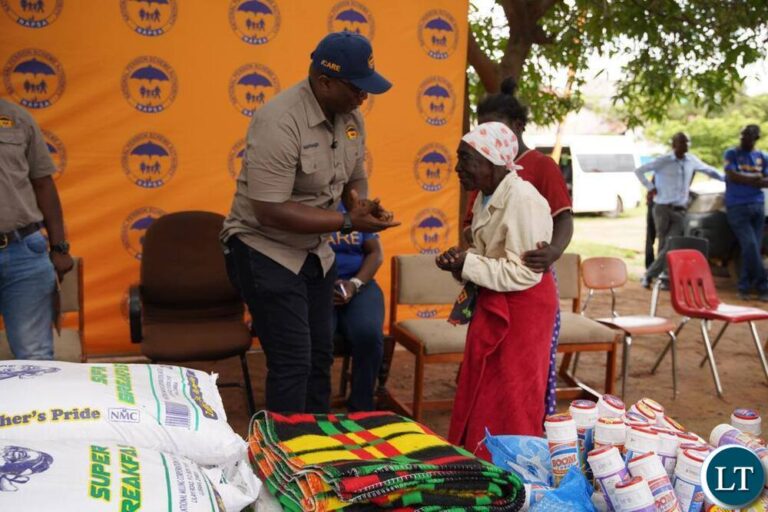
The National Pension Scheme Authority (NAPSA) has donated assorted items worth K140, 000 to Matero After Care Centre in Lusaka.

The donation of 60 mattresses, 60 blankets and assorted groceries, which is worth 140,000 Kwacha, has put smiles on the faces of these elderly people at the centre.

NAPSA Director General, Muyangwa Muyangwa says the organisation remains committed to undertaking initiatives that uplift communities and promote care, dignity, and inclusion.

Speaking at the Matero After Care Centre in Lusaka today, Mr Muyangwa said the donation demonstrates NAPSA’s continued commitment to social responsibility and community engagement.

He said the initiative is part of a broader effort to ensure that the institution remains responsive not only to its members but also to vulnerable groups within society.

“As NAPSA, our mandate goes beyond administering social security. We are deeply rooted in the communities we serve and recognise the importance of giving back in a meaningful and humane way,” he said.

Mr Muyangwa noted that it was the desire and hope of NAPSA that the gesture will supplement the efforts of the government in addressing the welfare of the aged people.

He said the elderly people are custodians of history and values, having contributed immensely to building society hence they deserve care, respect and support.

Mr Muyangwa has since commended the Matero After Care Centre management and staff for their dedication to the wellbeing of the elderly people despite challenging circumstances.

Meanwhile, Matero After Care Centre Security Officer-in-Charge, Christina Shawa, thanked NAPSA for the gesture saying it will go a long way in addressing the needs of the elderly people at the facility.

And one of the beneficiaries, Precious Kabwenge, commended NAPSA for the donation and urged the institution to continue with such gestures.

Political parties verify ballot papers for 3 local government by-elections

0

Two political parties have successfully verified ballot papers for local government by-elections in three wards.

The verification of the ballot papers was conducted today at the Electoral Commission of Zambia (ECZ) for the Muchinka ward of Chitambo district in Central Province, Liangati ward in Senanga constituency and Mutondo ward in Mongu’s Nalikwanda constituency in Western Province.

Sitali Lutangu from the ruling United Party for National Development (UPND) and Samson Kasongo of opposition United Prosperous and Peaceful Zambia (UPPZ) represented their parties in the verification exercise.

The ruling UPND, the UPPZ and the Leadership Movement Party are vying for the three local government seats.

And UPPZ Information and Publicity Secretary, Samson Kasongo, said in an interview that his party is ready for the polls set for Wednesday, December 31st, 2025 in Liangati, Muchinka and Mutondo wards.

“Our presence demonstrates the party’s readiness to defend its developmental agenda and deepen its footprint in all the three wards,” he said.

And UPND representative, Sitali Lutangu, said the party has delivered development without discriminating against anyone across all 156 constituencies.

Mr Lutangu said President Hakainde Hichilema must be supported in his developmental agenda for the country.

Kabwe Roads Upgrade to Begin in February 2026

1

Central Province Minister Mwabashike  Nkulukusa says the upgrading of 40 kilometres  township roads to bituminous standard in Kabwe District is expected to commence in February next year.

Mr Nkulukusa told the media that the township road project, which is part of the Lusaka-Ndola dual carriageway, will change the face of Kabwe once completed.

He said the local leadership in Kabwe has already identified the roads earmarked for upgrade and that the contractor was geared to commence the project.

The project will be undertaken by the Micro Ocean Consortium Limited (MOIC), the contractor working on the Lusaka-Ndola dual carriageway.

“I am happy to announce that the contractor is ready to start working on the project of upgrading 40 kilometres of township roads in Kabwe to bituminous standard but this can only happen in February next year,” Mr Nkulukusa said.

He said Kapiri Mposhi, Chisamba and Chibombo are the other districts that will benefit from the road upgrade project.

Mr Nkulukusa said the provincial administration was happy that Central Province will immensely benefit for the Lusaka-Ndola dual carriageway road project.

“More than 10 local contractors have benefitted through sub-contracting framework, which was literally not there before,” Mr Nkulukusa said.

Meanwhile, the duration for the construction of the Lusaka-Ndola dual carriageway has been reduced from three years to two years.

He said the project is expected to be completed in September next year.

About 600,000 Learners Progress to Grade Ten, Form One

A total of about 600,000 learners across the country have advanced to Grade Ten and Form One after the release of the 2025 Grade Seven national examination results, the Education Ministry has announced.

Education Minister Douglas Syakalima confirmed the results in Lusaka, stating that 722,321 candidates sat for the Grade Seven examinations, with 522,768 qualifying for progression to secondary school level.

Mr Syakalima said the results reflected continued improvement in learner performance under the revised education structure and Government’s policy of automatic progression at primary level.

According to figures released by the Examinations Council of Zambia (ECZ), 363,674 candidates qualified for Grade Eight places, while 159,094 were selected to proceed directly to Form One.

The minister said male learners accounted for 263,757 of the candidates who qualified for progression, while 258,911 were female, indicating a relatively balanced gender distribution.

Mr Syakalima said the 2025 results showed progress in learning outcomes compared with previous years, noting that increased investment in infrastructure, teacher recruitment, and learning materials had contributed to improved performance.

He stated that Government remained committed to expanding access to secondary education to accommodate the growing number of learners transitioning from primary school.

Mr Syakalima said the ministry had already taken steps to ensure that adequate classroom space, teaching staff, and learning resources were available to absorb the increased enrolment at secondary level.

He noted that the continued implementation of free education at primary level had contributed to higher learner retention and completion rates, resulting in increased numbers qualifying for progression.

The minister said that under the new education structure, Grade Seven examinations were primarily diagnostic and aimed at assessing learners’ readiness for secondary education rather than acting as a barrier.

He added that Government would continue to invest in education infrastructure, particularly in rural and peri-urban areas, to address pressure on secondary schools.

Mr Syakalima also urged parents and guardians to support learners as they transition to the next level of education, emphasising the importance of discipline and continued engagement in learning.

ECZ Executive Director Michael Chikondi said examination results could be accessed online through the ECZ portal, adding that schools had also been provided with official result summaries.

Mr Chikondi said the council had strengthened examination administration systems to ensure timely processing and release of results, as well as improved integrity in assessment procedures.

He noted that ECZ would continue to work closely with the Ministry of Education to align assessment practices with curriculum reforms and national education objectives.

Government has prioritised education as a key driver of human capital development, with increased funding allocated to school infrastructure, teacher recruitment, and curriculum reform.

The ministry reiterated that expansion of secondary school capacity remained a priority as enrolment continues to rise following sustained investment in primary education.

Auditor General Flags K300 Million Unrecovered CDF Funds

7

More than K300 million in Constituency Development Fund (CDF) allocations remains unrecovered across several constituencies, the Auditor General has disclosed, raising concerns over accountability and fund management at local authority level.

According to the latest audit findings, the unrecovered funds relate to amounts disbursed to various beneficiaries and projects that had not been accounted for by the end of the review period.

The Auditor General’s report indicates that the outstanding amounts were identified during audits conducted in multiple constituencies, where documentation supporting utilisation and recovery of CDF resources was either incomplete or unavailable.

The report notes that failure to recover the funds undermines the objectives of the CDF programme, which is intended to support community-driven development initiatives and improve service delivery at constituency level.

The Auditor General said weaknesses in monitoring mechanisms and delays in enforcing recovery procedures contributed to the accumulation of outstanding balances.

According to the report, some local authorities did not provide evidence that beneficiaries had repaid funds issued under empowerment components of the CDF, while in other cases repayment schedules were either not enforced or not documented.

The audit further revealed that certain councils had not put in place effective controls to track disbursements and recoveries, increasing the risk of misuse of public resources.

The Auditor General recommended that controlling officers ensure timely recovery of outstanding funds and strengthen internal controls to safeguard public finances.

The report also urged councils to enhance record-keeping practices and ensure that all CDF transactions are supported by appropriate documentation.

The Ministry of Local Government and Rural Development was advised to intensify oversight of CDF implementation and take corrective action against institutions that fail to comply with financial regulations.

Government has previously emphasised that CDF resources must be used strictly for their intended purposes and recovered where applicable to sustain the revolving nature of the fund.

The Auditor General stated that unresolved recoveries compromise the effectiveness of the CDF as a tool for local development and citizen empowerment.

Govt Targets SME Growth With 24 New Empowerment Loans

6

Govt Targets SME Growth With 24 New Empowerment Loans
The Government has unveiled 24 new empowerment loan products set to roll out in 2026, targeting Small and Medium Enterprise Development (SMEs) as part of a broader push to expand citizen participation in the economy and stimulate inclusive growth.

The new loan products will be administered under the Citizens Economic Empowerment Commission (CEEC) and are designed to address long-standing financing gaps faced by entrepreneurs, cooperatives, and small-scale producers across the country.

Minister of Small and Medium Enterprise Development Elias Mubanga announced the initiative, stating that the expanded product range reflects Government’s intention to reposition citizen empowerment as a central pillar of national development rather than a peripheral intervention.

Mr Mubanga said the new products would support value-chain development in key sectors, including agriculture, manufacturing, mining support services, energy, and enterprise development, with a deliberate focus on job creation and wealth retention within local communities.

He explained that the loan products had been structured to respond to challenges previously identified in empowerment financing, such as limited access to capital, rigid lending conditions, and insufficient sector-specific targeting.

According to the minister, Government has also taken steps to improve transparency and efficiency within the empowerment framework by cancelling all previous empowerment loan applications to allow for a fresh and orderly application process under the new structure.

The application window for the new loan products will open on December 29, 2025, and run until February 13, 2026. Mr Mubanga said the defined application period would enable prospective beneficiaries to prepare viable proposals aligned with the revised lending criteria.

He noted that the empowerment programme was guided by the Eighth National Development Plan, which emphasises private-sector-led growth, entrepreneurship, and citizen participation in productive economic activity.

Mr Mubanga said the empowerment loans were intended not only to provide financing but also to strengthen enterprise sustainability through improved access to markets, technology, and business development support.

He added that Government was placing particular emphasis on ensuring that women, youth, and persons with disabilities were meaningfully included in the empowerment programme, in line with national inclusion policies.

The minister further disclosed that CEEC had recorded increased demand for empowerment financing in recent years, prompting the need to diversify loan products and tailor them to different economic activities and enterprise sizes.

CEEC Director General Mwanga Muchebe said the commission had strengthened internal systems to support the rollout of the expanded loan portfolio and ensure effective monitoring and recovery mechanisms.

Mr Muchebe stated that improved loan recovery performance had enabled the commission to scale up financing and broaden its reach, adding that sustainability of the fund remained a priority.

He said the cooperative database managed by CEEC now accounted for a significant share of registered enterprises, reflecting growing interest in collective enterprise models, particularly in rural and peri-urban areas.

According to CEEC data cited during the announcement, agriculture and cross-cutting economic activities continue to account for a substantial proportion of empowerment financing, with manufacturing and financial services also featuring prominently.

Mr Muchebe said the diversification of loan products would allow the commission to respond more effectively to sector-specific financing needs while maintaining financial discipline.

He stressed that empowerment financing was not a grant facility but a revolving fund designed to support enterprise growth, employment creation, and long-term economic participation by citizens.

The Government reiterated that empowerment initiatives under the New Dawn administration were aimed at transforming citizens from consumers into producers, thereby strengthening the domestic economy and reducing dependency on imports.

Mr Mubanga said the success of the empowerment programme would be measured not only by loan disbursements but by the growth, resilience, and sustainability of the enterprises supported.

He called on prospective applicants to engage responsibly with the programme and submit credible, bankable proposals that demonstrate capacity for repayment and business growth.

Kasama man Jailed for Stealing Sausage from Shoprite

0

A 21-year old man of Chisanga Village in Senior Chief Mwamba’s Chiefdom in Kasama District has been sentenced to three months simple imprisonment for stealing sausage from Shoprite Store.

 John Bwalya was charged with one count of theft contrary to Section 272 of the Penal Code, Chapter 87 of the Laws of Zambia.

When the matter came up for plea before Magistrate Chapson Silwimba earlier, Bwalya pleaded guilty to the charge and was convicted upon his own confession of the crime.

Facts before the courts where that on November 27, 2025, Bwalya did steal sausage valued at K80.15 from Shoprite Store in Kasama.

In mitigation, Bwalya pleaded for maximum leniency, saying he was a first offender, who regretted his action, and that he did not know what he was doing at the time.

He asked the court to consider sentencing him to community service.

In passing sentence, Magistrate Silwimba said he had considered the mitigation presented by the convict but noted that community service was not a mandatory sentence.

 He then sentenced Bwalya to three months’ simple imprisonment, effective the day of arrest.

Magistrate Silwimba cautioned the convict to desist from stealing.

Keep Your Aid. Zambia Is Not for Sale.

2

Keep Your Aid. Zambia Is Not for Sale.

America has now said the quiet part out loud: comply with our mining interests, or your people will suffer. This is not aid. It is coercion. Zambia must reject it without apology.

By Daimone Siulapwa

With the bluntness captured on the News Diggers front page, the American envoy to Zambia has confirmed what many Africans have long understood but were discouraged from saying publicly: aid is conditionalobedience.

According to the envoy’s remarks, the United States will not give aid to Zambia while the country “fails to do business” with America as Chinese mines allegedly poison citizens.

This is not a misunderstanding. It is not a slip of the tongue. It is a declaration of policy. The message is simple and brutal. Align your mining sector with American interests, or your people will pay the price. That price includes the withdrawal of aid that sustains health systems, supports clinics, and underpins life-saving programmes.That is not partnership or diplomacy, it is blackmail.

The headline “Those Days Are Over” is revealing. What days, exactly, are over? The days when aid was dressed up as humanitarian concern while serving strategic interests quietly? If so, then at least there is honesty now.The quiet part has been said out loud, America has finally dropped the pretence.

Zambia is being informed that its health, welfare, and international standing are now bargaining chips in a widening geopolitical war between the United States and China. Our country is not being engaged as a sovereign state with its own priorities, laws, and future. It is being treated as contested ground, a pawn in a struggle for control of copper, cobalt, lithium and strategic influence.

Yes, environmental pollution is real. Yes, any mining company, Chinese or otherwise, that poisons water sources and destroys livelihoods must be held fully accountable. Sino Metals and others must face the full force of Zambian law if investigations confirm wrongdoing. Environmental justice is not negotiable.

But environmental concern can not be selectively weaponised.
If pollution were truly the central issue, the response would be consistent, legal, and grounded in Zambia’s regulatory institutions. Instead, pollution is being invoked as moral cover for economic pressure. It is being used to justify withholding aid until Zambia tilts its mining sector in a preferred geopolitical direction.

That is not environmental justice.
That is strategic manipulation.
What makes this moment even more dangerous is the precedent it sets. Aid is no longer presented as support for human life, but as a reward for alignment.

It is now clear that health funding is no longer a humanitarian commitment, but leverage in commercial and geopolitical negotiations. Zambian citizens are being reduced to pressure points and this is an extraordinary ethical failure.

Mining concessions are not short-term arrangements. They bind generations. They shape industrialisation, revenue, land use, and national capacity for decades. To attach such concessions to health funding is to mortgage the future under duress. It is to tell a nation that its children’s tomorrow must be surrendered to secure medicine today.

Zambia has already paid too high a price for externally imposed dependency. Debt restructuring, IMF conditionalities, and austerity have shifted unbearable burdens onto future generations. Now, on top of that, we are being told to trade the very minerals that could liberate those generations in exchange for conditional mercy.

My position to President Hakainde Hichilema and the UPND government is direct and unapologetic: reject this coercion. Do not allow Zambia’s health sector to be weaponised. Do not allow mining policy to be dictated through threats. Do not allow foreign powers, whether American or Chinese, to define Zambia’s sovereignty.

If the United States believes that withholding aid is an acceptable tool of persuasion, then Zambia must respond with clarity and dignity.
They can keep their aid.
Zambia is not a client state. We are not a colony in waiting. We are not owned by Washington, Beijing, or anyone else.

Yes, rejecting this pressure will be difficult. The strain will be real. But hardship endured with integrity is not defeat. What is defeat is surrendering sovereignty while applauding ourselves for avoiding short-term discomfort. A nation that trades its minerals for medicine today will never be free tomorrow.

This moment is bigger than Zambia. It is a test for Africa. If Zambia submits, the lesson to the continent will be unmistakable: defy great power interests and your people will be punished. That is not global leadership. It is imperial discipline.
If “those days are over,” then let it be the end of dependency politics altogether.

Let it be the day Zambia declares that its environment will be protected by its own laws, its resources governed by its own people, and its future decided without blackmail. Our children deserve more than a country that chose comfort over courage, and the future is not for sale, not for aid, not for minerals, and not for anyone.

Daimone Siulapwa is a seasoned Political Analyst and Consultant, as well as a dedicated governance and social activist. He is also a strong advocate for citizens’ empowerment and tribal unity. Comments, [email protected]

Mpulungu residents trained in plastic pollution awareness

0

The Vitalising Opportunities in Circular Economy for Sustainable Solutions in Lake Tanganyika (VOICES) Project in Mpulungu has trained 50 people in three communities on creating awareness on ending plastic pollution.

VOICES Project Officer Malisela Tembo says the project has continued to engage people in communities to train and introduce them to the concept of circular economy.

Speaking to the media in an interview in Mpulungu, Ms Tembo explained that the training emphasises the principles of reusing, and recycling waste in the district.

She revealed that the training also focused on equipping participants with practical skills to help them adapt to local settings and work on things with minimal supervision.

“So far we are happy that communities have mastered the concept, and as a project we look forward to a situation where they will be able to practice these skills and be innovative in their unique way,” she explained.

Ms Tembo added that the project wants to see communities come up with their own circular economy innovations that are marketable.

She said this will help people to utilise the waste that was around them by making products that can be sold to make a living.

She adds that this will also reduce overdependence on fishing in Lake Tanganyika while fighting pollution.

And community members in Mpulungu have expressed gratitude to the project for coming up with the initiatives that are aimed at improving people’s lives.

Mable Mazimba said the knowledge imparted to the people was important and would help not only to uplift people’s lives now but also in future.

Ms Mazimba added that the VOICES Project has helped communities with knowledge of how to reuse and recycle waste, stating that it will help to reduce waste and turn it into wealth that will help future generations.

She added that the project has taught members of savings groups how to get worn out plastic shoes and use materials to remake them so they look new and can be sold or just worn at home.

And Emmanuel Simfukwe said the knowledge gained in the training will help people in villages to make use of the waste to create new things that can be used.

Mr Simfukwe said the trained teams will take the information and spread it to other members of the community so that those with interest can join in turning waste into wealth.

Zambia Police Officer Honored for Refusing US$50,000 Bribe

4

A Zambia Police Service officer has been recognized by the Anti-Corruption Commission (ACC) for rejecting a US$50,000 bribe offered by a suspect intercepted at Kenneth Kaunda International Airport.

Detective Sergeant Ruth Nyambe was honored yesterday during the 2025 Integrity Committee Chief Executive Officers’ Forum. The suspect, who was found carrying US$2 million and suspected pieces of gold while traveling from Lusaka to an undisclosed destination, initially offered Nyambe US$5,000 and later increased the bribe to US$50,000 in exchange for release.

Nyambe refused the bribe, reported the incident to the Drug Enforcement Commission (DEC), and ensured the case proceeded to court.

ACC Director General Daphne Chabu commended Nyambe for her integrity and commitment to duty.

Also honored was Hendrix Mwinga, a technical plant health inspector with the Ministry of Agriculture’s Plant Quarantine and Phytosanitary Department (PQPS). Mwinga rejected a K160,000 bribe from a milling company attempting to move three truckloads of imported wheat grain from South Africa across the Kazungula border. The wheat was found to contain excessive extraneous material and was deemed non-compliant.

Mwinga reported the bribe attempt to PQPS management, who upheld the decision to send the commodity back to its country of origin.

Makebi Zulu Defends Political Ambitions Amid Lingering Burial Dispute

0

Patriotic Front (PF) presidential aspirant Makebi Zulu has responded to criticism over his active political engagement while the body of his former boss, President Edgar Lungu, remains in a South African morgue nearly six months after his death.

As the Lungu family spokesperson, Zulu has faced public backlash, ridicule, and demands for burial updates instead of campaign messages since announcing his political ambitions.

Speaking through an interview Zulu argued it is unfair to label him insensitive or opportunistic, stating that the prolonged burial delay weighs on him daily. He emphasized that mourning does not mean abandoning national responsibilities.

“President Edgar Lungu, even in his death, would want to see a better Zambia. He would want to see to it that rights of the people in Zambia are respected,” Zulu said.

He explained he has become a scapegoat in the burial impasse, accused personally of delays when he was only acting as family spokesperson. Zulu rejected claims that he is leveraging the tragedy for political gain, saying no one would choose extended mourning for such purposes.

The delay, he noted, stems from unresolved disagreements and mistrust between the family and the state, not his personal interests. Zulu said he has chosen to absorb public criticism to shield the grieving family from further pain.

“I am glad that I have been given the honour to be the shock absorber for and on behalf of the [family]. I’m happy to do that. All the attacks that have been levelled against the family, by the government, is propaganda machinery,” he stated.

Zulu added that Lungu would not have wanted his death to divide the nation or stifle discourse on issues affecting Zambians.

Nevertheless, until President Lungu is laid to rest, the unresolved burial continues to overshadow Zulu’s political aspirations.

Supreme Court of South Africa Grants Lungu Family Leave to Appeal Burial Order

0

The legal dispute concerning the burial of former Zambian President Edgar Lungu has returned to court, with the Supreme Court of Appeal of South Africa granting the Lungu family permission to appeal a previous court order.

The order had directed that the late president’s body be repatriated to Zambia for a state funeral and burial. The latest court documents indicate that if the family fails to proceed with the appeal, they will be liable for associated costs.

The family is contesting a judgment by the South African High Court, which ruled in favor of surrendering Mr. Lungu’s remains to the Zambian government. The Lungu family argues that the High Court did not adequately consider their rights in its decision.

The case was initiated by Zambia’s Attorney General, Mulilo Kabesha, and has led to prolonged delays in burying Mr. Lungu, who passed away on June 5, 2025, while receiving medical treatment in South Africa. The impasse over funeral arrangements previously led the family to consider burying him in South Africa.