Tuesday, June 16, 2026
17.7 C
Lusaka
Home Blog Page 224

Government and Partners Sign Agreement to Formalise Kikonge Gold Mining

0

LUSAKA – A tripartite Memorandum of Understanding (MoU) has been signed to oversee and formalise mining activities in the Kikonge area of North-Western Province. The agreement was executed by the Ministry of Mines and Minerals Development, ZCCM Investment Holdings PLC, and the mining firm Mining Mineral Resources-SAS.

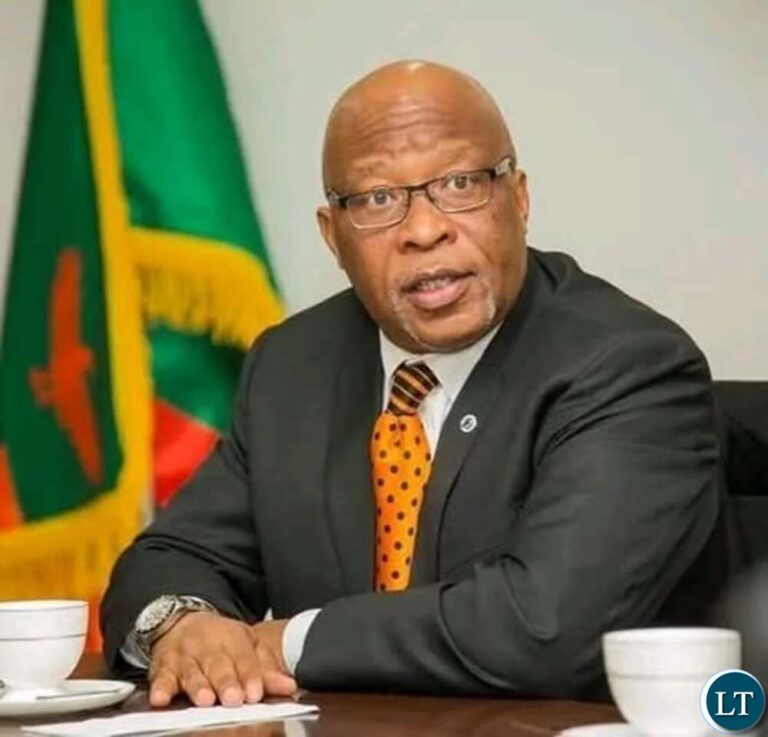
Mines and Minerals Development Minister Paul Kabuswe stated that the MoU is designed to ensure Zambia derives greater value from its natural resources. He emphasized that increased revenue from the sector would strengthen the nation’s capacity to service and settle its national debt.

Minister Kabuswe also issued directives to strengthen oversight. He urged the Bank of Zambia to provide clear records on the volume of gold currently being produced in the country. Furthermore, he called on all partners to support artisanal miners in transitioning into sustainable small-scale operators. The Minister assured trained small-scale miners holding artisanal licences that they will soon be allocated formal mining tenements.

Outlining the strategic vision for the site, ZCCM Investment Holdings PLC Board Chairperson Phesto Musonda announced plans to establish a modern gold mine in Kikonge. He stressed the necessity of a robust governance framework to deliver an effective national gold strategy. Mr. Musonda added that until Zambia establishes its own gold refinery, all gold produced through formal channels must be meticulously accounted for and reflected on the national balance sheet.

Elisee Tshibangu, Deputy General Manager of Mining Mineral Resources, said the MoU demonstrates a firm commitment to unlocking Zambia’s gold potential. He noted that the agreement marks the beginning of a structured journey from exploration to production. Mr. Tshibangu affirmed that the process would include support for artisanal and small-scale miners and pledged that his company would operate with transparency in full compliance with Zambian laws and international standards.

NNP President Warns of Election Crisis Should Constitution Bill Stall

5

LUSAKA – New Nation Party (NNP) President Dr. Nevers Mumba has issued a stark warning that Zambia could face a constitutional crisis during the next general election if the current Constitution Amendment Bill, known as Bill 7, is not passed.

Speaking at the official opening of the New Nation Party Secretariat in Lusaka, Dr. Mumba stated his party’s full support for the proposed amendments. He emphasized that the legislative process should proceed without delay, arguing that even an amendment addressing a single provision is critical.

Dr. Mumba pointed to historical precedent, recalling that his party, under its former name the Movement for Multi-Party Democracy (MMD), had long argued that the failure to amend Clause 52 of the constitution posed a risk. He stated that the clause could potentially cause an election to collapse if a presidential candidate withdrew from the race after the ballots were printed.

The NNP leader also expressed disappointment at what he termed persistent hate speech from the opposition directed at President Hakainde Hichilema. He called on all political actors to place national interest above partisan hostility.

Turning to other aspects of the bill, Dr. Mumba highlighted measures aimed at increasing inclusivity. He affirmed the NNP’s support for persons with disabilities, women, and young people, backing proposed changes to boost their representation in Parliament. He also noted that the bill’s provision for a new constituency delimitation process could accelerate national development if implemented.

In his closing remarks, Dr. Mumba called on citizens and political leaders to overcome hatred and mistrust, which he said remain sources of national division.

Tayali lauds Zambia-China ties

0

Government says it looks up to China for continued support in Zambia’s development process.

Transport and Logistics Minister, Frank Tayali, says China has significantly developed in key sectors of the economy.

Mr Tayali notes that China has assisted Zambia from a land locked to a land linked status.

He said Zambia and China should continue to deepen their bilateral relations that have existed for over five decades.

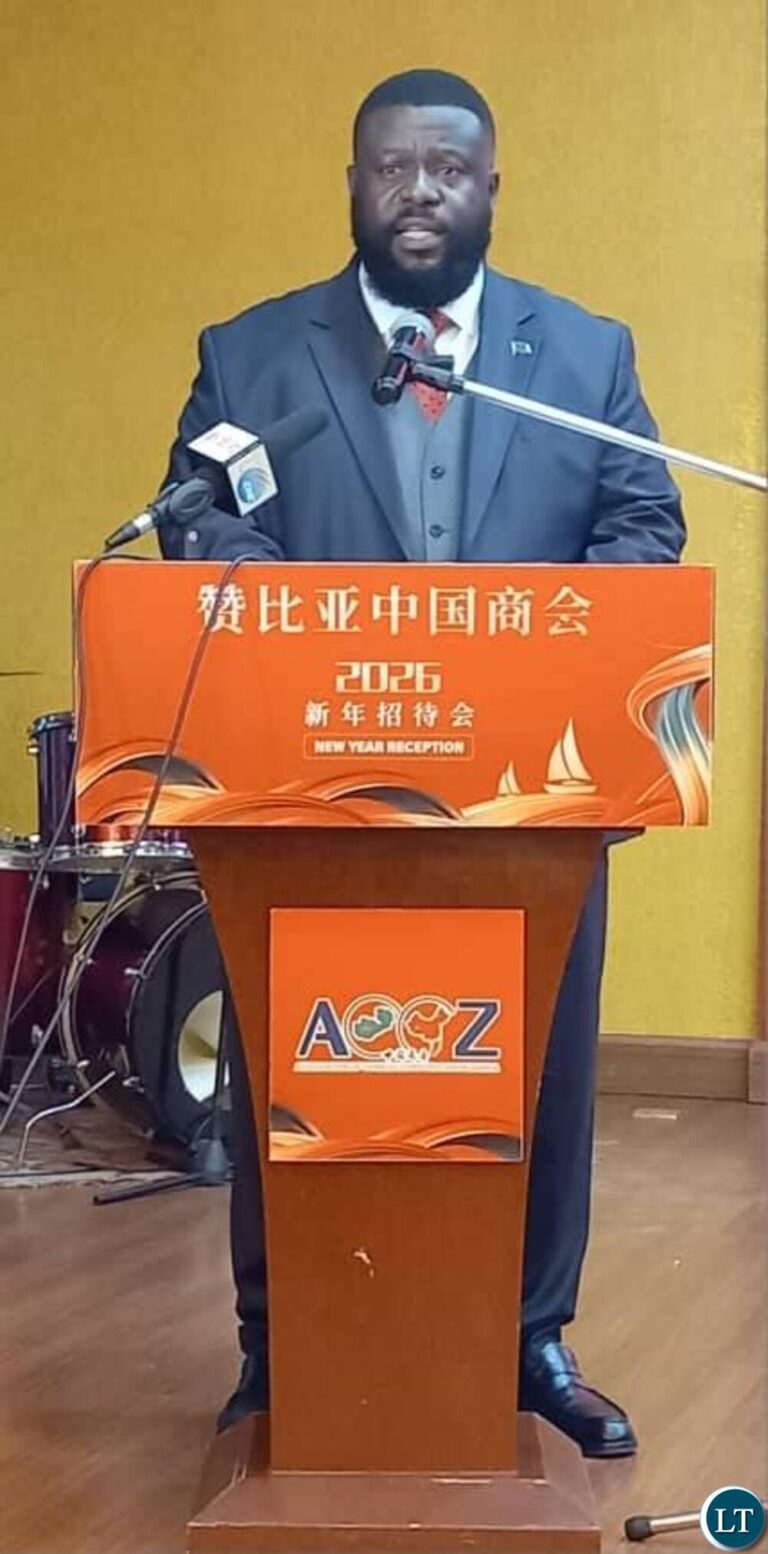
The Minister said this last evening in Lusaka during the 2026 New Year reception.

Mr Tayali also unveiled the white paper on Corporate Social Responsibility on Chinese enterprises in Zambia.

“Zambia is willing to work with China to carry forward the traditional friendship, intensify high-level exchanges, expand cooperation in fields such as trade, investment, minerals, agriculture, infrastructure and people-to-people and cultural exchanges, follow up on the revitalisation of the Tanzania-Zambia Railway thus enhance the economic development efficiency along the railway, and promote the building of a Zambia-China community with a shared future,” he said.

He said the revitalisation of the Tanzania-Zambia Railway (TAZARA) is a shared aspiration of the peoples of China, Tanzania and Zambia noting that it is a landmark project that is of high-quality.

And speaking earlier, Chinese Ambassador to Zambia, Han Jing, pledged his country’s commitment and desire to advance, modernise, and build an even closer China-Zambia community with a shared future so as to deliver more benefits to the peoples of the two countries.

“China is willing to strengthen cooperation with Zambia in areas related to people’s livelihood, such as agriculture, energy, mining, infrastructure and construction, health among others as well as human resource development and skills transfer, so as to enhance the two peoples’ sense of gain from bilateral cooperation,” he said.

He noted that the two countries should take the 2026 China-Africa Year of People-to-People Exchanges as an opportunity to strengthen friendly interactions at all levels, deepen exchanges and cooperation in culture, education, tourism and other fields, thereby solidifying the social foundation for bilateral cooperation.

Government commits to support women-led businesses

1

Government has reaffirmed its dedication to women’s empowerment and inclusive development.

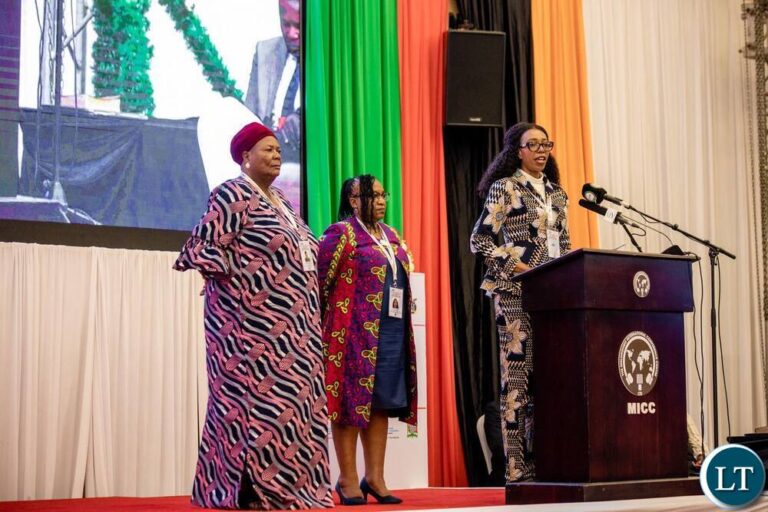
Gender Division Permanent Secretary, Mainga Kabika, says the government is committed to promoting women-led entrepreneurships because the can contribute significantly to economic growth, community well-being, and poverty alleviation.

Ms Kabika was speaking during the “Shealth Business Lunch” event organised by FEMMI Health Limited.

The Permanent Secretary has since encouraged women entrepreneurs to pursue their dreams with confidence, leveraging available financing, training, and networking opportunities.

She emphasized that their innovation, resilience, and leadership are crucial for Zambia’s inclusive growth and development.

Ms Kabika noted that women face socio-cultural barriers, limited access to finance, and markets, but assured that the government is working to dismantle these obstacles.

She said initiatives such as the Women’s Empowerment Fund, Citizens Economic Empowerment Commission, and Constituency Development Fund are aimed at supporting women-led businesses.

FEMMI Health Limited Director, Ireen Zulu, said the event is significant as it is a platform for connection, collaboration, and growth.

Ms Zulu noted that women, who form the backbone of Zambia’s healthcare delivery, face unique barriers blocking them from owning and scaling health enterprises, including limited funding, mentorship, and structural biases.

She stated that the communities will thrive when women are empowered to build businesses.

Ms Zulu said that mentorship is crucial for guidance, support, and fostering resilience among women entrepreneurs.

She also made a special appeal to the government for support in providing financial and technical assistance to women-led health businesses and facilitating value chain enhancements and market access among others.

NAPSA donates in Petauke, Kaoma

1

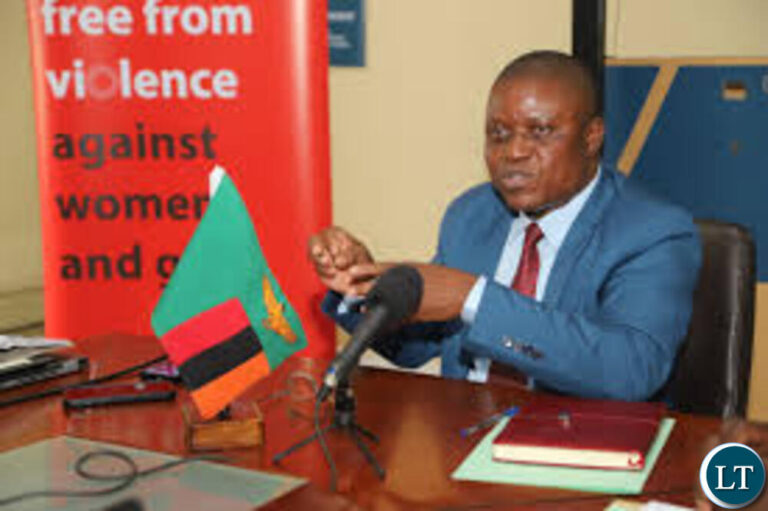
The National Pensions Scheme Authority (NAPSA) in Petauke, has donated assorted items worth K36, 000, to the Gender Based Violence (GBV) One Stop Center at Petauke District Hospital and Minga Mission Hospital mother’s shelter.

The media  reports that the gesture is part of its Corporate Social Responsibility (CSR) to enhance the recovery of GBV survivors and also enhance the well-being of women at the mothers’ shelter.

Speaking when he handed over assorted items to the GBV One Stop Center at Petauke District Hospital, NAPSA Petauke Station Manager, Lewis Chibebe, said the authority recognises the value of a united force towards the fight against social ills such as GBV.

“We acknowledge that the fight against social ills must continue and for us to achieve meaningful success, we must join hands into a united force. We recognise that we have an important responsibility as NAPSA to contribute not only to raising awareness about the various health and social challenges in our community but also to take practical steps to address some of these challenges,” he said.

And receiving the donated items, Petauke District Administrative Officer (DAO), Vincent Chibuye, said the donation came at the right time as the center was not fully furnished, a situation that is affecting its operations.

“You may wish to know that the centre is not fully functional now because there are a number of items that are missing and so this donation will go a long way in ensuring that all the sectors of the one stop centre are fully operational,” he said.

Meanwhile, at Minga Mission Hospital, expecting mothers received various items including mealie meal, washing and bathing soap and cooking oil, to meet some of their basic needs.

Minga Mission Hospital mothers’ shelter Chairperson, Kaluba Zulu, appreciated the gesture saying it will contribute to the wellbeing of the expectant mothers.

“We are grateful for this gesture, because we are coming from different households and you will find that some do not even have a single tin of mealie meal,” she said.

And NAPSA has donated assorted items worth K36, 0000 to Kaoma District Hospital’ antiretroviral therapy (ART) department to commemorate this year’s World AIDS day.

The items include two wheelchairs, BP machines, glucometers, gluco-sticks, thermometers and realms among others.

NAPSA Mongu Station Manager, Oster Chali, disclosed that the donation has been done in all the ten provinces country wide as part of the institution’s corporate social responsibility.

“We have decided to commemorate World AIDS day, though it is late but better late than never. So we chose Kaoma district hospital so that we can just give this token of items,” Mr Chali said.

Kaoma District Commissioner, Kashina Sheba, thanked NAPSA for the contribution and commended them for supplementing government efforts in the delivery of quality health services to the people.

Ms Sheba stated that Kaoma district, being a farming area, has a high population which needs health services.

Kaoma district hospital also caters for patients from other districts such as Nkeyema and Luampa hence the donated items will greatly contribute to quality health service delivery in the district.

Meanwhile Kaoma District Hospital ART department in charge, Muyunda Sishwashwa, thanked NAPSA saying the items will cushion some of the challenges which the department is facing and improve ART services to the 3,500 clients on ART treatment.

Assistant Secretary calls for full expenditure of secondary school bursary funds

0

Eastern Province Assistant Secretary (AS), Clement Chilembo, has called on responsible authorities charged with disbursing funds for secondary school bursaries to fully exhaust the money.

Mr Chilembo wondered why many vulnerable children who were eligible to be in boarding schools were still attending day school.

He said funds for secondary school bursaries are meant for vulnerable children and as such, those who scored high marks needed to be taken to boarding schools using the same money.

Mr Chilembo said this during an orientation meeting on civil service terms and conditions with government Heads of Department in Mambwe District in the Eastern Province.

He added that it was unfair that funds were not being exhausted despite the district having many vulnerable pupils who qualified to be in boarding schools.

He noted that boarding secondary schools offer a more conducive environment to learners.

Mr Chilembo further called on the office of District Education Board Secretary to help communities with the procedures of applying for secondary school bursaries.

“As you go for selection next year DEBs, those children who pass with marks suitable to go to boarding school and they are in day school, let us take stock of them, guide them on how to apply for bursary through the Ward Development Committee and submit to the council,” he said.

Labour ministry consults stakeholders on work-based learning bill 2025

0

The Ministry of Labour and Social Security has embarked on consulting stakeholders over the Work-Based Learning bill of 2025.

The consultation is aimed at repealing and replacing the Apprenticeship Act of 1964.

Assistant Labour Commissioner for Legal, Kabaso Chola, said the 1964 Apprenticeship Act is no longer responsive to the needs of the labour markets and the training that is required to remove skills mismatch.

Mr Chola explained that the new bill will transform the manner in which

internships and those on attachment are governed.

“This bill will transform the status of workers and how they are being governed in various institutions,” he said.

He stated that the Work-Based Learning Bill is also going to guard against abuse of apprenticeships and interns.

Mr Chola further indicated that during the process, the Ministry of Labour and Social Security will utilise this opportunity to also get the views of stakeholders on International Labour Organisation convention 102, which deals with social security.

He indicated that it is important for Zambia to ratify the international convention as a member state of the ILO so that the nation meets the mandate of the International Labour Organisation which will make it easy to domesticate the provisions that will suit the country’s environment.

“Once the country ratifies the convention, it will make it easy to domesticate it to our standards,” he indicated.

The Assistant Labour Commissioner further noted that it is important for the Ministry OF Labour to get views and positions from stakeholders in provinces on every Act contained in the bill.

Mr Chola has since urged all stakeholders across the country to state their position with regard to Zambia ratifying the convention 102, which will help to transform the social security of workers.

Meanwhile, Zambia Congress of Trade Union (ZCTU) Northern Region Coordinator, Chitupi Musonda, commended the government for engaging stakeholders to deliberate on the new bill, which will help guard against abuse of workers in various workplaces.

Mr Musonda noted that the bill is very important, as it will also recognise skills acquired from different trade schools and give them equal shares.

 “This will give equal shares to workers in places of work,” he said.

He explained that for a long time, skills from trade schools have been neglected despite their massive contribution to driving the developmental agenda of the nation.

Mr Musonda has since urged the government to continue engaging stakeholders in various issues of national development and when developing policies.

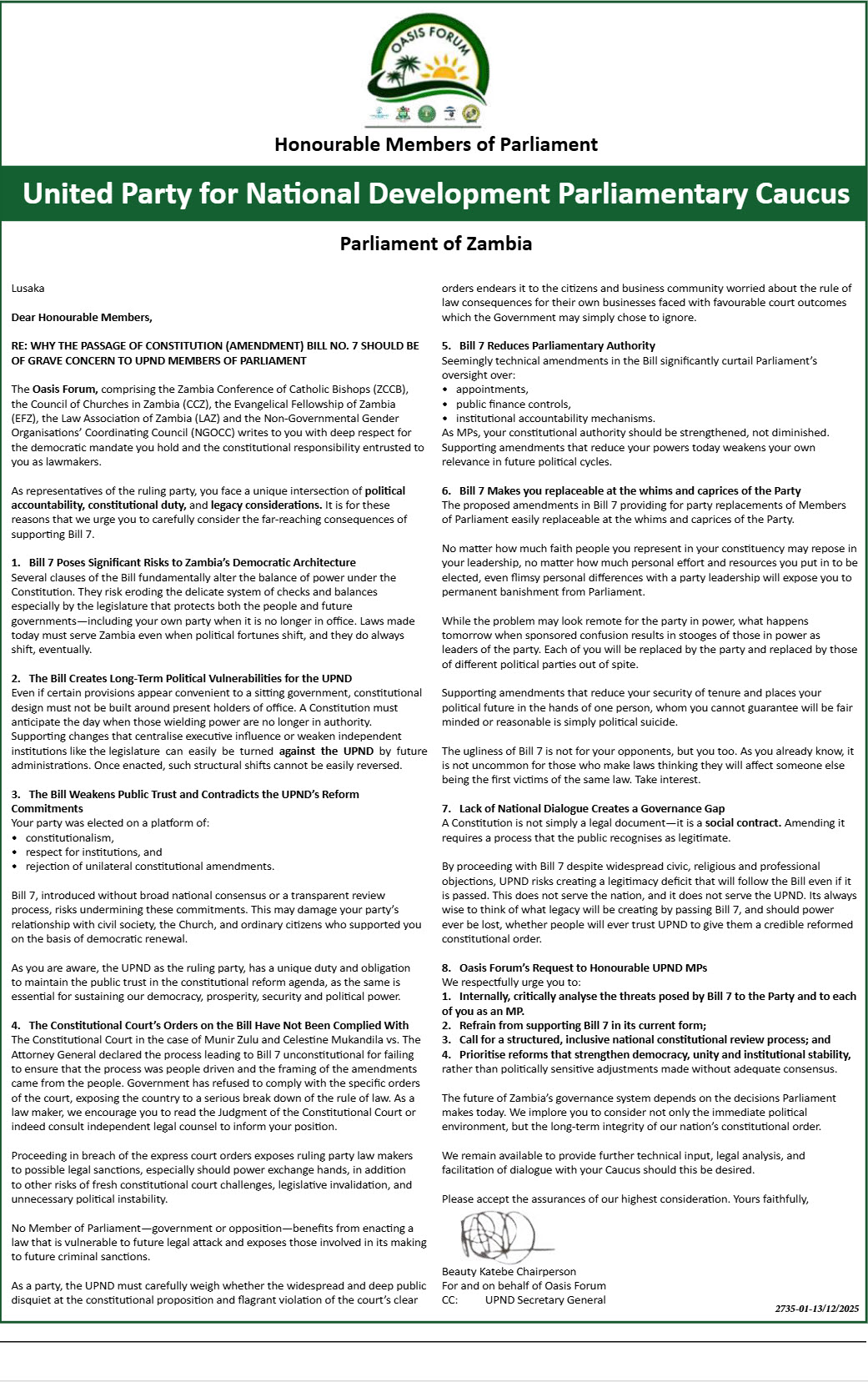
The Oasis Forum Letter and the Moment Parliament Cannot Escape

0
The Oasis Forum Letter and the Moment Parliament Cannot Escape

By Faustina Imanga

The letter addressed to the United Party for National Development Parliamentary Caucus by the Oasis Forum is not an ordinary piece of correspondence. It is a constitutional warning, carefully worded, institutionally grounded, and deliberately directed at the very centre of legislative power. It does not shout. It does not threaten. It appeals to conscience, history, and consequence. That restraint is precisely what makes it unsettling.

At its core, the Oasis Forum letter reminds Members of Parliament of a truth that is easy to forget in moments of political comfort. Parliamentary authority is not derived from party favour. It is derived from the Constitution and from the people. When the two are placed in tension, Parliament is expected to choose the latter. This is a crucial responsibility of the Parliament that cannot be overlooked.

The Forum’s first and most serious concern is structural. Constitution Amendment Bill No. 7 is presented not as a neutral technical adjustment but as a proposal that fundamentally alters Zambia’s democratic architecture. Constitutions are designed to outlive governments. Any amendment that centralises power, weakens oversight, or narrows accountability mechanisms does not merely affect the present administration. It reshapes the state itself. That reality makes short term political calculations dangerously insufficient.

The letter draws attention to a recurring historical pattern. Ruling parties often legislate under the assumption that they will remain in power long enough to manage the consequences of their decisions. History repeatedly disproves this assumption. Power changes hands. Laws remain. Instruments designed for convenience today become tools of repression tomorrow. The Oasis Forum urges UPND MPs to imagine Bill 7 not in the hands of their own leadership, but in the hands of a future government less committed to restraint. That thought experiment is not theoretical. Zambia has lived it before.

A second concern raised is legitimacy. The Forum highlights the absence of broad national consensus in the Bill 7 process. Constitutional amendments are not ordinary legislation. They alter the social contract. For that reason, they demand inclusive dialogue, transparency, and public trust. When a constitution is amended over sustained objections from civil society, the Church, legal bodies, and professionals, the resulting law may be valid on paper but hollow in legitimacy.

Legitimacy deficits do not disappear after enactment. They follow laws into the courts, into public discourse, and into future elections. A constitution that large sections of society do not recognise as theirs becomes a source of instability rather than order. The Forum’s warning here is measured but firm. Passing Bill 7 in the current climate risks creating a governance gap that no amount of political messaging can close.

The letter also raises a critical legal issue. It reminds MPs that the Constitutional Court, in the case of Munir Zulu and Celestine Mukandila versus the Attorney General, found the process leading to Bill 7 unconstitutional. The concern is not academic. Court orders are binding. Legislative action taken in defiance of such orders exposes Parliament and the executive to future legal challenges, possible invalidation of the law, and reputational damage to Zambia’s rule of law credentials.

For lawmakers, this is not an opposition argument. It is a personal one. The Forum makes the point that no MP, whether in government or opposition, benefits from participating in a process that is legally vulnerable. Laws born in procedural defect carry risk not only for the state, but for those who enacted them. The warning is clear without being alarmist.

Perhaps the most politically sensitive section of the letter is its discussion of parliamentary security. Bill 7, the Forum argues, increases the replaceability of Members of Parliament at the discretion of party leadership. In plain terms, it concentrates power upwards while weakening individual mandates. Constituency loyalty, performance, and public trust become secondary to internal party dynamics. In such a system, MPs cease to be representatives of the people and become delegates of party authority.

This argument cuts to the heart of parliamentary identity. MPs are elected by citizens, not appointed by parties. Any amendment that subtly shifts that balance undermines the very essence of representative democracy. The Forum’s message is blunt. Supporting provisions that reduce your own independence is not loyalty. It is political self harm.

The closing appeal of the letter is its most constructive. The Oasis Forum does not merely oppose Bill 7. It offers a path forward. It calls for restraint, for withdrawal of support for the Bill in its current form, and for a structured, inclusive national constitutional review process. This is not obstruction. It is an invitation to govern wisely.

The letter recognises the unique position of the UPND. As a party elected on promises of constitutionalism, institutional respect, and democratic renewal, it carries a heavier burden of consistency. The standards it applies to itself will shape public trust long after individual leaders leave office.

Parliament now stands at a defining moment. It can act as an extension of party machinery, or it can assert its constitutional role as a guardian of the republic. The Oasis Forum letter does not command. It implores. It asks MPs to think beyond the vote count, beyond caucus pressure, and beyond the next election cycle.

History will not record how loudly Parliament defended itself. It will record whether it listened when it mattered.

Below is the letter By Oasis Forum
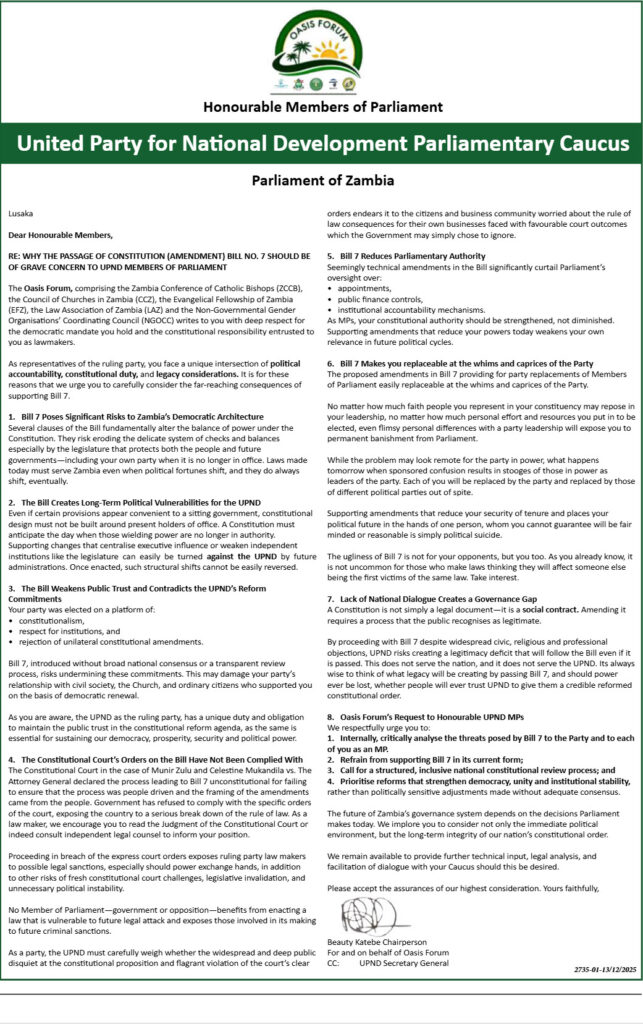
here is the full wording from the Oasis forum:

OASIS FORUM

Honourable Members of Parliament

United Party for National Development Parliamentary Caucus

Parliament of Zambia

Lusaka

Dear Honourable Members,

RE: WHY THE PASSAGE OF CONSTITUTION (AMENDMENT) BILL NO. 7 SHOULD BE OF GRAVE CONCERN TO UPND MEMBERS OF PARLIAMENT

The Oasis Forum, comprising the Zambia Conference of Catholic Bishops (ZCCB), the Council of Churches in Zambia (CCZ), the Evangelical Fellowship of Zambia (EFZ), the Law Association of Zambia (LAZ) and the Non-Governmental Gender Organisations’ Coordinating Council (NGOCC) writes to you with deep respect for the democratic mandate you hold and the constitutional responsibility entrusted to you as lawmakers.

As representatives of the ruling party, you face a unique intersection of political accountability, constitutional duty, and legacy considerations. It is for these reasons that we urge you to carefully consider the far-reaching consequences of supporting Bill 7.


1. Bill 7 Poses Significant Risks to Zambia’s Democratic Architecture

Several clauses of the Bill fundamentally alter the balance of power under the Constitution. They risk eroding the delicate system of checks and balances especially by the legislature that protects both the people and future governments – including your own party when it is no longer in office. Laws made today must serve Zambia even when political fortunes shift, and they do always shift, eventually.


2. The Bill Creates Long-Term Political Vulnerabilities for the UPND

Even if certain provisions appear convenient to a sitting government, constitutional design must not be built around present holders of office. A Constitution must anticipate the day when those wielding power are no longer in authority. Supporting changes that centralise executive influence or weaken independent institutions like the legislature can easily be turned against the UPND by future administrations. Once enacted, such structural shifts cannot easily be reversed.


3. The Bill Weakens Public Trust and Contradicts the UPND’s Reform Commitments

Your party was elected on a platform of:

  • constitutionalism,

  • respect for institutions, and

  • rejection of unilateral constitutional amendments.

Bill 7, introduced without broad national consensus or a transparent review process, risks undermining these commitments. This may damage your party’s relationship with civil society, the Church, and ordinary citizens who supported you on the basis of democratic renewal.

As you are aware, the UPND as the ruling party, has a unique duty and obligation to maintain the public trust in the constitutional reform agenda, as the same is essential for sustaining our democracy, prosperity, security and political power.


4. The Constitutional Court’s Orders on the Bill Have Not Been Complied With

The Constitutional Court in the case of Munir Zulu and Celestine Mukandila vs. The Attorney General declared the process leading to Bill 7 unconstitutional for failing to ensure that the process was people driven and the framing of the amendments came from the people. Government has refused to comply with the specific orders of the court, exposing the country to a serious breakdown of the rule of law. As a law maker, we encourage you to read the Judgment of the Constitutional Court or indeed consult independent legal counsel to inform your position.

Proceeding in breach of express court orders exposes ruling party law makers to possible legal sanctions, especially should power exchange hands, in addition to other risks of fresh constitutional court challenges, legislative invalidation, and unnecessary political instability.

No Member of Parliament – government or opposition – benefits from enacting a law that is vulnerable to future legal attack and exposes those involved in its making to future criminal sanctions.

As a party, the UPND must carefully weigh whether the widespread and deep public disquiet at the constitutional proposition and flagrant violation of the court’s clear orders endears it to the citizens and business community worried about the rule of law consequences for their own businesses faced with unfavourable court outcomes which the Government may simply choose to ignore.


5. Bill 7 Reduces Parliamentary Authority

Seemingly technical amendments in the Bill significantly curtail Parliament’s oversight over:

  • appointments,

  • public finance controls,

  • institutional accountability mechanisms.

As MPs, your constitutional authority should be strengthened, not diminished. Supporting amendments that reduce your powers today weakens your own relevance in future political cycles.


6. Bill 7 Makes you replaceable at the whims and caprices of the Party

The proposed amendments in Bill 7 providing for party replacements of Members of Parliament easily replaceable at the whims and caprices of the Party.

No matter how much faith people you represent in your constituency may repose in your leadership, no matter how much personal effort and resources you put into elected office, even flimsy personal differences with party leadership will expose you to permanent banishment from Parliament.

While the problem may look remote for the party in power, what happens tomorrow when sponsored confusion results in stooges of those in power as leaders of the party. Each of you will be replaced by the party and replaced by those of different political parties out of spite.

Supporting amendments that reduce your security of tenure and places your political future in the hands of one person, whom you cannot guarantee will be fair minded or reasonable is simply political suicide.

The ugliness of Bill 7 is not for your opponents, but you too. As you already know, it is not uncommon for those who make laws thinking they will affect someone else being the first victims of the same law. Take interest.


7. Lack of National Dialogue Creates a Governance Gap

A Constitution is not simply a legal document – it is a social contract. Amending it requires a process that the public recognises as legitimate.

By proceeding with Bill 7 despite widespread civic, religious and professional objections, UPND risks creating a legitimacy deficit that will follow the Bill even if it is passed. This does not serve the nation, and it does not serve the UPND. It is always wise to think of what legacy will be creating by passing Bill 7, and should power ever be lost, whether people will ever trust UPND to give them a credible reformed constitutional order.


8. Oasis Forum’s Request to Honourable UPND MPs

We respectfully urge you to:

  1. Internally, critically analyse the threats posed by Bill 7 to the Party and to each of you as an MP.

  2. Refrain from supporting Bill 7 in its current form;

  3. Call for a structured, inclusive national constitutional review process; and

  4. Prioritise reforms that strengthen democracy, unity and institutional stability, rather than politically sensitive adjustments made without adequate consensus.

The future of Zambia’s governance system depends on the decisions Parliament makes today. We implore you to consider not only the immediate political environment, but the long-term integrity of our nation’s constitutional order.

We remain available to provide further technical input, legal analysis, and facilitation of dialogue with your Caucus should this be desired.

Please accept the assurances of our highest consideration. Yours faithfully,

Beauty Katebe Chairperson
For and on behalf of Oasis Forum

CC: UPND Secretary General

2735-01-13/12/2025

God Bless You, Emmanuel Mwamba: A Witness from Exile and a Reckoning for Zambia

6

God Bless You, Emmanuel Mwamba: A Witness from Exile and a Reckoning for Zambia

By Father Oscar Mwansa Pombo Zambian Catholic priest based in Rome, Italy

I write this reflection not as a politician, not as a partisan voice, but as a Zambian priest living far from home, observing my country with prayer, concern, and honesty. Distance has a way of sharpening memory. It also clarifies conscience. From Rome, I follow Zambia closely, not through rumours or slogans, but through voices that speak consistently, calmly, and with courage. One such voice is that of Ambassador Emmanuel Mwamba.

Ambassador Emmanuel Mwamba’s insights and actions have been pivotal in shaping the dialogue around Zambia’s future.

Let me state clearly. This is not hypocrisy. It is not an attempt to say something pleasant for convenience. It is a public acknowledgment rooted in experience, disagreement, correction, and truth.

In 2021, Emmanuel Mwamba stood alone. That fact matters.The setting was Bakwetu TV, a platform many Zambians remember well. On that day, the panel was heavy with voices. Linda Banks was there. Dr. Kasonzo was there. Dr. Chilufya was there. Patrick was there. Ifewe was there. Awakos Radio was there. Nabambi was there. The room was full. The consensus felt settled. And on the opposite side of all of us stood one man, Emmanuel Mwamba.

He was alone. We were united in our position. He was isolated in his. We were convinced. He was firm. We were certain that Edgar Chagwa Lungu was irredeemably tainted. Mwamba insisted otherwise. He did not claim perfection. He did not deny mistakes. He argued something more uncomfortable. That the man had been painted black beyond truth. That a narrative had overtaken fairness. That judgment had arrived before evidence.

At the time, we did not listen. History has a way of returning conversations we thought were closed. With time, facts surfaced. Legal processes unfolded. Public understanding shifted. What many of us repeated with confidence turned out to be incomplete, exaggerated, or plainly wrong. The man we believed to be beyond redemption was revealed to be human, flawed, accountable, yet not the criminal caricature that dominated public discourse.

That moment forced a reckoning.It forced many of us to admit something difficult. Emmanuel Mwamba had been telling the truth, or at the very least, defending it when it was deeply unpopular to do so. Standing alone is not weakness. Often, it is the earliest sign of courage.

Today, look again at that Bakwetu TV panel. Apart from Ba mukelebai, now based in Europe, most of us have shifted to nuetral position after realising we supported wrong in UPND. Not opportunistically, but conscientiously. We have chosen to stand with the Zambian people, not with fixed camps. That shift did not happen overnight. It came through reflection, regret, and renewed responsibility.

This is why Emmanuel Mwamba’s story matters beyond personal sympathy. After that period, pressure mounted. Attempts were made to silence him. Arrest loomed. The intention was clear to remove a dissenting voice from the public square. Mwamba left Zambia. Exile followed. Exile is not travel. It is loss. It is the loss of home, routine, identity, and dignity. It is the daily effort to prove one respects the law while living away from the very country that should protect that right.

Many in exile disappear into bitterness or silence. Emmanuel Mwamba did not. Instead, he transformed exile into service. From a small room, with limited means, he built a platform that now reaches millions. His podcast, EMV, has become more than commentary. It is a civic forum. It is listened to by ordinary citizens, professionals, clergy, and members of the diaspora across Africa and Europe. I know this because priests, nuns, bishops, and European colleagues speak to me about it.

What draws them is not noise. It is tone.Mwamba speaks with sobriety. He respects the government even when challenging it. He speaks truth without insults. He does not shout. He does not ridicule. In a digital age driven by outrage, that restraint is powerful. It invites listening rather than reaction.

As a priest, I also observe character. Beyond politics, I have discovered in Emmanuel Mwamba something deeper. Humanity. Ubuntu. A concern for those without voice. A sensitivity to suffering that is not selective. These qualities cannot be manufactured. They are revealed under pressure.

I say this openly. If I were to endorse a presidential candidate based on personal conscience alone, Emmanuel Mwamba would be among those I would consider. That statement is not electoral instruction. It is moral assessment. Zambia needs leaders shaped by endurance, humility, and truth, not just ambition.

God’s ways are not rushed. Those who sought to silence him inadvertently expanded his audience. Those who pushed him into exile placed him in a position to speak more freely, more widely, and more responsibly. From that small room, he now speaks to millions. They listen because they recognise sincerity.

I also write this as an admission. I was wrong in 2021. Many of us were. Owning that error is part of national healing. Zambia will not move forward unless public figures learn to say, “We were mistaken.”

From Rome, I continue to pray for Zambia. Our country remains blessed. Our democracy, though strained, still breathes. Every voice still matters, whether spoken from State House, Parliament, or exile.

Emmanuel Mwamba has earned his place in that national conversation.Whether in Zambia or abroad, God is with you. God’s time is exact. Truth, even when delayed, always returns with clarity.

God bless you, Emmanuel Mwamba.

Court Hears Details of Multi-Province Manhunt for TikTok “Insult Specialist”

3

Lusaka, Zambia — The Lusaka Magistrates’ Court has been presented with a detailed account of the extensive, multi-province police operation that led to the arrest of social media personality Francis Kapwepwe, widely known as “Why Me.”

Testifying before the court, Detective Sergeant Kondwani Masuwa, attached to a special cybercrime unit, narrated how a tip-off finally culminated in Kapwepwe’s arrest at a lodge in Chirundu on July 25, 2025.

Masuwa stated that on March 1, 2025, the national cyber security team was approached by police headquarters to assist in apprehending Kapwepwe, who was wanted for cybercrime-related offences. The suspect’s high-profile activity on TikTok initially aided intelligence gathering but also made him difficult to locate.

The officer detailed the operation’s wide reach. Acting on intelligence, the team first traveled to Chililabombwe and Mufulira on the Copperbelt but failed to locate him. A subsequent lead suggesting the suspect was near Mwami Border Post in Eastern Province prompted another deployment. There, information indicated Kapwepwe had crossed into Zimbabwe, leading to a temporary halt in the pursuit.

The breakthrough came on July 17, 2025, with intelligence suggesting Kapwepwe planned a meeting in Chirundu. Masuwa informed the court that an informant later confirmed the meeting was scheduled for July 25.

Acting on this information, a team was dispatched to Chirundu. After coordinating with local police, they identified Wolves Lodge. An ambush was set, and between 09:00 and 10:00 hours, Kapwepwe was intercepted as he approached the lodge and apprehended without resistance.

A search following his arrest yielded two cell phones—a Samsung and an iPhone—which Kapwepwe acknowledged owning and for which he signed seizure documents. He was subsequently transported to Lusaka and formally handed over to authorities.

Masuwa emphasized that all operational procedures were followed, including obtaining necessary authority to work outside their jurisdiction.

Kapwepwe faces three charges related to alleged TikTok broadcasts made between March and April 2025. The charges include insulting Vice President Mutale Nalumango and members of the Tonga community. He is accused of alleging that President Hakainde Hichilema planned to install Chief Mukuni as a king and of calling for the secession of Southern Province. A third charge involves the use of obscene and derogatory language against the Tonga people.

Lawyers Seek Jail for MPs Defying Court Order on Bill 7

13

Lusaka based lawyer Celestine Mukandila and former Lumezi Member of Parliament Munir Zulu have filed a petition before the Constitutional Court seeking contempt proceedings against senior officials of the National Assembly and all members of the Parliamentary Select Committee handling the Constitution of Zambia (Amendment) Bill 7 of 2025.

The petition, filed on December 12, 2025, names the Speaker of the National Assembly, her two deputies, all clerks of the House, and every member of the Bill 7 Select Committee as respondents. The petitioners allege that the listed officials knowingly and willfully violated a binding order of the Constitutional Court issued in the matter of Munir Zulu and Another v Attorney General.

According to the petition, the Constitutional Court ruled that Bill 7 emerged from an unconstitutional process and is legally void. The petitioners argue that despite this ruling, the respondents continued to deliberate on, support, and process the bill, conduct they describe as a contumelious breach of the authority of the court.

The petition states that the respondents disregarded the court order and undertook actions that undermine and disrespect the authority of the Constitutional Court. It specifically identifies Speaker of the National Assembly Nelly Mutti, the First and Second Deputy Speakers, all National Assembly clerks, and all sitting members of the Bill 7 Select Committee as alleged contemnors.

Justice Minister Princess Kasune is also cited in the petition. The petitioners allege that she knowingly instructed the First Deputy Speaker, Attractor Chisanga, to reintroduce Bill 7 to the floor of the House despite being fully aware of the Constitutional Court judgment. The petition argues that this conduct was intended to undermine the authority of the court.

The petition further references a government press statement issued by Government Spokesperson Cornelius Mweetwa, which sought to distinguish the current Bill 7 from an earlier version previously invalidated by the court. The petitioners contend that this distinction is legally irrelevant and demonstrates disregard for the court order.

Mukandila also details an incident that occurred on December 12 when he attempted to personally serve court documents related to the contempt proceedings on Speaker Mutti and members of the Select Committee at the National Assembly buildings in Lusaka. He states that officials refused to accept service and that he was subsequently detained by security personnel within the precincts.

According to Mukandila, he informed officials that he was serving documents in relation to contempt proceedings before the Constitutional Court. He stated that officials in the legal office refused to receive the documents and that he was forcibly detained despite identifying himself as legal counsel.

Mukandila expressed concern about the treatment he received, stating that lawyers must not be obstructed from performing lawful duties. He stated that the law is clear on the manner in which court documents are to be served and that the incident raised serious concerns about respect for legal process.

The petition asks the Constitutional Court to order all named respondents to appear and show cause why they should not be cited for contempt of court. It also seeks an order halting all further proceedings related to Bill 7 and a declaration that all actions taken by the Select Committee after the court ruling are null and void.

The petition is anchored on the Constitutional Court’s earlier judgment, which found that Bill 7 lacks legal existence due to the unconstitutional process from which it arose. Constitutional law experts, including Professor Cephas Lumina, have publicly reiterated that Parliament has no authority to proceed with a bill that the Constitution does not recognise.

The petitioners argue that continued advancement of Bill 7 defies judicial authority and risks deepening Zambia’s constitutional crisis. They state that allowing political or procedural momentum to override a binding court order sets a dangerous precedent for constitutional governance.

The Constitutional Court has not yet scheduled a hearing date for the contempt application. The petitioners have urged the court to act without delay, arguing that each day of continued committee activity compounds the alleged contempt and further weakens respect for constitutional order.

The petition states that the matter is not a mere legislative disagreement but concerns the fundamental principle that no institution, including Parliament, is above the Constitution or the court mandated to interpret and protect it.

Zambia’s historic GIR welcomed

0

Economist Lubinda Haabazoka has welcomed Zambia’s newly announced historic US$5.2 billion worth gross international reserves (GIRs), describing the achievement as a clear indication that the country’s economy has reached a turning point.

Dr Haabazoka says the milestone places Zambia among the top performing countries in the region, ranking 5th highest in the Southern African Development Community (SADC) and 13th in Africa in terms of reserve levels.

He told journalists in Lusaka that the increase in reserves reflects a shift from crisis to recovery and is expected to stimulate economic stability, employment creation and renewed investor confidence.

“We are now looking at positivity because we have left the crisis. We expect strengthened economic growth and a stable currency. Investors will bring more money into the country, and the government’s ability to service debt will be enhanced as the Kwacha becomes more stable and planning becomes easier,” he explained.

Dr Haabazoka further noted that the improved reserve position will contribute to a better national credit rating, which will in turn lower the cost of borrowing for both government and industry.

He stated that a significant portion of the reserves includes gold, whose value has grown from US$69 million in 2022 to a projected US$300 million in 2025, representing more than threefold growth.

Dr Haabazoka said the rise shows that Zambia is beginning to take its rightful place among African nations with notable gold reserves.

He has since commended the government for successfully navigating the economic downturn, adding that the indicators now point toward sustained growth.

Recently, Finance and National Planning Minister, Situmbeko Musokotwane, announced in parliament that Zambia’s gross international reserves (GIRs) have climbed to a historic high of US$5.2 billion, marking the strongest external buffer ever recorded in the country’s history.

GIRs refer to the foreign currency & related assets held by Bank of Zambia to support the Kwacha, meet international payment obligations & cushion the economy against external shocks.

First-Year Medical Student Arrested After Newborn Found in Dustbin

0

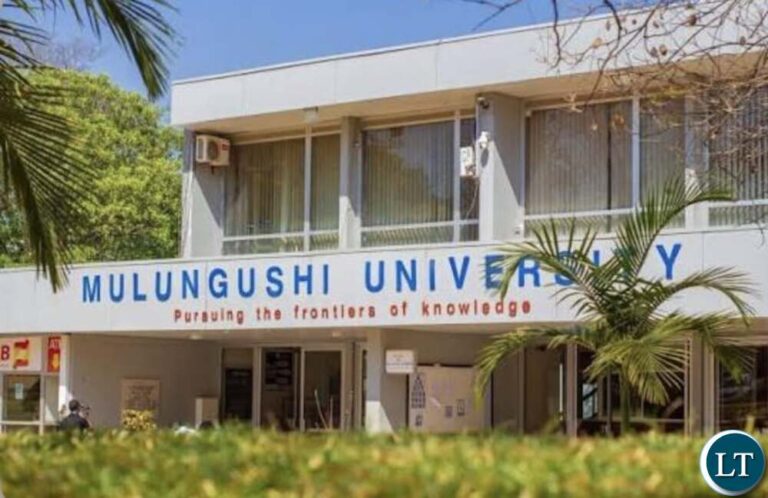
Kapiri Mposhi, Zambia — A 19-year-old first-year medical student at Mulungushi University’s main campus has been arrested after allegedly disposing of her newborn baby in a dustbin near her hostel.

The suspect, whose identity has been withheld, is currently receiving treatment at Kabwe Central Hospital under police guard.

According to Central Province Police Commanding Officer Yobe Luhana, the body of the infant was discovered on Thursday around 08:00 hours by a man scavenging for plastic bottles near Lalafuta hostel.

“Upon receipt of the information, police officers rushed to Mulungushi University main campus, where they found a still-born female baby lying on the ground, with part of its body wrapped in a plastic bag,” Mr. Luhana stated.

He explained that during the investigation, the suspect was identified and admitted that the deceased child was hers. The student reportedly told police that she had developed abdominal pains around 02:00 hours on Thursday, after which she went to a restroom and secretly delivered the baby. The infant reportedly fell into the toilet.

“She said she did not know whether the baby was born alive or not as it took some time to pick her from the toilet and that’s when she realised that she was dead,” Mr. Luhana recounted.

The suspect further narrated that she retrieved the baby’s body, placed it in a plastic bag, and discarded it in a trash bin near her hostel.

Police investigations into the incident are ongoing.

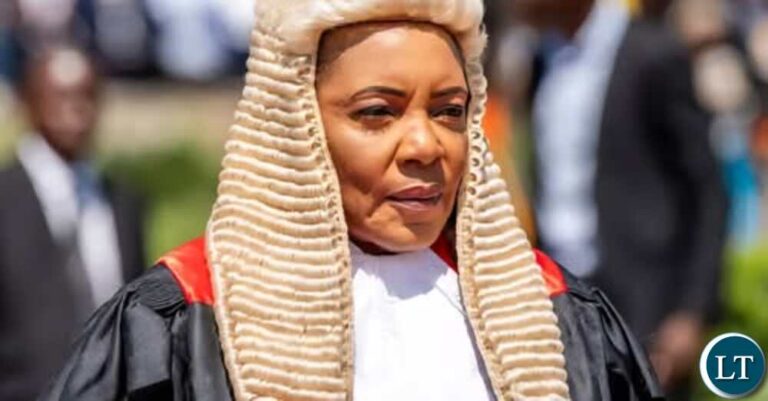
Fresh Contempt of Court Application Filed Against National Assembly Speaker

0

Lusaka, Zambia – Barely three days after the Constitutional Court dismissed a similar application, a fresh lawsuit has been filed seeking to cite Speaker of the National Assembly Nelly Mutti, Minister of Justice Princess Kasune, and other lawmakers for contempt of court.

The new application has been filed by jailed former Lumezi lawmaker Munir Zulu and Lusaka lawyer Celestine Mukandila. It targets Ms. Mutti, Ms. Kasune, the Speaker’s deputies, and all parliamentarians.

The petitioners allege that the decision to reintroduce the controversial Constitutional Amendment Bill Number 7 of 2025 is unconstitutional and in direct disregard of a previous Constitutional Court judgment. They argue that the court’s ruling on June 7, 2025, declared the original process leading to Bill 7 unconstitutional due to a lack of mandatory consultation.

This follows an earlier interlocutory application by the same petitioners, which was dismissed earlier this week by Constitutional Court Judge Judy Mulongoti. The judge ruled that application was “misconceived” because the main petition from which the alleged contempt arose had already been disposed of.

In their new filing, Zulu and Mukandila contend that the June judgment rendered Bill 7 unconstitutional for contravening several articles of the 2016 Constitution. They assert that the court ordered wide consultation and the correct procedure to be followed.

The petitioners argue that, in disregard of this judgment, the Speaker and others proceeded to reintroduce Bill 7 in the National Assembly and constituted a committee to review it with the intention of passing it into law. They are now seeking an order for the Speaker and the other named parties to be cited for contempt of court.

Zambia, UNESCO Complete Project to Safeguard Tonga Traditional Poetry

0

New Delhi, India, 12.12.25 — The Zambian Ministry of Tourism and the Zambia National Commission for UNESCO have successfully concluded a four-year project to safeguard Kuyabila, the traditional drum poetry of the Tonga people of Southern Province.

The project, which ran from 2021 with an International Assistance fund of US$83,790 from UNESCO, aimed to raise awareness of the UNESCO Convention on the Safeguarding of the Intangible Cultural Heritage. Activities included community meetings, local media engagement, and collaboration with traditional leaders in Monze and Namwala districts.

A key component involved capacity building, with 42 stakeholders trained in community-based inventorying methods to foster local understanding and ownership of the safeguarding process.

Speaking at the 20th Session of UNESCO’s Intergovernmental Committee for the Safeguarding of the Intangible Cultural Heritage in New Delhi, Mr. Thomas Mambo Mubita, Chief Cultural and Folklore Officer at the Ministry of Tourism, expressed gratitude for UNESCO’s support.

He outlined the project’s major achievement: the comprehensive documentation of Kuyabila. This included recording 40 poems, publishing a book, and producing a video documentary featuring performances, interviews, and community experiences. An inventory was also compiled, categorizing poems by themes such as marriage, initiation, funerals, farming, health, and education.

Mr. Mubita reported that the project has led to the integration of Kuyabila into educational and cultural activities. Communities have experienced renewed pride and motivation to practise and transmit this heritage, with growing recognition at cultural events and increasing interest from educational and media institutions.