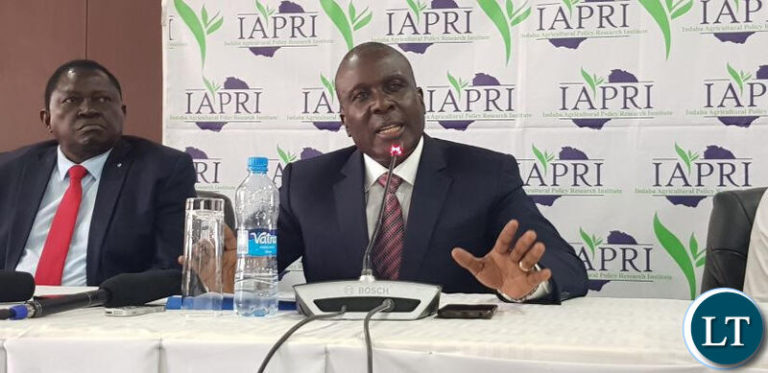
HH Engages AGRA and Strategic Partners to Boost Agriculture, Trade, and Tourism
Government Secures K5 Billion to Pay FRA Maize Suppliers, ZNFU Elects New Leadership
Chama Dismisses the Voter Registration Process as Pointless
Archdiocese of Kasama Archbishop Ignatius Chama has described the ongoing national voter registration programme as a sham that will not produce the intended results of enrolling more than three million new voters for the 2026 general elections. In remarks carried on his weekly radio programme Ishiwi Lyakwa Kacema, broadcast every Wednesday on Radio Lutanda, Archbishop Chama said survey findings from within the Archdiocese had shown that only a small proportion of eligible citizens had managed to complete the registration process so far.
He said low numbers among eligible people were evident in areas he had interacted with. He said that during meetings with large community gatherings, only a handful of individuals indicated that they had successfully registered. He stated that this outcome demonstrated that the voter registration process was not effectively reaching the population in sufficient volume for next year’s polls. He said that this reality would result in fewer Zambians participating in the 2026 general elections.
Archbishop Chama also stated that bureaucratic obstacles were effectively disenfranchising many people. He said that essential supporting documentation had not been made available to eligible voters. He said that a major grievance among young citizens was the lack of access to national registration cards, which are required for voter registration. He said this absence of national registration cards had prevented young people from starting the voter enrolment process.
The Archbishop also said that the lack of national registration card issuing officers at registration points had discouraged people. He said that without national registration cards, the possibility of registering as a voter was not possible, and that this had blocked many eligible youths from participating. He said he had observed that people expected that national registration card issuance would accompany the voter registration period, but that this expectation had not been met on the ground.
Archbishop Chama said even if the current registration period was extended, the time of year created further complications. He said that the farming season would affect participation because many people would be occupied in fields rather than registration centres. He said that people would be working on farms during the peak phase of the voter registration extension and that this would reduce registration turnout further.
He said the total combined effect was that the majority of citizens would not be registered in time for the 2026 elections. He said that this result would mean that only a small percentage of eligible Zambians would vote. He also said that those responsible for the registration process needed to recognise that the implementation design was preventing large numbers of people from accessing the system.
Archbishop Chama said that the purpose of his radio message was to highlight the practical realities he had encountered. He said the voter registration process would not deliver the intended objective under current conditions, and that this outcome was becoming visible before the exercise had been completed.
Nevers Mumba Renames MMD to NNP while rival faction rejects the rebrand
More than one version of events is being promoted following the announcement by former MMD President Nevers Sekwila Mumba that the Movement for Multiparty Democracy has now been renamed the New Nation Party. Dr Mumba declared that the party has entered a new chapter and will support President Hakainde Hichilema in the 2026 general elections. He stated that the party will not field a presidential candidate and that this position reflects a desire for national unity. The announcement was made at NASDEC Sports Complex in Lusaka during an Extraordinary Convention that his camp viewed as a legitimate MMD process.
NNP National Secretary Elizabeth Chitika urged members to align themselves behind the new direction. Vice President Winnie Zaloumis described the event as a democratic marker for a politically renewed organisation. UPND Secretary General Batuke Imenda attended the same function and said the process was peaceful and consistent with a position that the future of governance should empower citizens to own national resources and key economic assets.
This is however not the only interpretation being presented to the public. A splinter faction calling itself Operation Save MMD issued a detailed statement saying that the NASDEC gathering was not an MMD event. The group said Dr Mumba has no legal authority to rename the MMD because his constitutional tenure expired in 2022. The faction’s statement was delivered by Gaston Sichilima who said that what occurred at NASDEC was a personal launch of a separate political party. He stated that the MMD brand still exists and that the narrative that the MMD is now the NNP is false and misleading.
Operation Save MMD stated that the purpose of their organisation is to protect and restore the MMD in accordance with the party constitution. They said the announcement of a rebrand is in direct conflict with the structures that remain active within the party. They said they reject any claims that the MMD has ended or has been dissolved. Sichilima said that Dr Mumba’s history is relevant to the current situation because several organisations that he formed previously have been dissolved before. He said this pattern is evidence that the NASDEC event is another personal project rather than an institutional decision taken by a valid MMD convention.
The faction also said that the MMD must now begin the process of reconstructing its leadership and structures. Operation Save MMD said it will convene a national consultative gathering in the coming days with the purpose of identifying the next roadmap to a legitimate convention. The group said the constitutional right to choose national leaders is not held by individuals who no longer hold office. Sichilima said that the MMD should now prepare for a fresh democratic process which will restore authority through a transparent election of office bearers.
The two narratives have therefore collided directly. One narrative says that the MMD has legitimately rebranded into the NNP and that the decision is based on unity and strategy. The second narrative says that the MMD continues to exist and that the NASDEC event was a launch of a completely new party. The political question that now follows is which claim will be recognised by the Registrar of Societies and whether official documentation matches either side of the dispute.
The story continues to develop because both sides insist that their version is fact. Dr Mumba positions his announcement as a forward path. Operation Save MMD positions it as a departure. Both groups have stated that they will continue with their programme of action in the coming days. Further public statements are expected from each side as the status of the MMD identity becomes a topic of national political interest ahead of 2026.
Over twenty-five thousand farmers to benefit from FSP
Government officials say more than twenty-five thousand vulnerable but viable farmers in Northern Province are projected to benefit from the Food Security Pack programme in the 2025/2026 farming season.
Northern Province Permanent Secretary Bernard Mpundu stated that the programme remains a tool government is using to support vulnerable households and improve rural livelihoods. His remarks were delivered in a speech read on his behalf by Northern Province Assistant Secretary Mwenya during the provincial launch of the programme in Mungwi.
Mpundu said the province raised over K16 million through recoveries from previous programme cycles and that the funds have been channelled back into productive assets. According to his statement, the recovered funds were used to purchase tractors, tillers, treadle pumps, hammer mills and oil expellers among other equipment intended to improve agricultural output.
Mungwi District Commissioner Muma Musonda told attendees that the Community Welfare Assistant Committees are currently developing a K2.2 million community multi-facility, which he said will be the first such establishment in the district. He further indicated that over 1,800 vulnerable households, drawn from 20 of the 100 committees, will benefit from this year’s allocation.
Musonda explained that individual beneficiaries receive a 10 kilogramme bag of cereal or legumes, a 10 kilogramme bag of maize seed, two 50 kilogramme bags of D-compound fertiliser, and two 50 kilogramme bags of urea fertiliser.
Northern Province Community Development Officer Mary Namwinga said the programme has helped many households improve their food security and income capacity. She warned beneficiaries against diverting or selling inputs, stating that such practices work against the intended policy goals.
Mungwi District Council Chairperson Grace Chisanga urged beneficiaries to apply the inputs directly toward production in order to strengthen the impact of the intervention.
Chimanga village beneficiary Kedrick Mulenga said the support has helped vulnerable households push towards self-reliance and stable food availability at household level.
The Acting Paramount Chief Chitimukulu of the Bemba people commended government for maintaining the programme in his area. He directed village headmen under his chiefdom to monitor its usage and said individuals who misuse the inputs would be removed from the programme and may face prosecution.
Livestock theft becomes economic crime, HH
President Hakainde Hichilema has announced that his administration has classified livestock and agricultural theft as economic and financial crimes.
He has explained that following this, livestock and agriculture theft will be tried in the economic and financial crimes court with a prosecution period of five months.
President Hichilema has further directed the removal of bail for livestock theft offenders, in addition to the maximum sentence having been increased to seven years.
He has noted that this is expected to not only reduce such cases but also encourage more people such as retirees to invest in livestock and agriculture.
The Head of State said this in Lusaka, when he officially closed the Zambia National Farmers Union (ZNFU) 119th Annual Congress Meeting, held under the theme “Sustaining Productivity in a Changing Climate”.
President Hichilema further called on farmers in the country to partner with government and invest in the energy sector.
He says this will help mitigate the electricity shortage the country if facing, due to over dependence on hydro power, adding that farmers are among those affected as they require irrigation.
The President has since advised both farmers and Zambians at large to form consortiums and invest in sustainable energy ventures such as solar power projects.
“We are encouraging farmers and other citizens in the country to invest in energy. Demand in energy has increased. There’s already an off taker like ZESCO to aggregate what you will produce”, the Head of State stressed.
He has assured that investment in projects such as solar will be given presumptive approval on order to help expedite investment in the sector.
ZNFU has since ushered in a new President, Zvhikonyo Mahombe who takes over from Jervis Zimba.
Speaking at the same event, ZNFU Past President, Jervis Zimba commended President Hichilema for his policies that favour export of local agricultural products such the ban on onion imports.
He revealed that the Country was previously spending 40 million United States dollars, adding that the ban has empowered local farmers, leading to an increase in production of onions locally.
And United Capital Fertiliser (UCF) Board Chairperson, Chance Kabaghe expressed concern with the rise in the sale of fake seed in the Country.
He noted that small-scale farmers in rural areas are the majority of victims to such scams, a situation which threatens food security.
“We want the law stiffened for offenders just like it was done for cattle wrestlers” He proposed.
And Corteva Agri-Science Managing Director, Samson Nyendwa commended government for the 100 percent roll-out of the Electronic Voucher system under the Farmer Input Support Programme (FISP).
“The 100 percent roll-out of the e-voucher system is highly commendable as it empowers farmers with the liberty to choose the seed they would like to plant. It also improves efficiency of the FISP”, he said.
Government launches rural water supply projects
The Government has launched two new water supply projects in Zambezi and Kabompo Districts aimed at improving access to safe and clean water for rural communities, under the 2025 Constituency Development Fund (CDF).
Minister of Water Development and Sanitation, Collins Nzovu, announced that the projects will be executed by the North Western Water Supply and Sanitation Company Limited (NWWSSCL), with funding provided through the Zambezi and Kabompo Town Councils.
Mr Nzovu said the Kabompo project, valued at K793,000, will focus on expanding water supply networks in Chikata, Farm Training Centre (FTC), INDECO and M8 townships.
“Each township will receive a one-kilometre water distribution network, initially serving about 40 customers, with the target to reach over 100 customers in the medium term, ultimately benefiting more than 1,000 residents,” Mr Nzovu stated.
He said in Zambezi District, the project costing K564,800 under Phase One will involve the construction of a new water supply line from New Market Compound to Masumpu Village.
“This development will add 100 new customers and benefit approximately 600 people,” he said.
Mr Nzovu expressed satisfaction that both local authorities have already disbursed the necessary funds and that procurement processes are underway.
He commended the collaboration between commercial water utilities and local authorities, saying it will enhance the delivery of water and sanitation services through the effective use of CDF resources.
He further urged other councils in North-Western Province and across the country to work closely with water utilities and prioritise water and sanitation projects, particularly in rural communities.
Last year, the North Western Water Supply and Sanitation Company Limited successfully implemented two CDF-funded projects under the Mwinilunga and Manyinga Town Councils, valued at K1.2 million and K715, 000 respectively.
This is according to a statement issued to ZANIS by the Ministry of Water Development and Sanitation Principal Public Relations Officer, Prince Chiyuni.
Kaonga urges inclusive parliamentary nominations process
Mafinga Council Chairperson, Duncan Kaonga, has called for inclusitivity in the nomination of Members of Parliament (MPs) by the President.
Mr Kaonga proposed that the number of nominated MPs can be maintained with consideration to include persons with disabilities, women and youths.
He added that instead of increasing the number of nominated MPs, the current eight of those nominated should be four persons with disabilities, two women and two youths.
The Council Chairperson made this submission virtually to the Technical Committee on the Constitutional amendments today.
Meanwhile, Shiwang’andu District Commissioner Maureen Bwembya has strongly supported the increase in the number of members of Parliament from the current eight nominated Members to 10.
In her virtual submission, Ms Bwembya said it is imperative that the number of nominated Members of Parliament is enhanced in order to promote effective participation of Women and Youths including persons with disabilities.
Various stakeholders across the province made submissions to the Technical Committee with the most submitted terms of reference being delimitation of constituencies and Wards.
Ng’oma urges farmers to diversify crops
A renowned Zambian farmer has urged farmers in the country to diversify their crops and prioritise the production of legumes, particularly soybeans and groundnuts.
Evans Ng’oma observes that soybeans and groundnuts are crucial for edible oil production.
Mr Ng’oma who is Buy-Zambia (BuyZed) Campaign Founder and CEO, in a statement issued to the media in Lusaka today, warned that any possible shortage of the legumes could lead to a deficit.
“I urged my fellow farmers in the country to diversify soybeans and groundnuts and prioritise the production of legumes. These crops are crucial for edible oil production and a shortage could lead to a national deficit,’’ he said.
He adds that the legumes are vital to the country’s food security and economic growth.
He appreciated government’s efforts to support farmers through various ambitious agro-packages.
He strongly condemned some farmers allegedly stealing farming inputs instead of utilising them properly.
The BuyZed founder suggested to the government that the System Administrators should implement a locking mechanism to allow only two bags of fertilizer to be swiped per farmer unlike what is obtaining.
According to Mr Ng’oma, doing so will enable farmers to access the necessary fertilizers alongside purchasing seeds and other vital inputs.
The Buy-Zed Ambassador believed that this measure would help promote a balanced input usage, improve crop yields, and contribute to Zambia’s economic growth and food security.
Public urged to report police misconduct through local Councils
Police Public Complaints Commission (PPCC) Chairperson, Zunga Siakalima, has urged members of the public to utilise local councils when lodging complaints against police misconduct.
Speaking during a courtesy call on Isoka Town Council Secretary, Mr Siakalima said the Police Public Complaints Commission Act empowers council secretaries to receive complaints from the public against police actions, which are then forwarded to the Commission for investigation and recommendations.
“The Act gives power to the Council Secretary to receive complaints from the public in cases where they feel unjustly treated by the police,” he said.
Mr Siakalima explained that the PPCC’s mandate includes investigating cases of alleged police misconduct and making recommendations to relevant authorities in line with the provisions of the Act.
He said the Commission is conducting community sensitisation programmes in various districts to raise public awareness on how to lodge complaints and seek redress when mistreated.
“We want people to know that justice is within their reach and they do not need to feel helpless when they experience misconduct by officers,” he added.
And Isoka Town Council Secretary, Brian Musonda, described the law as progressive, stating that it empowers citizens to seek justice where they believe they have been unfairly treated.
“Many people lack information about such provisions, but we intend to change that through increased sensitisation,” he said.
Mr Musonda added that the council will enhance public sensitisation through community platforms such as WhatsApp groups with councillors and Ward Development Committees, as well as radio programmes supported under the Constituency Development Fund (CDF).
He further said Isoka Town Council will work closely with the PPCC to ensure residents are well-informed about their right to lodge complaints locally.
Govt begins consultations on fire, emergency management bill
The Ministry of Local Government and Rural Development has commenced national stakeholder consultations on the draft Fire and Emergency Management Services bill.
Permanent Secretary for Administration in the Ministry, Gabriel Pollen, said the bill, which is the first of its kind, is an important step towards strengthening the nation’s fire and emergency services.
Dr Pollen noted that the bill is a legislative framework designed to modernise, equip and empower fire services across the country.
“With this bill, the ministry takes a pivotal step toward strengthening our nation’s fire and emergency services. This is the first comprehensive fire and emergency services bill for the country,” said Dr Pollen.
He said the bill also aims to bring fire management in Zambia to speed with the changes in the natural environment brought about by climate change and increased use of emerging technologies such as electronic batteries and solar batteries, among others.
The Permanent Secretary was speaking in Lusaka today when he officially opened the national stakeholder consultative meeting for the Fire and Emergency Management Service Bill.
He disclosed that currently, the country does not have legislation on fire and emergency services, resulting in piecemeal interventions in the face of a growing population.
Dr Pollen added that the deterioration of fire and emergency management service provision at all levels has resulted in loss of lives and extensive damage to property.
“Our brave firefighters have operated under fragmented policies and legal frameworks, inconsistent standards, and limited resources. This draft bill seeks to change that. It is imperative that we strengthen fire and rescue services as these are the backbone of public safety,” he added.
He explained that the core pillars of the proposed fire and emergency services management legislation include standardisation of services, professionalisation and capacity building, community risk reduction, infrastructure and resource allocation, interagency coordination as well as accountability and oversight.
“Our government is committed to creating a conducive environment for business operations, marketeers, property owners and of course, firefighters,” added Dr Pollen.
Meanwhile, Superintendent – Fire Inspectorate at the Ministry of Local Government, Davy Nkomesha, said the country has for a long time operated without an established fire system, adding that fire services operations have been dependent on other pieces of legislation.
Mr Nkomesha disclosed that the ministry was last year granted authority to develop the Fire bill and a technical committee was constituted to put together a layman’s bill, so as to be able to deliver fire services as expected.
Don Bosco school seeks k1.8m to complete classroom block
Don Bosco Secondary School, run by the catholic church in Luwingu District is seeking over K1.8 million to complete the construction of an upstairs classroom block at the institution.
School Deputy Headteacher, Prudence Mutale, said the project has been funded using locally sourced resources, with over K1 million already spent to bring the structure to ring beam level.
Ms. Mutale explained that once completed, the new classroom block will help ease pressure caused by the high number of learners at the school, which runs from early childhood education to secondary level and has a population of about 1,200 students.
“We have over a thousand learners, so some pupils have to attend classes in the afternoon. Our goal is to ensure that all learners can attend in the morning,” she said.
Ms Mutale appealed to government institutions and individuals to support the school in completing the project.
Pupils have expressed excitement about the ongoing construction with Grade 11 student David Zulu expressing that the new block will be the first upstairs school building in the district.
“This will be the first-ever upstairs classroom in the district,” he said.
Another pupil, Usher Luboya, said the classrooms will provide a more conducive learning environment and expressed hope that the block is completed soon.
Outgoing Head Girl Catherine Tito urged all stakeholders to contribute toward completing the project and called on fellow students to avoid vandalising school property.
The two-by-three upstairs classroom block will include storage facilities and ablution blocks for both pupils and teachers.
Govt pledges support, tightens security after Chiwempala market fire
Copperbelt Province Minister, Elisha Matambo, has toured the gutted Chiwempala Market and assured traders that government will enhance security in markets prone to fires.
Mr Matambo also pledged that government will provide financial compensation to affected marketeers to help them resume their businesses.
He warned that stern action will be taken against individuals found responsible for setting markets on fire, describing such acts as criminal and retrogressive.
“It is disappointing that this market has been gutted just days after the district held a peace indaba aimed at ending negative vices such as riots and deliberate market fires,” Mr Matambo said.
And Chingola Mayor, Johnson Kang’ombe, has appealed to residents to embrace peace and unity, urging them to refrain from acts that cause harm to others.
He expressed regret over the incident, which he suspected may have been started by unscrupulous individuals with ill intentions.
The media reports that a fire swept through Chiwempala Market in Chingola yesterday, destroying goods worth large sums of money belonging to over 3,000 traders.
E-voucher restores dignity among small-scale farmers-Mtolo
Minister of Agriculture, Reuben Mtolo says the E- voucher programme has brought about transparency, efficiency and has restored dignity among small scale farmers.
Speaking at the E- voucher rollout under the Farmer Input Support Programme (FISP), Mr Mtolo said more than 2,800 new farmers have been put on the system.
He said 90 percent of the farmers under FISP have already redeemed their inputs for the 2025/2026 rain season.
He added that the satisfaction index of the E- voucher is above 80 percent, which means that the programme is a success and has been accepted by the farmers and agro dealers.
Mr Mtolo has since called for more agro dealers to register for the E- voucher programme saying the Ministry of Agriculture will not put a cutting date for registrations.
Speaking at the same event, Minister of Finance and National Planning, Situmbeko Musokotwane, said he is pleased with FISP outcomes.
Dr Musokotwane urged agro dealers to have confidence that they will get government contributions for the inputs.
Meanwhile Dr. Achim Fock, the Country Manager for World Bank, said E- voucher system is a critical part of Zambia’s agricultural sector.
Dr Fock noted that the E- voucher reform system programme has over one million verified farmers in the database and 631 agro dealers.
The E-Voucher programme was introduced in Zambia in 2015 as part of the Farmer Input Support Programme (FISP) to promote transparency, efficiency, and farmer empowerment in the distribution of agricultural inputs.
Under the system, eligible small-scale farmers receive electronic cards loaded with a subsidy value, which they can use to buy inputs such as seed, fertiliser, and chemicals from approved agro-dealers of their choice.