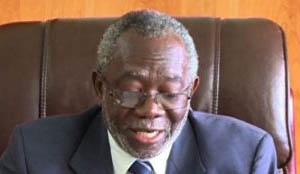
Copperbelt Minister Mwenya Musenge has castigated millers for creating artificial mealie meal shortage in the province.
Mr Musenge said after making prompt visits to milling companies in Kitwe that some of them were selling mealie meal above the agreed price with Government.
The minister said in a side interview that he would report his findings to higher authorities for action to be taken against those found wanting and ensure shortage normalises.
Some millers in Kitwe have overpriced the price of the commodity at their depots which traders were buying in bulk and resale at exorbitant prices which consumers could not afford.
Olympic Milling depot opposite Chisokone market has pegged a 25 kilogrammes bag of breakfast at KR52 instead of KR50 as recently directed by President Michael Sata, while a 25 kilogrammes of roller meal was fetching at KR38.
Mpongwe Milling depot in Chimwemwe Township was selling a 25 kilogrammes bag of breakfast at KR50 at its depots which forced some retailers to buy in bulk and resell the commodity as much as KR65.
“The millers are not supporting the Government on this issue. The depots that I have visited have a problem to implement the presidential directive as agreed between Government and millers and this is creating a problem to control the prices of the commodity,” he said.
The minister, who was accompanied by Kitwe District Commissioner Elias Kamanga, said it was regrettable that millers were selling the commodity at retail price instead of wholesale.
Residents of Chimwemwe Township charged that the Mpongwe Milling depot in the area was selling the commodity to unscrupulous traders who were smuggling it DRC.
“The millers were retailing instead of wholeselling the commodity which was creating the shortage and this was compounded by the fact that they sell in bulks to people who resell at exorbitant prices,” they complained.
Ruth Chulu and Faith Mwaba, all Chimwemwe residents, said they had been struggling to buy a single bag of mealie meal in the area for the past one week because of the artificial shortage.
This forced the minister to direct sales persons at Mpongwe depot to immediately start selling the commodity to residents who had been waiting to buy mealie meal for hours.
Meanwhile, Mr Musenge said Government managed to impound 12 trucks laden with 1, 200 bags of mealie meal each during last month which was intended to be smuggled into Democratic Republic of Congo via Kasumbulesa border.
The shortage of mealie-meal on the Copperbelt worsened in November last year affecting Kitwe, Chingola and Chililabombwe with a 25 kilogramme bag of breakfast fetching K75,000 and the Millers Association of Zambia assured that the situation would normalize in few days time.
Students from the Northern Technical College (NORTEC) yesterday stormed the streets of Ndola in protest against the quality of certificates that the Technical Education, Vocational and Entrepreneurship Training Authority (TEVETA) issues to graduates from the institution.
Police in riot gear had a tough time restraining the vengeful students who chanted slogans and sung solidarity songs as they marched their way to Cabinet Office seeking an audience with Copperbelt Minister Mwenya Musenge.
NORTEC students’ union president Gift Mumbi said the certificates issued by TEVETA did not have the Institution’s name, the candidate’s NRC number and the programme duration making it hard for graduates to be identified with the college.
“We wrote a letter to TEVETA informing them that these certificates given to NORTEC students do not have our institution’s name, the course duration and the candidates NRC number, so how can one know that I was trained at NORTEC,” he said.
Copperbelt Minister Mwenya Musenge who addressed the students told them to remain calm as he, together with their union representatives and NORTEC management would this Friday meet the TEVETA director general to discuss the matter.
“I have heard all your concerns and, I together with your college management and union representatives, will this Friday meet with the TEVETA director general so that we find the best solution to this problem,” Mr Musenge told the students.
In a separate interview TEVETA director General David Chakonta said the examination body had already put in place measures to ensure that the said features reflected on the certificates for this year’ graduates.
“We have adopted some changes, so for this year’s graduates, the names of the institution and assessment centers will be inserted on the certificates, however the NRC numbers may not reflect due to security features put in place to avoid forgery of documents ” he said.
After the address by the minister, the students returned to NORTEC and by midday, it was business as usual at the institution.
Government has challenged the Zambia Institute of Human Resource Management (ZIHRM) to put in place mechanisms that will enforce the ban on non-Zambians from performing human resource functions.
Labour and Social Security Minister Fackson Shamenda said this during a consultative meeting with human resources heads from various companies in Lusaka yesterday.
Mr Shamenda reiterated that it was Government’s view that non-Zambians should not perform human resource functions as the country had enough trained citizens to effectively handle such duties.
“Human resource functions are better understood by Zambians who have an in-depth understanding of the local people and their cultural practices.
“In this regard, Government would like to challenge the Zambia Institute of Human Resource Management to put in place mechanisms to enforce the provisions of the Act,” he said.
He said Government in conjunction with ZIHRM would be reviewing the ZIHRM Act to strengthen the enforcement of the mechanisms which would be acceptable by everyone.
He said Zambia had seen an increase in unlicensed human resource practitioners working in various institutions, something which should be addressed.
Mr Shamenda warned that Government would not allow non-Zambians to engage in businesses that could effectively be undertaken by Zambians as that reduced job creation opportunities for the citizenry.
“Government will soon be taking appropriate action to address this concern. The Ministry has also received reports that there are few employers who are not complying with the Statutory Instrument (SI) on the revision of the minimum wage, but it is expected that they would all do so by June this year,” he said.
He said the ministry had continued receiving reports of employers abusing their workers in various forms instead of promoting an atmosphere that fostered good relations through social dialogue to sort out disputes.
He warned that Government would not condone industrial unrest as it was retrogressive to national development, adding that investment could only thrive where there was industrial harmony.
He extended his warning to employers who were terminating employment contracts without giving employees a chance to exculpate themselves to desist as that was against the International Labour Organisation Convention 158 and international best practices.
Friedrich Ebert Stiftung programme manager Kathy Short pledged her organisation’s commitment in realising a better Zambia for all by promoting dialogue as well as a decent working environment.
ZIHRM president Winner Kanyembo said the Institute welcomed the ban on foreigners to perform human resource functions as the country churned out enough Zambians to perform that task and was hopeful the directive could be backed by a legal framework.
Zambia Federation of Employers executive director Harringtone Chibanda emphasised on the importance of social dialogue as well as labour as a key factor of production.
Zambia Congress of Trade Unions president Leonard Hikaumba said it was gratifying to note that Government was committed to ensuring that only local and qualified human resource practitioners were allowed to practice and was hopeful that such a provision be clearly outlined in the law, if it did not exist.
The Zambia National Union of Teachers (ZNUT) in the northern province is concerned about the complicated procedures in accessing loans from the Public Service Pensions Fund (PSPF).
This is contained in a press statement to ZANIS in Kasama yesterday by the provincial chairperson Jonas Musonda.
Mr Musonda said that the union will not condone the victimization of its members who joined the service starting from the year 2000 to date.
He explained that the teachers have been contributing to the pensions fund and hence need to benefit from this loan scheme, which PSPF is providing.
Mr Musonda added that it is not fair that a teacher who has been contributing to the scheme for 13 years cannot benefit from the loan scheme.
He has since appealed for an explanation from the public service pension’s fund.
And some civil servants bemoaned that the loan conditions are stiff which may force some people to continue borrowing from commercial banks.
They have since appealed to the scheme managers to ensure that the public is well informed about the matter.
The Ministry of youth and Sports in Livingstone has expressed worry over the slow response by youths to access the youth empowerment funds to enable them engage in gainful enterprises.
Speaking in an interview with ZANIS yesterday , Southern Province Youth Coordinator Vincent Sitali said it was worrying that so far only 25 applications have been received from Livingstone district despite the massive sensitisation programme carried out by the department.
Mr. Sitali said seven applications received were for grants while 18 were for loans under the youth fund.
He said although some applications have not yet been received from the Other districts, there were indications that the response from the youths has not been impressive.
“As a department we worried at the rather poor response from youths to apply for these funds and we hope that with the help of some districts volunteer committees that we formed to continue sensitisations we hope to see an increase in the number of application forms submitted,” said Mr. Sitali.
“In my own opinion I would be happy if we can have least 150 applications approved for the entire province”.
He said the department had planned to conduct the first evaluation exercise of the application forms on 20 February to facilitate release of funds to approved projects this month but could not do so because of the poor response.
“We were supposed to have the first evaluation of the forms on 20th February but we are still waiting to have at least 30 forms to begin the evaluation process”, said Mr. Sitali.
Government this year allocated K1.3 Billion (KR1.3 Million) under the youths empowerment fund for southern province for youths to engage in projects including tourism, agro processing, primary agriculture, arts among many others.
He further explained that the department would like to utilize all the money allocated unlike last year when the province only used about K500 Million to approved youths projects out of the total allocation of K1.1 Billion.
He encouraged the youths to apply for the funds to enable them benefit from the United Nations World Tourism Oranisation General Assembly (UNWTO) to be co-hosted between Zambia and Zimbabwe in August this year.
Chief Government spokesperson Kennedy Sakeni has been admitted to the University Teaching Hospital UTH.
Mr. Sakeni who is also Information and Broadcasting Minister was admitted to UTH on Sunday the 17th of March 2013.
UTH Managing Director Lackson Kasonka has confirmed that Mr. Sakeni was admitted to the hospital but could not disclose further what he was suffering from.
Dr. Kansonka said that Mr. Sakeni has responded well to treatment and would be discharged soon.
Shang’ombo district in Western province will have a 75 per cent reduction in this year’s crop because of a prolonged dry spell which the area experienced.
This is according to the Ministry of Agriculture and Cooperatives crop assessment that was conducted in Siwelewele Camp. The assessment shows that most crops are dying.
Siwelewele Camp Agriculture Assistant Officer Maybin Malama said the poor rainfall pattern experienced this season has negatively impacted the crop performance in the district.
Mr. Malama said a reduction in crop yield especially in maize is ranging between 15 to 20 per cent.
He said the camp has between 450 and 500 households and about 700 farmers that will be affected by the food shortage.
The agriculture officer said the crop assessment report reveals estimated crop yield of 400 to 500 kg of maize per hectare with rice estimated at 150 to 250 kg and cow peas at 100 to 250 kg per hectare among other crops
And newly appointed Deputy Minister of Information and Broadcasting Services Poniso Njeulu, who is also Sinjembela Member of Parliament, declared the hunger situation as a disaster.
Mr. Njeulu assured the people in the area and the entire Shang’ombo district that he would tell relevant authorities about the situation.
He said government, through the Disaster Management and Mitigation Unit (DMMU), will ensure that the food shortage was averted through a provision of relief food to the district.
Mr. Njeulu is in the area to identify possible development projects which can be established in order to address critical challenges facing the district.
Christopher Katongo has joined Zambia in training in Johannesburg.
The Zambia captain joined camp this morning after flying in from his base in China at second division club Henan Jianye.
Katongo has a individual workout before joining his team mates for the rest of Tuesday morning’s practice.
His arrival completes the list of call-ups for Zambia’s march 24 away 2014 FIFA world Cup group D qualifier against Lesotho in Maseru.
Meanwhile, defender Stopilla Sunzu is in a race to be fit for Sunday’s game.
The TP Mazembe defender arrived in camp on Sunday with a knee injury.
Zambia lead Group D on six points, Ghana are second on three points, Sudan is third with one point, level with bottom placed Lesotho after two rounds of matches played.
Mufulira Blackpool say it was not a difficult decision to give temporal refuge to their sworn enemy ‘Mighty’ Mufulira Wanderers at John Kachofa Stadium this season while Shinde Stadium was getting an upgrade.
Derbies between Wanderers and Blackpool are usually violent as witnessed in 2011 when the FAZ Division One North Week 21 game was abandoned at Shinde.
This is after Wanderers were awarded a second penalty by referee Chris Mauma who was later injured in the fracas that ensued.
In an interview, Blackpool vice secretary Raphael Kamanga told LT Sports that they regard Wanderers as partners and not enemies.
“We have welcomed them (Wanderers).It was not even difficulty because football is not about rivalry. We all play for the same community and we have one objective,” he said.
“Even if we compete, we treat them as colleagues. Even when Wanderers is doing well it benefits the entire Mufulira community,” Kamanga added.
FAZ Division One North Week One Results
16-17/03/2013
North
Kitwe United 1-Nkwiza 1
Mansa Health Stars 3-Kalewa 2
Ndola United 1-Indeni 2
Prison Leopards 2-FQM Operations 1
Greneker 2-Chindwin Sentries 0
Premium Sport 0-Kansanshi Dynamos 0
Bresmar United 1-Mumbwa Medics 0
Chambishi 1-Mufulira Blackpool 1
Mufulira Wanderers 1-National Assembly 2
SOUTH
Young Stars 1-Luena Buffaloes 1
Livingstone Pirates 0-Lusaka of Lusaka 1
Lusaka City Council 0-Nampundwe 0
Paramilitary 1-Nakambala Leopards 1
Green Eagles 2-Riflemen 0
Mazabuka United 1-Lusaka Tigers 1
*Mongu Youth Sport- Panza
*Kafue Celtic- Young Green Eagles
*Lusaka Dynamos-Kalomo Jetters *Not played
Sports Minister Chishimba Kambwili at the Soccer Match
Sports Minister Mr Chishimba Kambwili says nothing less than a win would be accepted from the Chipolopolo boys’ World Cup Qualifier against Lesotho on Saturday.
And Mr Kambwili says it is worth it for the country to bid for the hosting of the 2019 Africa Cup of Nations because of the many financial, infrastructural and social benefits this would have on the country.
Speaking shortly after he held a meeting with South African government officials and the Local Organising Committee (LOC) for the 2013 Afcon in Johannesburg on Monday, Mr Kambwili said the nation expects the Chipolopolo boys to win at all cost.
“People must be weary of the fact that what we are spending is tax-payers money. In most countries the FA (Football Association) must stand on its own to raise money for these games,” Mr Kambwili said. “In Zambia we have taken a stance that government must fund the senior national team programmes.”
Mr Kambwili said the nation would not continue accepting negative results from the national team, adding that Zambia was a big footballing nation on the Continent and no excuses would be entertained because if Lesotho were improving, so should Zambia’s be much more.
“We expect nothing but a win. In fact qualification to the World Cup is non-negotiable. It’s a do or die,” he said.
On the plans to bid for the hosting of the 2019 Afcon, Mr Kambwili said he met the LOC and government officials to compare notes on how South Africa managed to secure the 2013 Afcon bid.
He said he had learnt that it was profitable to host the tournament, saying the South African government made about US$3 million net profit from hosting the 2013 Afcon as well as the gross effect extending towards generating revenue in the tourism sector.
Mr Kambwili said he would wait for a write-up from South African officials so that he could prepare a Cabinet memo detailing issues to do with expenditure, profitability and the social impact the hosting would have on the nation.
MMD president Nevers Mumba tries to control the crowd that gathered to show solidarity to Rupiah Banda at the DEC offices.
Former President Rupiah Banda has been warned and cautioned on three counts bordering on corruption. Spokesperson for the Joint Government Investigative Team Namukolo Kasumpa confirmed the development in an interview with Journalists in Lusaka this afternoon.
Ms. Kasumpa said Mr. Banda has been warned and cautioned for his role in the oil supply deal with unnamed Nigerian oil firm.
She said Mr. Banda has also been warned and cautioned over the campaign materials for the 2011 elections and the Mpundu Trust Development Project.
This was after Mr. Banda was questioned for the second time this week on allegations of corruption during his three year reign as Head of State.
Ms. Kasumpa told journalists that the former President cooperated and was remained calm during the questioning.
She however stated that Mr. Banda is still expected to return to DEC Headquarters on Friday for continued questioning.
And Mr. Banda’s lawyer Sakwiba Sikota has accused the Joint Government Investigative Team of lacking sufficient evidence against his client.
Mr. Sikota told journalists in Lusaka that the investigations team had not done their work properly when there is already an impression created that the team had concluded its work.
[pullquote]“The mood in the room from our side is one of frustration. After being told that investigations had been completed, very very clearly investigations have not been completed and they are still trying to find evidence to fit the crime.”[/pullquote]
He added that it was unfortunate that the joint investigative wings were trying to fish for information from Mr. Banda.
And Mr. Sikota has charged that the joint investigative wings are being pressured to finding a specific offence for the former President.
Mr Sikota added that the investigation is being motivated by those that want Mr. Banda to be found with a case to answer even when there is no such case.
“The mood in the room from our side is one of frustration. After being told that investigations had been completed, very very clearly investigations have not been completed and they are still trying to find evidence to fit the crime.”
“They are going about things in the opposite way, one would have expected they already had their facts together and now they are trying to get facts from our client in order to fit their perceived crime.”
“Unfortunately it’s a waste of tax payer’s money and time that we can be going about this issue in the manner they are doing,” Mr. Sikota said.
Mr. Sikota said the investigators are dead set on finding something to charge Mr. Banda with.
“They are dead set on prosecuting Mr. Banda and unfortunately there is nothing to charge him with. The Minister of Justice has stated that they going to prosecute, he has clearly stated that there is a case to answer which case we are yet to find out.”
And Mr Banda says it is unfortunate that his alleged persecution might satisfy certain individuals.
“I was your President and I didn’t do this to anybody. I tried very hard to bury the past so that we can all come together and concentrate on what really bothers the people of Zambia, the difficulty that the poor people are facing, the shortages of everything that we do, that is what I think was my responsibility,” Mr. Banda said.
He continued, “but anyhow, perhaps my persecution, my prosecution will satisfy your needs.”
A parallel church umbrella body known as the Apostolic Prophetic Network (APN) has been formed and launched in Lusaka.
Founding president Dan Pule said the vision of the network was to speak on and partner in matters of national affairs.
Dr. Pule said the APN will among other things provide apostolic supervision, counsel, fellowship and networking to all churches from both local and international.
He has since called on churches, religious ministries, individuals, business and national leaders to join the network in order to promote Christian values in national affairs.
He said this at the launch of the APN at Dunamis Ministries in Lusaka today.
The formation of APN adds to the already existing church mother bodies in Zambia.
These are the Zambia Episcopal Conference (ZEC), Evangelical Fellowship of Zambia (EFZ) and the Council of Churches in Zambia (CCZ).
Meanwhile, Dr. Pule has said although the country has experienced growth in all sectors of the economy, there was still need to provide quality leadership, mentoring and networking in all the areas so that they can be fully sustained.
He further said the church has also experienced growth as a result of new emerging churches, ministries and leaders that had a greater zeal of fulfilling God’s given mandate of evangelising the gospel.
The APN executive comprise of Dr. Pule as its founding president, Prophet Israel Chelelwa as the first vice president, Bishop Alick Mbewe as second vice president and Bishop Edward Mbaso and Bishop Andrew Nyoni as Directors.
File: Some women marching during the international women’s day in Lusaka-2009
Flashback – March 1997
A couple of weeks before March 8th 1997 the international women’s day, several women were angered by some letters published in local newspapers. The authors of the letters were men. They charged that women could, and would never, capably take supreme authority over men. The authors argued that women, especially those in Zambia, will always have to depend on men to succeed in whatever goals they hoped to achieve. The chain reaction that followed saw some men agreeing with the argument while many women regarded this as one of the major reasons why women were perpetually down-trodden.
On March 8, the argument grew more intense as some women turned against each other.On that day, thousands of women in various parts of the country organised marches to commemorate the day with general calls for equal opportunities.Many of them cast aside their political differences and walked side-by-side in the quest to talk with one voice to prove that what women were demanding went beyond the artificial barriers of politics.
In Lusaka, the march was crowned by a speech by Nakatindi Wina, the chairperson of the women’s affairs committee in the ruling MMD party. She said the occasion was important to remind people of the continued fight by women for equal rights, international peace and social progress. Some women also called on government to declare the day an annual national holiday.
Edith’s Nawakwi’s response to marching on Womens Day
But, not all women saw the need to mark the occasion by marching on the streets or to be addressed by some dignitary or other. Thousands of other women were either ignorant of the occasion or chose to ignore it by going about their daily business. These included street venders, women who crush stones on road sides and women who do the cooking in makeshift restaurants. So it could be said that the women taking part in the marches were the more enlightened ones.However, among the enlightened women who chose to keep away from the occasion was Zambia’s only woman cabinet minister, Edith Nawakwi. She chose to spend the day working on a farm. Nawakwi, who was Agriculture, Food and Fisheries minister, condemned the tendency of women to mark women’s day by marching in the streets rather than working. She contended that “Zambia lags behind in development because of such attitudes, by not finding a positive manner in which to mark the day.”
[pullquote]For many women, however, political positions are not the issue. All they care about is being able to raise enough money to buy food for their children and to send them to school. [/pullquote] Nawakwi was a guest at a Field Day organised by 65 women engaged in agriculture production who chose to celebrate the day by demonstrating what they were capable of achieving in the field.Nawakwi’s condemnation of the march drew a sharp reaction from Wina and other women. Wina referred to on Nawakwi’s remarks as “indiscipline” and said she would table the issue before a national executive committee meeting of the MMD, to which both belonged . But, Nawakwi’s remarks also drew support from other women, who said that she was right in calling for a new perspective by women in commemorating their day.
Such bitter differences among Zambian women are not new. In 1995, Zambian women were split on similar lines when they differed over how to present their case and on who was to lead their delegation to the Beijing Women’s Conference.Zambia ended up having two delegations, each travelling separately with its own agenda. Against this background, and two years on, the one point all women seem to agree on is that the status of women has not improved.
As Zambia Congress of Trade Unions (ZCTU) committee secretary Judith Chomba said, poverty and unemployment had risen while economic and political power is still concentrated among men.The 150-seat Zambian parliament has only 13 women, with Nawakwi the only minister. And, although virtually all political parties proclaimed in their manifestos that they would strive to enhance the status of the woman, this was not reflected in practical terms.
What women really want
In the previous November’s parliamentary elections,the MMD fielded no more than 20 female candidates. The highest figure was fielded by the Zambia Democratic Congress with 25.For many women, however, political positions are not the issue. All they care about is being able to raise enough money to buy food for their children and to send them to school. It is the inability of some of their husbands to support their respective families, that has forced many of them into such jobs as stone-crushing and the street vending of foods. And, despite AIDS and the renewed efforts of the police to curb prostitution, for some women, this has become the solution to their money needs.
The then Deputy Minister of Health, Professor Nkandu Luo, believed that despite the harsh economic climate, women could still find a “decent” way in which to earn a living, and that women should be seen to be helping their fellow women.Professor Luo, Zambia’s first female professor of medicine, is a founder of a prostitute’s rehabilitation centre.Organisations like the Women’s Lobby Group, contend that one of the solutions for inequality is ensuring that girls are given the best of opportunities and incentives for being in school. Girls’ pass marks in government schools are lower than those of boys, as a deliberate government policy to ensure that more girls advance in school and eventually get into college or university.Some principals of privately-owned schools, however, argue that setting lower pass marks for girls could eventually work against the same people in the future because they would be advancing through the stages without being fully prepared for an independent and competitive life.Others, however, argue that more should be done for the female pupil saying that government should also protect girls from early marriage.
In rural areas,many girls are married before the age of 16.For women like Cecilia Makota, however, the solution lies in farming. She noted that most women in the rural areas of Zambia are already engaged in farming and that this is what should be enhanced to improve their status. She contended that mere talk or “walking the street in marches” would not draw the support and sympathy of the government. Ms Makota, a successful farmer and business woman, says that if women are seen to be making personal efforts to succeed, government or foreign support would be easier to source.Cultural barriers have also been identified as a major drawback in efforts to enhance the status of the Zambian women. In virtually all Zambian tribes, the woman must be submissive to the man. This often means that the woman does not have much, if any, say on issues like the number of children a couple is to have. Organisations like the Planned Parenthood Association of Zambia (PPAZ)has been lobbying government to pass a law that would limit a couple’s number of children to four. The effort has so far drawn a minimal response. Zambian women have evidently identified areas they would like to tackle in an effort to bridge the gap between themselves and the men. In some cases they have also offered steps that could be taken in getting solutions. In many cases, however, implementation of the proposals has been slow. And now, given what could be seen as this problem of differences amongst themselves, some men could just take advantage and reiterate that women will always need the guidance of men to achieve any goal.
The Zambian High Commission in South Africa has accused some sections of the international media of embarking on a systematic attempt to paint a bad image of Zambia.
Press Secretary at the Zambian High Commission in Pretoria Patson Chilemba contended that there seems to be an attempt to paint a negative image of Zambia by some international media.
In a letter sent out to the Business Day newspaper in response to an article published on March 12 headlined “Incoherent policy will undermine Zambia”, Mr. Chilemba pleaded with the newspaper to uphold the tenets of fairness, truthfulness and objectivity, which he said are some of the important hallmarks of journalism.
He said the newspaper alleged that there is growing political intolerance and impressions are that President Michael Sata’s government does not have a coherent development policy, which will undermine the country’s investment credentials and economic growth.
Mr. Chilemba also recounted that the newspaper alleged that there is a sustained assault on opposition leaders and the seizure of several private businesses sold to foreign investors by the previous administration which has raised questions about Mr Sata’s commitment to the rule of law and protection of investments.
He said the newspaper further stated that over the past several months, Mr Sata’s government has taken control of Zamtel, Zambia Railways, Finance Bank and the Collum coal mine.
“In our press statement sent to your staff reporter we gave various reasons for this. However, it seems our response to those cardinal issues has been ignored so that an impression could be sustained that the Zambian government was unilaterally seizing private businesses sold to foreign investors by the previous government,” he stated.
He continued: “The fact that the Zambian government, under the leadership of Mr Sata, managed to secure $750m via a eurobond — which was oversubscribed 24 times — is a sign of confidence in the administration.”
Mr. Chilemba added: “You mention that the Zambian economy will expand by 7.3% this year, from 6.9% last year, driven largely by demand from China. It is also worth noting that the economy is expected to expand mainly because of the sound economic policies of the Zambian government and the expected foreign direct investment into the country.”
He said: “Apart from raising issues in the article in question, you also published an opinion (Reversing Zambia’s democratic gains, February 22) in which you accused our president of stepping back from the democratic ideals.
While we appreciate your freedom to free expression and to cover events in Zambia, we plead with you to uphold the tenets of fairness, truthfulness and objectivity, which are some of the important hallmarks of journalism.”