BANK of Zambia (BoZ) governor Caleb Fundanga is optimistic that Zambia’s inflation rate will be reduced by four per cent or less to meet the 10 per cent inflation target set by Government in the 2009 national budget.
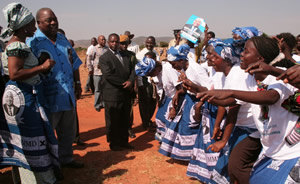
Speaking during a media briefing at the BoZ stand at the on-going Zambia Agricultural and Commercial Show, Dr Fundanga said it is possible for Zambia to achieve the 10 per cent annual inflation rate target in the remaining quarter of the year.
He said the reduction in food inflation due to the on-going crop marketing season including the reduction of mealie meal prices, will play a significant role in boosting the national economy.
Dr Fundanga said the high inflation rate was caused by the discontinuation of Government-subsidised maize by the Food Reserve Agency and pass-through effects of depreciation of the Kwacha against foreign currencies.
He said the BoZ hopes to see continued stability in the exchange rate and would continue to employ indirect instruments in monetary operations.
He said the 19.4 per cent rise in copper price to US$4,045. 66 per metric tonnes from US$3,389.42 per metric tonne, the doubling of sugar production by the Zambia Sugar Company and cement production by Lafarge Zambia, and the diversification of the economy would help the country pick up from its current economic woes.
He said it was too early to comment on whether or not Government will borrow from the public to meet its budgetary costs.
“There is still hope that some donors will honour their budgetary pledges before the end of August,” Dr Fundanga said.
Dr Fundanga also said China’s economic recovery will play a significant role in copper export revenue for Zambia because China is one of the major importers of copper.
He said, however, that relying on copper for more revenue would be risky because prices of the commodity are volatile.
Dr Fundanga observed that inflationary pressures are expected to emanate from high production costs due to current power shortages and the recently approved 35 per cent electricity tariffs and higher international crude oil prices.
The local currency is said to have been relatively stable against the US dollar and appreciated by one per cent compared with a depreciation of 9.3 per cent recorded in the first quarter of the year.
“The average inter-bank exchange rate of the Kwacha against the US dollar strengthened to K5, 281.64 against the US dollar as at the end of June from K5,337.18 against the US dollar as at end of March 2009.
Foreign players made net supplies of US$59.8 million in the previous quarter.
Dr Fundanga also said the volume of unpaid cheques declined by 11 per cent to 5,568 bank cheques and has urged the media to educate the public on the consequences of bouncing cheques.
He also said preliminary data shows that Zambia recorded an overall balance of payment surplus of US$24.9 million during the second quarter of 2009 with a deficit of US$147.7 million the previous quarter, due to narrowing of the current deficit to US$107.3 million from US$231.3 million.
He said copper export earnings have recorded about 19.4 per cent rise.
“Similarly, cobalt export earnings recorded a 39.2 per cent increase to US$18.0 million following an increase in the realised price to US$12.97 per pound from US$5.03 per pound,” he said
However, cobalt export volumes declined by 46 per cent to 628.51 tonnes.
He said that investment pledges totaled US$762.7 million compared with US$1.820.7 million during the same period in 2008.
Dr Fundanga also said the importation of vehicles declined by 25 per cent mainly because of the economic crisis the country is facing but acknowledged that the development is good for the economy.