
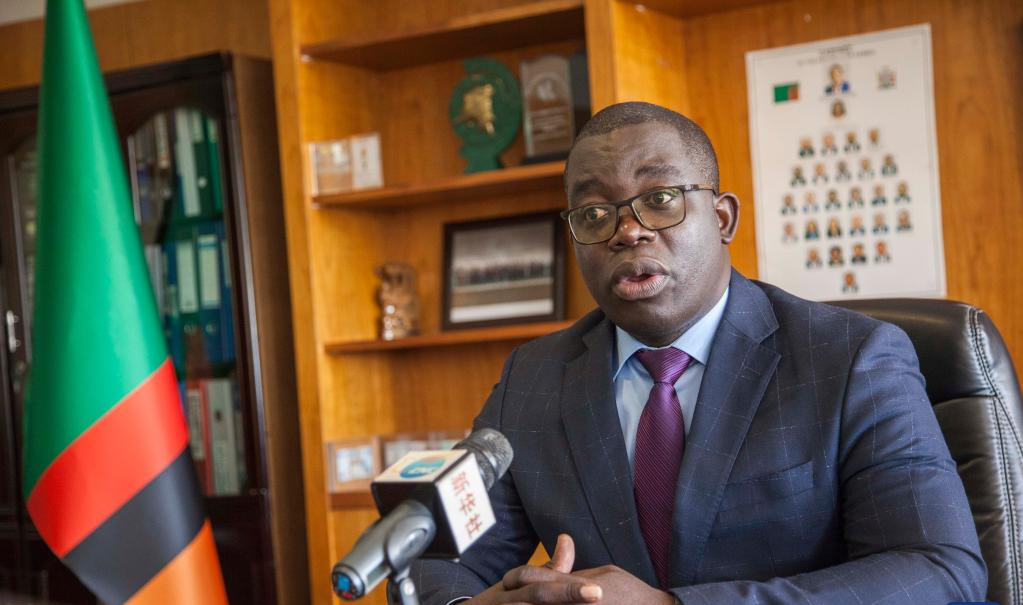
Government Tells Businesses to Cut Prices After Kwacha Gains
Government has called on businesses to adjust prices downward following the sustained appreciation of the Kwacha, stating that recent currency gains were the result of deliberate economic measures rather than market coincidence.
Minister of Commerce, Trade and Industry Chipoka Mulenga said the strengthening of the Kwacha reflected coordinated fiscal and monetary interventions aimed at restoring stability and confidence in the economy. He said the gains should translate into lower prices for consumers, particularly for goods with high import content.
Mulenga said government had observed that some businesses were slow to adjust prices despite the improved exchange rate environment. He said this created pressure on households and undermined the intended consumer benefits of currency stability.
The minister said currency appreciation reduced the cost of importing raw materials, fuel, and finished goods, adding that businesses had a responsibility to reflect these savings in pricing structures. He said failure to do so risked distorting the market and weakening public confidence in economic reforms.
According to Mulenga, the Kwacha’s recent performance was supported by improved foreign exchange inflows, increased export earnings, and tighter fiscal discipline. He said these measures were implemented to correct macroeconomic imbalances and stabilise the local currency.
Government has also pointed to improved coordination between the Ministry of Finance and the Bank of Zambia as a contributing factor. Officials said policy alignment helped manage liquidity, control inflationary pressures, and support currency stability.
Mulenga said the ministry would continue engaging business associations and suppliers to encourage fair pricing practices. He said price reductions should be guided by cost structures and not delayed unnecessarily once input costs decline.
Some traders have argued that existing stock purchased at earlier exchange rates limited the immediate ability to reduce prices. Government acknowledged this concern but said adjustments should follow once new stock is acquired at lower costs.
Consumer groups have welcomed the call, saying sustained currency stability should ease pressure on essential goods and services. They said transparent pricing would help rebuild consumer trust and stimulate demand.
Government said monitoring mechanisms were in place to track price movements and assess compliance with fair trading principles. Mulenga said engagement would remain the preferred approach, with enforcement applied where necessary.
The minister said government remained committed to maintaining macroeconomic stability and ensuring that currency gains benefit both businesses and consumers.



Only when commercial banks begin to reduce interests will there be widespread confidence amongst manifacturers and retailers to reciprocate
As soon as you made that comment kwacha has started sliding again. Why should business cut prices just for 2 weeks. Let it be a long term solution thats when prices will automatically come down.
If the exchange rate holds, you might expect reductions in things like fuel – oil prices are low, kwacha is strong. But there are lead times in business, like several months between ordering and sale. Is this man sufficiently qualified to understand that price reductions are not immediate? Hopefully government understands what happens if prices are controlled “by decree” – that means UNIP days are back. Business that have no import element will not benefit from strong kwacha – businesses that rely on export (like international tourism or indeed mining) will actually lose out if they don’t increase their prices to reflect the more expensive kwacha. It shows a certain lack of reasoning to “tell businesses” this kind of thing
Suspicious activities just before the general election
…….,.,
They will not reduce prices……..
GRZ needs to lean on them………
Industrial Manufacturing and processing of food is in the hands of mostly Indians and Lebanese……….
They only care about making the most money to externalise……..
Every country in the world gives out sweeteners before elections,………
Let’s hope it is long term……
We are here , the winning team
FWD2041
It will be a miracle. In my 50 years of life, I have yet to see prices of anything reducing.
Kwacha ‘gain’ is only one variable in the equation. EC 110 still applies production costs over the past four and a half years cannot suddenly be swept under the carpet by a two week gain. We know its one more election hype.
What type of economics is that? Shouldn’t businesses make own economic judgments?
This is just an election ploy we have seen it all before
In north Korea yes. Prices can be reduced by government.