
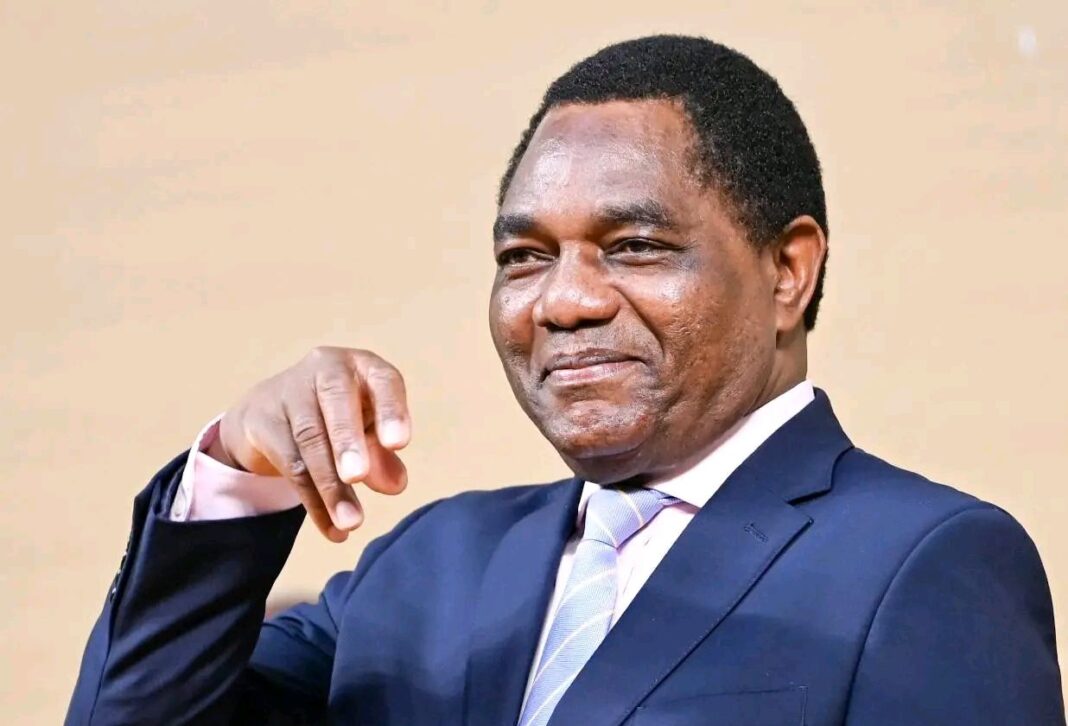
Five years of hard reforms have repositioned Zambia from a defaulted, stagnating economy into one of Africa’s fastest-growing. The work is unfinished . and only one man can finish it.
By M. Simuuwe – UPND
When Hakainde Hichilema took the oath of office in August 2021, he did not walk into a normal transition of power. He walked into a genuine national emergency a sovereign default, collapsed mines, gutted schools, and a decade of institutional decay that had been quietly eating away at the foundations of the country. What he has built in five years is nothing short of a national turnaround. On August 13, 2026, Zambia faces a decisive question: do we protect what we have built, or risk everything on the unknown?
A Nation Pulled Back From the Edge
The numbers tell a story that no political spin can fabricate. When President Hichilema assumed office, Zambia was posting a GDP growth rate of -2.8%, inflation had reached 22%, and the country had become the first African nation to default on its debt during the COVID pandemic. The economy was not just struggling,it was in freefall.
Today, those same indicators have been reversed. GDP growth is projected at 6.4% for 2026, inflation has been brought down to single digits, and Zambia’s gross international reserves now stand above US$6.5 billion, a figure that would have been unimaginable at the start of this administration. The kwacha has stabilised. The IMF, rarely given to flattery, has confirmed a primary fiscal surplus of 3.1% of GDP in 2025.
This is not rhetoric. These are independently verified, internationally recognised results projected GDP growth of 6.4%, 94% of national debt restructured, US$6.5 billion in foreign reserves, 1.1 million jobs created, 2.5 million children back in school, and over US$11 billion in mining investment attracted.
The Debt Miracle: Cleaning Up a Decade of Ruin
In 2011, when the Patriotic Front first came to power, Zambia’s external debt stood at US$1.9 billion. By the time they left office in 2021, that figure had exploded to US$18.6 billion. A decade of borrowing, spending and corruption had burdened every Zambian child with a debt they had no say in creating.
President Hichilema did what was politically painful but economically essential: he engaged the IMF, entered a structured reform programme, and successfully restructured 94% of Zambia’s external debt. Annual debt service payments, the money that was being swallowed by interest before it could reach schools or clinics, have been reduced from US$2.3 billion per year to approximately US$900 million. That is over US$1.4 billion redirected toward Zambian lives every single year.
Critics complained the process was slow. But consider the alternative: more default, more junk ratings, more capital flight, more unemployment. Hichilema chose the hard road. Zambia is now on the right side of it.
As the President himself put it in February 2026: “On August 13th, 2026, there will be a decision by Zambians based on our track record a solid one. We are not worried about the elections.”
Free Education: A Generation Rescued
Of all the President’s accomplishments, none carries greater moral weight than the introduction of free education from primary through secondary level. This single policy decision has brought 2.5 million children back into classrooms — children who had been excluded from education not by lack of ability or desire, but simply by their families’ inability to pay fees.
In May 2026, the President went further: he signed free education into law. This was not a campaign promise or a budget allocation that the next government could quietly reverse. It is now a legal right. Whatever happens at the polls, Zambia’s children are protected. That is the mark of a leader who governs for the long term, not just the next election cycle.
The administration has backed this policy with substance. Over 45,000 teachers have been recruited, and the Constituency Development Fund the vehicle that builds local schools, clinics and roads — has been expanded from K1.6 million per constituency in 2021 to K40 million in 2026, a twenty-five-fold increase.
The Mining Renaissance: Reviving Zambia’s Copper Heart
Copper is Zambia’s lifeblood — and under the previous government, that lifeblood was being drained. In 2021, only two mines remained operational. Mopani Copper Mine had been described as “comatose.” The Konkola Copper Mine was mired in litigation. Entire towns had been hollowed out as workers abandoned communities where no income was possible.
By 2024, eight mines were operational, with seven more in advanced stages of reopening. Mopani is now producing strongly again. Kalengwa Mine — idle for 47 years — has returned to production. Shaft 28, dormant for over two decades, is being brought back online. The copper town of Luanshya, which residents had largely abandoned, is being revitalised.
The President’s target is one million tonnes of copper produced this year, and three million tonnes annually within a decade. The investment to make this possible — over US$11 billion in committed mining capital — did not arrive by accident. It arrived because an investor-friendly, reform-committed, rule-of-law government was finally in place.
Energy, Agriculture, and the Infrastructure of the Future
When severe droughts threatened to crash Zambia’s hydroelectric power supply — and with it the entire economy — President Hichilema responded with structural reform, not panic. By opening the energy sector to independent power producers and liberalising generation, the administration prevented what could have been an economic catastrophe.
In agriculture, despite back-to-back droughts in 2023 and 2024 that would have broken weaker policies, Zambia recorded a historic bumper harvest of 3.6 million metric tonnes of maize. The administration’s investment in farmer support, input subsidies and irrigation infrastructure made the difference.
And beyond these sectors, Zambia is positioning itself as a manufacturing nation — now producing transformers, fertiliser for export, lithium batteries and other industrial goods. This is the beginning of the value-addition economy that Zambians have long been promised and rarely seen.
A Man Forged by Zambia — Not Born Into Power
Leadership is not only about policy — it is about character, and character is proven under pressure. Hakainde Hichilema is a son of the soil. Born in modest circumstances in Monze, he earned his way through the University of Zambia before completing an MBA in Finance and Business Strategy at the University of Birmingham. He built a successful business career, becoming CEO of both Coopers Lybrand Zambia and Grant Thornton Zambia, and served on the boards of institutions including Barclays Bank Zambia.
He did not inherit wealth or political position. He built both — through discipline, intellect and an unrelenting belief that Zambia could be more than it was. He ran for the presidency six times before winning in 2021. He was once imprisoned on politically motivated charges. He kept going. That is not ambition. That is conviction.
His international stature reflects this. In 2025, he was recognised by The Telegraph and other international observers as one of the best-performing African leaders, noted for restoring investor confidence, implementing fiscal discipline and stabilising an economy that had been deliberately driven off a cliff. Economic growth was projected at 5.8% in 2025 and 6.4% in 2026, with the mining industry tipped to record historic production and revenue levels.
The Stakes of August 13, 2026
Every election is a choice between two futures. In 2026, that choice could not be clearer.
The opposition offers nostalgia for an era that produced sovereign default, gutted mines, shuttered schools and institutional decay. They offer no credible alternative economic vision — only the promise that the current administration’s reforms are insufficient and that disruption would somehow produce better results.
President Hichilema offers something more valuable: a proven record, a clear plan for continued growth, and the international credibility to attract the investment Zambia needs for its next chapter. His government has acknowledged there is more to do — cost of living pressures, youth unemployment and infrastructure gaps remain real challenges. But these are the challenges of a growing, reforming country, not a collapsing one.
The copper boom that Zambia is entering — with the global energy transition driving unprecedented demand for the metal — will only benefit those in a position of economic stability, institutional credibility and investor confidence. Zambia is in that position today. Walking away from that would be a tragedy the next generation would bear.
The Verdict
The case for re-electing President Hakainde Hichilema is not built on hope — it is built on evidence. Debt restructured. Children educated. Mines reopened. Jobs created. Reserves rebuilt. Inflation tamed.
These did not happen by accident. They happened because Zambia finally had a president with the courage to make difficult decisions, the competence to see them through, and the integrity to stay the course when it was unpopular.
On August 13, 2026, Zambia has a simple choice: continue building, or start over. The answer is clear.




Mr Simuuwe how about starting your own propaganda website? Stop trying to sell your tribal party on LT
Sometimes it’s necessary to take a step backwards to move forward again
Why upnd cannot see where all this stems from is baffling