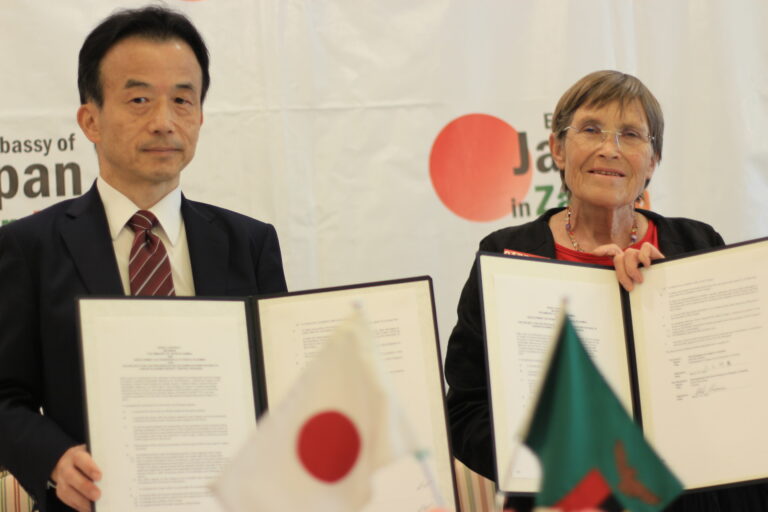
Government of Japan has signed a grant contract with Development Aid from People to people in Zambia (DAPP) valued at US$49,777 to support the installation of a solar power system at the Railway Surgery Health Centre in Kabwe District, Central Province.
Ministry of Health Permanent Secretary Administration, George Sinyangwe said the grant is part of Japan’s Grant Assistance for Grassroots Human Security Projects, aimed at improving the health and wellbeing of communities in Zambia.
Speaking at the contract signing ceremony, Dr Sinyangwe expressed gratitude to the Government of Japan for the generous support, which will significantly enhance the health centre’s capacity to detect and treat lead poisoning cases.
He noted that Kabwe District has historically been affected by lead contamination and the project will provide a reliable and sustainable source of energy for the laboratory, enabling uninterrupted operation of testing equipment and accelerating detection and treatment of lead poisoning cases.
Dr Sinyangwe said that the solar power system will support the health centre’s efforts to address the public health challenge posed by lead poisoning, particularly among children in the district.
He commended Development Aid from People to People (DAPP) for their role in mobilizing support and securing the grant, and urged responsible institutions to safeguard and maintain the solar power installation to ensure maximum benefit to the community.
The Japanese Ambassador to Zambia, Mikami Akiteru, has emphasised the importance of access to healthcare in human development.
“What may appear to be a simple installation of a solar power system will, in reality, have a profound impact on children’s health, their educational attainment, and ultimately, the future of this country,” he said
The Ambassador highlighted Japan’s own experiences with environmental pollution, citing the Ashio copper mine pollution incident, and emphasized the importance of environmental management and public health protection.
“Japan has supported research on lead contamination in collaboration with the University of Zambia and this project complements those efforts by strengthening local capacity for testing and treatment, he added
Meanwhile, Kabwe Central Member of Parliament, Chrizoster Phiri, expressed gratitude to the Government of Japan for its generous grant to support the installation of a solar power system at the Railway Surgery Health Centre.
Ms Phiri highlighted the challenges faced by the community, including superstition and reluctance to provide blood samples.
“This solar system will enable continuous testing and provide results that will help our children get better treatment,” she said
Ms Phiri stated that the project is expected to improve healthcare services in Kabwe, particularly for children affected by lead poisoning, and contribute to the government’s efforts to achieve free education and better health outcomes.
The project is implemented by Development Aid from People to People (DAPP) Zambia, which has been addressing lead contamination in Kabwe District through testing and prevention efforts.
The grant is part of Japan’s continued support to Zambia across various sectors, including health, education, infrastructure, and community development.