
Sunday, June 7, 2026
27 C
Lusaka
Home Blog Page 2704

The DSTV Mzanzi Viewers choice Awards make SA entertainment history

DSTV Mzanzi viewers choice awards

History was officially made at the inaugural DStv Mzansi Viewers’ Choice Awards held on 26th August . Over 1 million votes were cast for 50 nominees in 10 categories, as South Africa made her voice heard. The glittering gala evening was the culmination of a legendary battle worthy of Mzansi’s entertainment history, as fans put their thumbs through the wringer voting for their favourites in the inaugural DStv Mzansi Viewers’ Choice Awards.

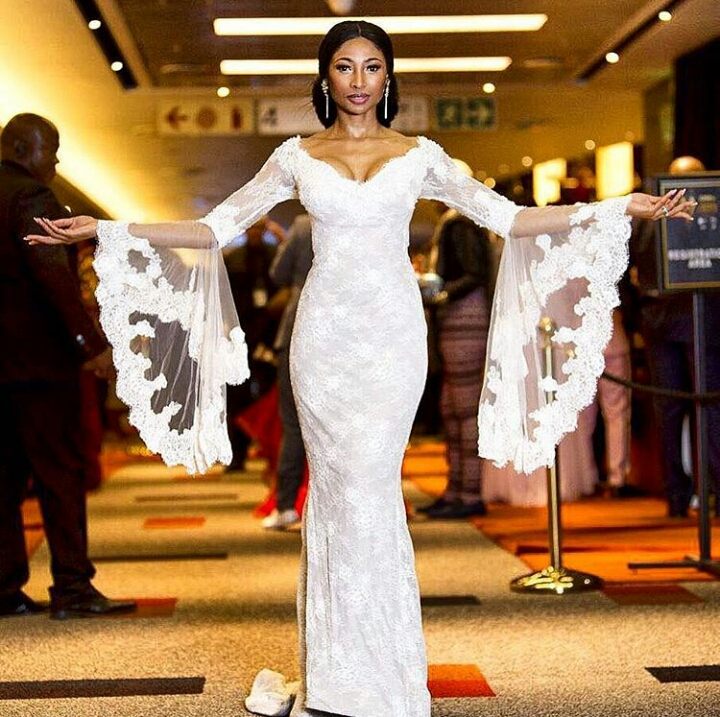
The red carpet at the Sandton International Convention Centre was ruled by ladies in alluring gowns and men in elegant suits, as fans cheered their favourites in an unparalleled fashion and glamour frenzy. Thespians, musicians, sports personalities and comedians were among those who put their best foot forward to be part of entertainment history in the making.

Bonang “Yo Girl B!” Matheba was beguiling as the evening’s MC, as she hosted guests and viewers in flawless style and boasting impeccable fashion. If this was a Night of the Stars, then Matheba was the brightest of all.

The DStv Mzansi Viewers’ Choice Awards was beamed live to millions of households via Mzansi Magic (DStv Channel 161). The show lit up all social media platforms and left the live audience at the ICC and those watching from the small screen in awe, as a parade of Mzansi’s finest entertainment talent walked off the stage clutching the coveted black and gold statuette.

Legendary jazz maestro, Hugh Masekela, was honoured with a Lifetime Achievement Award handed to him by M-Net CEO, Yolisa Phahle.

However, the night was not just about the who’s who of the entertainment industry. Anna Dithane walked off with R50 000 after being named the 1Life Life Changer for uplifting her community, proudly presented by 1Life Direct. Another R50 000 went to Eugene Dithane, who nominated his community warrior mother.

Viewers who voted also got a slice of the cake when one was rewarded with a brand-new Kia Picanto worth R150 000 after being randomly selected via an audited process. Another lucky voter found themselves with a R100 000 Vodacom World Shopping Experience after predicting the Song of the Year. It sure is rewarding to a DStv Mzansi viewer, neh!

The top-notch entertainment was befitting a celebration of this magnitude. The ICC auditorium was transformed into a laser-and-tribal print cavern, with the stage hosting – among others – the likes of Lady Zamar, social media dance maven Zodwa Wabantu, the majestic Thandiswa Mazwai, Lion of Judah power voice Lebo Sekgobela and the beautiful ratchetness of Gqom, led by seasoned industry pros DJ Cleo, Winnie Khumalo and Busiswa. Surprise special guest, Tshedi Mholi, made a throwback appearance wearing a ravishing and heavily-embellished fuchsia gown with a train worthy of bodyguards. Her stage partner Cassper Nyovest certainly “gave it away” on stage, and had the audience going wild. It was a sight to behold!

The charismatic gap-toothed Thembisa Mdoda was the belle of the ball as she scooped the gong not only for the Favourite Presenter category, but also the Ultimate Viewers’ Choice Award. It was the perfect ending to a perfect night! 

FULL LIST OF THE DSTV MZANSI VIEWERS’ CHOICE AWARD

SONG OF THE YEAR: Prince Kaybee – Charlotte

TV PRESENTER: Thembisa Mdoda

COMEDIAN: Summary

RISING STAR: Sjava

RADIO PERSONALITY: B2Cada

ACTOR: Themba Ndaba

ACTRESS: Vatiswa Ndara

MUSIC ARTIST OR GROUP: Kwesta

DJ: Black Coffee

SPORTS PERSONALITY: Caster Semenya

ULTIMATE VIEWERS’ CHOICE: Thembisa Mdoda

PICTURES FROM THE EVENT
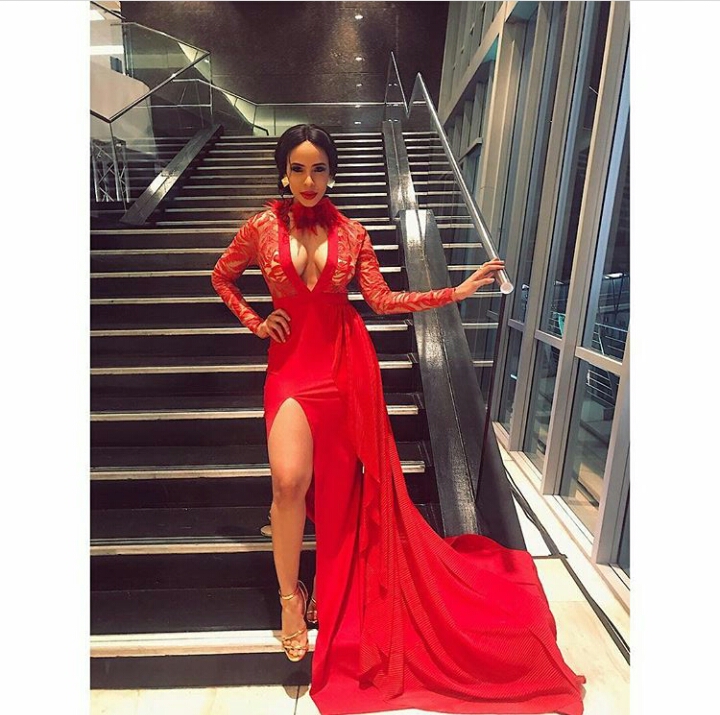
Thulisile Phongolo
Gert-johan coetzee(left)
Minnie Dlamini
Pearl Thusi
celebrities on the Red carpet
Bonang Matheba
Bonang Matheba
DSTV Mzanzi viewers choice awards
Thembisa Mdoda
Thulisile Phongolo
celebrities on the Red carpet
Enhle Mbali
celebrities on the Red carpet
Pearl Thusi


Leaders Know Your Emotional Intelligence

13

Leadership plays an important role in our families, local and international communities, churches and other places of worship and places of employment. The strength and endurance of each of these institutions will largely depend on whether leaders possess high emotional intelligence (EI). Leaders with deficient EI can often be dangerous to themselves and to those they lead. This article defines EI, five of its most important characteristics, and the leadership implications of each characteristic.
What is Emotional Intelligence?

EI (also referred to as EQ) is a term created by two researchers – Peter Salavoy and John Mayer – and popularized by Dan Goleman in his 1996 book of the same name. It is defined as the ability to recognize, understand and manage one’s own emotions and to recognize, understand and influence the emotions of others.

Leaders ought to be aware of the impact of their emotions which will often shape their behaviour and either have a positive or negative impact on those they lead. Despite this, many corporate, community and national leaders appear to lack any sense of EI. This could explain why many leaders appear oblivious to the consequences of their actions on those they lead.

It is important to appreciate that leadership is not restricted to a chosen few. At some level, we all assume positions of leadership, be it in a family context as husbands, wives, fathers, mothers and siblings or in the broader community, religious and employment contexts. Since we are all leaders, we ought to examine ourselves and be aware of the need for high EI. This ensures that we are better equipped to demonstrate effective leadership for the benefit of those we lead.

Critical to this goal is the need to learn to manage our emotions and influence the emotions of others in a way that will result in better relationships that are more likely to release our God-given potential as leaders. To this end, it is worth considering the five key characteristics of EI identified by Goleman which are: (a) self-awareness; (b) self-regulation; (c) motivation; (d) empathy; and (e) social skills.

Self-Awareness

Self-awareness involves recognizing and understanding our own emotions and motivations and their impact on others. To be able to recognise emotions leaders must clearly identify what they feel. This can range from fear, anger/rage, envy, hatred, self-attention, anxiety, sorrow, grief, despair, dejection, frustration, joy, trust, anticipation, high spirit, kindness, or love.
To understand our emotions it is essential that we discern the reasons behind it. If fear is the emotion, is it because of the wrongs you have done and you are afraid the truth may be revealed, or is your fear driven by the concern that having assumed a position of leadership, you will one day have to step aside? If envy is the emotion, is that emotion driven by jealousy of another person’s success, intelligence or popularity.

A genuine leader who remains alert to the drivers behind his or her emotions will stand a better chance of avoiding pitfalls that present when emotions are not kept in check. In the political context, leaders will often succumb to the abuse of instruments of power and government institutions to cover up wrong deeds, target opponents and corruptly amass wealth. Behaviour that results from fear, hatred, and envy is more likely to present as a reign of terror, intolerance of divergent views, suppression of freedoms and human rights and outright impunity as regards laws of the land. A fearful, hateful, and envious leader is likely to have no confidence and self-worth. He or she may even find it difficult to accept and appreciate those that helped elevate him or her to that position of leadership.

Self-Regulation

Self-regulation simply means the exercise of self-control and restraint. Ultimately, self-regulation is the capacity to delay or stop our impulses. When faced with emotions it is better not to act in the heat of the moment but rather reign in our emotions and use the head and not the heart (seat of emotions) before responding.

The Bible says in 1John 2:16 and 17:
16 For everything in the world—the lust of the flesh, the lust of the eyes, and the pride of life—comes not from the Father but from the world.
17 The world and its desires pass away, but whoever does the will of God lives forever.

Our lives are bombarded by the three “Ps” in verse 16: passion (lust of the flesh), pleasure (lust of the eyes), and pride. These are powerful forces that may drive our behaviour in ways that are not compatible with God’s expectation if we are not able to regulate ourselves. It is in pursuit of these vices that many leaders in all spheres of life have failed their accountability test as leaders.

Self-Motivation

Leaders cannot be effective without motivation. Self-motivation involves mobilising our positive emotions to drive us to our goals. A leader with high EI will likely have a deep desire to succeed in his or her leadership role. Those positive emotions include joy at seeing other people succeed, love for those we lead, kindness towards the weak and vulnerable.
Where a person possessing such traits assumes a position of leadership, his or her pre-occupation is more likely to be focused on creating and fostering a conducive environment for tranquillity and prosperity of his or her constituents. Such a leader would also have a clear vision that would drive his or her own behaviour and influence the behaviour of those constituents.
Contrast the above to a leader with low EI who will instead seek to amass wealth, power and status at all cost, as a result of negative emotions such as fear, anger, grief, envy, and shame. The instruments of power in the hands of such a leader would therefore be used for self-serving purposes to the detriment of that leader’s constituents.

Empathy

Empathy is the experience of understanding another person’s condition from their perspective. You place yourself in another’s shoes and feel what they are feeling. A leader with high EI is empathetic such that he or she is able to understand the despair, sorrow, and grief of the weak and the less fortunate. Such a leader would be concerned with the welfare of his or her constituents and would use their position of power and influence for their benefit. Like Jesus Christ, an empathetic leader would not be master but a servant.
In contrast to the above, an un-empathetic leader can be dangerous. Traits that characterise such a leader include brutality, cruelty, deception, evil, hateful, inhumane, malicious, mercilessness, and sadistic. Such a leader takes pleasure in the suffering of others.

Social Skills

Social skills are the skills we use to communicate and interact with each other, including both verbal and non-verbal means of communication and interaction. The Bible has many scriptures that illustrate the point that our communication comes from deep within our hearts. A good leader will do well to “watch over your heart with diligence, for from it flow the springs of life. Jesus Christ said:
No good tree bears bad fruit, nor does a bad tree bear good fruit. Each tree is recognized by its own fruit. People do not pick figs from thorn bushes, or grapes from briers. A good man brings good things out of the good stored up in his heart, and an evil man brings evil things out of the evil stored up in his heart. For the mouth speaks what the heart is full of.

Jesus thus provides us with the tools with which to test our leaders’ social skills. Becoming a good leader takes effort, it does not come on a silver platter. Watching over your heart takes deliberate personal effort. It requires self-improvement. You have to be a long-life learner, though it is never too late to start afresh. This means that even leaders who are driven by bad emotions can be transformed through learning and by the grace of God from communicating by means of threats and fear-mongering to guiding their constituents with inspiration. In that regard, a good leader will use persuasion and negotiation to manage conflict and not brutal suppression of dissent.

Conclusion

The various characteristics of EI outlined above are important tenets for effective leaders. Leaders that lack emotional intelligence can be dangerous to themselves and the people they lead. Leadership can be learned, but above all it must be driven by a deep desire to succeed for the good of one’s constituents.

By Mapanza H Nkwilimba

Janza slams referee Nkole

4

Red Arrows coach Honour Janza has alleged that Lusaka referee Audrick Nkole favoured Power Dynamos to beat his side 3-1 on Saturday.

Nkole awarded Power a controversial late penalty that was converted by two-goal hero Alex Ng’onga as Power overcame Arrows in this Round 25 match of the Super Division.

In a post-match interview, Janza described Nkole’s officiating in this game as the worst he has experienced.

“Let the referees not participate in influencing the game. Let the officials make the ground even for both teams.
The referee must be fair to the boys,” he lamented.

“This is the worst officiating I have experienced. You can see that this is a mistake or the referee did it deliberately. The first goal for Power Dynamos, if there are no longer offside rules in football the referees should tell us,” he said.

Nkole also sent off Janza’s assistants Joel Bwalya and Kalililo Kakonje for protesting his decisions.

“For me it was useless to be on the bench with that officiating.”

Power coach Dan Kabwe saluted his team for scoring three goals.

“Goals have flown today. I am happy we have scored,” Kabwe said.

Correctional Services welcomes Constitutional Court’s decision to allow prisoners to vote

17

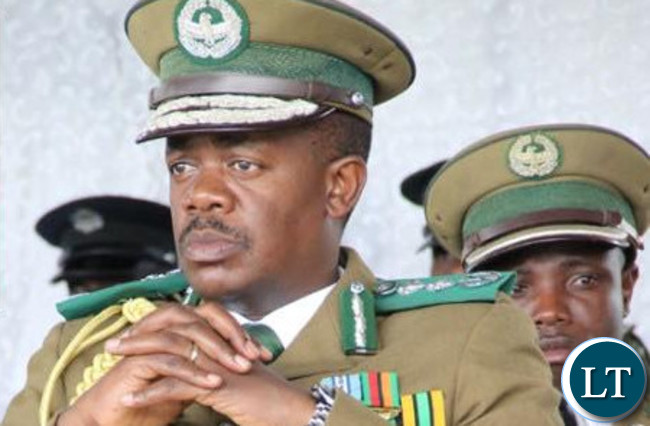
Zambia Correction Service Commissioner General Percy Chato
ZAMBIA Correctional Service Commissioner General Percy Chato has welcomed the Constitutional Court’s decision to allow remandees to vote because people in incarceration have the right to participate in elections.

Mr Chato said in an interview that inmates too have human rights, including that of voting.

“We welcome the court’s decision [to allow inmates to vote] and the inmates surely deserve to vote. We will study that decision and put in place regulations and benchmarks,” Mr Chato said.

Recently, Constitutional Court judge Enoch Mulembe ruled that remandees and other people in incarceration who have appealed against their cases be allowed to vote during elections.

Judge Mulembe ordered that persons in lawful custody and those whose freedom of movement is restricted under the law be allowed to vote in future elections.
This was after Prison Care and Counselling Association executive director Godfrey Malembeka petitioned the Electoral Commission of Zambia and the Attorney General in the Constitutional Court over the matter.

Mr Malembeka wanted a declaration that all remandees and convicts who have appealed against their cases and are unable to secure bail be allowed to vote.

Kansanshi Mines truck accident pollutes Kifubwa River

13

Solwezi residents scramble for poisoned fish as acid tanker spills into Kifubwa River
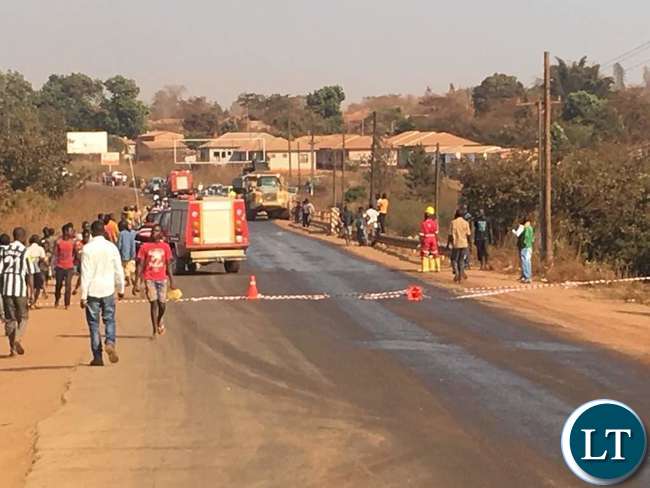
A truck from Kansanshi Mines has overturned at Kifubwa Bridge spilling sulphuric-acid into the Kifubwa River in Solwezi District.

North-Western Water and Sewerage Company has since shut down six of its boreholes at Kifubwa well fields in order to assess the extent of the contamination.

The incident happened around 07:00 hours this morning as the truck was on its way to deliver the chemical to the mine but tried to overtake a Toyota Spacio car.

North Western water and sewerage company project Manager Mufalo Kabika has told ZNBC’s Patricia Banda at the accident scene that the shutdown will affect about sixty percent of its customers who get water from the boreholes.

And Kansanshi mine safety manager Baston Sichinsamba says the mine has with immediate effect engaged the Zambia News and Information Service (ZANIS) to sensitise people not to eat fish from Kifubwa River.

Mr. Sichinsamba says the other safety measure that will be put in place is to put lime around the accident scene and in the water to neutralise the chemical.

Meanwhile, Ministry of Water Development Permanent Secretary Bishop Ed Chomba says the sulphuric spillage incident is unfortunate adding that a comprehensive statement will be issued soon.

Bishop Chomba stated that polluting the environment is a serious offence under law.

Eastern Province tops the Divorce Chart in Zambia

16


OVER 28,000 divorce cases were recorded countrywide last year mainly because of infidelity between spouses.

According to latest statistics from the local court office, Zambia recorded 28,101 divorces across the country’s 10 provinces.

The average age of couples seeking divorce was between 20 and 45 years.

Eastern Province had the highest number of divorces, at 5,889.

One of the major causes of divorce in Eastern Province was cruelty between spouses.

Western Province recorded the second highest number of divorces at 5,537 with ill-treatment, adultery and conjugal rights disputes being among the major causes.

Copperbelt Province had 3,764 cases followed by Lusaka, which had 3,325.

In Lusaka, the major causes of divorce included lack of proper marriage counselling, interference from friends and family members as well as poor communication among couples.
On the Copperbelt, the major causes of divorce included adultery and desertion.

Southern Province had 2,873 cases followed by Northern Province, which registered 2,142 cases.

The major cause of divorces in Southern Province was extra -marital affairs while the love for money and material things was the major cause of divorce in Northern Province.
North-Western Province recorded 1,652 cases with mistrust and poverty being the major causes.

Luapula Province had 1,281 cases with over-expectation from spouses being the major contributor to divorces in the region.

Central Province registered 888 cases of divorce with fear of contracting HIV from spouses being the main causes of divorce.

Muchinga Province had the lowest number of divorce cases at 750 mainly because of marital disputes.

Research indicates that divorced adults are more likely to become impoverished while their children experience psychological and economic stress which hinders their social development.

A Chines Investor to spend $500 million on constructing a cement production plant in Chongwe.

6

A CHINESE investor Sinoma Mpande Limestone Limited will spend US$500 million on constructing a cement production plant in Chongwe.

During a tour of the plant in the company of Minister of Water Development, Sanitation and Environmental Protection Lloyd Kaziya recently, Lusaka Province Minister Japhen Mwakalombe said he was happy that about 1,000 jobs have been created so far.

Mr Mwakalombe reaffirmed Government’s commitment to creating employment for Zambians.

“First of all, I am very excited that Sinoma is investing such huge amounts of money in this plant. What is so exciting is that the management has taken care of issues of dust emission into our environment.

“I am pleased as provincial minister that issues of job creation for the local people have been prioritised by Sinoma. We want jobs for our people,” he said.

Mr Mwakalombe also asked the Ministry of Water Development, Sanitation and Environmental Protection to work closely with his office so that issues of environmental protection can quickly be resolved by the Zambia Environmental Management Agency to enable the plant to operate at full capacity.

And Mr Kaziya said direct private sector investment is key to industrialisation, a development which President Lungu has prioritised.

“This is a project worth supporting, we need such industries in Zambia. This is what President Lungu is committed to achieving. The head of State wants more jobs to be created. We will do everything possible to support such investments,” Mr Kaziya said.

Sinoma Mpande Limestone Limited managing director Zhang Yuanci said about 85 percent of the works at the plant have been completed.

Mr Yuanci said the plant is expected to be commissioned in March next year, and that over 600 Zambians will be employed when it is fully operational.

“We plan to send Zambians for further training in China, after which they will be engaged to come and work at the plant. Most of our workers will be local people,” he said.

Mr Yuanci said about US$200 million has so far been invested in phase one of the construction of the cement production plant.

Farmers Union ready to be taken to court over the refusal to sell maize to FRA at K60 rate

12

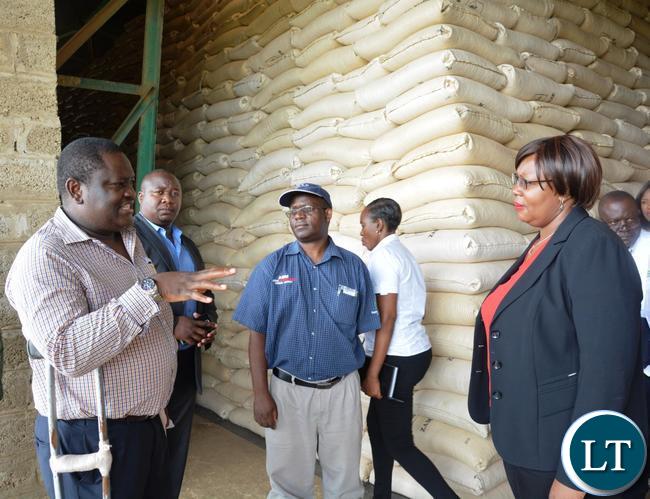
Food Reserve Agency Executive Director Chola Kafwabulula(l) explaining to the Minister of Agriculture Dora Silaya(r) as she toured the Food Reserve Agency
Food Reserve Agency Executive Director Chola Kafwabulula(l)
explaining to the Minister of Agriculture Dora Silaya(r) as she toured
the Food Reserve Agency
THE Zambia National Farmers Union (ZNFU) has maintained that it will continue urging farmers to hold on to their maize despite threats of court action by the Food Reserve Agency (FRA).

Last week, FRA executive director Chola Kafwabulula threatened to drag ZNFU to court for urging farmers to hold on to their maize so that they do not sell the commodity to the agency.

But in a statement yesterday, ZNFU second vice-president Austin Shinachize said no amount of pressure or threats will stop farmers from getting a good price for their crop because they need to regenerate money for further investments.

“We as farmers are the owners of the commodity [maize], and we are ready to be sued for refusing to sell our crop for a pittance. The buyer cannot dictate the price at which to buy the crop. The producer, the seller should,” Mr Shinachize said.

He said the best route FRA can take is to re-negotiate the price of maize with farmers, failure to which they will continue holding on to the commodity.

“If FRA thinks the solution lies in the court process, we are ready to face them. But as far as ZNFU is concerned, we are still waiting for a meeting with the Minister of Agriculture whom we wrote a letter to so that the farmers’ cry can be heard,” he said.

There has been a stand-off between FRA and ZNFU over the K60 price for a 50kg bag of maize.

Government to make it illegal to marry any person under the age of 21

87
Victoria Kalima
Victoria Kalima

Government will revise the marriage Act that will describe a child as any person under the age of 21.

Minister of Gender Victoria Kalima says the law will have to be harmonised to make it effective in the fight against vices such as early marriages and defilement.

Ms Kalima says at the moment, the law describes a child as anyone under the age of 16 while any person can marry at the age of 18.

She says the Marriage Bill is before the ministry of justice and will soon be presented to Parliament.

Ms Kalima says once the bill is passed, it will be illegal for anyone to marry or have canal carnal knowledge of a person under the age of 21.

The Minister was speaking when she called on Chief Mushoro during the presentation of bicycles for the stop early marriages campaign in Chipata.

Ms Kalima said the bicycles will be used in disseminating information on the dangers of early marriages.

And Chief Mushoro said the bicycles will be handy in disseminating information in his chiefdom.

He said it has been difficult to spread information on GBV because of lack of equipment.

And Women for Change Executive Director Lumba Siyanga says Eastern Province is one of the worst affected by early marriages and defilement cases in the country.

Ms Siyanga however said it is encouraging that more people are now coming out in the open to report such cases.

ZRA to use private sector agents to collect taxes from the informal sector

5
The Zambia Revenue Authority (ZRA) is holding a ZRA Open Day in the central business district on Ndola on the Copperbelt from 30th to 31st March, 2017 in a bid to bring services closer to the people and encourage them to pay their taxes as well as access other services offered by ZRA such as Tpin registration. Picture by Tisa Banda-Nkhoma/ZANIS

THE Zambia Revenue Authority (ZRA) will partner with private sector organisations by appointing them as agents to collect taxes from the informal sector.

ZRA corporate communications manager Topsy Sikalinda says this is part of the authority’s strategy to broaden the tax base by improving collection systems for taxes such as turn-over, base, presumptive on taxis and minibuses, and withholding tax on rentals.

He said in a statement yesterday that the agents will be key in collecting taxes from all players in the informal sector through smart partnerships with ZRA.

Mr Sikalinda said the decision is in line with the provisions of the Income Tax Act Chapter 323 of the Laws of Zambia.

He said to be considered for selection, ZRA has put in place clear criteria which bidders will be subjected to.

This will include adequate financial and non-financial resources, evidence of effective working collaboration with key stakeholders, a well-organised record-keeping system and good performance.

Mr Sikalinda said successful agents will be required to propose and implement best revenue collection modalities or mechanisms which will guarantee security of government revenues, efficiency and timeliness in tax collection.

“In line with the local empowerment policy of the government, ZRA will give priority to Zambian influenced entities. The bidders are required to submit company registration and valid tax clearance certificates for them to be eligible for consideration.

“The agents, in executing their functions, shall submit all reports on deliverables to the office of the commissioner general under whose direction they will be working. The contracts with agents will initially run for 12 months with a possibility of renewal depending on performance,” Mr Sikalinda said.

Mopani has Crossed the Red Line by cutting 300 Contracts for Zambian Suppliers and Contractors

29
GREEN Party Presidential Candidate Peter Sinkamba

By Peter Sinkamba

We as the Green Party believe Mopani Copper Mines (MCM) has now crossed the red line by cancelling 300 contracts for Zambian suppliers and contractors in addition to its planned retrenchment of 4,700 miners.

If Government has failed to veto the absurd MCM management through the Golden Share scheme, then it is high time that President Edgar Lungu invoked Emergency Powers Act to end the impunity of the company. Section 3 Regulation 2 of the Emergency Powers Act empowers the President to take over, on behalf of the Republic, any undertaking in an industry which has been declared a strategic industry by the President. Mines are classified as strategic industries, and therefore eligible for compulsory acquisition if the manner in which management of the mine is running the company is inimical to State security and national economy.

As the Green Party, we expect President Lungu to move in and deal with the issue of MCM personally. Parliament gave him the powers through the resolution which was overwhelmingly supported. Those power should not be only seen to used to harass ordinary citizens at markets and for loitering (shishita) purposes. The powers should be used for economic sabotage acts such as the MCM case which have more serious and widespread local, regional and national impacts.

It is pointless for the President to venture into shuttle diplomacy by sending his Ministers to MCM, when the company has shown serious disrespect for his government and the people of Zambia.

There is absolutely no reason for his government to continue pleading with Mopani, unless his government is compromised through state capture corruption. This level of corporate impunity by MCM only manifests when Government officials captured by the Company, whereby the ruling elite and powerful businessmen manipulate policy and influence rules of the game to their own advantage. A captured economy is thereby trapped in a vicious circle in which the policy and institutional reforms necessary to improve governance are undermined by collusion between powerful firms and state officials who extract substantial private gains from the absence of clear rule of law and interventions by government officials. At the end of the day, a small group of people is able to extract considerable profits from those distortions.

We believe government is in a state of capture because there is no excuse why MCM operations should not be compulsorily acquired.

First, this company, which has been operating for 17 years has not paid any dividends for the 20% government stake but keeping all profits to itself.

Second, this company has pruned workers from 30,000 at privatization in the year 2000 to 8,000 at the moment, and wants to reduce that further to 4,000.

Third, the company has been giving petty businesses to Zambian suppliers and contractors. The bulk of businesses are given to Peruvians and South Africans. Even for the petty businesses, 300 such contracts has been terminated.

Fourth, the company has hedged it copper sells at $3,000 per tonne. Even if the price of copper reaches $10,000 or more, Zambia will get nothing because the hedged $3,000 per tonne is less than the production cost of $4,000.

Fifth, the company is failing to pay for electricity and owes CEC $15 million yet it making a big kill from copper sales now fetching $6,500 per tonne. We the poor members of the public are paying even high cost reflective tariffs upfront through prepaid scheme. Why should a foreign firm making big profits fail to pay. The company wants to cling on to the so-called Power Supply Agreements which were cancelled by the late President Mwanawasa. Those agreements have no legal leg to lean on.

Sixth, the company owes the Zambian people more than $80 million in environmental liabilities which it has failed to cover through bank guarantees.

Seventh, the company has failed to provide key documents to ZRA to fully assess its VAT returns and and its copper sales, whereby civil society estimates indicate Zambian has been defrauded by the comapny in excess of $10 billion. The company denies but the only way it can be vindicated is to provide documentation in a transparent manner but is refusing to do so. Why should government continue tolerating such a fake company?

Eighth, this company was acquired from ZCCM “at a song” and not through a cash transaction but credit or “nkongole”. Government gave it tax exemptions running in hundreds of millions of dollars. Why should government fail to re-acquire it through similar fashion?

Ninenth, from company documents posted through the “Mopani Way” public relations, it appears this company plans to abandon operations in Zambia in 2023. Why should we wait until the copper reserves are exhausted?

Tenth, the multi-billion question then is: Why should a responsible government continue allowing a foreign company to rape natural resources to the extent of Mopani if it is not captured?

If the PF Government is not captured, we demand that the President moves in immediately to acquire the MCM assets forthwith. We also demand that all contracts for Peruvians and South Africans are cancelled forthwith. We finally demand that all work permits for MCM expatriates and contractors are cancelled forthwith.


President
Green Party of Zambia

Young women in Zambia must fight for political space-CYLA

0
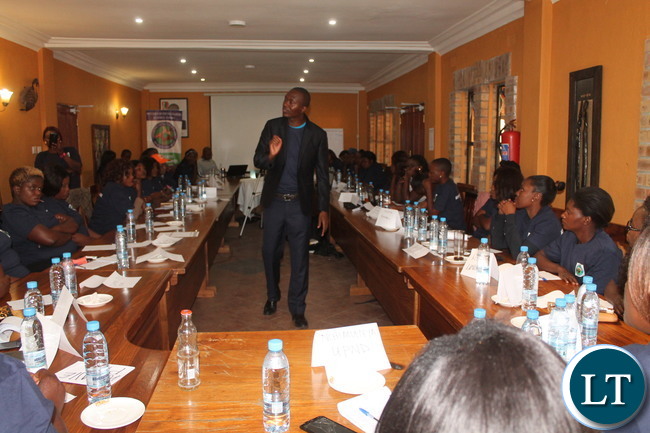
 Some of the Youth women who took part in the capacity building workshop
Some of the Youth women who took part in the capacity building workshop

The Centre for Young Leaders in Africa (CYLA) has called on young women in the country to fight for political space.

Speaking during a capacity building workshop for women youths from various political parties, CYLA Executive Director Jones Mulunga said it was high time that women fought for positions in decision making posts as opposed to waiting to be given.

Mr Mulunga said women should not accept being given positions freely because free things don’t last.

He said women should embrace competition as that is the only way they will gain political power.

He noted that men will never give up power easily hence the need for women to come together and fight for a common agenda of ensuring that their participation in leadership was at par with men.

He urged the women in the country to stop fighting each other but embrace the idea that they can work together for the good of the country.

He explained that what has made few women to participate in politics and leadership was the fact that women were not embracing each other once they ascend to power.

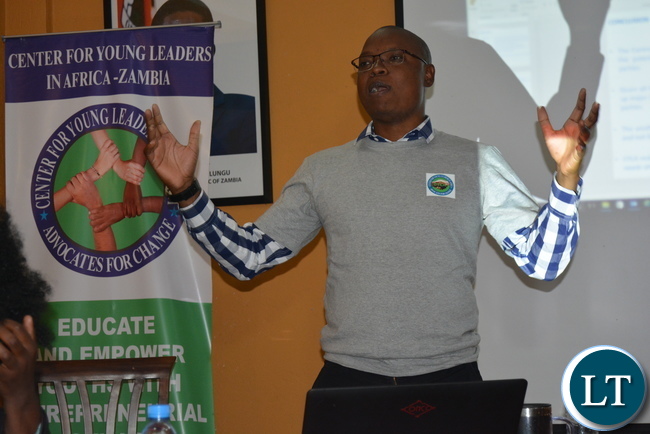
And another facilitator Robinson Chipili who is the Director of Programs for CYLA said jealousy and name calling was a big hindrance to the full participation of women in politics.

Mr Chipili noted that women are scared of joining politics because they fear being labelled as prostitutes.

He noted due to jealousy women do not support each other when one of their own is on top but instead concentrate on trying to bring them down.

The workshop was attended by women youths from among other parties NAREP, UPND, UNIP, FDD, PF and MMD others were ADD, Rainbow Party and the Greens

Robinson Chipili making a presentation
Jones Kalunga making his presentation during the workshop

Presidential Empowerment Initiative Fund has distributed K10 million to over 7,000 traders and vendors

1

PEIF Patron Chanda Kabwe
The Presidential Empowerment Initiative Fund (PEIF) has disbursed more than K10 million to over 7,000 traders and vendors since its inception in 2015.

PEIF Patron Chanda Kabwe said the money which is part of the President Edgar Lungu’s contribution to vulnerable marketeers across the country has been in form of loans.

Mr Kabwe said during Patriotic Front (PF) media interactive forum in Kabwe yesterday that the Fund was targeting to reach 17,000 beneficiaries by 2020.

He said contrary to claims by some disgruntled politicians, the initiative had changed many lives of people who were giving testimonies on how they had developed after receiving the loans.

President Edgar Lungu continues to contribute up to 10 percent of his monthly salary towards the empowerment initiative while other contributions come from well wishers.

“There are great stories out there because we have changed the lives of many people that have benefited from the funds and these are stories that can be confirmed by the beneficiaries.

“You should also realise that we have never used a single ngwee from the Government, this is a generosity from the President in response to the sufferings of the marketeers and vendors,” he said.

Apart from the monetary benefit, the presidential initiative had also offered material as well as constructed market infrastructure to improve the operations of traders and vendors.

He said more than 800 traders at Kitwe’s Chisokone Market had benefited from the funds while K300,000 had been spent on the construction of an ablution block for marketeers at Fisenge in Luanshya.

Mr Kabwe, who is also Central Province Permanent Secretary, said the Fund would on Tuesday launch the first disbursement in Southern Province where K200,000 is expected to be given out in Mazabuka.

He also revealed that the Fund structures that determined how the money would be disbursed while its books were audited regularly to ensure that there was no abuse.

Mr Kabwe however, admitted that the loan recovery rate was low because many people were not paying back after receiving the funds.

“But we know that this is because there are some people that have been going in markets telling the traders that they should not pay back.

“So have engaged some experts including the banks to train marketeers before receiving the funds so that they are able to pay back.

During the Interactive Forum, Mr Kabwe also disbursed K500 to each of the nine Kabwe traders who are selling various merchandise.

Mopani needs accept Government’s decision to remove subsidies on electricity-President Lungu

13

President Lungu with mopani Chief Executive officer Mr Johan jansen tour Synclinorium Shaft at Mopani operation room operates the Shaft gear in the Control Room – Picture by Eddie Mwanaleza 05th May 2016.
President Edgar Chagwa Lungu has implored Glencore owned Mopani Copper Mines Ltd, to accept government’s decision to remove subsidies on electricity that for a long time has kept the cost of energy in Zambia lower than any other country in the sub-region said Presidential Spokesman Amos Chanda.

Briefing the media in Lusaka today, Chanda said the phasing out of unrealistic subsidies that left a huge hole on government coffers in the energy sector, fuel and even agriculture sector must be respected by corporate bodies.

“Ordinary Zambians, mostly poor Zambians have already accepted the removal of subsidies. Mopani must accept the move too,” Chanda said, “The President has instructed the Mines Minister to engage Mopani immediately and resolve this matter.”

This comes on the heels of MPC also co-owned by First Quantum Minerals and ZCCM-IH threats to sack thousands of workers due to the removal of subsides that is going to push up the cost of power.

Low tariffs in the energy sector due to heavy government subsidies that have been in place for over 40 years has discouraged investment in the sector. Now the interest in Zambia’s energy sector has about doubled.

President Lungu becomes the first Zambian President to pull the plug off the consumption subsidies on both the energy and fuel sector since independence in a move hailed as progressive by bi-lateral and multilateral partners.

Chanda in a recorded statement said President Lungu has refused to be blackmailed by private business, as he tries to create jobs and expand the economy.

Revision of Zambia’s sovereign rating is an affirmation of the soundness of Government policies-Felix Mutati

38

Minister of Finance Felix Mutati
The revision of Zambia’s sovereign rating by Standards and Poors Global from negative to POSITIVE-WITH-A-STABLE-OUTLOOK is an affirmation of the soundness of the policies being implemented by the Government of President Edgar Chagwa Lungu to stabilize and grow the economy, FINANCE MINISTER FELIX MUTATI has said.

STANDARD AND POORS [S&P] GLOBAL RATINGS has revised Zambia’s outlook on the ‘B’ long -term foreign and local currency sovereign ratings to STABLE FROM NEGATIVE. At the same time, the ‘B’ long-term and ‘B’ short-term sovereigns have been affirmed.

“This development rides on the basis of the critical reforms which we have embarked on as a country under the Economic Stabilisation and Growth Programme to implement fiscal consolidation, remove subsidies, reform the energy sector, and embark of diversification of the economy through agriculture development and industrialisation,” Mr. Mutati has said.

“The result from the assessment conducted by S&P Global is a welcome incentive for investors as they should remain confident assured that this country is on track with economic stabilisation and growth,” he said.

“We will work diligently to ensure that the confidence of our people and that of investors in the good intentions of the government to stabilize and grow the economy are not taken for granted,” assured Mr. Mutati.

According to the report on Zambia issued by S&P Global last Friday 25th August, 2017, “although still tight, the government’s fiscal financing position appears more assured, with domestic liquidity conditions continuing to improve.”

S&P Global has also observed in the report that the country’s economic growth prospects are improving, as a result of which, they said, they were revising their “outlook on Zambia to stable from negative and affirming the ratings at ‘B/B’.”

In the report issued by BENJAMIN YOUNG, Primary Credit Analyst, and GARDNER RUSIKE, Secondary Credit Analyst, S&P Global further stated that Zambia’s “stable outlook, balances an improving macroeconomic picture against a number of negative rating pressures, including a still large fiscal deficit and substantial debt stock.”

They cautioned that the rating could be lowered if the government materially deviated from its FISCAL CONSOLIDATION TARGET.

“We could also lower the ratings if previously destabilizing factors re-emerge, for example, if copper prices were to materially fall, or if rainfalls disappointed, or if improvements in the liquidity of the domestic banking system reversed,” they said, adding that “these factors have a substantial bearing on macroeconomic stability, growth, and the government’s financing position.”

S&P Global noted that, “should Zambia’s external imbalances reduce materially faster than expected in tandem with faster growth than they currently expect, which could raise their GDP per capita trend growth forecast, “UPWARD MOMENTUM ON THE RATINGS COULD EMERGE.”

“We have assigned a stable outlook to reflect a number of more positive developments that we expect will continue to reduce pressure on Zambia’s fiscal, economic, and external assessments,” they said, adding that they still assessed “Zambia as being highly vulnerable to a reversal of these trends, despite the authorities implementing policies that aim to reduce macroeconomic susceptibility to such events,” and further stating that, “we have improved our economic growth forecasts and expect increased economic output will be supportive of corrective fiscal measures.”

In the report, S&P Global views reducing fiscal deficits and the stock of debt as CORE TO ZAMBIA’S RATING TRAJECTORY, particularly as larger external debt maturities enter the forecast horizon through 2020.

S&P Global expects the agreement with the International Monetary Fund (IMF) to be in place by year end and that this will act as a policy anchor.

“We also note that discussions with the IMF have been ongoing for well over a year, derailment of an expected agreement could dent confidence, reduce investment, and offset the positive factors,” they said, and cautioned that, “it could also risk the benefit to external finances of increased foreign participation in the government’s local currency debt market.”

S&P Global further noted that, “particularly between now and an IMF disbursement, higher copper prices and an expected increase in copper output are both supportive of not only higher growth but also of banking system liquidity, which in turn is a key source of government financing.”

Copper prices have risen by about 18% in 2017 and core liquid assets in Zambia’s banks by some 44% over the same period. The Bank of Zambia has continued to ease its policy rate and Zambia’s currency, the kwacha, has remained on a slight appreciation path for some time now. As a result of these factors, the cost of debt for the government has also reduced. A related factor, given that inflation has fallen, is that foreign participation in the local bond market has increased by around 2.5% of GDP over 2017, which is a helpful current account deficit financing item.

“On the downside, the factors leading to anticipated higher growth are largely outside of the government’s immediate control, leaving them vulnerable to calming demand for copper or unfavorable weather patterns,” said S& P Global, acknowledging that, “the government has made efforts that are gradually diversifying the country’s energy mix.”

AND Mr. Mutati has reaffirmed that government will continue to pursue fiscal consolidation, economic stabilisation, and growth. He maintained that the Ministry of Finance will remain highly alert on the need to reduce borrowing by enhancing resource mobilisation initiatives such Public Private Partnerships, increasing grant-inflows, and reinforcing tax-related initiatives which are targeted at strengthening enforcement and compliance.

S&P Global Ratings’ analysis of sovereign creditworthiness rests on its assessment and scoring of five key rating factors: (i) institutional assessment; (ii) economic assessment; (iii) external assessment; (iv) the average of fiscal flexibility and performance, and debt burden; and, (v) monetary assessment.