Sunday, June 14, 2026
21.6 C
Lusaka
Home Blog Page 56

Gonzales exit speech shakes Zambia politics

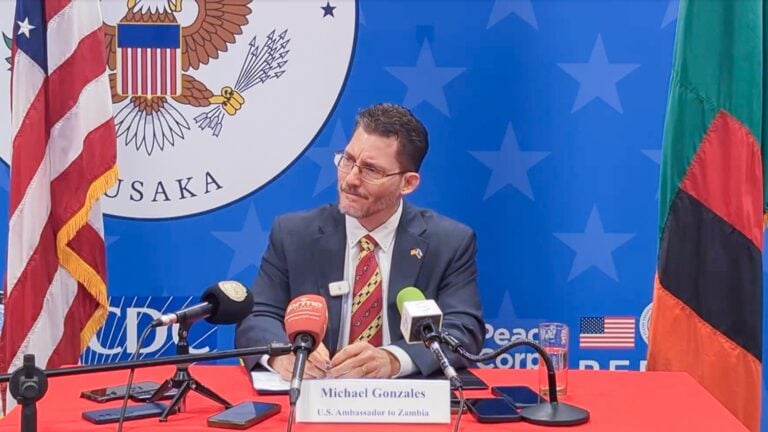
LUSAKA — Outgoing United States Ambassador Michael Gonzales has left Zambia with a farewell speech that has rapidly evolved into one of the most politically disruptive developments of the country’s election year, forcing corruption, institutional credibility and governance accountability back into national focus just as political parties intensify preparations for the August 13 general election.

What was expected to be a routine diplomatic send-off quickly became a national political flashpoint after Gonzales questioned the credibility of anti-corruption efforts, raised concerns about institutional accountability and warned about governance weaknesses that continue to undermine investor confidence. His remarks landed at a time when political temperatures were already rising and economic frustrations remained deeply embedded among voters confronting high living costs and employment pressures.

The speech immediately triggered fierce political reactions across the opposition landscape, where several leaders argued that the remarks merely amplified concerns citizens had already been expressing privately and publicly. Opposition figures linked the comments to wider frustrations over unemployment, rising household pressure, governance standards and public trust in state institutions. Others argued that international concern over accountability had now become impossible for government to dismiss as partisan political rhetoric.

Government adopted a more measured tone as pressure intensified. Officials indicated that diplomatic channels would be used to establish whether Gonzales had been speaking on behalf of the United States government or expressing personal views at the end of his diplomatic assignment. The cautious response appeared designed to prevent the controversy from escalating into a diplomatic dispute while avoiding prolonged public confrontation over the substance of the allegations.

The controversy has also reopened broader scrutiny of Zambia’s anti-corruption programme, one of the administration’s most prominent campaign promises after taking office. Supporters argue meaningful progress has been made through investigations, prosecutions and institutional reforms aimed at restoring accountability. Critics maintain enforcement has been inconsistent and selective. That divide has now returned to the centre of national political discourse at a time when confidence in institutions remains politically valuable.

The economic implications are equally significant. Zambia is aggressively pursuing investment in mining, agriculture, infrastructure and energy while working to consolidate gains from debt restructuring and improve fiscal stability. Investor confidence often depends on predictable institutions, transparent governance systems and policy consistency. Sustained public controversy around corruption enforcement risks creating uncertainty at a time when government is trying to project economic stability.

The political consequences are already unfolding. Campaign messaging has shifted sharply toward governance accountability, opposition figures are expected to continue using the remarks as mobilisation material and government officials now face renewed scrutiny over corruption commitments. A farewell speech that should have marked the quiet end of a diplomatic posting has instead inserted governance credibility directly into Zambia’s election campaign, ensuring corruption remains a major issue heading into August.

Man killed by elephant in Mukuni area

An unidentified man, believed to be between 30 and 35 years old, has been killed by an African elephant in the Mukuni area of Livingstone, Southern Province.

Southern Province Police Commanding Officer Moono Namalongo said the incident is believed to have occurred between midnight and 06:00 hours.

According to police, a driver from Mukuni Big Five discovered signs of disturbance along a road, including human and animal tracks, scattered clothing, and footwear.

Officers later found the body of the man about 20 metres from the road, lying in nearby bushes with disturbed vegetation around the scene.

The deceased sustained multiple injuries, including open wounds on both legs, a bruised back, and suspected internal injuries, consistent with an animal attack.

The body has been taken to Livingstone University Teaching Hospital Batoka Mortuary, where it is awaiting postmortem examination and formal identification.

Authorities have not yet identified the victim and investigations are ongoing.

Sean Tembo rules out alliances over ‘lack of integrity’

Sean Tembo, leader of the Patriots for Economic Progress (PeP), says his party cannot be part of alliances with political players he describes as lacking credibility and integrity.

Tembo stated that PeP could not continue being in the Tonse Alliance, accusing some members of dishonesty and inconsistency, particularly those who supported Bill 7.

He argued that meaningful opposition unity is difficult due to what he called “traitors” within political ranks.

“We have always had a high appetite for collaboration, but not with the wrong people who lack integrity and do not share our vision,” Tembo said.

He emphasised that political leaders must be consistent and genuinely committed to serving citizens, adding that trust cannot be built where there is “double dealing.”

Meanwhile, PeP presidential candidate Chanda Katotobwe echoed the sentiments, saying integrity is essential for anyone seeking public office.

Katotobwe warned against associating with individuals he described as betrayers, stating that such alliances pose risks to credibility and leadership.

He added that political participation should be driven by a desire to serve the people rather than personal publicity, expressing confidence that PeP has strong chances in the August 13 elections.

The two were speaking during a programme on Hot FM, where Katotobwe also announced his resignation as a Patriotic Front Member of Parliament for Luapula.

Man killed by elephant in Mukuni area

An unidentified man, believed to be between 30 and 35 years old, has been killed by an African elephant in the Mukuni area of Livingstone, Southern Province.

Southern Province Police Commanding Officer Moono Namalongo said the incident is believed to have occurred between midnight and 06:00 hours.

According to police, a driver from Mukuni Big Five discovered signs of disturbance along a road, including human and animal tracks, scattered clothing, and footwear.

Officers later found the body of the man about 20 metres from the road, lying in nearby bushes with disturbed vegetation around the scene.

The deceased sustained multiple injuries, including open wounds on both legs, a bruised back, and suspected internal injuries, consistent with an animal attack.

The body has been taken to Livingstone University Teaching Hospital Batoka Mortuary, where it is awaiting postmortem examination and formal identification.

Authorities have not yet identified the victim and investigations are ongoing.

Mweetwa hails workers’ dedication to duty

Government has commended workers in Zambia for their continued solidarity and restraint, which has helped create a stable and conducive environment for investment, even during challenging periods of drought and prolonged load shedding.

Speaking during Labour Day celebrations held in Choma, Minister of Information and Media, Cornelius Mweetwa, praised workers across the country for maintaining peace, noting that the past five years have recorded no civil demonstrations.

“The last five years have not seen any demonstrations from workers. This is notable and commendable. We thank you for your solidarity in times of good and in times of bad. You remained calm during the days of drought and load shedding, and this has provided a conducive environment for foreign investment,” Mr Mweetwa said.

He added that the prevailing stability has contributed to economic growth, with Zambia’s economic portfolio reportedly doubling from about 20 billion United States dollars to approximately 40 billion dollars.

The minister reaffirmed the government’s commitment to improving the livelihoods of workers under the 2026 Labour Day theme, “Securing Zambia’s Future of Work; Promoting Jobs, Skills and Pensions for Decent Work for All.”

He outlined key economic strides made since 2021, including successful debt restructuring, improved macroeconomic stability, and the revitalisation of critical sectors such as mining.

Mr Mweetwa further highlighted ongoing efforts to enhance job creation through the promotion of a 24-hour economy, pension reforms targeting informal sector workers, and intensified labour inspections aimed at ensuring decent work standards across industries.

“Our workers are the backbone of this country’s development. There can be no sound development without you. Politics alone cannot develop the country; technocrats and workers must drive national progress,” he said.

He also emphasised the importance of cultivating a culture of hard work, attributing this to the leadership of President Hakainde Hichilema.

“There can be no better life without hard work. Since coming into office, the President has promoted a mindset shift towards diligence, discipline and decent work,” he said.

On social protection, Mr Mweetwa noted progress in the payment of terminal benefits, stating that retirees are now able to access their benefits within three months, with ongoing efforts to ensure payments are made promptly upon retirement.

He further disclosed that the government is working towards creating more jobs over the next five years, driven by economic reforms and the reopening of previously closed mines, which are expected to generate thousands of employment opportunities.

Meanwhile, the Zambia Congress of Trade Unions (ZCTU) has acknowledged government’s efforts in improving the welfare of workers.

ZCTU Deputy General Secretary, Catherine Kantumoya, cited several achievements, including the massive recruitment of teachers, health workers, and security personnel, as well as the creation of a more enabling environment for labour unions.

“The labour movement is now operating freely and without fear. There is increased consultation between government and unions on matters affecting workers,” Ms Kantumoya said.

She also welcomed the introduction of a 24-hour economy, noting its potential to reduce unemployment, but called for the implementation of strict security measures to safeguard workers.

Ms Kantumoya further observed that workplaces have become largely free from harassment, but cautioned public service workers against being drawn into political activities as the country approaches the 2026 general elections.

“As we move closer to elections, public workers must remain professional and avoid being entangled in political matters,” she said.

The Labour Day commemorations in Choma also saw outstanding workers recognised for their contributions, as government and labour unions reaffirmed their commitment to promoting decent work and inclusive economic growth.

Over 500 defectors Join UPND in Chinsali

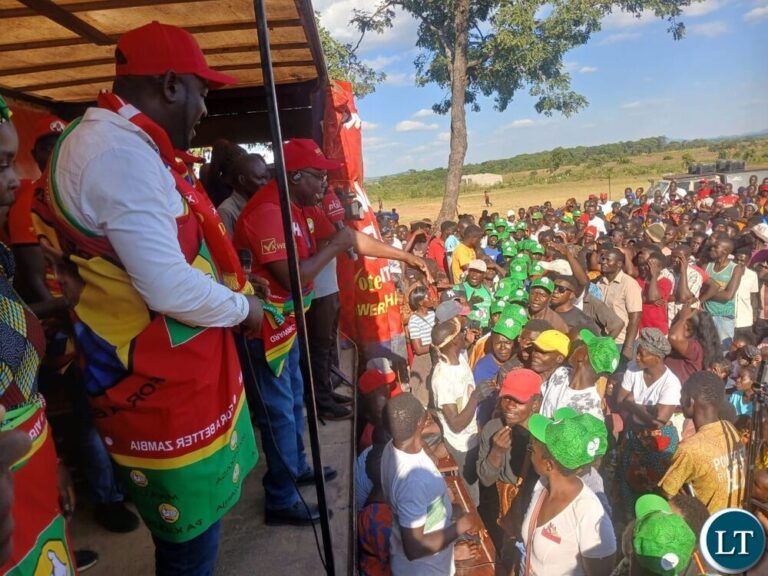
Over 500 people from different political parties in Chinsali District, Muchinga Province, have ditched their parties to join the United Party for National Development (UPND).

The defectors announced their decision to join the party at a public event held in Chinsali today and addressed by republican President Hakainde Hichilema.

Speaking when he addressed the defectors, President Hichilema welcomed the defectors and urged them to bring more members to the party.

“As the UPND Party, we want development, hence focused on national unity,” he said.

He said the UPND has a place for everyone who wants to join the party.

He further advised people to vote for the UPND in the province so that it can have members of Parliament.

The President further called for unity in the country in order to propel development.

And speaking on behalf of defectors, PF Chinsali Constituency Chairperson Festus Chibeka commended President Hichilema for his good leadership.

He is citing the free education policy and increased number of social cash transfer beneficiaries, among other developments that his government has brought.

NAREP pushes back on Gonzales’ farewell remarks, accuses envoy of overreach

LUSAKA, May 1 — Zambia’s opposition National Restoration Party has pushed back against remarks made by outgoing United States Ambassador Michael Gonzales, accusing the envoy of making sweeping claims about corruption, illicit financial flows and Zambia’s health sector without presenting specific evidence.

In a statement issued Friday, Ezra Ngulube said while his party recognised the long-standing relationship between Zambia and the United States, it rejected what it described as “mischaracterisations” and “one-sided accusations” directed at Zambia and past administrations.

Ngulube said some of Gonzales’ concerns were legitimate, particularly around accountability and public resource management, but argued that the ambassador’s farewell comments crossed into what he called “paternalistic” diplomacy that undermined Zambia’s sovereignty.

He challenged Gonzales’ reference to alleged illicit financial flows amounting to US$4 billion, saying the figure had not been backed by country-specific evidence. Ngulube argued that global financial systems, including tax havens and multinational corporate structures largely based in Western economies, also play a role in facilitating such outflows.

The opposition leader said if the United States government possesses specific evidence linked to Zambia, that information should be handed to law enforcement agencies such as the Anti-Corruption Commission and the Drug Enforcement Commission rather than being raised in public speeches.

His remarks come in the wake of heightened public discussion surrounding donor support to Zambia’s health sector after disruptions linked to concerns over medicine theft and accountability.

Ngulube said the temporary strain experienced in the health sector during the U.S. funding pause exposed Zambia’s dependence on external support, but argued that structural weaknesses in healthcare financing had accumulated over decades.

He said donor-driven systems had, at times, weakened local capacity to build sustainable domestic financing mechanisms.

“The temporary disruption exposed not only Zambia’s over-reliance on foreign aid but also the danger of unilateral decisions by donor nations,” Ngulube said.

He maintained that Zambia needed stronger domestic funding structures to shield essential public services from external shocks.

Ngulube also criticised the government’s handling of diplomatic engagement, saying concerns raised by Gonzales over cancelled meetings and communication failures reflected weaknesses within the current administration.

He said those failures should not be used to define Zambia as a country.

“We have had, and will have again, leaders who respect international partnerships while defending national dignity,” he said.

Despite the criticism, NAREP said it agreed with parts of Gonzales’ message, particularly on the need to strengthen public institutions, improve accountability and reduce dependence on foreign aid.

Ngulube said his party had previously proposed measures including a National Sovereignty Fund, mandatory asset declarations for public officials and tighter oversight of public procurement systems.

He said Zambia needed accountable leadership rather than what he described as “unaccountable aid.”

The party leader also criticised what he termed the use of aid withdrawal as leverage in diplomatic relations, saying no country should threaten access to life-saving HIV medication as a means of compelling reforms.

“That is not diplomacy; that is coercion,” Ngulube said.

He said Zambia remained open to international partnerships but insisted those relationships must be built on mutual respect.

Ngulube thanked Gonzales for his diplomatic service but said Zambia would continue fighting corruption based on its own national interests rather than pressure from foreign governments.

The statement adds another political voice to the growing national conversation triggered by Gonzales’ departure remarks, which have drawn both support and criticism across Zambia’s political landscape.


FULL STATEMENT BY Ezra Ngulube (AS ISSUED)

STATEMENT BY NAREP PRESIDENT EZRA NGULUBE ON REMARKS BY OUTGOING U.S. AMBASSADOR MICHAEL GONZALES

LUSAKA – May 1, 2026

The opposition National Restoration Party (NAREP) has taken note of the farewell remarks made by outgoing United States Ambassador to Zambia, His Excellency Michael Gonzales. While we respect the diplomatic service of Ambassador Gonzales and acknowledge the long-standing partnership between Zambia and the United States, we must categorically reject several mischaracterizations and one-sided accusations leveled against our nation and its successive governments.

Let me be clear: NAREP does not condone corruption. We have always stood for transparency, accountability, and the prudent use of public resources. However, Ambassador Gonzales’ speech while containing some valid concerns was laced with sweeping generalizations, factual exaggerations, and an unacceptable tone of paternalism that disrespects Zambia’s sovereignty.

First, on the alleged $4 billion in illicit financial flows: The Ambassador provided no verifiable, country-specific evidence for this figure. While illicit financial flows are a global challenge affecting developing nations, singling out Zambia with such an unsubstantiated claim without acknowledging the role of Western financial systems, tax havens, and multinational corporations in facilitating these outflows is disingenuous. NAREP demands that if the U.S. has specific evidence, it should be handed over to Zambian law enforcement immediately not used as a political talking point at a farewell reception.

Second, on the collapse of the health system during the U.S. funding pause: The temporary disruption exposed not only Zambia’s over-reliance on foreign aid but also the danger of unilateral decisions by donor nations. The U.S. paused funding based on its own internal political processes, not due to any new finding of Zambian malfeasance. Zambia’s health system challenges predate this administration and are rooted in decades of underinvestment partly because donor conditionalities have discouraged domestic resource mobilization. NAREP has long argued that aid dependency is a structural trap, not a moral failing of Zambian officials alone.

Third, on the absence of arrests over stolen medicines: If the U.S. has intelligence on specific individuals who diverted donor medicines, they have a moral and legal obligation to share that intelligence with the Anti-Corruption Commission (ACC) and the Drug Enforcement Commission (DEC). Publicly shaming Zambia without supporting prosecutions helps no one except those who wish to paint an entire country as irredeemably corrupt. NAREP calls on the government to invite the U.S. to present any dossiers for immediate action.

Fourth, on unanswered calls and cancelled meetings: This is a matter of executive conduct. NAREP agrees that the current administration has been dismissive and uncoordinated in its diplomatic engagement. But Ambassador Gonzales should not conflate the incompetence of one government with the character of the Zambian people. We have had, and will have again, leaders who respect international partnerships while defending national dignity.

Where we agree with Ambassador Gonzales: Zambia must increase domestic health financing, end the culture of impunity, and take ownership of our public systems. NAREP has consistently proposed a National Sovereignty Fund, mandatory asset declaration for all public officials, and competitive tendering with citizen oversight. We also agree that “Zambia does not need more money” in the form of unaccountable aid it needs accountable leadership and strong institutions.

Our message to the outgoing Ambassador: Criticism without partnership is just noise. The U.S. has been a valuable partner, but no nation has the right to demand reforms under the threat of withdrawing life saving medicines for HIV patients. That is not diplomacy; that is coercion. Zambia will fight corruption, not because Washington demands it, but because it is the right thing to do for our own children.

We thank Ambassador Gonzales for his service, but we remind him and his successors: Zambia is a sovereign republic. We welcome accountability, but we reject humiliation. NAREP stands ready to work with any nation on an equal footing respectfully, transparently, and without threats.

Issued by:
Ezra Ngulube
President, National Restoration Party
May 1, 2026

When Michael C. Gonzales’ Statements Miss the Moment  

By Adrian Gunduzani

There are moments when words matter not just for what they say, but for whether they fit the reality they are meant to describe.

The recent remarks by Michael C. Gonzales raise concerns that, in principle, are familiar: corruption, accountability, and the management of public resources. These are not new themes in Zambia’s governance conversation.

But what stands out is not the subject matter. It is the mismatch.

Because the Zambia being described does not fully align with the Zambia that has been taking shape over the past four years.

There has been a visible and deliberate shift in governance. The restoration of order in public spaces, the reduction of cadre influence, the tightening of systems in key sectors, and a more disciplined approach to administration have not been theoretical claims – they have been lived experiences for many citizens.

In sectors like health, where concerns are often most sensitive, the current administration has made sustained efforts to clean up procurement processes, strengthen oversight, and restore credibility. These are not perfect systems. But they are not the systems that existed before.

So when broad concerns are raised without distinction, they risk painting a picture that belongs to a different time.

This is where the difficulty lies.

It is not that the issues mentioned are impossible. It is that presenting them in a way that does not reflect the current trajectory creates a distortion. It overlooks the reality that governance reform is already underway, and that the direction has been towards correction, not deterioration.

Context, in this case, is not an optional detail. It is central to accuracy.

There is also the question of timing.

In an election year, public statements – especially from external actors – carry weight beyond their immediate content. They enter a charged environment where narratives are actively being shaped and contested. In such a context, even well-intentioned remarks can take on meanings that extend beyond their original purpose.

What is missing from these remarks is not just balance, but grounding.

The issues raised are not new discoveries. They are the very conditions that have been under active correction.

To speak as though they define the present, without demonstrating that these efforts are absent or ineffective, shifts the statement from evidence to assumption.

There is no clear indication that the current systems are being ignored, nor that the direction of governance has regressed. On the contrary, the observable shift has been towards order, discipline, and tighter control.

In that context, broad assertions do not strengthen the conversation. They weaken it.

Because without clear evidence that the present trajectory is failing, such claims risk describing a situation that is no longer accurate.

Zambia deserves a conversation that reflects where it is – not where it once was.

VEEP calls for improved work culture among workers

Vice President Mutale Nalumango has challenged workers to improve their work culture.

Mrs Nalumango stressed that employees have an important role to play in securing the future of work in Zambia, hence the call to embrace the culture of hard work.

She implored workers from both the public and the private sectors to focus on being more productive in their respective lines of work.

Mrs Nalumango advised workers to be loyal, disciplined and responsible as they discharge their duties at all times.

“We must improve our work culture. We must focus more on productivity. We must be loyal, disciplined and responsible workers at all times.” She said

The Vice President said this when she graced this year’s Labour Day celebrations in Lusaka.

And Mrs Nalumango has urged employers to invest in the development of workers through skills training.

She said investment must include supporting workers to acquire new skills in line with trends in digital technology and industry requirements.

Mrs Nalumango explained that acquiring new skills will enable employees to adapt to the changing world of work.

The Vice President encouraged employers to offer training and development opportunities to employees so as to enhance their productivity.

Mrs Nalumango stressed on the need for supporting workers to adapt to new technology and work processes.

“Employers are encouraged to offer training and development opportunities for employees to acquire new skills and adapt to the changing nature of work. You are encouraged to support employees to adapt to new technology and work processes.” She said,

She stressed that employers must ensure that digital transformation does not lead to job losses and erosion of workers’ rights.

“As employers, you must ensure that digital transformation does not lead to job losses and erosion of workers’ rights,” She said.

The Vice President has thanked employers in Lusaka provinces for demonstrating resilience and contribution to the country’s economic growth.

Mrs Nalumango said the government remains committed to creating an enabling
environment that supports businesses to thrive and creating new job opportunities.

She appealed to employers to invest more in their workers while at the same time adhering to labour standards.

“We thank all employers for your resilience and contribution to job creation in the province and the nation at large. Government remains committed to creating an enabling environment that supports business. We call upon you to invest more in your workers and continue adhering to labour standards.” Mrs Nalumango added.

Meanwhile, Mrs Nalumago said Labour Day is an important event dedicated to celebrating the resilience, dignity and invaluable contributions of workers across the country.

The Vice President pointed out that workers are the backbone of the economy as they drive economic growth.

Mrs Nalumango said that without the dedication and hard work of the employees, the country can’t prosper.

She said the government has joined in recognising every worker for their contribution to the growth and development of the country.

“Workers are the backbone of our economy. Without your dedication and hard work, our nation would not prosper.

“Today, we recognise every worker for their contribution to the growth and development of our country,” She stated.

The Vice President said the government remains committed to growing the economy and creating job opportunities.

She said the government is determined to protect jobs and guarantee social security systems and uphold the dignity of workers, during employment and in retirement.

Mrs Nalumango assured the labour movement that the government remains committed to promoting social dialogue with employers and workers to ensure industrial harmony.

Speaking earlier, Zambia Congress of Trade Unions, first Deputy President Joseph Chewe has implored politicians not to entangle civil servants and other public workers in partisan politics as the country goes to polls in August this year.

Mr Chewe stressed that public workers must not be dragged into partisan contests ahead of the elections.

He pointed out that civil servants and other public workers are servants of the nation who should not be enticed or lured into partisan politics.

Mr Chewe said employees should not be used as instruments of politics by politicians when it suits them.

“As we approach election periods, we demand that workers must not be dragged into partisan contests. Civil servants, teachers, health workers, police officers, and other public employees are servants of the nation. Not instruments of politics.” He said.

Mr Chewe pointed out that civil servants must be protected from politicians as they are professionals.

He said the jobs of public workers and civil servants should never depend on political loyalty.

He encouraged civil servants and other public workers to remain neutral and professional if they were to be respected.

And in a related development, the Zambia Congress of Trade Unions has commanded the government for introducing a 24-hours economy.

Mr Chewe said the union strongly believes that running a 24 hours economy will lead to increased production.

He further stated that unemployment among the youths is expected to reduce.

“We strongly believe that having the economy running for 24 hours will increase production and reduce unemployment, especially among the youths.” He added.

At the same event, the Zambia Federation of Employers (ZFE) Vice President for the Midlands region, Kennedy Njamba thanked workers for turning in numbers to commemorate the international Labour Day.

Mr Njamba said the turnout of workers was overwhelming at this year’s Labour Day celebrations.

And Lusaka province Minister, Sheal Mulyata said the presence of the Vice President at these commemorations of the International Labour Day underscores the importance the government attaches to the plight and welfare of the workers across all sectors of the economy.

Gender Division condemns intimidation of women aspiring candidates

he Gender Division under Cabinet Office has expressed concern over continued reports of intimidation targeting women aspiring for political office, describing the practice as a serious barrier to gender equality and democratic participation.

In a statement issued by Gender Division Permanent Secretary, Mainga Kabika, she said reports indicate that some women are being pressured by senior party officials to settle for lower positions instead of contesting seats of their choice.

Ms Kabika stated that such actions undermine women’s participation in politics and limit their contribution to national development.

She emphasised that intimidation of female candidates is not merely an internal party issue but constitutes a form of Gender-Based Violence (GBV) and a violation of human rights.

“The act of party leaders intimidating women seeking elective office is a predatory deterrent to gender equality and a direct assault on our democratic values,” she said.

Ms Kabika noted that political intimidation remains one of the most significant non-financial barriers to women’s political participation in Zambia, as it silences capable voices and undermines merit-based leadership.

She has since called on political parties to adopt and enforce clear codes of conduct that prohibit intimidation and ensure a safe political environment for women.

The Permanent Secretary further urged political parties to establish internal grievance mechanisms that allow women to report cases of intimidation confidentially and independently.

She added that any party official found guilty of intimidating female candidates should be dismissed and handed over to law enforcement agencies for prosecution.

Ms Kabika also encouraged women experiencing intimidation to seek support through the National Gender-Based Violence Call Centre by dialing the toll-free helpline 944 for counselling, legal guidance, and other assistance.

She reaffirmed the government’s commitment to promoting gender equality and ensuring that women can participate fully in the country’s political and socio-economic processes without fear of harassment or abuse.

President Hichilema expresses happiness with development in Muchinga Province

President Hakainde Hichilema has expressed happiness at the developmental activities taking place in Chinsali District and  Muchinga Province at large.

Speaking when he addressed scores of Chinsali residents who welcomed him in the district, Mr Hichilema expressed happiness with the developments happening in the area.

He particularly indicated the strides the province has made in growing the agricultural sector.

He stated that he will continue to visit other areas to check on developmental projects.

The head of state also stated that he will continue with the agenda of taking commemoration of public events to all parts of the country.

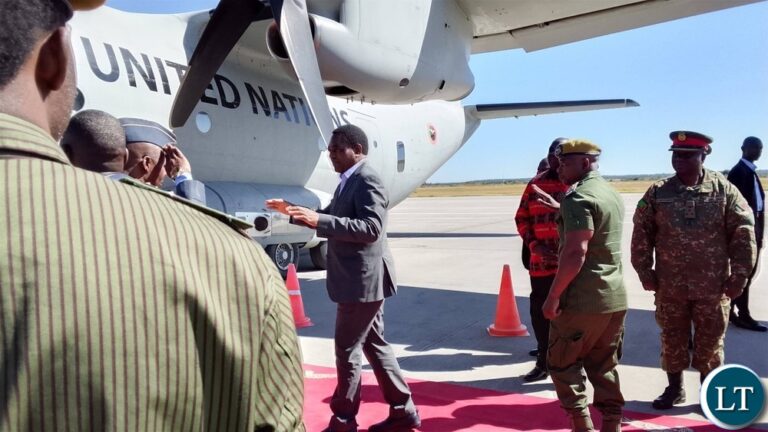
The president who is accompanied to Chinsali by his Special Assistant for politics, Levy Ngoma, was received at the airstrip by Muchinga Province Minister, Njavwa Simutowe, Minister of Water Development, Collins Nzovu among other senior government officials.

President Hichilema urges employers to ensure stable workplaces

President Hakainde Hichilema has called on employers to provide stable workplaces to enhance productivity and business growth.

Speaking during Labour Day celebrations in Chinsali, President Hichilema stressed that employers and workers depend on each other, and a conducive work environment is key to creating more jobs.

“A stable workplace is an ingredient for successful employees and vice versa. As a rancher, I know that if I don’t take care of my cattle, I won’t have milk. Likewise, employers must take care of workers for businesses to thrive,” he said.

The President further encouraged dialogue between employers and workers, noting that differences should be resolved in boardrooms rather than through street protests.

Labour Minister Brenda Tambatamba highlighted progress in protecting workers’ rights, citing disciplinary and grievance procedures as systems that promote fairness and productivity.

International Labour Organization (ILO) Country Representative Wellingstone Chibebe commended Zambia for advancing pension reforms, noting that strengthening social protection through NAPSA secures workers’ futures.

Mr Chibebe also praised constructive engagement among government, employers and workers in managing change and ensuring inclusivity in the labour market.

Meanwhile, Zambia Congress of Trade Unions (ZCTU) president Blake Mulala urged government to address salary anomalies in ministries, particularly Education, where many teachers retire at lower positions despite having served in higher roles.

‎Ex-U20 player mourned

0

Former Zambia Under-20 Women Team player Gift Theresa Musatila Chilufya was on Friday put to rest at Chingola Road Cemetery in Kitwe.

‎Chilufya died on Wednesday in Kitwe after an illness.

‎Family members, fellow players, officials and fans attended funeral Mass and burial.

‎She was playing for Zesco Ndola Girls at the time of her death.

‎”Gift was more than just a player — she was a valued member of our family, a dedicated athlete, and a young woman whose passion, commitment and spirit inspired everyone around her. Her loss is heartbreaking to all of us at ZESCO United Football Club and the wider football community,” the club mourned.

‎FAZ president Keith Mweemba says Musatila’s death is particularly devastating as she was one of the three promising youngsters that FAZ and Cosafa sent to Spain on a La Liga one year sponsorship program.

‎Musatila was in 2023 sponsored with Esther Musialela and Jessy Zulu on a La Liga scholarship program, following their impressive performance at the 2022 Under-17 Region VI tournament in Malawi.

‎“We are saddened to learn of the death of Theresa Musatila who was one of the talents nurtured within our structures at FAZ. She had grown from representing the Under-17 and Under-20 national teams and was looking like a Copper Queens prospect. It is sad to lose such a young and promising star,” Mweemba said.

‎“Our commiserations are extended to the family, Zesco United Ndola Girls and the wider football community.”

‎Musatila died at the time she was recovering from injury.

President concludes Copperbelt visit, heads to Labour Day celebrations

President Hakainde Hichilema has wrapped up his two-day working visit to the Copperbelt Province and departed for Chinsali in Muchinga Province to attend Labour Day celebrations.

The Head of State left Simon Mwansa Kapwepwe International Airport in Ndola at around 09:50 hours.

He was seen off by Copperbelt Minister Elisha Matambo, Transport Minister Frank Tayali, and other UPND officials.

Matambo described the visit as successful, stating that it demonstrated the President’s commitment to further developing the province.

Meanwhile, UPND officials in the region expressed appreciation to President Hichilema, with some describing the Copperbelt as his “second home.”

President Hichilema urges clergy to back free education

President Hakainde Hichilema has urged the clergy to take a lead in ensuring that every child benefits from the Government’s free education policy.

Speaking during a meeting with members of the clergy in Mufulira district, President Hichilema called on the clergy to identify children in their communities who do not go to school and ensure that they are enrolled.

He highlighted that the government’s strategy of ensuring every child has an equal chance at education is comprehensive, involving not only the removal of school fees but also the massive recruitment of teachers, the procurement of desks, and the construction of new classroom blocks.

Meanwhile, the President stated that churches are eligible to benefit from the Constituency Development Fund (CDF).

Mr Hichilema emphasised that churches are not merely spiritual centres but important community institutions that qualify to benefit from public resources to address various infrastructural challenges they may be facing.

“If a church has water challenges they should access CDF and install a borehole,”he said.

During the engagement, the President expressed gratitude to the church mother bodies for their support of Bill 7.

He noted that this legislative milestone is crucial for creating a more inclusive Parliament, specifically aimed at increasing the participation of women and youth in the country’s governance after this year’s elections.

And the President stated that the country is on the right path of development noting the various developmental milestones achieved over the past five years.

“Look at where we are, this is not where we were five years ago,” he said.

He cited the local content statutory instrument of 2025 as among the new dawn government’s achievements that are meant to put more money in citizens’ pockets, citing other achievements such as recruitment of health workers and teachers, and introduction of free education.

The President also noted that the UPND government has gotten rid of caderism at markets and bus stations, leading to a more peaceful environment for citizens.

President Hichilema assured that the government will continue to work closely with the church for the betterment of the country.

He praised the clergy in Mufulira for their unity despite belonging to various denominations.

The president assured that government will continue to provide a conducive environment for the church to thrive:

And the Mufulira Christian Ministers Fellowship, Chairperson Reverend Simon Mwashoma, praised the United Party for National Development (UPND) administration for its visible developmental milestones.

Speaking on behalf of the various church mother bodies, Reverend Mwashoma cited the increased CDF allocation, the introduction of free education, and the recent large-scale recruitment of health and education personnel as transformative achievements that are directly benefiting the people of Mufulira.

Reverend Mwashoma said the various developmental milestones that the UPND government have achieved have renewed hope for the future among citizens.

“Increased CDF has brought development to every corner of the district, and your promotion of the rule of law has ended caderism, “he said                                                                          Reverend Mwashoma further commended government for recapitalising Mopani Copper Mines, increased support to the agricultural sector, and social cash transfer among others.