

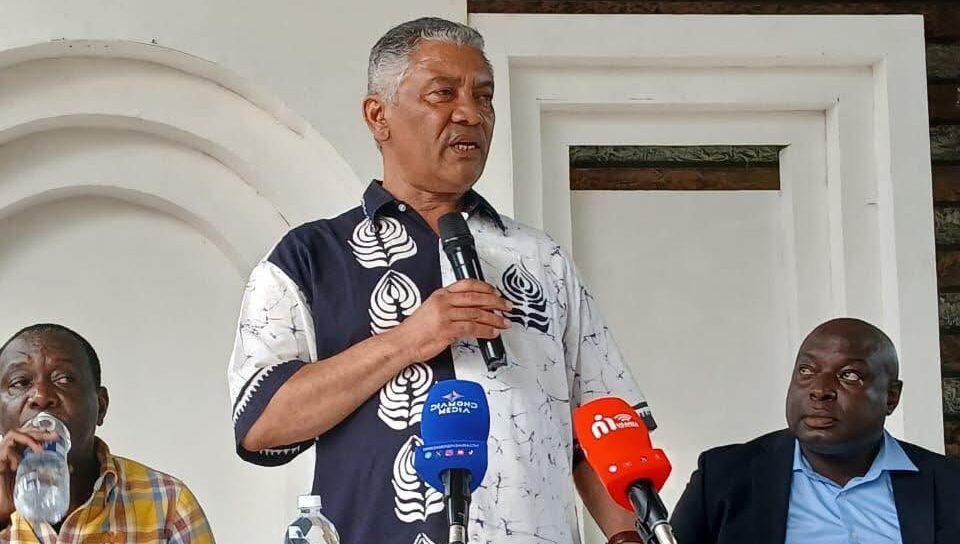
UPND Media Director Mark Simuuwe says the administration has implemented a series of commitments contained in its election manifesto, pointing to developments in education, agriculture, mining and public sector employment as indicators of policy implementation since taking office. Simuuwe said development unfolds through sustained programmes rather than isolated decisions and argued that government performance should be measured against the commitments made during the campaign. His remarks form part of the party’s attempt to present what it describes as measurable outcomes across sectors where policy changes have taken effect.
Free education formed one of the earliest reforms introduced after the administration assumed office. The policy removed tuition fees in public primary and secondary schools, a step Simuuwe said was intended to widen access to education for households that previously struggled with school costs. Education reforms have unfolded alongside the expansion of the Constituency Development Fund, which now stands at K40 million per constituency in 2026, representing a national allocation of about K6.245 billion across Zambia’s 156 constituencies. The fund supports community infrastructure, bursaries for students and empowerment initiatives that include loans and grants for local businesses.
Simuuwe said the scale of the fund reflects a steady increase in CDF allocations since 2021. Constituencies received K1.6 million in 2021 before the allocation rose sharply to K25.7 million in 2022. The figure increased further to K28.3 million in 2023, K30.6 million in 2024, K36.1 million in 2025, and K40 million in 2026. Simuuwe said the objective is to shift development planning closer to communities so that residents can identify and prioritise projects within their own constituencies. He added that authorities have set a utilisation target of at least 85 percent of allocated funds by 2026 to ensure the resources translate into visible development.
Simuuwe also pointed to payments made to farmers who supplied maize to the Food Reserve Agency but had remained unpaid under the previous administration. According to him, government cleared outstanding payments owed to about 258,000 farmers who had waited up to two years to receive their money. He said the move was intended to restore confidence among producers and stabilise the country’s grain supply chain. Government also settled wage arrears owed to around 34,000 council workers whose salaries had accumulated between seven and fifteen months of unpaid balances.
Agricultural support programmes expanded during the same period. Simuuwe said government placed more than 1 million small-scale farmers under agricultural insurance schemes designed to protect production during drought conditions and other risks affecting farming. The Farmer Input Support Programme now includes over 500,000 women farmers, a shift that authorities say is intended to widen participation in national food production. Simuuwe said the programme is meant to strengthen maize production and stabilise mealie meal supply during periods of reduced rainfall and external shocks affecting agriculture.
Recruitment across the public sector resumed after the removal of an employment freeze that had limited hiring in several sectors. Simuuwe said government has recruited more than 45,000 teachers since the policy change to address staffing shortages in schools across the country. The health sector also saw recruitment, with about 25,000 health workers engaged to strengthen staffing levels in hospitals and clinics. Simuuwe said wage restrictions affecting public employees were lifted during the same period, allowing annual salary adjustments across the civil service.
Youth training programmes formed another element of the government’s policy agenda. Simuuwe said over 200,000 young people have completed skills training programmes supported by government initiatives designed to prepare participants for employment and small-scale enterprise. Economic indicators also shifted during the same period. Zambia’s gross domestic product growth moved from negative 2.7 percent to about 5.8 percent, according to figures cited by the party, while inflation declined from around 22 percent to single-digit levels.
Debt restructuring formed a central component of the administration’s economic programme. Simuuwe said Zambia has restructured about 94 percent of its external debt under the G20 Common Framework, a process aimed at easing pressure on public finances and restoring economic stability. Mining reforms were also highlighted in the party’s statement. Copper production stood slightly above 280,000 metric tonnes before reforms began and has since increased to about 1 million metric tonnes, with authorities targeting 3 million metric tonnes annually in the coming years.
Simuuwe also cited developments in Zambia’s gemstone sector, saying the country now leads global emerald production ahead of Colombia. Industrial programmes have extended into fertiliser manufacturing, with Zambia producing fertiliser locally and exporting the product to eight countries. Simuuwe added that Zambia has attracted more than $5 billion in investment commitments across sectors including mining, agriculture and energy.
Tourism arrivals have also increased during the same period. Annual international visitors rose from about 500,000 to more than 2.2 million tourists, according to figures cited by Simuuwe. He said the recovery reflects renewed international travel and increased promotion of Zambia’s tourism sector. Simuuwe also said cooperation with international partners has expanded, including the resumption of budget financing from the European Union following earlier governance concerns.
Social protection programmes expanded alongside economic reforms. Simuuwe said Cash-for-Work initiatives and the Social Cash Transfer programme now support vulnerable households across several districts. School feeding programmes have also been introduced in public schools to support learners from low-income families. He added that Zambia has entered battery export markets, with locally produced batteries reaching eight international markets.
Simuuwe said the administration continues implementing programmes outlined in its manifesto while expanding economic opportunities and social services. He challenged opposition parties to present alternative policy proposals addressing the sectors where the government says progress has been recorded.




With zero impact on the ground
In PF, in K100 you could buy mealie meal. Roller meal was K100