
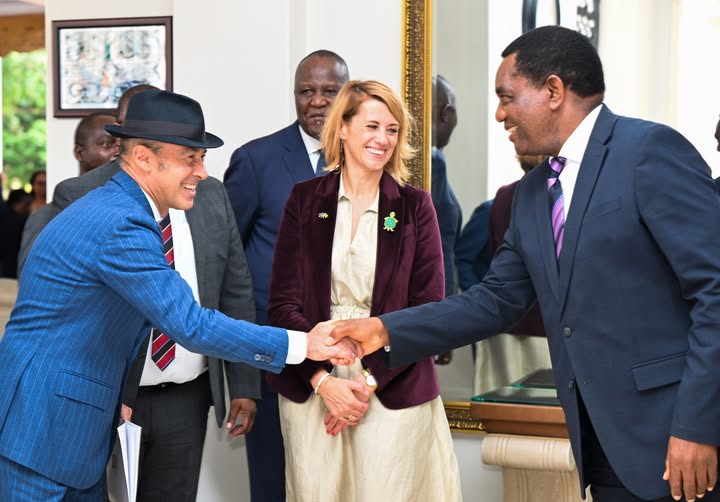
Zambia and the European Union have reaffirmed a broad political and economic partnership, with an EU election observation mission under consideration ahead of the country’s 2026 general elections, as President Hichilema seeks investment shift in EU partnership talks.
The engagement followed a formal EU-Zambia Partnership Dialogue held on 26 February, bringing together cabinet ministers, diplomats and senior officials to assess cooperation across governance, trade and development priorities.
European Union representatives confirmed that an exploratory team is already in Zambia to assess the feasibility of deploying a full election observation mission, following an invitation from the government. The move signals continued EU involvement in Zambia’s electoral process, framed as support for democratic institutions and transparency.
Karolina Stasiak, Ambassador of the European Union to Zambia, said the dialogue reinforced shared commitments to democracy, inclusive development and a rules-based international order. She described the partnership as anchored in trust, predictability and common principles, with both sides positioning themselves as reliable partners in a shifting global landscape.
The discussions took place against a backdrop of geopolitical tensions, economic uncertainty and pressure on multilateral systems. EU officials said the evolving global environment has increased the importance of stable bilateral relationships capable of delivering tangible outcomes for citizens.
A central pillar of the talks focused on Zambia’s economic trajectory, with both sides aligning around a transition from recovery to growth. President Hakainde Hichilema told the meeting that the country is now prioritising expansion following progress in restructuring public debt, a process supported by international partners including EU member states.
He said remaining elements of the debt restructuring process must be concluded to unlock the next phase of economic activity. The President referenced ongoing engagements with individual European countries, including recent agreements with Italy, as part of efforts to finalise outstanding obligations.
Hichilema urged European partners to accelerate bilateral processes, stating that the full value of their support would only be realised once debt restructuring is fully settled. He framed the completion of this process as essential to sustaining Zambia’s macroeconomic stability and enabling long-term growth.
The EU delegation outlined its investment strategy under the Global Gateway initiative, describing a comprehensive approach combining infrastructure development, policy support and private sector engagement. The Lobito Corridor emerged as a flagship project during the discussions, with officials highlighting its potential to improve regional connectivity and attract international investment.
EU representatives said investor interest in Zambia has been rising following the Lobito Corridor Business Forum held in Lusaka, with increased attention from European and global stakeholders. They stressed that predictable regulatory frameworks and transparent governance systems remain critical to sustaining that momentum.
Green transition initiatives also featured prominently. The EU reaffirmed its support for Zambia’s environmental goals through programmes such as the EU-Zambia Forest Partnership, which targets sustainable land use, biodiversity protection and community-based value chains. Climate-smart agriculture was identified as a priority area linking environmental policy to economic resilience.
Both sides reflected on environmental risks following the Kafue River pollution incident, noting the need for stronger oversight and accountability in strategic sectors. EU officials emphasised that economic development must be matched by adherence to environmental, social and governance standards.
Foreign Affairs Minister Mulambo Haimbe said the dialogue confirmed the strength of Zambia’s relationship with the EU, describing it as growing and grounded in shared values. He reiterated the government’s openness to election observation, stating that external monitoring strengthens democratic credibility.
Haimbe also pointed to Zambia’s role in regional and global institutions, including its participation in discussions on United Nations Security Council reform. He said Zambia continues to seek EU support on governance reforms within multilateral structures.
President Hichilema used the platform to highlight global instability as a direct risk to Zambia’s economic outlook. He cited ongoing conflicts, including the Ukraine-Russia war and tensions in the Middle East, as factors likely to disrupt fuel prices and broader macroeconomic stability.
He warned that such external shocks, though beyond Zambia’s control, could affect domestic programmes and growth targets. The President stressed that cooperation with partners like the EU would be critical in navigating these pressures.
Hichilema also positioned Zambia as an active regional actor, referencing its current and incoming roles within the Southern African Development Community and its involvement in African Union reform processes. He said these roles create opportunities to align regional integration efforts with international partnerships.
The President called for a shift toward joint ventures and deeper business collaboration between Zambia and European partners, moving away from traditional aid-driven models. He said shared investment and market access would deliver more meaningful outcomes for both sides.




Please report professionally… That intro!!
And why report today something that happened in February? Where was Karina speaking from?