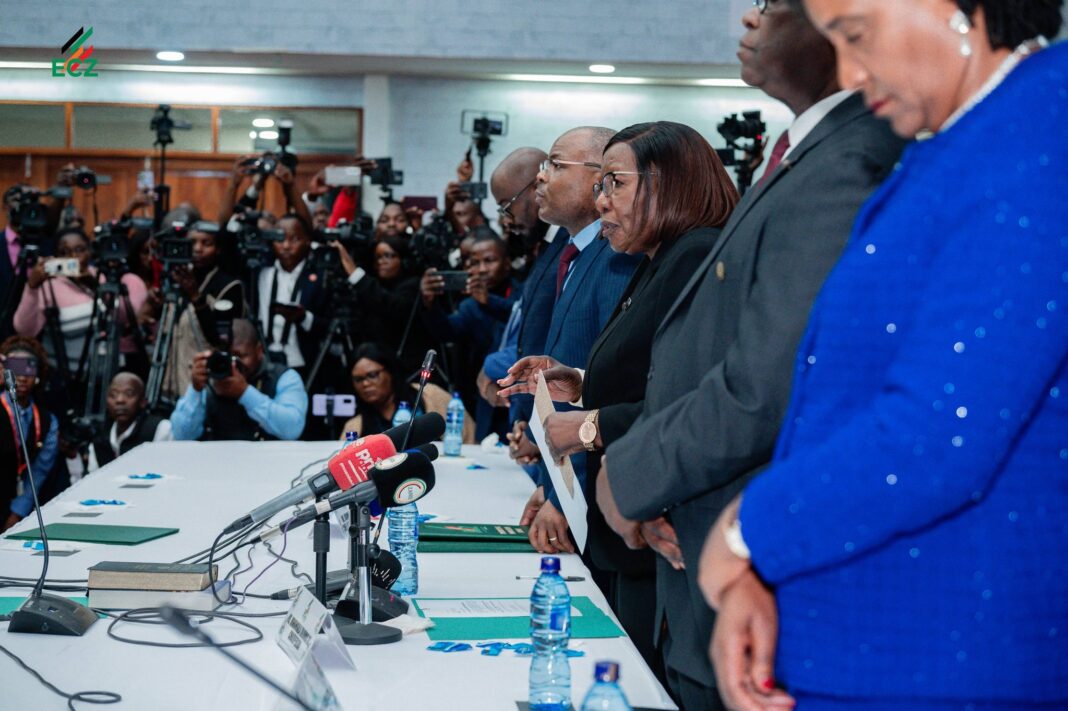
The Electoral Commission of Zambia (ECZ) has moved to publicly rebut claims that it is printing extra presidential ballot papers or concealing security features embedded in them, as printing of ballots for the August 13 general election nears completion in Dubai.
ECZ vice-chairperson Major General Vincent Mukanda (Rtd) said approximately 4.7 million presidential ballot papers had been printed as of Wednesday, with the process of serial numbering and stitching the ballots into booklets already underway.
Gen Mukanda said the Commission was compelled to address the allegations after concerns emerged among observers, warning that such claims had the potential to undermine public confidence in the electoral process.
Briefing stakeholders observing the printing exercise at Dubai-based Al Ghurair Printing and Publishing, which was engaged to produce the ballots, Gen Mukanda said the printing process was progressing well and remained on schedule.
Tonse Alliance observers in Dubai, including Professor Nkanda Luo, Enock Tonga and Kasonde Mwenda, had questioned the printing of 9.1 million presidential ballot papers against 8.7 million registered voters. They also raised concerns over the Commission’s refusal to disclose the security features embedded in the ballot papers.
Responding to those concerns, Gen Mukanda explained that ballot papers are produced in serialised booklets of 50, a packaging method the Commission has consistently used in every general election and by-election since 2006.
He said because polling stations have varying numbers of registered voters, it is impossible to produce ballot booklets that exactly correspond with the number of voters assigned to each polling station.
Using an example, he explained that a polling station with 502 registered voters would receive 11 booklets containing a total of 550 ballot papers because ballot papers are bound in booklets of 50. The remaining 48 unused ballot papers, he said, are fully accounted for and reconciled during and after polling.
Gen Mukanda stressed that there would be no separate packages of so-called “extra” ballot papers, explaining that every ballot paper would be pre-allocated and packaged for a specific polling station.
He further assured stakeholders that all ballot papers for the August 13 general election would be fully accounted for and that the Commission was neither printing undisclosed ballot papers nor concealing information capable of compromising the integrity of the electoral process.
The ECZ vice-chairperson said accredited political party agents and election observers were monitoring the printing exercise, while the Commission had established strict accountability measures throughout the production process.
These include unique serial numbers on every ballot paper and booklet, multi-stage verification from production through delivery, and reconciliation of all issued, used, spoiled and unused ballot papers after the close of polling.
On concerns surrounding ballot security features, Gen Mukanda said the Commission had incorporated robust safeguards designed to prevent unauthorised printing, copying and counterfeiting.
He, however, maintained that the Commission would not disclose those security features, explaining that revealing them would defeat their intended purpose.
Gen Mukanda also dismissed media reports suggesting that pre-marked ballot papers were being printed in another country, describing the ongoing printing exercise as legitimate, transparent and trustworthy.
He said the Commission would continue providing regular updates on the printing exercise until its completion later this month.
According to Gen Mukanda, serialisation of presidential ballot papers has already commenced, while binding and packing of the ballots is expected to begin next Tuesday. Verification of National Assembly template ballots is also underway ahead of their printing.
UPND chairperson for health Bob Sakahilu, who is among stakeholders observing the printing process, urged political leaders to channel their concerns through electoral reform processes and propose constructive changes capable of strengthening future elections instead of advancing unsubstantiated allegations.
Al Ghurair Printing and Publishing general manager Lakshmanan Ganapathy confirmed that serialisation of the presidential ballot papers had begun. He said final printing was expected to conclude this week before binding and packing commenced next Tuesday.
The clarification comes as the Electoral Commission separately warned that it would suspend any candidate or political party found responsible for political violence following the recent campaign-related deaths in Kaputa and Mazabuka districts, signalling a broader effort by the Commission to reinforce both the integrity and security of the electoral process with six weeks remaining before polling day.