
By Mwizenge S. Tembo, Ph. D.Emeritus Professor of Sociology
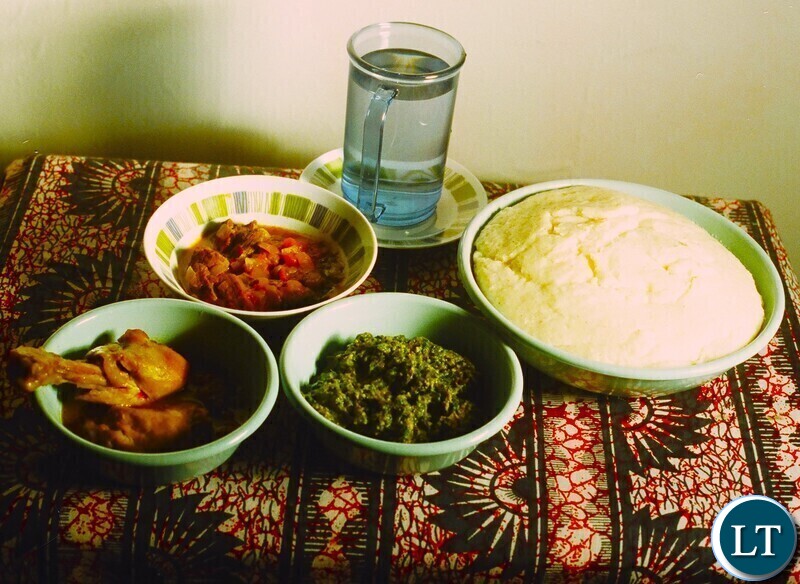
One of the most significant aspects of the Zambian staple meal by which the nshima is ultimately identified with is what in English and among Zambians is called “relish”. Relish is an English somewhat poor equivalent or translation, which obviously, does not precisely reflect or capture what Zambians often realize is the very fundamental and transcending essence of the dish. The relish is a second dish that is always and without exception served with the nshima. It has many indigenous equivalent names. Among the Tumbuka of Eastern Zambia it is known as dende, among the Ngoni and Chewa of Malawi and Eastern Zambia it is known as ndiyo or ndiwo, and umunani among the Bemba speaking people of Northern Zambia and the Copperbelt Province.
The ndiwo second dish, which is always served with nshima, is often cooked from domestic and wild meats that include beef, goat, mutton, deer, buffalo, elephant, warthog, wild pig, mice, birds, rabbits or hare, antelope, turtle, alligator or crocodile, monkey, and chicken eggs. Green vegetables include domestic or garden grown like rape or repu, collard greens, cabbage, pumpkin or squash leaves (kwanya, chiwawa, mphangwe), sweet potato leaves (chimphorya), pea leaves (mtambe), cassava leaves (chigwada, katapa), bean leaves, kabata, nyazongwe, or bilizongwe leaves.
There are numerous wild green vegetables that include katambalala, chekwechekwe, katate, lumanda, and numerous others, which are all referred to by the very well-known generic name of delele or thelele among people of Eastern Zambia and Malawi. There are anywhere from 20 to 30 of this group of thelele vegetables. Other types of ndiwo or dende include fish, peanuts, peanut butter (chibwabwa or chimphonde), chipokoro, numerous types of wild mushrooms, and many varieties of beans and peas.
Because the delele and other groups of vegetables are always so plentiful and easily available in the natural environment, it is one ndiwo that is frequently held in contempt. In rural Zambia the daily conversation will often focus on how difficult it is to get ndiwo. Someone will invariably complain that they have been eating delele for three straight days. Since any type of meat protein is the most scarce, it is the most valued or desired. In fact there is a special term that is used for that irresistible desire or yearning for meat which is known as nkhuli in Eastern Zambia and Malawi.
The pair of nshima and dende, ndiyo or ndiwo is therefore the most significant Zambian meal. One is rarely possible without the other. The nshima and ndiwo are like Siamese twins, the left and the right hand, student and teacher, husband and wife, male and female or mitt and glove in American baseball parlance. Having nshima without ndiwo or the reverse is possible but is always regarded as a serious anomaly or oddity. If the cook induces the condition of eating nshima or ndiwo on its own, it would be regarded as lack of proper planning. If the diners induce the condition, they would be regarded as having poor judgement or being immature or careless.
One excellent reason for why nshima and ndiwo always go together is that they complement each other. Nshima eaten by itself is rather relatively plain and bland. Although if you are an experienced, seasoned, and sophisticated traditional eater of the meal, the nshima has its own subtle differences in taste and flavor depending on the type of mealie-meal and how it was cooked.
In fact when Westerners and other non-Zambians first eat nshima, their typical reaction is: “God, why don’t you add butter, sugar or something to give it some taste or flavor?” But that is exactly the beauty and deeply acquired taste and appreciation of nshima in that it is the dende, ndiyo, ndiwo or relish second dish that gives it the unique taste or deliciousness. The nshima therefore accentuates the ndiwo and the reverse is also true. Eating the nshima by itself will fill the eater but without any taste of ecstasy. Eating the ndiwo by itself might be gratifying but the individual will not feel full or satiated. Eating nshima by itself is known as kusoza among the Tumbuka people of Zambia. Among the Chewa, kusinkha refers to eating ndiwo or relish by itself in the absence of nshima.



Yaba, makes me miss those vegetables. My diaspora it’s only cabbage which is available. I grew my own rape this past summer, felt like a king.
Losing your identity just so you can live in foreign land. Sad. Come back home
Very interesting write up, but Nshima was introduced to Zambia in the early 1900’s as maize came from Mexico and South America , it was introduced to be a fast growing staple that made you feel full, it has no real nutritional value and has very high carbohydrates which lead to high blood pressure, heart issues and diabetes and cancer, Also to blame is cooking oil that the greens and meat are cooked in. The statement that you add alligator is incorrect as that animal does not exist in Africa. Its time for Zambians to stop eating Nshima and cooking oil and eat healthy traditional diet style foods, (Sorghum and Cassava ) stop frying everything in oil. We will have a much healthier population and save costs on the health system.