By Venus N Msyani
For three consecutive years, Zambia’s head of state has skipped the world’s most prominent diplomatic forum, the United Nations General Assembly, sending surrogates in his place. And while the president commends women empowerment as a cornerstone of his leadership, his actions tell a different story.
On Monday, September 29, the Foreign Affairs and International Cooperation minister, Hon. Mulambo Haimbe, successfully addressed the 80th Session of the United Nations General Assembly on behalf of President Hakainde Hichilema.
In 2021, fresh off his electoral victory, Hichilema stood before the 76th Session of UNGA and pledged a new era for Zambia. His speech, themed “Building resilience through hope,” was met with optimism. He promised to root out corruption, uphold human rights, and restore Zambia’s global reputation, which was tarnished under the previous Patriotic Front (PF) administration.
Corruption, he said, would be “at the center of Zambia’s economic transformation agenda.” The international community listened. So did all Zambians.
But by the time he returned to New York in 2022 for the 77th Session, themed “A watershed moment: transformative solutions to interlocking challenges,” the tone had shifted. Corruption scandals had begun to surface. Arrests related to freedom of expression raised eyebrows. And critics accused Hichilema’s anti-corruption campaign of being selectively enforced, targeting opposition figures while shielding allies.
Notably, the president omitted any mention of corruption in his 2022 address. The silence was deafening. As Lusaka Times noted in an October 5 column, “HH addressed the UN General Assembly without mentioning corruption, which is both surprising and not surprising.”
Since then, Hichilema has been skipping UNGA. In 2023, then Foreign Affairs and International Cooperation Minister Stanley Kakubo represented Zambia at the 78th Session, themed “Rebuilding Trust and Reigniting Global Solidarity.” In 2024, Justice Minister Hon. Mulambo Haimbe, SC, MP, took the podium for the 79th Session. This year, Haimbe, now Minister of Foreign Affairs and International Affairs, returned to New York for UNGA once more.
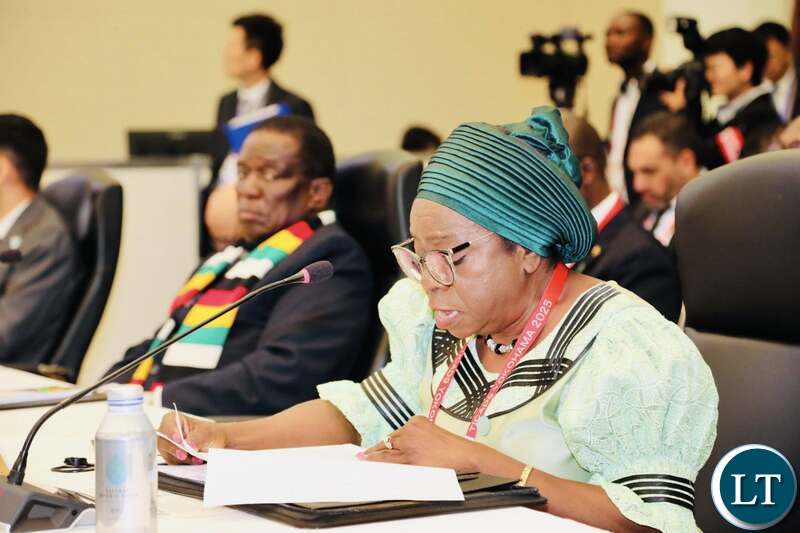
While delegating is not uncommon, the pattern raises questions, especially given the president’s vocal commitment to gender equity. For four years, Vice President Mutale Nalumango, Zambia’s highest-ranking female official, has been denied the opportunity to represent her country at UNGA.
Hichilema has anchored his push for constitutional reform ahead of the 2026 general election on the promise of empowering women. Yet his refusal to allow Vice President Nalumango to attend UNGA contradicts that narrative.
UNGA is more than a speech; it’s a platform for global engagement, media exposure, and legacy-building. Denying Hon. Nalumango this opportunity sends a troubling message: that women empowerment in Zambia may be more rhetorical than real.
Nalumango may shrug off the snub, but the symbolism is hard to ignore. Honest leadership demands consistency between words and actions. And in this case, the gap is widening.
President Hichilema’s absence from UNGA is not just a missed diplomatic opportunity; it’s a missed chance to live up to his own promises. If women empowerment is truly a priority, it must be reflected not just in policy proposals but in practice. Representation matters. And right now, Zambia’s leadership is failing that test.
They say charity begins at home. Contextually, home means Hichilema’s political circle. President Hakainde Hichilema has failed to prove that his women empowerment agenda is authentic by allowing his whole first term to slide without sending Nalumango to represent him at UNGA.