Tuesday, June 16, 2026
17.9 C
Lusaka
Home Blog Page 216

300 mining cooperatives receive artisanal licenses nationwide

3

The Ministry of Mines and Minerals Development has trained and issued Artisanal licenses to 300 Mining Cooperatives drawn from 9 Provinces of the Country.

Minister of Mines and Minerals Development Paul Kabuswe who handed over mining licences and certificates to the trained Mining cooperatives in Mpika District in Muchinga Province, said the ongoing formalization process in the mining sector was  meant to  boost and promote mining production in Zambia.

Mr Kabuswe said the 20 days training program  in Mpika district of Muchinga Province will promote a regulate the mining sector.

He   has urged those that are still carrying out illegal mining activities to refrain from the vice by getting registered as Artisanal and Small-scale Miners.

He stressed that illegal miners were exploited on a daily basis hence the reason why Government was formalising illegal mining activities through training of Small-scale miners to promote sustainable and safe mining practices.

“We are coming after illegal miners contaminating rivers by using unconventional ways to wash gold,” he said.

He added that Government will come in to actualise value of the gold resource and other resources by promoting safety and health mining practices, at the same time curbing exploitation.

“Am happy that today we are doing the right thing under the Leadership of President Hakainde Hichilema to issue licenses to Artisanal and Small-scale Miners, promoting a proper mining system,” he said.

Meanwhile, Muchinga Province Minister Njavwa Simutowe said Muchinga Province continued to emerge as an important mining frontier, particularly in gold production in Kanyelele, Kamabwe and Danger Hill demonstrating significant mineral potential, attracting a growing number of Artisanal and Small-scale miners.

Mr Simutowe said the training and issuance of Artisanal and Small-scale Mining cooperatives was a great milestone for Muchinga Province to enhance livelihoods of People and enhance responsible management of the natural resources in the Province.

“We acknowledge the economic importance of gold mining in the Province and the challenges that have risen from informal mining operations such as unsafe mining practices, Environmental degradation and illegal operations.

He said the challenges observed in informal mining do not only threaten the safety of miners but also sustainable development for the Province.

Mr Simutowe further said the training of miners in Muchinga Province was a decisive intervention by the Government to address the challenges by formalising mining operations and equipping them with knowledge and skills.

He added that Government was deliberately shifting gold mining in Muchinga Province from short term survival to long term development.

“We want Muchinga Province to be known for safe, legal and community centred mining,” he said.

Speaking during the same event, the Bisa Royal Council Spokesperson Silvario Kangela said the Bisa Royal Establishment was delighted that mining has been formalised in Muchinga Province.

Mr Kangela said training has been done at a great cost which shows how much Government cares for the people of Zambia and further urged the licensed Mining cooperatives to be compliant and operate within the mining regulations.

Speaking in a vote of thanks Bishop Peter Mutale highlighted that granting license Artisanal and Small-scale Miners shows Government’s commitment to create employment opportunities though empowerment such as this one.

Bishop Mutale said the Mining cooperatives that have undergone the training have expressed appreciation to the Government and Traditional Leaders for their support and encouragement throughout the training program.


Show Society recognises media

1

Minister of Information and Media Cornelius Mweetwa has commended the Agricultural and Commercial Cooperative Limited Zambia (ACSZ), for recognising the critical role media plays in disseminating Information to the public.

Mr Cornelius Mweetwa says that the media play a vital role in ensuring that citizens are well informed, educated and empowered to make meaningful decisions.

Speaking during the 97th Show Society Media Engagement Breakfast and Awards Ceremony in Lusaka, he expressed that the media through reporting helps bridge the gap between institutions and the citizens in promoting transparency.

He further, emphasised that the media helps to stimulate economic growth, citing that it contributes to national prosperity.

“The media helps stimulate economic growth, encourage participation and highlight opportunities that contribute to national prosperity,” Mr Mweetwa stated.

He further added that the government is fostering an enabling environment in which the media can operate freely, responsibly, and sustainably.

“I would like to thank those media houses that created a platform to those who were opposed to Bill Number Seven, as well as those who provided a platform to those who were pro-Bill Number,” he said.

He noted that the media provides different views which ensure that the country’s democracy is healthy and alive.

Meanwhile, Society Show President, Rene Lourens disclosed that these awards recognise excellence, creativity, professionalism plus dedication to quality storytelling.

Mr Lourens highlighted that there is a need for more journalists to participate in these media awards to foster stiffer competition in various categories.

“These Media Awards will get bigger and better each year, reflecting the value the cooperative places on their contribution,” he said.

Mr Lourens further said the work of journalists does not merely inform, but also shapes perceptions, sparks conversations as well as drive participation.

Petauke Woman Found Dead After Brother’s Threats

1

A 61-year-old woman from Mankhungwe Village in Petauke District has been found dead following threats made by her younger brother to kill her.

The threats stemmed from a heated argument over a family ox, which the brother had taken from the deceased’s kraal.

The deceased, Loveness Mwale, 61, was discovered with a broken hand and leg, and deep cuts on the chin and thigh.

Eastern Province Police Commanding Officer Robertson Mweemba said the suspected murder is believed to have occurred between December 17, 2025, and yesterday, December 18.

The Police Chief said the alleged murder comes about five days after the siblings quarreled and issued threats.

The matter was reported to Petauke Police Station yesterday, Thursday, December 18, at 07:30 hours.

“Brief facts of the matter are that on 12th December, 2025 at around 21:00hrs Female Loveness Mwale aged 61years now deceased, was threatened to be killed by his brother Male Charles Mwale, aged 42yrs of Kalima Village,Chief Mwanjawantu, Petauke District  when the two argued over the family Ox which Mwale got from the deceased kraal but later the animal returned back to the deceased’s Kraal,” he said.

Mr Mweemba said on Wednesday, December 17, at around 16:00hrs, the deceased left her house and went to the maize field to check on the crops and never returned.

“This prompted the daughters and grandsons to follow her but the search was in vain,” he said.

Mr Mweemba stated that   the search continued following day on Thursday when she was found dead, lying near the road next to her maize field.

“Physical check was conducted and the body had deep cuts on the chin and leg thigh. She also had a broken left hand and left leg,” he said.

The body has been deposited to Kalindawalo General Hospital Mortuary awaiting postmortem, while investigations have been instituted on the case.

President Hichilema mourns with Kapala family

1

President Hakainde Hichilema has expressed his deepest condolences following the untimely passing of the wife to Minister of Livestock and Fisheries, Peter Kapala, who died yesterday in Lusaka.

The media reports the President has further expressed his deepest condolences and wishes to Mr Kapala and his entire family, by wishing them God’s strength and mercies, during this trying moment.

President Hichilema notes that this is a tragic and very sad event, calling on the entire nation to give compassion and support to the Kapala family as they go through this difficult period.

The President said this in a speech read on his behalf by Minister of Information and Media Cornelius Mweetwa at a media briefing in Lusaka.

Chilufya Dismisses Expulsion Claims, Reaffirms PF Presidential Bid

2

Mansa Central lawmaker Dr. Chitalu Chilufya has dismissed attempts by a faction within the Patriotic Front (PF) to expel him. This follows his vote in favor of Bill 7, which was against the faction’s position.

Dr. Chilufya stated that he has not been expelled from the party. He emphasized that he remains a member of the PF, a member of its Central Committee, and a candidate for the party presidency.

The response comes after PF figure Given Lubinda announced the expulsion of all party lawmakers who supported Bill 7. Following this, deputy secretary general Miles Sampa directed party members in the affected constituencies to begin interviews for potential replacement candidates.

Dr. Chilufya labeled these actions as misinformation circulated by his opponents. He described his pursuit of the PF presidency as irreversible and declared himself the incoming party president.

He further argued that the PF is not facing extinction but is undergoing a transition that requires new leadership. “The Patriotic Front Party will not be extinct,” Dr. Chilufya stated.

Assessment Underway for National Assembly Expansion Following Bill 7 Enactment

0

Infrastructure and Urban Development Minister Charles Milupi has announced the start of an assessment to prepare for the expansion of the National Assembly. This follows the enactment of Bill 7 into law.

Minister Milupi stated that a team from the Ministry of Infrastructure, Housing and Urban Development, led by Permanent Secretary Professor Albert Malama, visited the National Assembly earlier this week to conduct the review.

He explained that the expansion is planned to accommodate 260 Members of Parliament, as stipulated by the new legislation. Construction work is scheduled for completion before August 2026 to ensure the chamber can seat all members.

The assessment will evaluate the assembly’s current layout, structural capacity, and services. This review will determine the scope of work, timelines, and technical requirements needed before detailed designs and procurement processes begin.

Minister Milupi confirmed that the ministry is treating the project with urgency to ensure the National Assembly is prepared to operate effectively under the provisions of Bill 7.

IMF sets conditions for Zambia’s final ECF review

6

IMF sets conditions for Zambia’s final ECF review
Zambia is approaching the final review of its Extended Credit Facility programme with the International Monetary Fund, a process that will determine whether the country qualifies for the next and final disbursement under the arrangement.

The IMF has indicated that the review will focus on Zambia’s adherence to agreed fiscal targets, debt sustainability measures, and progress on structural reforms implemented during the life of the programme. The assessment forms part of the 38-month facility that was approved to support economic stabilisation and recovery efforts.

Central to the review will be government performance in maintaining fiscal discipline, controlling public expenditure, and strengthening domestic revenue mobilisation. These measures were agreed as part of efforts to stabilise public finances following years of debt distress and limited access to external financing.

Debt management remains a key component of the programme, with the IMF expected to assess progress in restructuring obligations and maintaining sustainable borrowing levels. Zambia’s engagement with creditors and commitment to transparent debt reporting are among the benchmarks under consideration.

The final review will also examine broader macroeconomic indicators, including inflation trends, exchange rate performance, and foreign exchange reserve levels. These indicators are used to measure the effectiveness of policy interventions and the resilience of the economy under prevailing conditions.

Structural reforms remain a core pillar of the programme. These include governance improvements, strengthened public financial management systems, enhanced oversight of state-owned enterprises, and reforms aimed at reducing fiscal risks. The IMF has consistently linked these reforms to long-term economic stability and growth.

Social spending protections embedded in the programme will also be reviewed. The framework requires the preservation of budgetary allocations to priority sectors such as health, education, and social protection, ensuring that fiscal adjustment does not undermine support for vulnerable groups.

Zambian authorities have maintained that progress has been made in stabilising the economy under the programme, citing improved fiscal controls and reforms in key institutions. The government has positioned the IMF programme as a foundation for restoring confidence among international partners and investors.

The outcome of the final review is expected to influence Zambia’s access to concessional financing and shape perceptions of policy credibility beyond the programme period. IMF programme assessments are closely monitored by development partners and financial markets, often serving as a signal of reform commitment.

While no specific date has been announced for the conclusion of the review, discussions between Zambian authorities and IMF officials are ongoing. Completion of the review will depend on verification of data, policy implementation, and fulfilment of agreed benchmarks.

As the ECF programme approaches its conclusion, attention is increasingly shifting toward the sustainability of reforms once IMF support ends. Policymakers face the challenge of maintaining discipline and reform momentum while addressing economic pressures and development needs.

The final review represents a critical juncture for Zambia’s economic programme, marking the transition from IMF-supported stabilisation toward a post-programme policy environment anchored on domestic reform ownership.

Kalaba says Bill 7 is now law and warns UPND will “lose the people”

8

Kalaba says Bill 7 is now law and warns UPND will “lose the people”

Citizens First president Harry Kalaba has delivered a wide ranging critique of the UPND administration, accusing it of deepening national divisions, presiding over what he called unprecedented load shedding, weakening small and medium enterprises, and using the anti corruption agenda for political ends.

Kalaba made the remarks on KBN TV’s State of the Nation programme hosted by Kennedy Mambwe, as the discussion reviewed the country’s direction ahead of the 2026 elections.

During the interview, Kalaba said Constitution Amendment Bill No. 7 had been assented to on Thursday, December 18, 2025, and described it as a measure crafted to advantage the governing party rather than address public priorities. He said the bill’s passage, despite opposition from sections of civil society, churches and legal stakeholders, reflected what he characterised as a process that did not meet expectations of broad based consultation.

Kalaba told the programme that, in his view, constitutional change should be built around public participation and outcomes that serve citizens rather than political players. He said that while the bill was now law, he believed it would carry political costs for those who championed it, stating that the UPND may have secured parliamentary numbers but would face public judgment.

As the interview returned to the electoral implications of the new law, Kalaba pointed to the introduction of mixed member proportional representation and suggested it could ultimately work against the current administration, depending on how future votes translate into seat allocation. He also referred to provisions affecting mayors and council chairpersons, saying the removal of term limits at local authority level could set a precedent that may later be used to advance wider arguments on term limits in national politics. In an exchange with the host, he said he believed the President’s political thinking was to rely on increased parliamentary numbers after elections to pursue further changes, though he acknowledged the President had not publicly stated such intentions.

Kalaba also criticised Speaker of the National Assembly Nelly Mutti over public celebrations that followed the bill’s passage, and said he supported calls for the Speaker to reconsider her position. He said the Speaker’s role required visible impartiality because Parliament includes divergent political parties and is expected to operate under rules of fairness and decorum.

On claims of shrinking democratic space, Kalaba said his party had faced repeated restrictions when attempting to hold meetings and cited a Chipata incident in which a planned rally was stopped, with police reportedly stating that the campaign period had not begun. He further alleged that Citizens First had made multiple notifications for public meetings, but had only held a limited number. He also discussed an incident in Mufulira where he said police arrived during a church gathering after what he described as “fresh instructions” to halt the meeting, before an officer reviewed documentation and declined to proceed.

The interview also turned to the Chawama parliamentary by election. Kalaba said Citizens First had decided to participate, arguing that boycotting the contest would leave residents without a challenge to the governing party. He announced that the party’s candidate is retired Captain Davison Mulenga, whom he described as a Chawama resident with previous public service experience including councillor, deputy mayor, district commissioner and permanent secretary.

On social and economic issues, Kalaba claimed the cost of doing business had risen and used the reliance on generators as an example raised during the broadcast. He also criticised the way the Constituency Development Fund is discussed in public debate, saying it should not substitute core government service delivery functions, and he said his party would seek to “realign” CDF if elected.

On the health sector, Kalaba criticised Health Minister Elijah Muchima’s public response to volunteer doctors, after the host raised concerns that some doctors had threatened to withdraw voluntary services. Kalaba said the issue required engagement and assurances, and he stated that Citizens First would seek to reduce administrative barriers in recruitment, including for teachers and other public service roles.

Kalaba also questioned official explanations for improvements in load shedding, disputing claims linked to water levels and suggesting, without providing specific details, that other decisions and arrangements were driving the situation. He said his party would prioritise measures to stabilise power supply and referred to plans that include expanding generation and considering nuclear power development over time.

The discussion ended with Kalaba saying Citizens First remains open to collaboration with other opposition figures, while confirming it will contest the 2026 elections as a standalone party.


ACC Acknowledges Mwamba Complaint as Bill 7 Becomes Law

3

ACC Acknowledges Mwamba Complaint as Bill 7 Becomes Law
The Anti-Corruption Commission (ACC) has formally acknowledged receipt of a complaint by former Ambassador Emmanuel Mwamba alleging bribery, inducements, and intimidation of Members of Parliament in the lead-up to the passage of Constitution Amendment Bill No. 7, even as the Bill has since been assented to by President Hakainde Hichilema and is now law.

The acknowledgment, stamped by the Office of the Director General on December 17, 2025, confirms that the complaint has been formally received and placed on record, marking the first documented institutional response to the corruption allegations linked to the Bill 7 vote.

President Hichilema assented to Bill 7 after its passage by Parliament during a Special Session held on December 15, 2025, completing the legislative process despite ongoing legal, political, and procedural disputes surrounding the Bill. The assent means that the constitutional amendment now has the force of law, irrespective of unresolved allegations relating to the manner in which parliamentary support was secured.

In his complaint dated December 16, 2025 and addressed to ACC Director General Daphne Pauline Soko Chabu, Mwamba alleges that agents or representatives linked to the President offered cash payments, gifts, and threats of arrest to MPs to influence the outcome of the Bill 7 vote.

The complaint claims that a group of Patriotic Front and Independent MPs were transported and flown to an executive lodge in the Lower Zambezi area, where they were allegedly kept until voting day. Mwamba alleges that the MPs each received US$150,000, paid in two instalments before and after the vote.

The letter further alleges that the operation was coordinated by State House Special Assistant for Politics Levy Ngoma, with additional claims that Government Deputy Chief Whip Likando Mufalali made similar payments to ruling-party backbenchers. It also alleges that some MPs were contacted by officers from the Zambia Police Criminal Investigations Department and threatened with arrest if they failed to support the Bill.

All claims remain allegations, and no findings have been made by the ACC.

The passage and assent of Bill 7 occurred against a backdrop of sustained controversy. Earlier in 2025, the Constitutional Court had declared the Bill unconstitutional and void, citing the absence of a legal framework and insufficient public consultation.

Despite that ruling, the Bill was revived through parliamentary procedures, culminating in its approval during the December Special Session and subsequent presidential assent. The enactment of the law has not extinguished the corruption allegations, which relate to the conduct surrounding the vote rather than the formal legality of assent itself.

In parallel with the legal developments, political consequences have begun to unfold. Opposition political structures have moved to expel some of the MPs alleged to have received inducements, citing disciplinary breaches linked to their conduct during the Bill 7 vote.

The expulsions, announced after the Bill had already been passed and assented to, have introduced an additional layer of complexity, raising questions about accountability, timing, and the practical consequences of disciplinary action after legislative outcomes have already been finalised.

No court has ruled on the legality or effect of the expulsions, and no by-elections have been triggered at this stage.

While the ACC’s acknowledgment confirms receipt of the complaint, it does not indicate whether investigations have commenced or whether any preliminary assessment has been made. Under the Anti-Corruption Act No. 3 of 2012, the Commission is mandated to investigate allegations involving public officials, including Members of Parliament and executive actors.

The complaint places the Commission in the position of examining allegations that touch the highest levels of the executive, even as the law whose passage is in question has already taken effect.

For now, the acknowledgment serves as a procedural record rather than a substantive determination. Whether the allegations lead to investigations, prosecutions, or remain archived as part of the official record remains an open question.

Giving Up on Zambia, Sangwa Pens a Note to Sishuwa

19

Constitutional lawyer and public intellectual John Sangwa has penned a deeply personal open letter to political analyst and historian Sishuwa Sishuwa, following Sishuwa’s announcement that he is stepping back from public political commentary after fifteen years of sustained engagement. The decision came in the aftermath of the passage of Constitution Amendment Bill No. 7, which has since been assented to by President Hakainde Hichilema and is now law.

In this letter, Sangwa reflects on the weight of that moment, not only as a legal and political turning point, but as a deeply human reckoning for those who invested time, expertise, and personal risk in opposing the bill. He situates Sishuwa’s withdrawal within a broader national context, marked by growing disillusionment with parliamentary conduct, institutional accountability, and the limits of public warning in the face of political outcomes already decided.

Rather than responding with abstraction, Sangwa addresses Sishuwa directly and urges him to reconsider his decision. He chronicles the personal costs of sustained dissent, the loneliness of principled critique, and the quiet sacrifices that often accompany speaking truth to power. At its core, the letter is both an appeal and a testament, arguing that moments of democratic strain demand persistence rather than retreat, and that voices shaped by integrity retain their value even when the political terrain appears unresponsive.

Below is the open letter by John Sangwa, published in full and without alteration.

Giving Up on Zambia, Sangwa Pens a Note to Sishuwa
Open Letter to Sishuwa Sishuwa

18 December 2025

Dear Sishuwa,

I read with deep sadness your announcement that you will step away from offering public political commentary after fifteen years of steadfast engagement. This decision follows the passage of Bill 7, which has since been signed into law by the President of Zambia. I am fully aware of how tirelessly you and many others fought, both publicly and, perhaps more importantly, privately, to prevent this outcome. I can only imagine the depth of disappointment you must have felt following the vote in the National Assembly.

Your words resonated deeply when you wrote that, “Sometimes, warning people does not work. It is important to let them live through the experience, good or bad, of the very thing that you are warning the people against embracing.” One of the burdens you carry is that, because of your professional training, you are able to discern the direction of travel well in advance, long before many are able to grasp its consequences through lived experience.

Because your farewell message was shared publicly, I have chosen to respond in the same spirit. I hope you will not mind, and that this open letter finds its way to you. I respectfully ask you to reconsider your decision to withdraw from providing political commentary on the affairs of our country. Please do not believe, even for a moment, that your voice has been anything other than essential.

It has been a clarion call, reminding us that democracy is a sacred covenant that must be defended at all cost. We have watched you stand firm when it was difficult, speak out when it was dangerous, and bear witness when others chose silence, regardless of which political party held power. Your resilience has woven courage into the fabric of our collective conscience, emboldening others to discover and act upon their own convictions.

Your insistence on truth does not dissipate into emptiness, it creates a living discourse that others recognise and into which they are inspired to lend their voices. The manner in which Bill 7 was passed through the National Assembly feels historic in its gravity. That fact alone is reason enough for you to continue addressing the pressing issues of our time and to remain a moral compass for the nation.

We can no longer place unquestioning faith in a parliament that has shown a willingness to subordinate the national interest to personal considerations and a judiciary that has failed to discharge its solemn duty as the final bulwark in the defence and preservation of our democracy. This is not the moment to withdraw, for in your persistence you hold the line not only for principle, but for the enduring belief that a single individual, armed with integrity, can influence the course of history.

Your voice has safeguarded the democratic flame in countless citizens. By continuing, you will ignite it anew in people you may never meet. You are not a solitary voice crying out each day, many others are joining you in the struggle for a free, just, and democratic Zambia. We need you to continue speaking for Zambia.

I know, perhaps better than many, the depth of your love for this country. You live a clean and dignified life. You are highly educated. You hold a job that gives you purpose and security. You reside in a community where basic public services function as they should. Yet despite these comforts, you have quietly endured abuse and insults, often from those who do not realise that you are speaking on their behalf.

You have faced threats, lost friendships, witnessed betrayal, and borne the heavy cost of speaking truth to power. It is easy to underestimate the personal sacrifice demanded by your consistent commitment to holding elected officials from successive governments to account. While I understand the reasons that may compel you to step away, I urge you not to do so for the sake of the country you so clearly and deeply love.

Keep speaking.
Keep writing.
Keep inspiring.

I am grateful for what you do for Zambia, and I know that I am far from alone in this appreciation. I sincerely hope that you will reconsider your decision and return to the battlefield. Now more than ever, Zambia needs patriots like you who, even when personally secure, are willing to sacrifice for her future.

Many of our contemporaries may fail to appreciate your efforts and may even direct hostility toward you, but posterity will recognise and honour your contribution alongside those of our fallen heroes, including Lucy Sichone.

Yours in the struggle for a better Zambia,

John Sangwa

PF Expels MPs Over Bill 7 Vote as Leadership Dispute Complicates Enforcement

9
PF Expels MPs Over Bill 7 Vote as Leadership Dispute Complicates Enforcement

The Patriotic Front (PF) has announced the expulsion of all its Members of Parliament who voted in favour of Constitution Amendment Bill No. 7, citing defiance of party instructions and what it describes as a betrayal of the Zambian people.

The decision was announced on Thursday by PF Acting President Given Lubinda during a media briefing in Lusaka, shortly after President Hakainde Hichilema assented to the bill.

Lubinda stated that the party had issued a three-line whip directing all PF MPs to vote against Bill 7 and to ensure that a “No” vote was formally recorded during proceedings in the National Assembly. He said the directive was clear, lawful, and communicated repeatedly to members of parliament.

According to Lubinda, PF leadership held at least eight engagement meetings with its MPs ahead of the vote. He added that the party’s national chairperson, Jean Kapata, publicly reiterated the directive during a press briefing on the eve of the vote, which was broadcast live and reported in the print media.

“No member of parliament can claim not to have heard the directive,” Lubinda said.

Constitutional Court ruling cited

Lubinda anchored the expulsions on the Constitutional Court ruling in Celestine Mukandila and Monia Zulu v Attorney General (Case No. 2025-CCZ-009), which found that the government’s initiation of the constitutional amendment process was inconsistent with the spirit of the Constitution.

He said the court ruled that beginning the amendment process without wide public consultation violated several constitutional provisions, including Articles 1, 2, 5, 7, 8, 9, 61, 90, 91 and 92.

Lubinda stated that the court guided that any constitutional amendment process must be people-driven, led by an independent body of experts, and grounded in broad and meaningful consultations with citizens.
Despite that guidance, he said Parliament proceeded with Bill 7, which was later passed and assented to.

Division list dispute

Lubinda also criticised the National Assembly for failing to release the official division list showing how MPs voted on Bill 7, four days after the vote.

He said parliamentary practice requires the division list to be published within 24 hours, arguing that the delay undermines accountability and transparency.

“Members of parliament are accountable to the electorate, and the electorate has a right to know how their representatives voted,” Lubinda said.

He called on Speaker of the National Assembly Nelly Mutti to immediately release the division list, stating that parliamentary proceedings are public and that voting records cannot be lawfully concealed.

Lubinda added that the PF already knows which of its MPs were present in the chamber and how they voted, regardless of the delayed publication of the official record.

Immediate expulsions announced

Lubinda announced that all PF MPs who voted in favour of Bill 7 had been expelled from the party with immediate effect.

“This decision is final and irreversible,” he said.

He added that all PF structures across the country had been directed to take formal notice of the changed status of the affected MPs.

Lubinda said MPs who absented themselves from the vote were not automatically considered to have endorsed the bill, stating that the party hoped those decisions were made in good faith and in line with the will of the electorate.

Enforcement tied to recognised leadership

However, the practical enforcement of the expulsions remains uncertain due to unresolved questions surrounding the recognised leadership of the Patriotic Front.

Under parliamentary practice, the Speaker of the National Assembly acts on formal communication from the legally recognised leadership of a political party when considering matters such as loss of party membership and the status of MPs.

In the PF’s case, the leadership dispute centres on the party presidency, with Chabinga currently holding himself out as party president without having been elected through a national convention, the traditional mechanism for leadership selection under PF structures.

As a result, any communication to the Speaker regarding expulsions may be contested unless it is issued by leadership that is formally recognised in law.

This situation places the expulsions within a broader legal and institutional dispute, rather than a straightforward parliamentary process.

Political position maintained

Lubinda said the PF was prepared to proceed politically regardless of the consequences, stating that the party would rather operate without MPs it considers to have acted against the people’s will.

He instructed party structures to begin identifying potential candidates to stand on the PF ticket in the 2026 general elections.

He also called on opposition political parties to remain united in defending constitutionalism and the rule of law.

While the Patriotic Front has asserted its political position by expelling MPs who supported Bill 7, the effectiveness of that decision ultimately turns on the unresolved question of party ownership and lawful leadership. With the PF presidency itself under dispute and the courts yet to conclusively determine who holds legitimate authority over the party, the expulsions remain politically significant but legally contested. Until the judiciary settles the question of who rightfully controls the Patriotic Front, actions taken in the party’s name are likely to continue facing institutional and legal uncertainty.

World Vision Zambia donates to persons with disability in Kafue

0

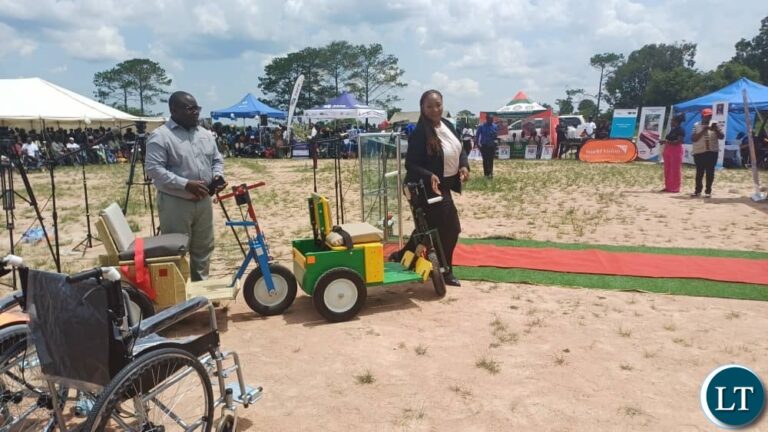
World Vision Zambia has donated four hand-cranked carts to persons with disabilities in Kafue District.

Speaking during the handover ceremony, World Vision Zambia Development facilitator, Ruth Chikanya said her organisation is committed to promoting disability inclusion, empowering persons with disabilities, and ensuring equal opportunities for all.

“We believe every person with disabilities, regardless of ability, deserves to thrive and reach their potential,” she said.

The media reports that Ms Chikanya further noted that the organisation is committed to breaking barriers, through inclusive development by ensuring that persons with disabilities are incorporated in all programmes and decision-making processes.

She said the hand-cranked carts will support the recipients with mobility and help to enhance livelihoods

“I urge everyone to join hands in promoting disability inclusion, advocating for the rights of persons with disabilities, and ensuring equal opportunities,” Ms Chikanya said

And one of the recipients of the hand-cranked carts, Stanley Musanto commended World Vision Zambia and government, for the commitment to addressing the plight of persons with disabilities.

“I want to commend the government for ensuring that persons with disabilities are not left behind in the development process of this country, “he said

Meanwhile, Zambia Agency for Persons with Disabilities (ZAPD) Provincial Coordinator, Elivas Nyirenda appealed to all Organisations for persons with disabilities to ensure that all members have a disability identity card.

She said identity cards will enable them to access all services that are meant to benefit persons with disabilities.

“The cards will also help us to know statistics of persons with disabilities,” she said

NFA embarks on nationwide inspection of Mortuaries, Laboratories

0

The National Forensic Authority (NFA) has embarked on nationwide inspections of mortuaries and laboratories to pave the way for the decentralisation of forensic services, with Mpika District set to benefit.

NFA Executive Director, Brigadier General Professor Lawson Simapuka, says the Authority is mandated to regulate forensic pathology and science in both the public and private sectors.

Speaking immediately after touring Mpika Urban Clinic, Chilonga Mission Hospital, and Michael Chilufya Sata Hospital, Brig Gen Simapuka said the NFA, which began operations in May 2021, is now expanding its footprint to ensure specialised services reach all parts of the country.

The media reports that Brig Gen Simapuka explained that the inspection team is assessing whether health facilities in the province have the capacity to handle samples obtained from forensic postmortems.

“We are the regulators of forensic science in Zambia. We license and accredit facilities only after inspecting that the infrastructure, equipment, and human resource meet the minimum standards,” he said.

The Executive Director highlighted the importance of forensic biology and DNA analysis, noting that the country has moved beyond relying solely on oral testimony to scientific evidence to secure convictions.

“Government opened a laboratory in April 2023 to analyse DNA. This means samples collected from a crime scene can now be scientifically compared with those of a suspect and other corroborative evidence,” he explained.

Brig Gen Simapuka disclosed that the NFA is currently touring the country to collect samples for the creation of a National Population DNA Database for statistical analysis and criminal profiling.

He said the database will assist in medical genetics, identifying missing persons, disease tracing, and ancestral tracing, ultimately enhancing justice delivery by ensuring the right perpetrators are prosecuted.

He further indicated that the Ministry of Home Affairs and Internal Security is collaborating with the Ministry of Local Government and Rural Development to upgrade mortuary and laboratory infrastructure in Muchinga Province to accommodate the services.

Meanwhile, Mpika Town Council Advocate, Mercy Sela, has welcomed the development, describing it as a beacon of hope for crime reduction.

Ms Sela noted that the forensic services are timely, given the increased mining activities in the district which have altered the demographic landscape.

“The increase in mining activities has led to a population surge and a subsequent rise in crime. These services will greatly aid in curbing crime in the district,” she said.

Veep Lauds Russian humanitarian food assistance

5

The Russian Government in collaboration with the World Food Programme (WFP) has donated humanitarian food assistance to Zambia’s valued at two million United States Dollars.

The consignment includes 93.8 metric tons of vegetable cooking oil and 648 metric tons of yellow split peas.

And in receiving the donation, Vice President Mutale Nalumango thanked the Russian Government for the humanitarian assistance rendered to Zambia.

The media reports that Mrs Nalumango said that close to two million people are in need of food assistance.

“The 2025 index vulnerability and needs assessment report indicates that approximately close to two million people require some form of food assistance,” said Mrs Nalumango.

She explained that 50 districts across nine provinces are still in need of food assistance.

Mrs Nalumango explained that the 50 districts are part of the districts that were affected by the 2023 to 2024 drought.

The Vice President indicated that not all the districts have fully recovered from the impact of the drought.

She assured the Russian government that the humanitarian assistance will be distributed to intended communities affected by the drought.

And speaking earlier, Russia’s Ambassador to Zambia, Azim Yarakhmedov said the humanitarian assistance is meant to cushion communities from the impact of the drought, induced by climate.

Mr Yarakhmedov said Russia has a duty to support friendly states like Zambia.

The Russian government pledged to continue supporting Zambia’s efforts aimed at strengthening food security.

Government laud Airtel Zambia for investing 107 Million US dollars

0

Minister of Science and Technology, Felix Mutati has commended Airtel Zambia for its significant investment of US$107 million aimed at expanding network infrastructure through the construction of additional towers nationwide.


Speaking during a tour at Nyumba yanga and Chalala Network tower sites, Felix Mutati expressed optimism that the investment will improve the network in the country and create more tax revenue for the government to keep powering development in the country.


The media reports that Mr Mutati disclosed that the US$107 million investment will go towards the construction of 406 network sites, a move expected to significantly enhance the quality of connectivity and service delivery across the country.


Mr Mutati said the investment will boost employment in Zambia by creating jobs for local people, while also spurring additional opportunities in related industries that will support skills development and wider economic growth.


The Minister disclosed that the construction of network towers no longer requires approval from the Zambia Environmental Management Agency (ZEMA), a process that previously took nearly six months to complete.


“We are moving with urgency to provide our people with high-quality network services,” Mr Mutati said.


The Minister applauded Airtel Zambia for investing in solar energy, noting that the initiative helps tackle the country’s power challenges and keeps network towers operational around the clock.


Meanwhile, Airtel Zambia’s Managing Director, Hussam Baday, disclosed that 126 out of the planned 406 sites have already been constructed and are now fully operational.


He stated that all sites are expected to be completed by March next year, emphasising that the company’s engineers are fully capable of meeting the deadline.


He also revealed that the $107 million investment marks Airtel Zambia’s largest single-year expenditure, underscoring the company’s commitment to closing the country’s digital divide.


Mr Hussam assured customers that the investment was driven by the company’s awareness of concerns over poor network quality and their commitment to addressing them.


The move follows increasing public dissatisfaction with Airtel’s network services across the country, as customers have raised complaints about frequent disruptions and poor connectivity, prompting the company to invest heavily in improving its infrastructure.