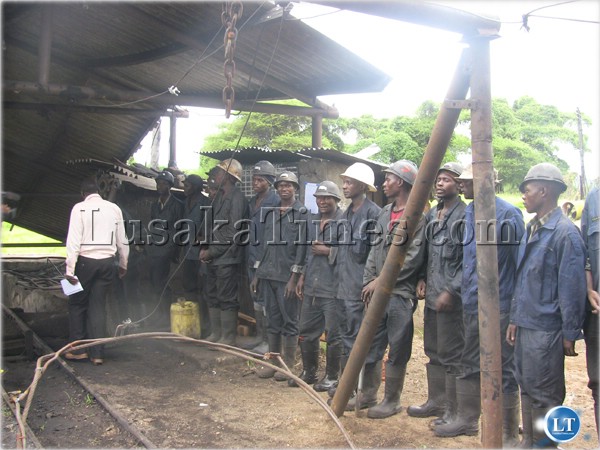
The United Mine workers Union of Zambia (UMUZ) has appealed to all workers at Mopani Copper Mine and Konkola Copper Mine – KCM to remain calm and focused during this undesirable period.
Mopani and Copperbelt Energy Corporation are locked in a dispute after the mining giant refused to pay for the revised electricity tariffs being paid by other mining companies in the Country while KCM has maintained that it will go ahead and outsource the management of the mine.
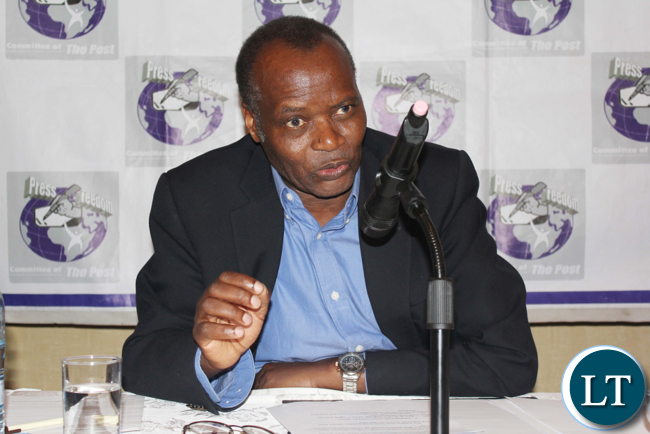
Union General Secretary, Yosamu Nyirongo however says workers at the two mining companies should not panic as their unions are following the issues closely.
Mr. Nyirongo has also thanked Government for ensuring that both Mopani and Konkola copper mines negotiate with stakeholders to stabilize the business operations.
He has urged union leaders to refrain from issuing half-baked statements to the media on matters that are still under discussion as it undermines the spirit of dialogue between parties.
Mr. Nyirongo notes that the courts of law should be left to determine the outcome of the matter between CEC and Mopani because the two parties are operating under a duly signed contract.
This is according to a statement made available to Znbc news in Lusaka.
Patriotic Front Secretary General Mr. Davies MwilaThe ruling Patriotic Front Secretary General Davies Mwila has distanced itself from Police action which led to the cancellation of Thanksgiving Prayers by the Opposition UPND.
“The Patriotic Front is not allergic to prayer. As a matter of fact, it has been our consistent prayer that a day will come when the Opposition UPND would understand the need for Prayer in a Christian Nation like ours. It is a matter of public knowledge that in the Past, the UPND have refused to join the rest of the nation in matters of prayer. They have politicised 18th October, which President Edgar Lungu declared as a public holiday, dedicated to prayer, fasting and reconciliation”, he has observed.
Mr Mwila has further challenged the UPND not to shun in this year’s October 18th National Prayers, Fasting and Reconciliation as they always do.
“We hope UPND and other Opposition Parties can attend this year’s national prayers. As Political parties, we must ensure we are identified with prayer as opposed to being linked to dark forces. The former is the Journey of Faith Patriotic Front is proud to promote in line with our declaration of Zambia as a Christian Nation. The latter is about the evil undesirable in our nation. So we encourage everyone to pray”, Hon Mwila has said.
Mr Mwila has further denounced assertions by UPND National Chairperson Mrs Mutale Nalumango linking the ruling Party to a Police decision.
“Mrs. Nalumango knows too well that the Police are not a branch of the Patriotic Front. They make decisions, good or bad, on their own. They ensured public safety and security after UPND leader Hakainde Hichilema was released after the DPP entered a Nolle Prosequi. The UPND procession went uninterrupted and no UPND National Chairperson linked the Police to the ruling Party at that point. With the unfortunate and unnecessary cancellation of Opposition prayers, the UPND has found it convenient to apportion blame on the ruling Party. But we are accustomed to UPND’s 11th Commandment – when Courts rule in their favour, they celebrate justice but when a Judgement goes against them, they insult the Judiciary as being held hostage by the ruling PF. It’s nothing but a UPND mindset problem”, he has said.
The PF Secretary General has also announced the appointment of Chungu Bwalya, MP, as Acting Provincial Chairperson for Northern Province, following Mr. Felix Mfula’s appointment into Foreign Service. Hon Mwila has also lifted suspensions for all Northern Province Party Officials with immediate effect and has since directed all who were acting to revert to their substantive positions. He has since called for hard work in the Province.
Striker Riyad Mahrez will lead Algeria’s charge against Zambia next week’s 2018 FIFA World Cup Group B doubleheader.
The Leicester City striker is joined by hs club mate Islam Slimani and Yacine Brahimi of Porto in Portugal.
Goalkeeper Rais M’Bolhi of French club Rennes has also been selected for the September 2 away and september 5 home leg.
Coach Lucas Alcaraz has also named four players from Algeria’s 2018 CHAN team that failed to qualify for the Kenya tournament after it was eliminated by 2014 champions Libya.
Zambia and Algeria are tied on 1 point after two rounds of matches played,one point behind second placed Cameroon and five points adrift of leaders Nigeria.
Team:
Goalkeepers: Rais M’Bolhi (Rennes – France) Abdelkadir Salhi (CR Belouizdad – Algeria), Mehdi Jeannin (Clermont Foot – France).
Immediate past Minister of Health Joseph Kasonde has died.
Family sources revealed that Dr Kasonde died after a battle with liver cancer.
Zambia Medical Association President Dr Abidan Chansa confirmed the death of Dr Kasonde.
“It is with a heavy heart that I announce the passing on of our senior colleague of the profession, Honourable Dr Joseph Kasonde, former Minister of Health,” Dr Chansa said.
Dr Kasonde died around 21:30 Hours on Friday at the University Teaching Hospital in Lusaka.
Dr Kasonde was a Zambian politician who served as the Minister of Health from October 2011 to 2016.
He served both in the Michael Sata as well as the Edgar Chagwa Lungu administration (2011 to 2016).
Dr graduated from the University of Aberdeen in 1966 with a Bachelor of Medicine, Bachelor of Surgery degree.
He was a fellow of the Royal College of Obstetricians and Gynaecologists.
He thereafter attained his Doctor of Medicine degree by thesis in 1976 from the University of Oxford.
From 1977 to 1984 Dr Kasonde served as Director of Medical Services, combining this position with that of Permanent Secretary in the Ministry of Health of Zambia from 1979.
From 1985 to 1998 he worked for the World Health Organization as Responsible Officer for Research Capacity Strengthening in Developing countries in the Special Programme for Research and Research Training in Human Reproduction
Power Dynamos on Saturday welcomes Red Arrows at Arthur Davies Stadium in Kitwe seeking to go top of the FAZ Super Division table.
Third placed Power, who sits on 42 points, will dislodge leaders Zesco United from the top spot if they beat 10th placed Arrows in this Week 25 match in Ndeke.
Zesco will only play their match on Sunday against Green Buffaloes in away Lusaka.
Power are three points behind Zesco but have a superior goal difference over the Ndola side.
Arrows and Power drew 1-1 in the first round encounter played in Lusaka in May.
The Air Men have 33 points, nine behind their weekend rivals Power.
Elsewhere on Saturday, Sunset Stadium in Lusaka hosts a double-header that will see Lusaka Dynamos battle Green Eagles in the 13h00 kick off match.
Zanaco will complete the Sunset double-header with a 15h00 encounter against visitors Nchanga Rangers.
FAZ SUPER DIVISION – WEEK 25
Saturday, 26th August, 2017
13:00 Lusaka Dynamos vs Green Eagles – Sunset Stadium
15:00 Zanaco vs Nchanga Rangers – Sunset Stadium
15:00 Nkwazi vs Forest Rangers – Edwin Imboela
15:00 Power Dynamos vs Red Arrows – Arthur Davies Stadium
15:00 Lumwana Radiants vs Nakambala Leopards – Lumwana Ground
15:00 Kabwe Warriors vs Mufulira Wanderers – Godfrey Chitalu Stadium
Sunday, 27th August 2017*
15:00 Napsa Stars vs Buildcon- Edwin Imboela Stadium
13:00 Green Buffaloes vs Zesco United – Vodafone Stadium
15:00 City Of Lusaka vs Nkana – Vodafone Stadium
15:00 Real Nakonde vs Konkola Blades – New Nakonde Stadium
Mopani Copper Mines has asked the Kitwe High Court to commence contempt proceedings against the Copperbelt Energy Corporation-CEC- for allegedly disobeying a court order.
This is in matter in which Mopani has applied for a mandatory order in the Kitwe High Court to compel CEC to restore full power supply to the mine.
Mopani wants CEC Managing Director Owen Silavwe and Operations Manager Christopher Nthala cited for contempt for allegedly disobeying a court
Order.
The Court order was directing CEC to allow the Mine draw electricity of up to 2-hundred and 50 megawatts monthly from the various interconnections necessary for its operations.
This is According to an affidavit in support of ex-parte summons to support the application of the committal order filed by Mopani Copper Mine Company Secretary Goodwell Mateyo in the Kitwe High Court today.
CEC and Mopani are locked in a dispute over the revised electricity tariffs.
Mopani contends that the behavior of CEC and its officers undermine the course of justice and may seriously impair the standing and reputation of the court and the entire judicial system in Zambia.
On August 11, this year, Mopani commenced a court case against CEC for restricting power supply to the mining company following a dispute over tariffs.
Kitwe High Court Judge Timothy Katenekwa has adjourned the matter to August 30, 2017, in Kabwe.
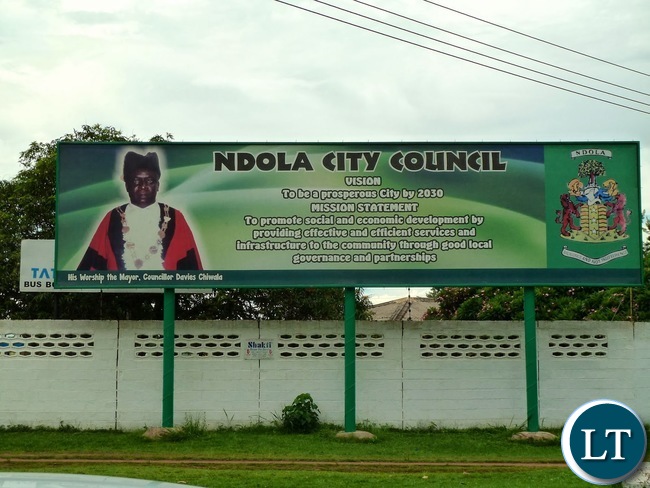
The Local Government Service Commission has suspended Ndola Town Clerk Ernest Sumani and thirty other officers at the local authority. Commission Chairperson Amos Musonda says the 31 suspended officers are believed to have been involved in illicit land activities at the council.
Mr. Musonda says the suspension of Mr. Sumani and his subordinates is indefinite. The Local Government Service Commission Chairperson said this at a media briefing in Kitwe. He said the Ndola City council had a special council meeting where it resolved to suspend the 31.
The suspended officers are from the planning, Housing and legal departments. He said a Governmental steering committee to preside over the land problems at the embattled city council has since been constituted.
Earlier this year, Minister of Local Government Vincent Mwale revoked the land administration agency from the Ndola City Council.
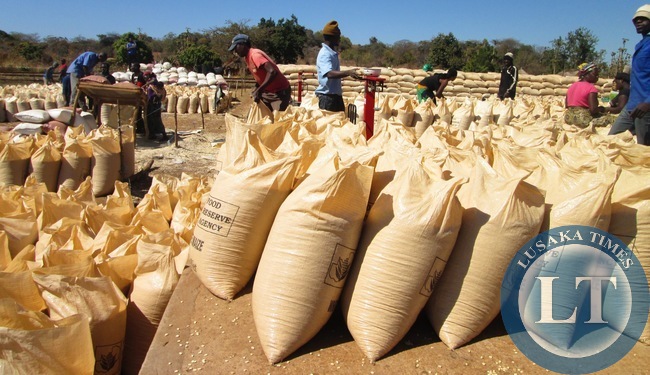
Chinkuli Multipurpose Co-operative Society (CMCS) in Chongwe District of Lusaka Province is offering K 80 per 50 Kg bag of maize to its members aimed at encouraging them to continue growing the crop.
Chinkuli Multipurpose Co-operative Solar Society chairperson Peter Miti said his organisation has decided to intervene in the ongoing marketing season by offering attractive price for maize as a way of rewarding its members for producing the crop.
Mr. Miti stated that this development has prompted farmers to sale their produce to the cooperative.
“Honourable Minister, these developments have delighted our co-operators and we would like your office to convey this wonderful message to our beloved President Edgar Chagwa Lungu for his visionary leadership. Our cooperative has also worked out a plan to help our members by offering K 80 per 50 Kg bag of maize,’” he revealed.
Mr. Miti pointed out that the attractive price of K 80 per 50 Kg bag of maize has given the milling plant enough stock and in turn increased the share capital because farmers are also buying shares promptly.
This came to light when Lusaka Province Minister Japhen Mwakalombe who is also Chongwe Member of Parliament commissioned the Chinkuli Multipurpose Co-operative Solar Powered Milling Plant Project in the outskirts of Chongwe District.
And Lusaka Province Minister Japhen Mwakalombe said the presidential solar milling plants project is designed to stabilize and lower the price of mealie meal to less than K 50 by lowering the cost of production, and with the efficiency of the milling plants.
Mr Mwakalombe said the ongoing installation of the presidential solar milling plants across the country has enhanced the diversification and value addition in the agriculture sector.
Mr Mwakalombe added that the aim of the presidential solar milling plants programme is to make diversification a reality, create more jobs and value addition in the agriculture sector as outlined in the Patriotic Front (PF) party manifesto.
The Lusaka provincial minister explained that President Edgar Lungu’s initiative of the solar hammermills for maize, cassava and rice is meant to encourage the co-operatives to enhance value addition to their produce.
“Chongwe District has so far a total of 18 solar powered milling plants installed in 19 wards. The presidential initiative is designed to stabilize and lower the price of mealie meal to less than K 50 by lowering the cost of production, and with the efficiency of the milling plants, this is tenable, “he said.
“Despite challenges faced in the domestic front the economy is resilient and the government under the wise leadership of our President Mr. Edgar Chagwa Lungu has committed to ensure that diversification objectives are attained.”
Mr Mwakalombe further explained that the presidential initiative is undeniably key in improving people’s livelihoods as it addresses all the sustainability elements of job creation, uplifting of social standards, food security, revenue creation, environmental protection, use of alternative energy sources.
Chongwe has a total number of 256 registered co-operatives throughout the district
Chongwe District Commissioner Fraser Musonda, Chongwe Municipal Council Mayor Geoffrey Chuumbwe and other senior government officials attended the launch.
Special Assistant to the President for Press and Public Relations Amos Chanda chats with Patriotic Front Media Director Sunday Chanda at Kenneth Kaunda International Airport yesterday 17-08 2017. Picture by ROYD SIBAJENE/ZANIS Special Assistant to the President for Press and Public Relations Mr Amos Chanda has urged the Civil society organisations alleging that the Zambian government is undemocratic to examine their assertions and see if they reflect the reality of what is obtaining in the Nation.
At a Public talk on the Voice of America platform moderated by Host of Straight Talk Africa, Mr Shaka Ssali at the University of Zambia this Morning whose panelists included, Executive Director for Alliance for Community Action Laura Miti, Media Practioner, Lawyer and Author Mr Dickson Jere and Political Science Lecturer at the University of Zambia Mr Lee Habasonda, Mr Chanda gave examples as to why Zambia could not possibly be classified as undemocratic.
“When you talk about an impossible government and getting things done, ask yourselves this question, who defeated the bill of rights which can take care of all the things you are complaining about? Its the opposition. “We called a referendum question to say yes to the bill of rights and the opposition defeated that.”
And responding to assertions that the PF government was not inclusive, Mr Chanda stated that it was not the fault of the PF government that Mr Hichilema had an 11th commandment in the UPND to never agree on anything with the Republican President of Zambia Mr Edgar Lungu. He stated that opportunities had been availed to opposition parliamentarians from UPND to be in Cabinet and they had declined.
“The law says the President shall appoint Ministers from within parliament. And if that is not sufficient, in the broader principle of inclusiveness, the President has 8 Ministers to nominate from those that are not in parliament.”
He stated that if the President nominated opposition members of Parliament, and they declined what was he expected to do?
He threw the challenge on civil society organisations such as the one Mr Lee Habasonda represented to persuade the opposition to think in a civil manner and accept cabinet positions.
“The President will not appoint from outside parliament. When Hon. Siamunene was defence Minister, the people of southern province literally retired him. Whose problem is it? Thats the issue about inclusiveness.” He said.
“Am happy that Dickson Jere has been there, he can tell you the difficulty of any President when the election delivers the kind of result that we had in 2015/2016. What the President does is to look at what he has in parliament. And what he can have among those he appointed.” He said.
“And Mr Hichilema says that the 11th commandment in the UPND is never ever to agree with Edgar Lungu. So can you tell me if Garry Nkombo was called to government, how does it sit with that kind of commandment? Stop this utopia and idealistic way of looking at government. I think government is much more complex than that.”He said.
And responding to Mr Dickson Jere on media associations which went to a very wrong conclusion and broad opinion that the PF government was the most dictatorial, Mr Chanda stated that this was the only government that in the last two years had no journalist in jail because of their work.
Mr Chanda further stated that for instance, the current First lady had the least budget since the inception of the First lady office. Mr Chanda also wondered about the rationale behind those that thought a career in government gave such a good life than careers away from government stating that for him, when he was a Journalist, he lived in Kabulonga on sable road and now that he was in government, he still lived in Kabulonga only this time on Kabulonga road. He stated that with civil society, sometimes even when the facts were before them, it was very difficult for them to accept.
“We cant agree sometimes on even how to kick a can down the road. Even when it is said rain starts in November, when you are in civil society even when its a fact, you will say rain starts in January, ” he said
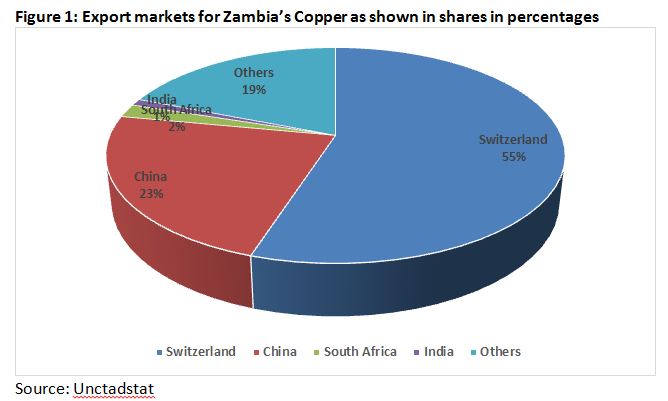
Switzerland is Zambia’s largest Importer of Copper
Yesterday, on Tuesday 22 August 2017, the Lusaka Times published a gloomy article reading, “Close to 5,000 miners to lose jobs as Mopani refuses to pay more for electricity.” Without appearing to be expert in matters of mining and tariffs, there are basic things that anyone can comment on if only to help improve the situation and save loss of jobs for so many Zambians. As an outsider, we know very little about the truth of the matter and perhaps even how to fix the problem. But one thing that we know for sure is that Mopani and its Swiss owners are very important to the Zambian economy. In case you did not know, we present the key export markets of Zambia’s copper and find that out of the total exports of copper to the world of about $ 4 billion in 2016 (We don’t have figures for 2017), Switzerland accounted for 55%, meaning it is the most important market for the country with China coming second with 19% (Figure 1).
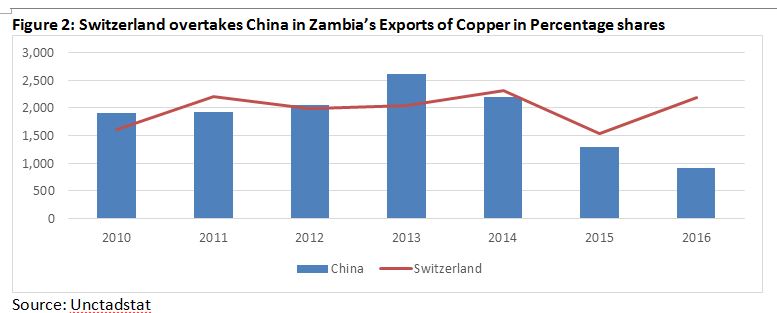
Switzerland has overtaken China as Zambia’s export market
In the last 2-3 years Switzerland overtook China as Zambia’s largest importer of copper. In 2010, China imported $1.9 billion compared to Switzerland’s $1.6 billion but in 2016, as can be seen, Switzerland imported $2.2 billion compared to $917.0 million (Figure 2). On the production side, we are also told, “Mopani is one of the largest investors in Zambia’s mining sector, having committed over USD$ 4 billion since 2000. Since 2014, Mopani has invested over USD$1 billion in site expansions and upgrades to extend the life of mine by a further 25-30 years.
”
The 80/20 Rule or Pareto Principle must apply to the Swiss Company
Management uses the 80/20 rule which states that if 80% of the company’s profits or revenue comes from 20% effort, then it is important for the company to focus its attention and reward the factors that are contributing to most income. All investors are important and must be treated equally but the last thing you want to do is frustrate the lifeblood. In this case, as said earlier, since Mopani contributes over 50% share to the country’s exports of copper, the goose that lays the golden eggs, all efforts must be made to ensure that the company remains free and happy to continue to operate and generate the revenue. As the main export revenue for the country comes from Mopani, it is not the company you want 5,000 workers to be laid off.
It is also not the company that you want to operate without predictability and consistence of the contracts reached between it and the other Zambian companies like Copper belt Energy Corporation. The company needs special efforts from Government to ensure it operates with full energy supply. When differences occur, you want to ensure that they are immediately resolved so that there is continued operation of the mine. From the article I read, all Mopani is asking for is respect for contracts signed. Private companies do not like operating without predictability and respect for contracts. That is why countries ensure that the World Trade Organization administers tariffs on imports making them predictable by binding them so that there is no frequent change. But even public companies and individuals operate better in a country where contracts are respected. Zambia must always remember that it is competing with other countries for investment and companies will go where rules and contracts are honoured.
We hope the problem can be solved as soon as possible so that there is loss of revenue from exports of copper which is so important for lubricating the country’s economic squeaks and groans. Again, as non-experts and given that most contractual documents in Zambia are opaque to the public, we don’t exactly who between the two parties is right. But if it is a question of contract, then respect must be given to what was agreed. Often, the problem in Zambia is that contracts with foreign companies are a preserve of a few Government officials who commit Zambians without their consent. In future, we must involve experts in managing and signing contracts. Managing tariffs too is not easy hence requires expertise and delicate balance between investors’ needs and those of the public.
Police in Lusaka have arrested a 29 year old woman for allegedly setting on fire her 12 years old biological daughter using Kerosene.
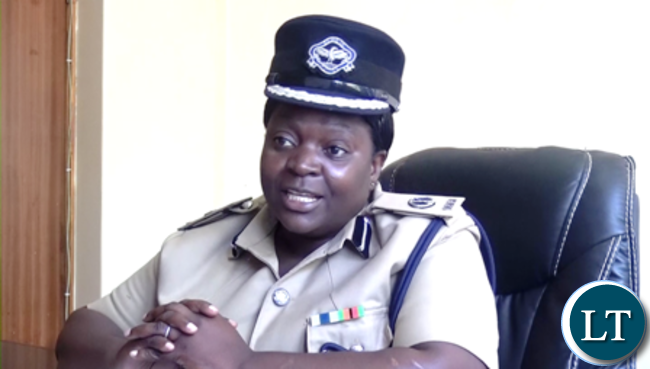
Police Spokesperson Esther Katongo has identified the woman as Prudence Phiri of unmarked house number in Lusaka’s Old Kanyama Compound.
Ms Katongo says the suspect was apprehended by concerned members of the public who later took her to Police.
She says this happened on 24th August, 2017 at about 17:00 hours in Old Kanyama Compound.
Ms Katongo explained that the child sustained multiple burns on the body and was rushed to Kanyama Hospital for medical attention, while the suspect is detained in police custody.
City of Refuge Ministries Overseer Pastor Kangwa Chileshe says police have now allowed him to hold a thanksgiving ceremony on the day of his choice.
This follows the move by police yesterday to block the thanksgiving prayers at the Cathedral of the Holy Cross for UPND leader Hakainde Hichilema following his release from prison.
Pastor Chileshe told QTV News that police canceled yesterday’s thanksgiving ceremony on the basis that he did not get a police permit to organize such a gathering.
He said following his summoning by the Lusaka province Police Command yesterday, he was told that he needed to write to the Ministry of Religious Affairs notifying the Minister of the event.
Pastor Chileshe, however, argues that in his twenty years of ministering, he has never been stopped by authorities on the pretext that he did not get a police permit.
Pastor Chileshe explained that when he attempted to enter the premises of the Cathedral of the Holy Cross, he was denied entry by the police.
He says he was later in the day called back by Lusaka Province Police Commissioner Nelson Phiri informing him that National Guidance and Religious Affairs Minister Reverend Godfridah Sumaili had given the go ahead for the prayers on the day of his choice.
Pastor Chileshe has since stated that he will communicate the new date on which the prayers will be held.
Uncle Tenson or adada sat in his brown sofa chair. Aunt a Nya Zghambo or amama sat is her brown sofa chair next to him. I sat in the corner closest to them on the long brown 3 cushion sofa.
“Tizaso and Misozi!” Uncle Tenson called.
“Sah!”
“Sah!” both of them answered and came to the living room.
“Go now to the bathroom. Musuke mino na mswaji, wear your pajamas and go to bed. You have to get up early tomorrow to go to school. Kucedwa yayi ka! (Go and brush your teeth. Do not delay).”
I quickly went to my bedroom and brought my package. I opened it on the coffee table to show them the 6 large dry bream fish I had brought.
“Yeo Tembo, (Thank you)” Aunt Nya Zghambo said clapping her hands. “This is very good fish. We will cook some of it tomorrow for supper. The rest we will put in the deep freezer.”
“Yes, Yeo Tembo (Thank you)” Uncle Tenson also said clapping hands.
“Tembo,” Uncle Tenson turned to me and said. “Malonje ngakuti ine na Anyi Namwe, and the family tose we are doing very well since you left. So tell us about Barotseland!? How was your trip to Western Province? How was it?”
“Adada na Amama muli apa, (Father and mother right here)”, I replied emphatically. “Ulendo ukanowa chomene. Ningamtetezghani yayi. (The trip was very sweet. I cannot lie to you).”
“Eh! Anenani (Tell us more).”
“Uku Ku Ulozi nkhuwemi chomene(The land of the Lozi is very good). “This was the second time I have flown on a plane. The first time was in 1974 when I flew Zambia Airways from Lusaka to Chipata for which I personally paid the fare of K13.00”.
“Sure?” my uncle said with surprise at the very low fare. “That was about the price of a UBZ bus fare from Lusaka to Chipata at the time!”(United Bus Company of Zambia)
“Enya!! The flight from Lusaka to Mongu was even better; very smooth very good. The NAMBOARD officials Mr. Imasiku and the Driver Mr. Mundia welcomed me at the air strip. But what happened the following day, I will never forget.”
“What happened!?”
“Mr. Imasiku had put me at Lyambai Hotel. When I woke up in the morning and opened the curtains of my window, the scene was the most beautiful I have ever seen in my whole life living in Lundazi, Chipata and Lusaka. The long glowing soft morning sun rays were landing on a beautiful canal with shimmering blue waters with some of the Lozi people busy rowing canoes up and down catching fish. After the first rains, the November tiny shoots of green grass were just beginning to shoot up all over the land along the canal.”
“Anenani (Tell us more)”, Uncle Tenson said sitting on the edge of his chair.
“The previous night I had gone to Sinjonjo Bar.”
“We are not surprised!” Uncle and Aunt Nya Zghambo laughed. “We know you are a young man.”
By Mwizenge S. Tembo, Ph. D.
Professor of Sociology
There have been many questions raised by a number of people notably Laura Miti, Mike Mulogoti and Charles Milupi about the role the DPP is playing in prosecutions in the Zambian criminal justice system. I would like to address the concerns raised. The DPP’s handling of the cases of People v. Hakainde and Others and the People v. Mwaliteta and others raise serious concerns as to whether the DPP office is discharging its constitutional responsibility in criminal prosecutions in Zambia. I take the two cases to illustrate that the DDPs office is either playing politics or is incompetent. Either situation, would be sad for Zambia. An argument has been made by the President and others that it was up to the courts to decide whether the two cases should go on or not.
This argument is disingenuous, Zambia is not a civil law system where judges bring indictments. In Zambia prosecutions are initiated by the police which belongs to the executive and are authorized by the DPP which constitutionally is an independent office. The office of the DPP bears responsibility for certifying that the evidence presented by the police supports a criminal charge or indictment. The courts do not exercise control over the institution or continuation of criminal proceedings, save where it is necessary to prevent an abuse or to ensure fair trial (Maxwell v. R , 1995) The courts cannot be blamed for an indictment.
They can only be blamed for bad judgments. In this article, I would like to show that no properly trained lawyer let alone a DPP who had applied his or her mind to the law and facts concerning the Hakainde case and the Mwaliteta case would have authorized the indictments, and drawn such incompetently drafted charges (in the case of the Hakainde the charge sheet even contains elementary grammatical mistakes). And yet on more than one occasion the DPP affirmed these indictments. In contrast, the DPP used her powers to take over and stop the cases of contempt by private prosecutors against Godfridah Sumaili, Minister of Religious Affairs, and Amos Chanda, Special Advisor (press) to the President.
In my view, the DPP by repeatedly sanctioning prosecutions which no impartial judge properly directed in accordance with the law could reasonably be satisfied beyond reasonable doubt that the individuals who were being prosecuted had committed criminal offenses, failed in her responsibility and in the process undermined the judicial system in Zambia.
Additionally, she violated the human rights of the accused persons (in the cases of Hakainde and Mwaliteta) and violated international standards and guidelines for prosecutors. The fair, independent and impartial administration of justice requires prosecutors to be held accountable should they not fulfill their functions in accordance with their professional duties. The DPP must be held accountable. Constitutional office holders are accountable to the constitution. They must do their job and not play politics.
The DPP is a fundamental gatekeeper to the sacred temple of justice in any democratic society. This is because, the office of the Public Prosecutor has since evolved from its odious past – as a willing cudgel in the hands of feudal authoritarians – to its modern position; as not only the defender of the ethos of society via criminal prosecution, but also as firm protector of the integrity of the criminal justice system. The office has also developed to become a bulwark, protecting the citizens from the whimsical and capricious use or employment of the criminal justice system to oppress them. This is because, it has become axiomatic that justice is the primary reason of organized societal living. To deny this is to create a Hobbesian state of nature where life is “nasty, short and brutish.” “Take away justice and what are societies but organized brigandage.”
By the same reason, law is a tool of justice – a framework through which every member of society is accorded due self-worth, dignity and fundamental freedoms. Law therefore, is not an end in itself but a means through which justice is guaranteed to “all manner of persons, without fear or favor, affection or ill-will.” The New South Wales, Australia, Guidelines for Prosecutors describes a prosecutor as a “Minister of Justice”. The Guidelines state that the prosecutor’s principal role is to assist the court to arrive at the truth and to do justice between the community and the accused according to law and the dictates of fairness.
A prosecutor is not entitled to act as if he or she is representing private interests in litigation. A prosecutor represents the community and not an individual or political party. A prosecutor should act independently yet in the general public interest. The “public interest” is to be understood in that context as an historical continuum acknowledging debts to previous generations and obligations to future generations.
There is hardly any oath of office for Public Prosecutors in the common law tradition – which Zambia is a co-heir – which does not have one version of this solemn clause or otherwise. Justice therefore has many branches – including but not limited to equity, fairness, due process and insulation from arbitrary use of state powers. Essentially, it protects citizens – particularly the vulnerable – from abuse which is inherent in unbridled use of state powers. It allocates and regulates powers thus forestalling the crude appropriation of the coercive instrumentalities of state.
In the same vein, crime and punishment are subsisting attributes of law and society. Thus, the socio-political health of any nation can be measured by an evaluation of the structures that govern crime and punishment in that society – the criminal justice system. This is hardly surprising, considering that tyranny thrives in societies with weak and pliable criminal justice systems. Therefore, justice is the first casualty of tyranny and ‘democratic dictatorship’ is justice. For instance, under the Apartheid system, all that was needed to make the free movement of blacks and other persons of color criminal, was to just make a pronouncement to that effect and even justify it as of ‘good neighborliness’ or ‘law and order.’
In democratic dictatorships, all that is needed is to invoke powers of emergency – which are only preserved for extreme situations to preserve the life of the state – at the flimsiest excuse. By so doing, the state effectively suspends the full panoply of due process and other human right guarantees which the citizens are entitled to. This is extremely manifest in societies where there is a clear executive capture of the other organs of government – the legislature and the judiciary.
Evidently, the Directors of Public Prosecutions – as important personnel in the criminal justice system – hold what can be called a ‘power of life and death.’ They can cause the incarceration of citizens by merely framing charges against them. Such citizens may even face the prospect of death depending on the charges which it pleases the Prosecutor to put on them. The extent of the damage that can be done is even more far-reaching when one considers that a citizen once charged will go through the process of (pre-trial detention and) judicial trial even if such a citizen is merely challenging the validity of the charges against him.
What this means is that the powers of the Public Prosecutor may be wrongly used with devastating consequences not only to the liberty of citizens but also to democracy. The chilling effect of potential spurious charges by the DPP on citizens can destroy their ability to demand accountability from state authorities. The experience traumatizes citizens and leaves them bankrupt as a result of huge legal costs incurred in fighting the spurious charges. Indeed, the weakness or dysfunctionality of any criminal justice system is a calamity to citizens as shown in the plight of HH in which Magistrate Greenwell Malupani ruled in April that the treason charge against him was incompetent and lacked specifics on the planned overt act to commit treason. This decision by the Court showed that the Office of the DPP had failed in its responsibility to protect a citizen and compounded the failure by not dropping the case at this stage.
In the case of Mwaliteta, Judge Bowa in his well-reasoned and articulated judgement ruled that the Prosecution had not established a case sufficiently to warrant the Court to put the accused on their defence; the evidence presented did not meet the charge of aggravated robbery that the office of the Prosecutor had authorized. The accused persons were not even at the scene of the crime, their alibis were not investigated. They arrived at the scene of the crime after the alleged crime. The police linked them to the crime because they parked near a police car and looked suspicious when they arrived at the scene of the alleged robbery. And yet the accused persons had spent over a year in prison under inhuman conditions. In both the Hachilema and Mwaliteta cases the accused were deliberately slapped with non-bailable offences to keep them in jail. Such miscarriages of justice are due to the failure of the office of the DPP to do justice as the gatekeeper of the criminal justice system. Instead the Courts are left to do the job of the DPP’s office, thus undermining their role and overburdening them with cases that should not have come before them in the first place and unnecessarily overcrowding already overcrowded prisons.
It is this understanding of the linkages between law, justice and criminal justice that led to reforms in many democracies – particularly the establishment and insulation of the office of the Director of Public Prosecutions from the many influences of men of Power. Thus, the office of the DPP, is not only there to prosecute criminal behavior, but also to protect the citizen from the illicit exercise of coercive powers of state.
OFFICE AND FUNCTIONS OF THE DPP UNDER THE ZAMBIAN CONSTITUTION
Section 180 of the Zambian Constitution Amendment Act 2016, created the Office of the Director of Public Prosecutions. By the distinct Provisions of that same section, the DPP though appointed by the President subject to the ratification by the Parliament is not an officer in the Presidency. In other words, she is not the President’s steward. The stewardship inherent in that office is to the Zambian people. Thus, the Office of the DPP enjoys a special status and only a person qualified to be a judge can be appointed to be the Director of Public Prosecutions under the relevant laws in Zambia. She is not only the Chief Prosecutor for the whole Zambian nation, she is also the Head of the National Prosecution Authority. The DPP has the power to institute criminal proceedings on behalf of the state and to determine prosecution policy. He or she must issue and enforce policy directives to be observed in the prosecution process and has the power to review a decision whether to prosecute or not.
The powers and duties are extensive and their proper exercise and performance is crucial to attainment of criminal justice in the country and the attainment of an effective criminal justice system is in turn vital to our democracy. It is therefore a position of immense public trust and responsibility, hence; the office is protected in such a manner that the occupant of that office can only be removed by the detailed and cumbersome process of removing a judge. By the further provisions of Section 180(4) of the Zambian Constitution Amendment Act 2016, the DPP may “institute and undertake criminal proceedings against a person before a court, other than a court martial for an offence alleged to have been committed by that person”.
The DPP also has powers and the function to “take over and continue criminal proceedings instituted or undertaken by another person or authority; and discontinue at any stage before judgement is delivered, criminal proceedings instituted or undertaken by the DPP or any other person or authority.” Indeed, she can perform any of these duties either directly or through officers in her office. Significantly, section 180(7) of the Zambian Constitution Amendment Act 2016, provides unequivocally that “the DPP shall not be subject to the direction or control of a person or an authority in the performance of the functions of that office, except that the DPP shall have regard to the public interest, administration of justice, the integrity of the judicial system and the need to prevent and avoid abuse of the legal process.”
The obvious import of these provisions, is to grant autonomy and full agency to the DPP so that the holder of that Office may pursue justice vigorously, unhindered by self-interest and animated only by the finest interests of the public. I argue that this interest of the public is simply justice, due process and respect for fundamental rights of citizens. Any other thing added to should only be to enhance the foregoing values rather than derogate, diminish or indeed out-rightly destroy them. The DPP therefore is an authority unto herself whose motivation to frame charges, prosecute or refrain from prosecuting any alleged criminal offence must be informed by the duty to do substantial justice.
Little wonder then, why the framers of the law strengthened the position of the DPP by providing that she can only be removed in the same manner that a judge is removed from office – Sections 182(3) and 144 of the Zambia Constitution Amendment Act 2016. This autonomy of authority granted to the DPP is further founded on section 6 of the Prosecutions Authority Act (Law number 34 of 2010). In view of these powers, and functions vested in the office of the Director of Public Prosecutions, it is clear that the DPP enjoys an elevated public service position under the extant Zambian laws. It is therefore imperative, that particular attention is paid to this special public office as it is a crucial gatekeeper to the temple of justice.
THE UNITED NATIONS GUIDING PRINCIPLES FOR PUBLIC PROSECUTORS AND COMPARATIVE EXPERIENCES AROUND THE GLOBE.
According to the UN Special Rapporteur on the Independence of Judges and Lawyers, “Prosecutors are the essential agents of the administration of justice, and as such should respect and protect human dignity and uphold human rights, thus contributing to ensuring due process and the smooth functioning of the criminal justice system.” Prosecutors also play a key role in protecting society from a culture of impunity and function as gate keepers to the judiciary.
Despite the central role of prosecutors, it is noticeable that often they are not the center of attention in the administration of criminal justice. Often, the police, the courts and sometime the defense counsel gets the full public glare and scrutiny. Thus, the prosecutor who is the lynchpin in the entire criminal justice architecture is left to enjoy the comfort of anonymity while accused persons are slammed with frivolous charges and incarcerated pending trial. Sometimes, the period of awaiting trial surpasses the period of time the accused would have served in prison custody if (they were) he was tried expeditiously and convicted.
This is particularly so for petty offences usually committed by ordinary citizens – who often may not have the wherewithal to secure effective legal representation. These and many more concerns led the United Nations Congress on the Prevention of Crime and Treatment of Offenders to adopt “the Havana” Guidelines. The Guidelines are aimed at “assisting member states in their task of securing and promoting the effectiveness, impartiality and fairness of prosecutors in criminal proceedings”.
They also seeks to ensure that governments take these guidelines “into consideration within the framework of national legislations.” They therefore emphasize that “it is essential that the prosecutors have sufficient independence or autonomy to take their decisions regardless of any outside pressure, in particular from the Executive power of the state.” They state further that, where such pressures can be and are brought, the Prosecutor will not be able to protect the interest of justice, will not be able to respect the rule of law or human right and will be powerless to deal effectively with cases of corruption or abuse of state power.”
Summarily, the Havana Guidelines emphasize(s) that Prosecutors shall:
i. At all material times maintain the honor and dignity of their profession;
ii. Always conduct themselves professionally, in accordance with the law and the rules and ethics of their profession;
iii. At all times exercise the highest standards of integrity and care;
iv. Keep themselves well informed and abreast of relevant legal development;
v. Strive to be and be seen to be consistent, independent and impartial;
vi. Always protect an accused person’s right to fair trial and in particular ensure that evidence favorable to the accused is disclosed in accordance with the law or the requirements of a fair trial;
vii. Always serve and protect public interest;
viii. Respect, protect and uphold the Universal Concept of human dignity and human rights; and
ix. Act with objectivity.
These cannons are abundantly acknowledged by the Zambian Public Prosecution Authority Act, although their practical effect on the National Prosectution Authority is not visible. Other similar instruments have been adopted in the Region. For instance, South Africa has since adopted “An Ethical Code of Conduct for Members of the National Prosecuting Authority.” The code is anchored firmly on integrity, impartiality, diligence, and professionalism as the foundations of public prosecutions. The abundance of the cannons and the wide adoption of same by many democratic countries is indicative of the fact that fair, effective and impartial public prosecution is indispensable in any democratic society.
GENERAL COMMENTS AND CONCLUSIONS
Undoubtedly, the Director of Public Prosecutions is a remarkable gatekeeper of justice in any democratic society. The powers of the office of the DPP are enormous and can give a crushing blow to human rights and democracy if improperly exercised. This makes the need to safeguard that office and use its powers in the best interest of the public indispensable. All prosecutorial decisions must be made against the backdrop of the requirements of domestic law and procedure and a constant and unwavering appreciation of fundamental human rights.
Prosecutions ought to be initiated or continued only where two conditions are satisfied: (a) the evidence which can be adduced in court is sufficient to provide a reasonable prospect of conviction-evidence test and (b) the prosecution is required in the public interest-the public interest test.
Zambian democracy presently is on trial. There is what one may call a creeping self-appropriation of the coercive powers of state by state authorities. In that unholy expropriation of the people’s right to respect of their rights and fundamental freedoms, the Parliament and the Judiciary appear to have been totally emasculated. The largely present impotence – of the Judiciary and the Parliament – is telling and many a citizen have lost interest in seeking justice before the courts or expecting the lame duck parliamentarians to act in the interest of the public.
Amidst this trying time, the DPP holds a lot of powers and should courageously refuse to become a willing tool of repression, oppression and egregious violation of the fundamental freedoms of citizens. To do otherwise would be to turn the office into a thing of ridicule and office of public persecution. The reckless framing of charges and use of the same to put “perceived enemies” of the state out of circulation is an injustice that stinks.
Democratic societies thrive on competitive ideas and politics; they would die otherwise. It is unbearable when such trumped up charges bear the seal of the DPP whose oath of office demands that she does justice to all manner of persons, without fear or favor, affection or ill-will. The DPP stands on the threshold of history at this period of moral crises for the Zambian People – she cannot afford to stay aloof or feign ignorance or indifference. Indifference to evil is a greater evil.
The Author Professor of Law Cornell University Law School and Director of the Berger International Studies Program and Institute for African Development at Cornell University