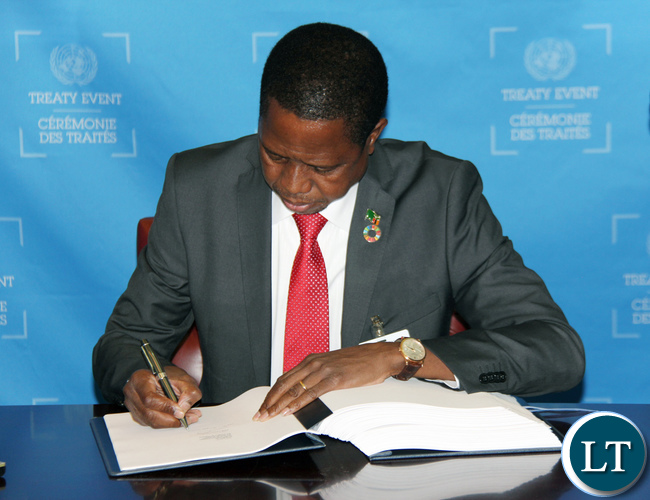
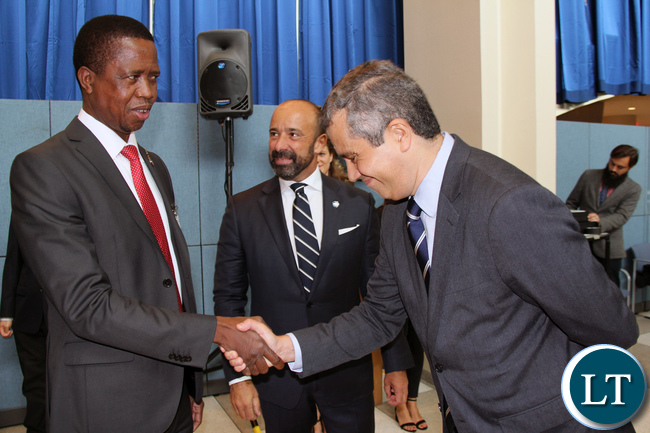
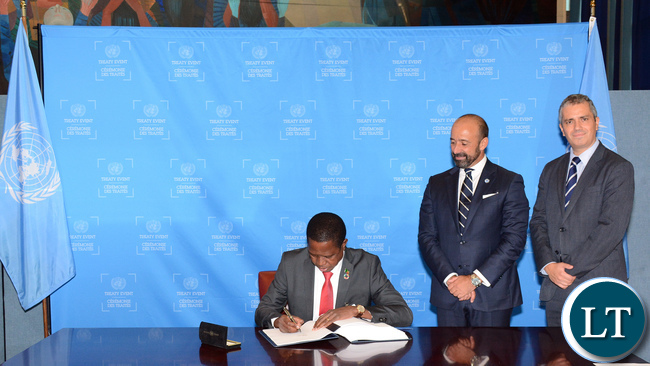
President of Zambia His Excellency Mr. Edgar Chagwa Lungu signing the Paris Agreement on Climate Change during the UN Treaty Signing Event at the on-going High-Level Segment of the 71st Session of the United Nations General Assembly in New York USA on Tuesday 20 September 2016. PHOTO | CHIBAULA D. SILWAMBA | ZAMBIA UN MISSION
President Edgar Lungu yesterday appended Zambia’s Signature to the Paris Agreement on Climate Change during the Treaty Event at the on-going High-Level Segment of the 71st Session of the United Nations General Assembly in New York, USA.
The overall objective of the Agreement is to strengthen the global response to the threat of climate change by keeping a global temperature rise this century well below 2 degrees Celsius above pre-industrial levels and to pursue efforts to limit the temperature increase even further to 1.5 degrees.
According to the statement released to the media by Zambia’s Permanent Mission First Secretary for Press and Public Relations at the United Nations, Mr Chibaula Silwamba, the Paris Agreement was adopted at the Twenty-first Session of the Conference of the Parties (COP21) held in Paris, France on 12th December, 2015, following successful negotiations by 196 Parties to the Convention on Climate Change. The Paris Agreement commits Parties to implement ambitious efforts to combat climate change and adapt to its effects while promoting sustainable development.
To date, about 181 States Parties including Zambia have signed the Paris Agreement and 28 Parties have further ratified. These Nations account for an estimated 39.08 percent of global greenhouse gas emissions. The agreement will enter into force 30 days after attaining the 55 percent threshold of the total global greenhouse gas emissions.
By signing the Paris Agreement on Climate Change, the Government of the Republic of Zambia renewed its commitment and resolve to take action in order to attain sustainable prosperity, safeguard the health of our people and the planet.
Among the Senior Officials who accompanied the President to the signing event, was Mr. Trevor Kaunda, Permanent Secretary at The Ministry of Lands, Natural resources and Environmental Protection who expressed elation at this development.
The Permanent Secretary added that in order to enhance the implementation of the Paris Agreement at country level, Government has developed its Nationally Determined Contribution (NDC) to the Paris Agreement which outlines various mitigation and adaptation programme/actions to be implemented. Mr. Kaunda said the recently adopted National Policy on Climate Change will provide a framework and ensure coordinated approach in implementation of climate change actions with a view to help the country fulfil its obligation under the Convention on Climate Change and the Paris Agreement.
The Zambian Government is confident that through collective implementation of the Agreement, developing countries like Zambia will be assisted increase its ability to adapt to the adverse impacts of climate change and foster climate resilience and transition into low greenhouse gas emissions development.
Ultimately, this will ensure environmental integrity and foster socio economic sustainability and help save our planet.
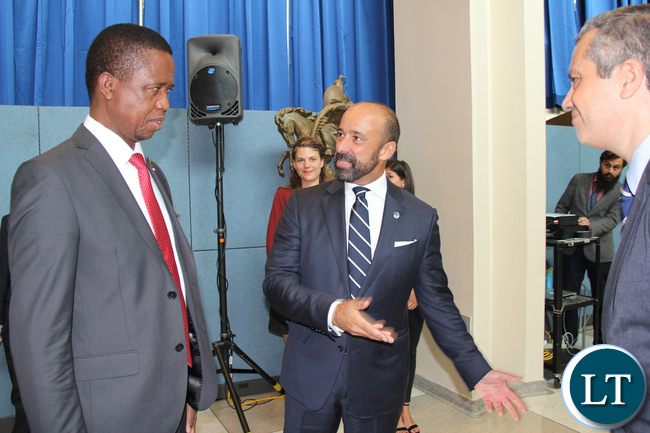
President of Zambia His Excellency Mr. Edgar Chagwa Lungu talking to United Nations Under-Secretary-General for Legal Affairs and Legal Counsel João Miguel Ferreira de Serpa Soares (c) and UN Treaty Section Chief Santiago Villalpando when the Head of State went to sign the Paris Agreement on Climate Change at UN HQ in New York USA on Tuesday 20 September 2016. PHOTO | CHIBAULA D. SILWAMBA | ZAMBIA UN MISSION
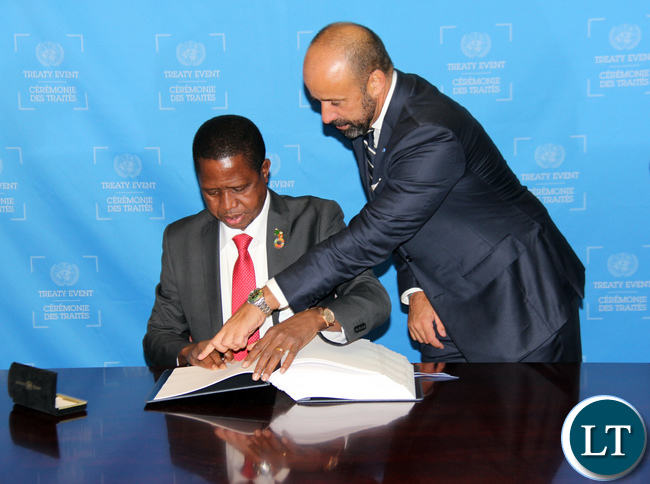
United Nations Under-Secretary-General for Legal Affairs and Legal Counsel Miguel de Serpa Soares (r) showing the President of Zambia His Excellency Mr. Edgar Chagwa Lungu where to sign during signing ceremony for the Paris Agreement on Climate Change at UN HQ in New York USA on Tuesday 20 September 2016. PHOTO | CHIBAULA D. SILWAMBA | ZAMBIA UN MISSION
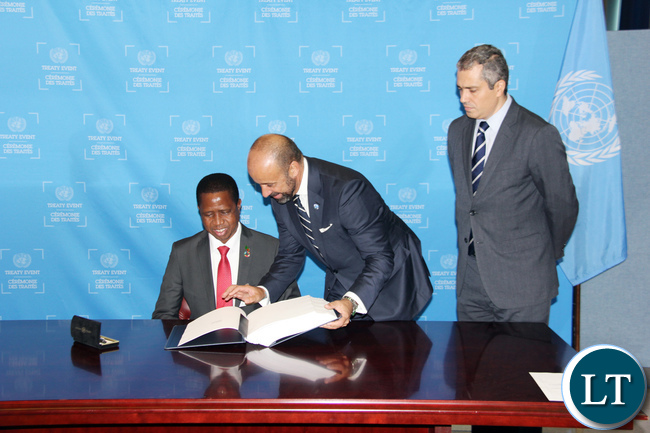
President of Zambia His Excellency Mr. Edgar Chagwa Lungu signing the Paris Agreement on Climate Change during the UN Treaty Signing Event at the on-going High-Level Segment of the 71st Session of the United Nations General Assembly in New York USA on Tuesday 20 September 2016. Looking on is UN Under-Secretary-General for Legal Affairs and Legal Counsel Miguel de Serpa Soares (c) and UN Treaty Section Chief Santiago Villalpando (right). PHOTO | WIN KHINE | UN TREATY SECTION
Zesco United coach George Lwandamina has named a 20-member squad to face Mamelodi Sundowns in Saturday night’s return leg of the 2016 CAF Champions League semifinals in Pretoria, South Africa.
Chicken George has welcomed back in the squad star midfielder Cletus Chama, who missed Zesco’s last two Champions League matches due to suspension.
Club media officer Katebe Chengo said Zesco travels to Pretoria on Wednesday afternoon ahead of the tie set for Lucas Moripe Stadium .
The Super Division champions have a 2-1 advantage over Sundowns from the first leg match played in Ndola on Saturday.
Full squad:
Goalkeepers
Jacob Banda, Lameck Nyangu, Brown Nyirenda
Defenders
Ben Adama Banh, David Owino Odhiambo, Simon Silwimba, Daut Musekwa, Bernard Mapili, Ayo Oluwafemi,
Midfielders
Anthony Akumu Agay, Misheck Chaila, Clatous Chota Chama, John Chingandu, Kondwani Mtonga, Maybin Mwaba, Mwelwa Mwape
Strikers
Jesse Jackson Were, Jackson Mwanza, Idris Ilunga Mbombo, Lazarous Kambole
The opposition UPND has written to the Inspector General of Police to allow party members hold a peaceful walk from the Party Secretariat to the residence of their President Hakainde Hichilema.
Party Secretary General Stephen Katuka says the objective of the walk is to petition the President and his running-mate Geoffrey Mwamba to take the presidential petition case to the International Criminal Court (ICC) and International Court of Justice (ICJ).
Below is the copy of the later copied to the media.
Dear Inspector General:
We seek your office’s immediate intervention concerning our application to hold a peaceful walk from the UPND Secretariat to the residence of our Party’s President, His Excellency, Hakainde Hichilema’s, residence on Saturday the 24th of September 2016 at 14:00 hours. The route we intend to use is Burma Road.
The objective of the walk is to petition UPND President, his Excellency, Hakainde Hichilema and his running mate, Hon. Geoffrey Bwalya Mwamba, to take the presidential petition case to the International Criminal Court (ICC) and International Court of Justice (ICJ).
We are, however, dismayed by the failure of the Police to effectively process this application despite the fact that we adhered to the preconditions and requirements by submitting the application on the 16th of September 2016. This application was addressed to the Police Commissioner, Lusaka Province.
We were later notified that the Police Commissioner only saw the application on Monday the 19th of September 2016 and hence the application couldn’t be considered because it fell out of the stipulated seven days that the police should be notified before the date of the event. We were also advised to address the application to the Police Command, Lusaka Urban and not the Police Commissioner, Lusaka province.
As per guidance, we resubmitted the application and addressed it to the Lusaka Urban Police Command. To our shock and disbelief, the Police Command told us to write to the Lusaka City Council to get permission to use their road. Instead of stamping our application letter, the Police Command just wrote their address on it. See attached.
This has left our party in a dilemma as we are shocked at the response of the Police. We are aware that the law clearly stipulates that all we need to do is inform the Police before we hold such an event and there is nowhere in the laws of the land where it states that we need to get permission from the council.
We strongly feel this is just one of the many attempts by those in authority to violate and silence the opposition and those with dissenting views in this country. We need not remind you that it’s within our rights to hold such a procession as long as we meet all the requirements of the laws of the republic of Zambia. Denying us this occasion will be a clear violation of our rights and freedoms which are evidently enshrined in the Constitution of Zambia.
It’s not a hidden secret that when the PF members want to match or demonstrate, they do it without following the due process of the law. They are free to willfully stage a protest or demonstrate without the consent of the Police. As a matter of fact, they do it so willfully giving the impression that they are above the law.
The UPND is a law abiding and peaceful party. We have had our rights subdued over the course of time and we feel this should come to a stop immediately. Zambia belongs to all of us who live in it. Public roads belong to all Zambians and it’s shocking that we have to ask for permission to use what belongs to us. We need to move away from these retrogressive cat and mouse games.
We await your positive response.
Sincerely,
Stephen Katuka.
Secretary General.
UPND
CC – His Excellency, Hakainde Hichilema President UPND
The Council of Churches in Zambia (CCZ) and the Zambia Conference of Catholic Bishops (ZCCB) released a statement on the proposed creation of the Ministry of National Guidance and Religious Affairs
FULL STATEMENT BELOW:
Dear brothers and sisters, fellow citizens, the people of God.
As leaders of the Council of Churches in Zambia (CCZ) and the Zambia Conference of Catholic Bishops (ZCCB), formerly ZEC, we hereby wish to state our position with regard to the proposed creation of the Ministry for National Guidance and Religious Affairs.
Firstly, we believe that the common denominator and our mutual rallying point between the Church and the State is that we are both concerned about the common good and the well-being of God’s people. As such, we see the need for the two to trust each other, engage in genuine dialogue and work as partners in promoting the development of its peoples, especially the poor. This requires sustaining a healthy Church-State relationship, with the Government not favouring only those groups that praise every decision it makes and every plan it follows. On our part, we shall continue to be non-partisan and respectful while playing a vital role of being a voice of conscience calling a nation to order, especially in the aftermath of the 2016 general elections that have incurred on our people scars of violence, division, tribalism and hatred.
Secondly, and notwithstanding our readiness to collaborate with the government of the day in our common pursuit for national development, our position is that the Church and State should be and continue to remain separate. In view of the various financial and economic challenges our country is currently facing, we neither see the creation of the said ministry as a top priority nor a prudent decision. After-all, we believe that Zambians want their country to be a democracy rather than a theocracy. Not only that, we believe that as churches and other faith communities, we have thus far been able to exercise our God-given mandate and meaningfully contribute towards national development without having such a ministry. Therefore, both CCZ and ZCCB stand opposed to the creation of the above mentioned ministry.
Thirdly, we stand by the biblical principle as clearly taught by our Lord Jesus Christ, who declared: “Well, then, give to Caesar what belongs to Caesar, and give to God what belongs to God” (Mark 12:17). Again, our Lord and founder defined our prophetic mandate when he proclaimed: “The spirit of the Lord has been given to me, for he has anointed me. He has sent me to bring the good news to the poor, to proclaim liberty to captives and to the blind new sight, to set the downtrodden free, to proclaim the Lord’s year of favour” (Luke 4:18; Cf. Isaiah
61:1-2). In other words, the Church derives its authority, mission and structure from God and this must not be confused with temporal order of political governance.
Fourthly, we take this opportunity to reassure our membership that, we the said Church Mother Bodies, will not be intimidated in exercising our God-given mission of being the conscience of the nation and exercising our prophetic ministry of calling for social justice following the example of our Founder, Jesus Christ. At the same time, we commit ourselves to continue being credible and reliable instruments for promoting a culture of dialogue, reconciliation, justice, unity, development, respect for divergent views and peace in Zambia.
May God bless you all and bless our nation Zambia.
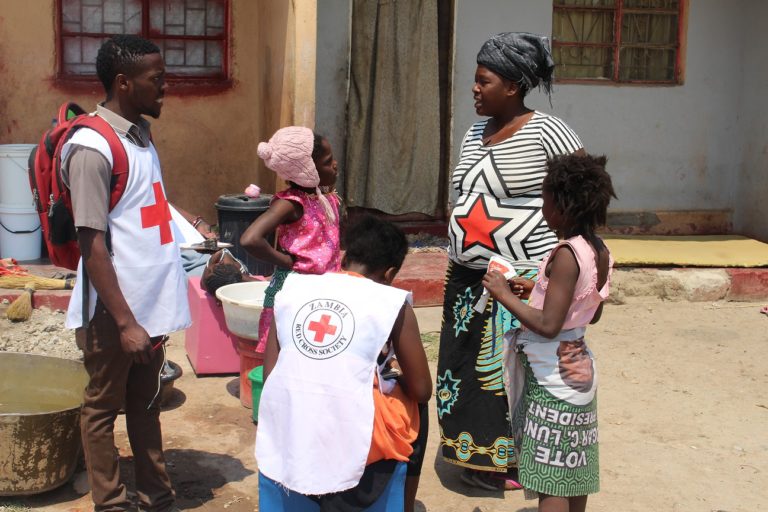
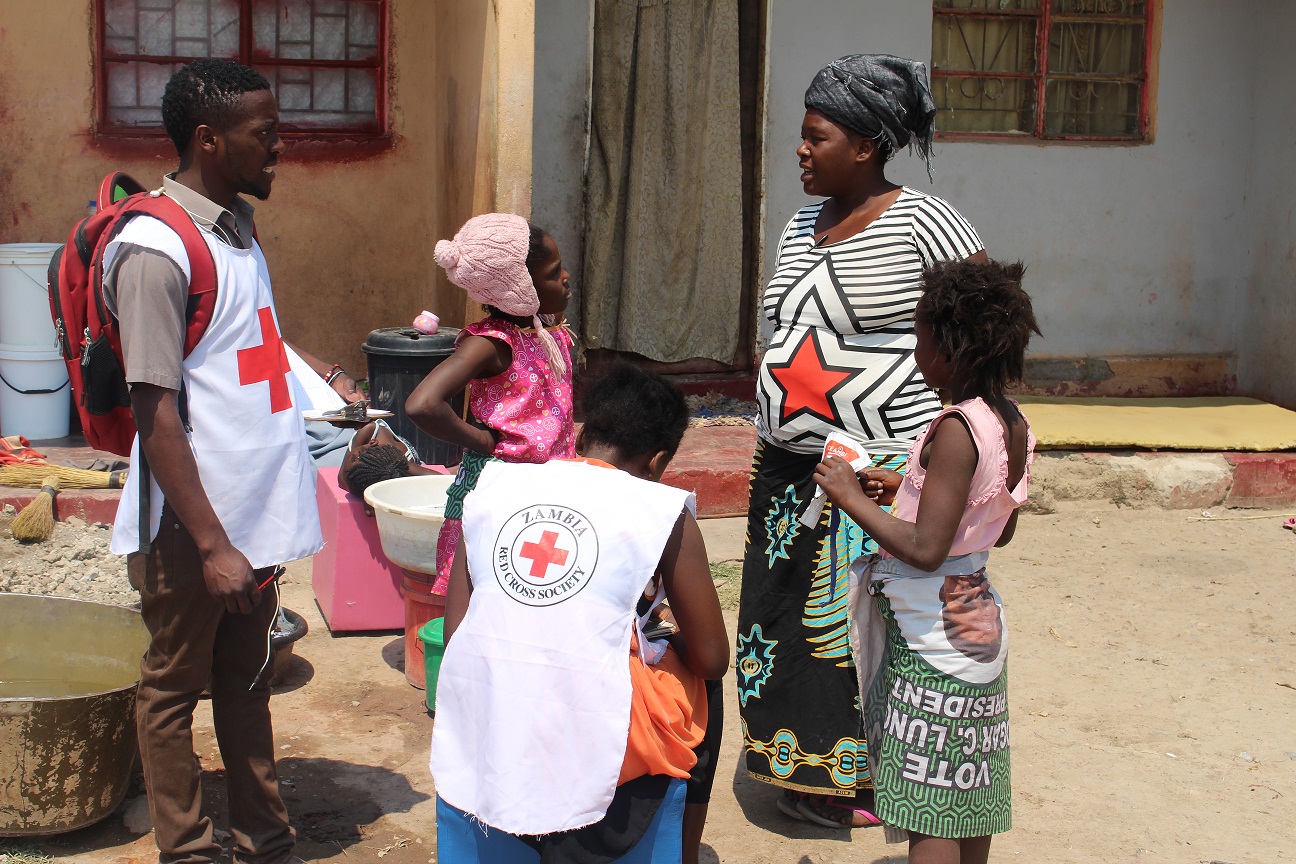
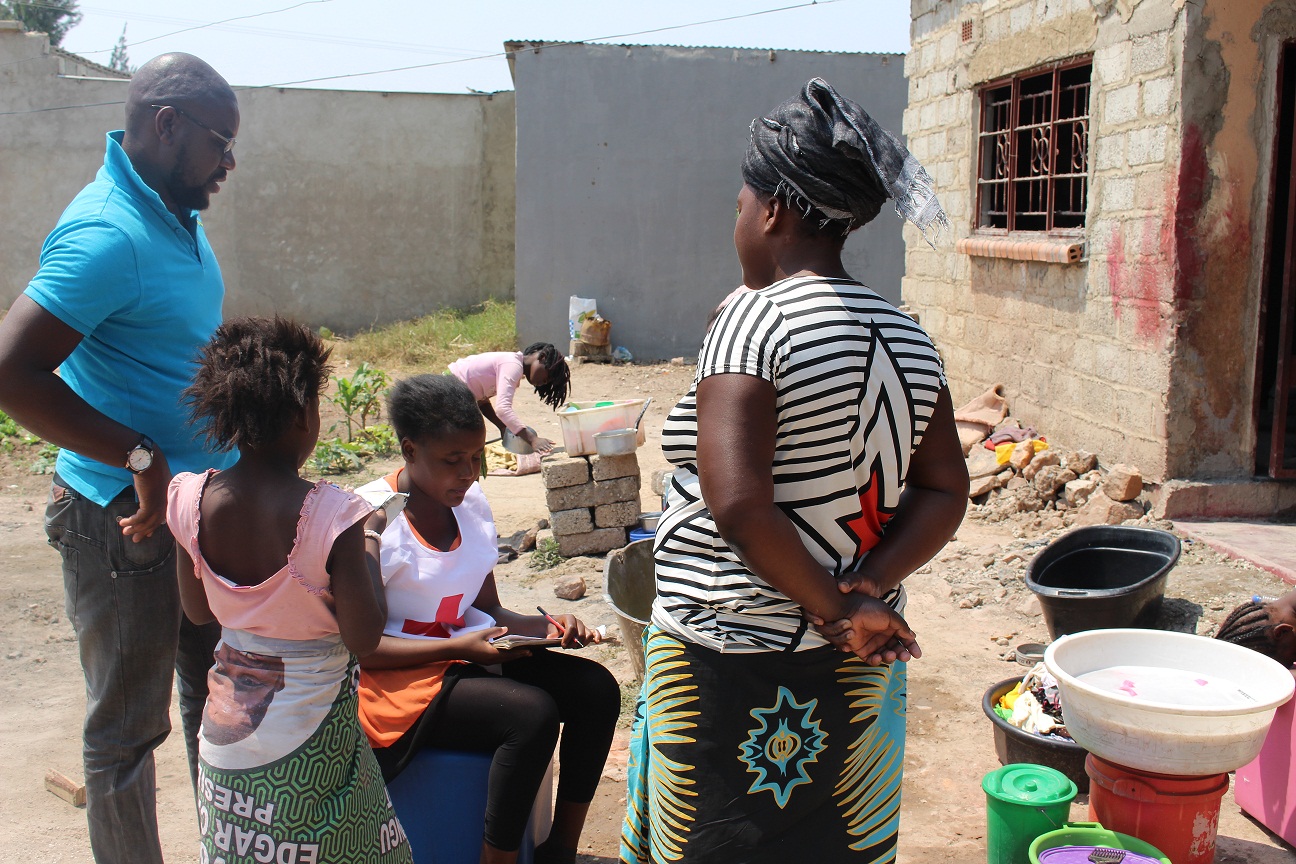
The Zambia Red Cross Society has deployed over 1,300 Red Cross Volunteers to carry out Community sensitisation campaigns in Lusaka’s high density compounds of Mandevu, Chawama, Kanyama, George, Chipata and Chaisa at a total cost of about ZK1 Million.
The door to door Community campaigns and community announcements aim at encouraging parents and guardians to take their children aged between 9 months and 15 years to receive vaccination against Measles and Rubella from the nearest Health facility between 19th September and 24th September 2016.
“Our volunteers are spread out in various communities to encourage parents and guardians to take their children for vaccination. We want to ensure that Government reaches out to more children with Measles and Rubella vaccine.” says Abraham Geevarghese – Zambia Red Cross Society Secretary General.
The Zambia Red Cross is assisting Government to reach its over 6 million children target of Children vaccinated against Measles and Rubella.
The Zambia Red Cross Society is motivated to render this support because it is auxiliary to Government and is a member of Zambia’s Universal Child Immunization (UCI) Coordination Committee team.
Lawyer Mushipe (in blue) after leaving Woodlands Police
The Lusaka Magistrate Court has granted bail to UPND Lawyer Martha Mushipe who was charged and arrested this morning by the Zambia Police for being in possession of seditious materials.
The document is question is titled “Strategy of domination PF against UPND 2015-2016 and beyond-UPND at crossroads-transition or conflict/Patriotic Front’s use of ethnic divide and rule as a means of maintaining political control in Zambia 2015-2016 and beyond”.
The document is said to have been authored by veteran Zimbabwean politician Didymas Mutasa, Former Justice Minister Dr. Ngosa Simbyakula and General Tendai Muduli.
Lawyer Mushipe (in blue) after leaving Woodlands Police
Wedson Nyirenda has shown his hand with his debut Zambia list that includes some surprises amongst the usual suspects in a 33-member provisional team called-up for the 2018 FIFA World Cup Group B opener against Nigeria on October 9 in Ndola.
For the first time in the post-George Lwandamina era, four Power Dynamos players have been summoned to the national team.
Interesting on the list is the name of left-back Lawrence Chungu who has received his debut Zambia call-up after two convincing seasons in that position at Arthur Davies Stadium in Kitwe.
Wedson has also summoned Chungu’s club mate and defender Billy Mutale despite the jury still out on the young central defender abilities.
There is, however, no place for Green Buffaloes defender Buchizya Mfune nor the Katongo brothers; Felix and Christopher.
But Fwayo Tembo is on the list despite the Power Dynamos midfielders’ self-imposed exile from the Chipolopolo setup.
In-form Power striker Patson Daka, who has scored eight goals over the last two months, has been handed a chance to resuscitate his still very young Zambia career.
But Power’s archrivals Nkana only have one call-up in defender Donaciano Malama and there is no place for midfielder Jacob Ngulube.
Chisamba Lungu of FC Ural in Russia is back so too is Mamelodi Sundowns goalkeeper Kennedy Mweene and striker Collins Mbesuma of Highlands Park who were all absent for Zambia’s final 2017 Africa Cup Group E qualifier game against Kenya earlier this month.
Striker Lewis Macha, a player reportedly Wedson recommended to Kaizer Chiefs and was recalled to the team by his predecessor for the Kenya match, is in the team after missing that Group E due to an injury he sustained during Zambia’s camp for the match in Ndola.
Nine foreign-based players in all are on the list.
GOALKEEPERS:Jacob Banda (Zesco United), Kennedy Mweene (Mamelodi Sundowns, South Africa), Racha Kola (Zanaco)
DEFENDERS:Lawrence Chungu, Billy Mutale (both Power Dynamos), Fackson Kapumbu, George Chilufya, Ziyo Tembo (all Zanaco), Simon Siliwmba (Zesco United), Adrian Chama (Green Buffaloes), Kabaso Chongo (TP Mazembe, DR Congo), Stopilla Sunzu (Lille, France), Donashano Malama (Nkana)
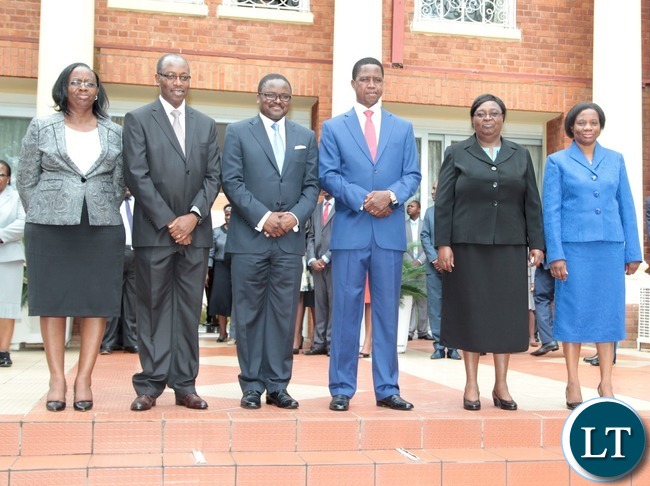
President Edgar Lungu take Photo with Constitutional Court President and Judges (2nr) Constitutional Court President justice Hildah Chibomba, (r) Constitutional Court Judge Justice Mulenga Mugeni, (from left) Constitutional Court Judge Justice Mwewe Anne Sitali (l) Constitutional Court Judge Justice Enock Mulembe, and Constitutional Court Judge Palan Mulonda shortly after swearing in Ceremony of Constitutional Court Judges at State House
If the drama that was Hakainde Hichilema v Edgar Chagwa Lungu (2016/CC/0031) has any lessons for the continent, it is how not to adjudicate upon a presidential election petition. Three judges of the court effectively succeeded in making an unfortunate mockery of their bench and risking the otherwise good image Zambia’s electoral process has enjoyed for a few decades now. We should, however, not be too quick to cast aspersions on the court and the learned judges. In order to understand what transpired in the Constitutional Court of Zambia, we have to look at the relevant legal provisions guiding presidential election petitions.
The Constitution of Zambia (as amended in 2016) provides at article 101(2) that a candidate must garner more than 50% of the valid votes cast to be declared president in the first round of voting. Article 103(2) provides that, ‘[t]he Constitutional Court shall hear an election petition relating to the president-elect within fourteen days of the filing of the petition’. In a well-meaning attempt to rectify a mischief that has plagued many an African nation, Zambians introduced this 14-day amendment in January 2016. Prior to this amendment, such petitions would languish before the courts for years and by the time decisions were handed down, the person whose election was challenged was well into his/her term of office. The effect was that either too much uncertainty was created by the pending petition that the president could not fully perform the important functions of the office, or the petition was so overtaken by events altogether that the court’s decision was more or less predetermined. Conventional wisdom therefore required some degree of certainty to be legislated. Zambia borrowed heavily in this regard from Kenya which had only five years earlier constitutionalised a strict 14-day timeline for its Supreme Court to hear and determine presidential election petitions.
Fast-forward to August 2016 and the re-election of Edgar Lungu by 1,860,877 votes against Hakainde Hichilema’s 1,760,347 votes was challenged by Hakainde at the Constitutional Court. The petitioner and the court seem to have been oblivious of the Rules of the Constitutional Court which appear to have either been mischievously drafted or were simply the result of bad legislative drafting. The rules require the respondent to file an answer to the petition within 5 days of service and the petitioner to reply within five days of being served with the answer. Thereafter, a process of discovery is done which is followed by a status conference before the hearing can commence. These preliminary processes even if rushed consume a better part of, if not the entire, 14 days.
The above constitutional provision read together with the rules of the court presented an uncomfortable dilemma for the court and the petitioner. By the time the preliminary processes were dispensed with, it was 2 September 2016, the last day of the 14 days. Had the court anticipated this dilemma, and it should have by all reasonable expectations, then perhaps it would have suo motto overruled or ignored its own rules in favour of the supremacy of the constitution and set shorter timelines for the preliminary processes in order to leave a few days out of the 14 days for the hearing. Better still, the petitioners should have anticipated this scenario and moved the court to interpret the rules in light of article 103(2). The petitioners neither moved nor did the court volunteer. Both failed to anticipate the awkward position they would find themselves in.
When this dilemma was apparent, the court took the easy but controversial way out. Majority of the court held on Monday 5 September 2016 that since the constitutional 14-day timeline had lapsed on Friday 2 September 2016 before the petitioners presented their case, there was no petition to be heard. The petition was dismissed for want of prosecution. Interestingly though, the court did not deliver this decision on 2 September when the time supposedly lapsed, but on Monday 5 September after adjourning proceedings to allow the petitioner to engage new legal representation. The court therefore staged an unprofessional and unfair ambush on the petitioner because he was neither given an opportunity to present his case nor asked to show cause why the petition should not be dismissed on 2 September 2016.
While computation and interpretation of time is arguably best done literally to give some degree of certainty and finality in legal matters, presidential election petitions are not per se legal in the strict sense of the word. They traverse the realms of the legal and the political and as such care should be taken when adjudicating upon them as the political consequences can be unpredictably unpleasant.
The court would have done its reputation and the people of Zambia a favour by adopting an expansive and generous interpretation of article 103(2). The article provides that ‘The Constitutional Court shall hear an election petition relating to the President-elect within fourteen days of the filing of the petition’. The ‘devil or angel’ herein is in both what it says and what it does not say. The provision only requires the court to ‘hear’ the petition within fourteen days. The provision does not require the court to determine the petition within fourteen days, but only to hear it. Therefore, it is submitted that the constitutional requirement is met if the court commences ‘hearing’ of the petition within fourteen days of its filing. Further, no timeline is set for the court to finish hearing the petition so this process can continue for as long as the court deems fit as long as it commences within fourteen days of filing. Since the provision is silent on the time for ‘determining’ the petition, the court’s judgment could be issued anytime after the hearing is completed as there is no deadline for this. To cure the danger this interpretation poses of a prolonged process, the court ought to read the provision in light of the spirit of the constitution which is to ensure justice. Justice can neither be ensured by rigid reliance on technical provisions nor unreasonably prolonged processes, but rather by a process that enables the court to fully but expeditiously interrogate the law and the facts. Indeed, Munalula J strongly argued for such purposive interpretation in her dissenting opinion. Unfortunately, however, for the petitioner and the Zambian electorate, minority had its say while the majority had its way.
Even if the conservatives on the bench were still inclined towards a literal reading as they indeed were, one other option was still available to them. The ‘fourteen days’ as provided in the provision could have been interpreted as referring to working days of the court. As such, only week days would be computed and weekends would not form part of the computation. The final day for the court to render judgment would therefore have been 8 September 2016, that being 14 working days from the date of filing. While still grossly insufficient, it would have afforded the court a few days to at least hear the parties’ arguments even if just to give the illusion of a hearing.
The Constitution of Kenya 2010 from which Zambia supposedly drew inspiration when drafting the above provision also provides at article 140(2) that, ‘[w]ithin fourteen days after the filing of a petition … the Supreme Court shall hear and determine the petition… .’ This provision also caused almost similar tension in Raila Odinga v Independent Electoral and Boundaries Commission (2013) when the narrow electoral victory of Uhuru Kenyatta was challenged by Raila Odinga. The Supreme Court interpreted the above provision to the effect that the petitioner is not expected or entitled to reply to the respondents answer to the petition in the interest of time. While the court cannot be faulted for limiting the preliminary procedures to ensure ‘ample’ time is left within the fourteen days to ‘hear’ the petition and make a determination, this again draws attention to the gross inadequacy of the fourteen days.
These two presidential election petitions highlight the counterproductive effect of otherwise well-meaning constitutional provisions. While the mischief of unreasonably prolonged election petitions has been cured by these constitutional provisions, the flip-side has been to rob the judiciary of sufficient time to hear petitions, evaluate evidence and render judicious decisions that uphold the integrity of the electoral process and promote democracy. What the Kenya and Zambia scenarios have shown is that courts have no option but to hold what amounts to formality hearings, if at all, and make obligatory pronouncements without having the benefit of properly hearing and deliberating upon all the evidence. While these processes may be legal in the strict sense of textual law, they raise serious questions as to whether they are just and moral to the extent that politics is moral. Considering the nature of presidential election petitions and the potential implications for a country, it is indeed in the public interest for the court to have sufficient time to hear the petition, properly consider rival arguments and render its decision. This is a decision that the court should not render lightly. Perhaps it is time to reconsider our judicial approach to presidential election petitions and the legal frameworks governing them.
Martha Mushipe
Police in Lusaka have charged and arrested Lusaka lawyer Martha Mushipe.
Ms Mushipe who is a senior legal counsel for the UPND has been charged with being in possession of seditious materials.
The charge relates to a confidential document entitled Strategy of domination PF against opposition UPND 2015 – 2016 and beyond” which among others involves use of violence against the opposition.
The document is alleged to have been authored by former Justice Minister Dr Ngosa Simbyakula and two others.
This is after her lawyer firm located at Millennium Village Complex in Lusaka was searched by police in April this year.
Her lawyers told Journalists that Ms. Mushipe has been denied police bond and that they have now sought the intervention of the Lusaka Magistrate Court to secure her release.
FILE: Archbishop of Lusaka Diocese Telesphore Mpundu speaking at the Julia Chikamoneka awards which was organised by the Press Freedom Committee of The Post Newspaper
The Zambia Conference of Catholic Bishops and the Council of Churches of Zambia has opposed the proposed formation of the Ministry of National Guidance and Religious Affairs.
In a joint statement, Zambia Conference of Catholic Bishops President Teresphore Mpundu and CCZ President Dr. Alfred Kalembo said the Church and State should be and continue to remain separate.
They said in view of the various financial and economic challenges our country is currently facing, they neither see the creation of the said ministry as a top priority nor a prudent decision.
The Church leaders said they believe that Zambians want their country to be a democracy rather than a theocracy.
“We stand by the biblical principle as clearly taught by our Lord Jesus Christ, who declared: “Well, then, give to Caesar what belongs to Caesar, and give to God what belongs to God” (Mark 12:17). Again, our Lord and founder defined our prophetic mandate when he proclaimed: “The spirit of the Lord has been given to me, for he has anointed me. He has sent me to bring the good news to the poor, to proclaim liberty to captives and to the blind new sight, to set the downtrodden free, to proclaim the Lord’s year of favour” (Luke 4:18; Cf. Isaiah 61:1-2).”
“In other words, the Church derives its authority, mission and structure from God and this must not be confused with temporal order of political governance. Fourthly, we take this opportunity to reassure our membership that, we the said Church Mother Bodies, will not be intimidated in exercising our God-given mission of being the conscience of the nation and exercising our prophetic ministry of calling for social justice following the example of our Founder, Jesus Christ,” they said.
They added, “At the same time, we commit ourselves to continue being credible and reliable instruments for promoting a culture of dialogue, reconciliation, justice, unity, development, respect for divergent views and peace in Zambia. May God bless you all and bless our nation Zambia.”
The Drug Enforcement Commission has officially arrested two Zambia National Farmers Union (ZNFU) officials for money laundering activities, reports Pan African Radio Journalist Hermit Hachilonde.
In a statement unveiled to the media today the 20th September, 2016, DEC Public Relations Officer Theresa Katongo said Ndambo Evelyn Munkombwe Ndambo, 43, an Executive Director at the ZNFU residing at Farm No. 87a/D/26 Chongwe has been arrested and jointly charged with Dr Evelyn Nguleka, 46, a former President at ZNFU residing at Plot No. 2752, Ndeke Meanwood in Lusaka for theft by public servant, obtaining money by false pretences and money laundering contrary to the Laws of Zambia.
She stated that the Particulars of the offence are that on dates unknown but between 1st November, 2012 and 31st December, 2015 Ndambo Evelyn Munkombwe Ndambo jointly and whilst acting together with Dr Evelyn Nguleka and other persons unknown did fraudulently authorise the transfer of K906, 750.00 from the ZNFU account to R.N Parks and Gardens.
Ms. Katongo explained that Ndambo purported to show that the said payments were for landscaping and plumbing works at ZNFU when in fact he engaged R.N Parks and Gardens to carry out construction and landscaping works at his farm in Chongwe.
She further stated that on unknown dates but between 1st November, 2012 and 31st December, 2015 the duo did fraudulently authorise withdrawals of a sum of USD15, 000.00 from the ZNFU Dollar account purporting that the said funds were for various members of staff attending conferences in South Africa when in fact not.
Ms. Katongo also revealed that in the third count, on unknown dates but between 1st November, 2012 and 31st December, 2015 Ndambo Evelyn Munkombwe Ndambo jointly and whilst acting together with other persons unknown did fraudulently obtain household furniture from Décor More Investments Limited valued at K169, 000.00 which was paid for by drawing cheques on the ZNFU account.
“The said cheques were meant for procuring ZNFU office furniture but the furniture ended up at Ndambo Ndambo’s house”
“The suspects are currently on Police Bond and will appear in court soon” she said
Details have started emerging of how senior officials at the Zambia National Farmers Union embezzled billions of Kwacha in donor funds meant to help small scale farmers.
About 70 small scale farmers who are direct beneficiaries of the donor support will be affected.
In court papers prepared by the Drug Enforcement Commission, ZNFU Executive Director Ndambo Ndambo and former Union President Evelyn Nguleka stole close to K3 billion between 2012 to December 2015.
Mr. Ndambo aged 43, of Farm No. 87a/D/26 Chongwe was yesterday arrested and jointly charged with Dr Nguleka aged 46 of Plot No. 2752, Ndeke Meanwood in Lusaka for theft by servant, obtaining money by false pretences and money laundering contrary to the Laws of Zambia.
The duo is accused of fraudulently authorising the transfer of K906, 750.00 from the ZNFU account to R.N Parks and Gardens on dates unknown but between 1st November, 2012 and 31st December, 2015.
Mr Ndambo purported to show that the said payments were for landscaping and plumbing works at ZNFU Headquarters when in fact he engaged R. N Parks and Gardens to carry out construction and landscaping works at his farm estate in Chongwe.
And the duo is also accused of fraudulently authorising withdrawals of a sum of USD15, 000.00 from the ZNFU Dollar account purporting that the said funds were for various members of staff attending conferences in South Africa when in fact not on dates unknown but between 1st November, 2012 and 31st December, 2015.
In the third count, Mr Ndambo jointly and whilst acting together with other persons unknown did fraudulently obtain household furniture from Décor More Investments Limited valued at K169, 000.00 which was paid for by drawing cheques on the ZNFU account on dates unknown but between 1st November, 2012 and 31st December, 2015.
The said cheques were meant for procuring ZNFU office furniture but the furniture ended up at Mr. Ndambo’s house.
Yesterday, Dr Nguleka stepped down from her position as ZNFU President and consequently relinquished her position as Head of the World Farmers’ Organisation.
The two officials had earlier refused to yield to donors’ demands for the funds to be paid back after the donors which included Sweden, Finland and We Effect urged the Zambian authorities to take firm action against those involved so that the funds intended to benefit small-scale farmers are recovered.
“We need to ensure that accountability takes place by the board but also by law enforcement agencies,” said David Wiking, the head of Development Cooperation at the Swedish Embassy. “It is also important to remember that donors have a due-responsibility, both to tax payers at home in Sweden and Finland but also to farmers in Zambia.”
“The conclusion is that ZNFU has systems that fails, whether by design or by accident,” said Mr Wiking. “KPMG report also concludes that there is significant non-budgeting of cost related to among other things… the executive pay, significantly higher than what has been agreed by the donors,” said Mr Wiking during a news conference.
But the ZNFU board dismissed the audit reports on the institution, saying they were “flawed and not handled professionally”.
The board vice president, Richard Lisimba who is now the Acting President following Dr Nguleka’s resignation said the donors were free to terminate funding to the farmers if they so wished.
Following the release of the preliminary report in January this year, ZNFU top officials engaged in a deliberate attempt to mislead the public by dismissing the findings of the audit carried out by EMM Corporate Partners.
But KPMG Finland, an accounting firm tasked to evaluate the disputed audit did not question the report.
And sources at ZNFU have indicated that the embezzlement at ZNFU was going on at a time when Mr Ndambo was earning US$15,000 as monthly salary
Amongst the biggest audit queries are payments in excess of K1.4 million made to Jambo Vehicle Tracking Limited, a company owned by Ndambo and his wife which were made outside the ZNFU budget.
After the release of the first report in January this year, Mr Ndambo is said to have written a letter to Mr. Wiking, claiming the report is “reprehensible and the insinuations are odious”, and accused the auditors of incompetence, malice and lacking an understanding of the operations of ZNFU, and in full breach of many applicable audit standards.
In addition, he claimed the report “contains inaccurate elements that were not substantiated with the appropriate personnel” which “illustrate a lack of objectivity”.
He further claimed that the report was being used “as a tool to discredit the union and management.”
ZNFU also threatened legal action against the audit, acts of intimidation that the audit “considered both reportable and at odds with Sections 30 and 38 of the Accountants’ Act 2008, given the statutory, protected and privileged nature of audit assignments”.
But the request of the ZNFU Council, the Zambia Institute of Chartered Accountants (ZICA) reviewed the entire audit process and the findings of the preliminary audit report and declared that the auditor, EMM, “complied with all relevant standards and that there is no evidence of any professional misconduct or malpractice, and that there is no basis for any disciplinary action against EMM.
It is an outcome that did not please the union, which has tried to discredit the work of the auditors. ZNFU had previously accused EMM of being “totally ignorant of the joint financing agreement” between ZNFU and the donors.
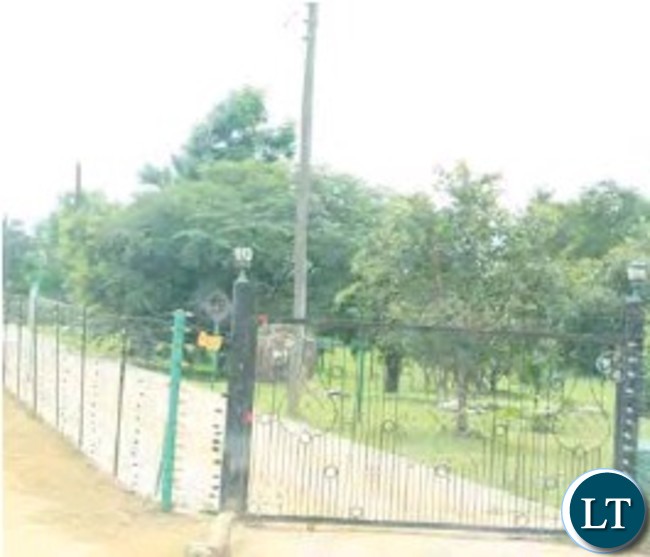
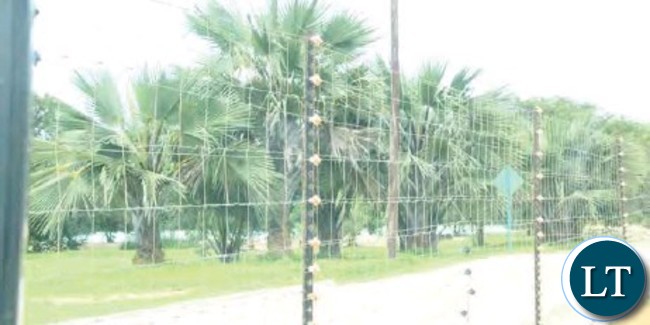
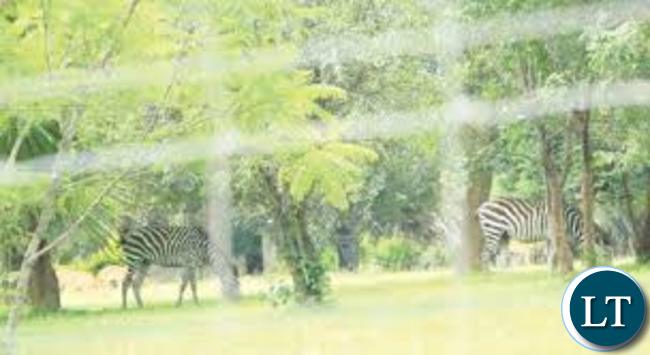
In February this year, DEC performed a search at the ZNFU offices and Mr. Ndambo’s farm estate in Chongwe which is fitted with a 9-hole golf course, Zebras and Impalas.
The suspects were arrested yesterday and are currently on Police Bond and will appear in court soon.
Part of Ndambo’s farm estate in ChongwePart of Ndambo’s farm estate in Chongwe
PF Secretary General Davies Mwila
PF Secretary General Davies Mwila says Mpulungu Ward 23 Councillor Christopher Shakafuswa remains the party’s candidate for the position of Lusaka Deputy Mayor.
Mr Mwila said the party has since instructed all its councillors to vote for Mr Shakafuswa.
He said anyone going against that decision will be subjected to disciplinary action which can include expulsion.
Tasila Lungu, the daughter of President Edgar Lungu yesterday declared her intentions to stand for the position of Lusaka Deputy Mayor.
Tasila who was elected as Nkoloma Ward Councillor in Chawama Constituency in the just ended 2016 election said she is now ready to serve the greater city of Lusaka as Deputy Mayor.
She said it is only fair that she becomes Deputy Mayor of Lusaka especially that the city has a male Executive Mayor.
And PF SG Davies Mwila says the Central Committee is yet to sit and decide on Miles Sampa’s re-quest to re-join the party.
He has however stated that the Central Committee is not in a hurry to sit because the PF managed to win without Miles and others wishing to re-join.
Mr Mwila who was responding to a question on UDF President Miles Sampa’s apology and his wish to rejoin the Party said the Party won elections without the members who ran away thinking they would lose the general elections hence will not be in hurry to welcome them back because the Party won the elections without their help.
He said though Party has decided to welcome members who left, the PF is not desperate to have the people who thought the party would lose the elections back in Party.
He said members wishing to rejoin the party will have to write to either him or President before being readmitted to the party.
Mr Mwila also said the Party will table the issue of candidates who stood as independents after being left out by the the Party during adoption of candidates.
Chipolopolo goalkeeper Kennedy Mweene has warned that Zambia should not be underrated by their Group B rivals in the 2018 FIFA World Cup qualifiers.
Zambia will tackle Algeria, Nigeria and Cameroon in the World Cup qualifiers.
Mweene saids being rated as underdogs in Group B will motivate Chipolopolo.
“We are in a tricky group but Zambia performs well when a lot of people have written them off. Even the teams we will be playing against like Nigeria and Algeria know that it won’t be easy to beat Zambia,” Mweene said.
Zambia faces Nigeria in the group opener on October 9 at Levy Mwanawasa Stadium in Ndola.
“We have accepted that tag of being underdogs. Being considered underdogs we would like to prove many people wrong. Knowing the way Zambia plays we will be equal to the task,” the Mamelodi Sundowns keeper said.
Mweene added:” Despite being underdogs it won’t be easy to beat Zambia.”
Zambia advanced to the final stage of the Russia World Cup qualifiers after eliminating Sudan over two legs last year.