
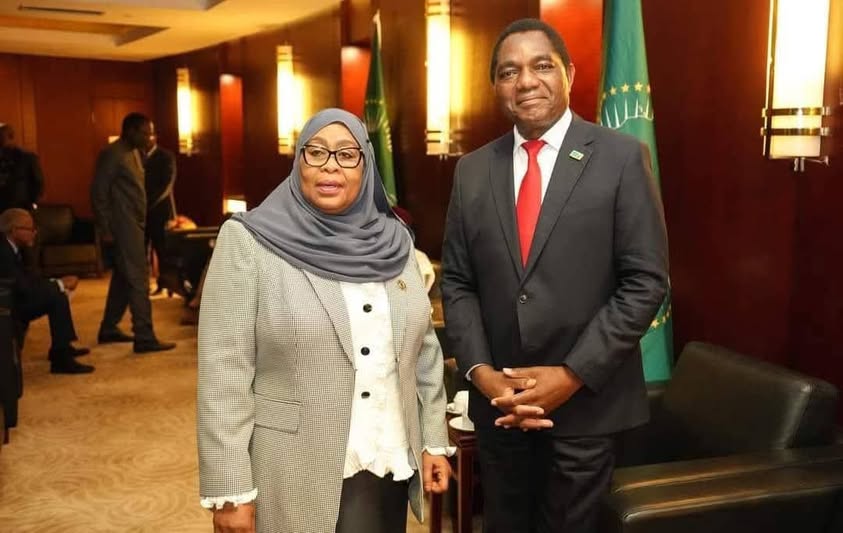
By Kapya Kaoma
Zambia’s political stability faces scrutiny as Hichilema ventures abroad ahead of the 2026 election.
According to The Kenya Times, “Only one foreign head of state, Zambian President Hakainde Hichilema, attended President Samia Suluhu Hassan’s swearing-in ceremony at State House Chamwino in Dodoma.”
The optics are striking. The man who had once been inaugurated in Zambia’s stadium stood alone, under the global spotlight, presenting himself as a statesman to a nation still reeling from bloodshed. But statesmanship is more than appearance—it is earned through moral courage, political wisdom, and impeccable timing.
Key East African leaders—Presidents William Ruto of Kenya, Yoweri Museveni of Uganda, Évariste Ndayishimiye of Burundi, Félix Tshisekedi of the Democratic Republic of Congo, and Paul Kagame of Rwanda—were notably absent. The East African Community boycotted, and SADC dismissed the elections as a “shamble.” Their absence speaks far more about Hichilema than about Tanzania.
If leaders like Museveni and Kagame—well known for manipulating their own elections—can boycott, why should Hichilema attend? Diplomacy is one thing, but what if a dictator is replaced tomorrow? Will Zambia remain tied to a regime being resisted by its own citizens? Other nations are waiting to see how the crisis unfolds. Hichilema, however, seemed blind to this calculation. Should the opposition gain power while he remains president—Zambia could be the first target for economic sanctions. Optics alone cannot replace prudence.
Hichilema lectured Tanzanians on democracy, but the narrative is riddled with contradictions. Aside from ruling as a dictator, yes, he lost elections in opposition—but he had never been barred from contesting them. No court ever disqualified him, even amid allegations that could have ended a lesser politician’s career. Until 2016, when the MMD collapsed under Nevers Mumba, the UPND had no mass following; any attempt at protest would have been crushed. And no party in Zambia has ever won 98% of the vote, as Hassan did, since the return to multi-party democracy. Hassan also barred her opponents and imprisoned one. So comparing Zambia to Tanzania appears less a lesson in democracy than a justification for Hichilema’s 2026 ambitions.
East African leaders are not fooled. They know the wind of change in Africa no longer blows from guns but from the young, politically conscious, and restless. If Hichilema imagines Tanzania as a model for managing post-election unrest, he is mistaken. Zambia’s political terrain is treacherous: public trust is fragile, divisions run deep, and youth mobilization is unpredictable. Force cannot guarantee legitimacy—it may ignite the very unrest he hopes to avoid.
Across Africa, disputed elections have repeatedly led to loss of life, mass displacement, economic collapse, and social fragmentation. Ethnic polarization, weak institutions, and elite manipulation fuel crises whose consequences ripple for years. Hichilema’s symbolic attendance in Tanzania cannot insulate him from Zambia’s reality– legitimacy is homegrown, not imported. For some, his presence may even have diminished his democratic stature, signaling a willingness to prioritize optics over principle.
Using Tanzania as a template risks misreading Zambia’s political landscape. A symbolic inauguration abroad cannot prevent domestic unrest if citizens reject the outcome. Young Zambians, emboldened by social media and civic awareness, are no longer passive observers—they are active participants shaping the nation’s future. Any attempt to impose an outcome against their will could spark protests or violent confrontation. In Zambia, unlike Tanzania, optics alone will not secure acceptance; credibility, dialogue, and accountability must prevail.
Zambia’s future will not be borrowed from Dodoma or podiums abroad. It will be fought for, debated, and earned at home. Running to Tanzania may offer temporary relief, but the 2026 election is approaching. Zambians will not watch an election stolen—they will fight for it, and, if necessary, die for it.



Mscheeeeew .
chamusebanya sana
Shameful but expectrd from HH. He has no morality.
YOU WANT TO PLAY POLITICS WITH YOUR MOST IMPORTANT STRATEGIC PARTNER …. YOUR ARE CHILDISH
No there was also presidents of Burundi, Mozambique, Somalia although some notably sent VPs or DPs or in DRC’s case just a minister… At least check facts, it’s easy to spend 60 seconds on Google before you hit publish
What did you expect? Of course, not all presidents must attend inauguration ceremonies. A representative is enough but, in our case, Tanzania is an important economic partner we can’t easily ignore considering most goods pass through their borders. Surely, should everything be politicized?
Most of Zambia’s goods pass through South Africa.
Every vision is time sensitive, has a turning point. Miss these two and you are off course. Some situations are there for our lesson, we do not need to be close enough to understand what’s obtaining. It is unfortunate when one puts him/herself in a situation one would have avoided. Some losses we have incurred have been so due to gross insensitive. It is to be accepted anyway, others are obstinate to reason at the expense of their own destruction.
Should have just sent the VP.
Such a poorly written article. Too emotional and personal.
He did well…
The president have to put Zambia’s economy before his personal ambition all the reliance and corporation between the two countries have to come first. Kenya, Rwanda Uganda that is not good comparison. HH has put Zambia first that way he can have a working dialogue with Tanzania. What’s there to gain from not doing so. Tanzania like many other countries here to sort out their own internal issues.
Scratch my back andcI will Scratch yours
I agree that is a poorly written article as it lacks objectivity!