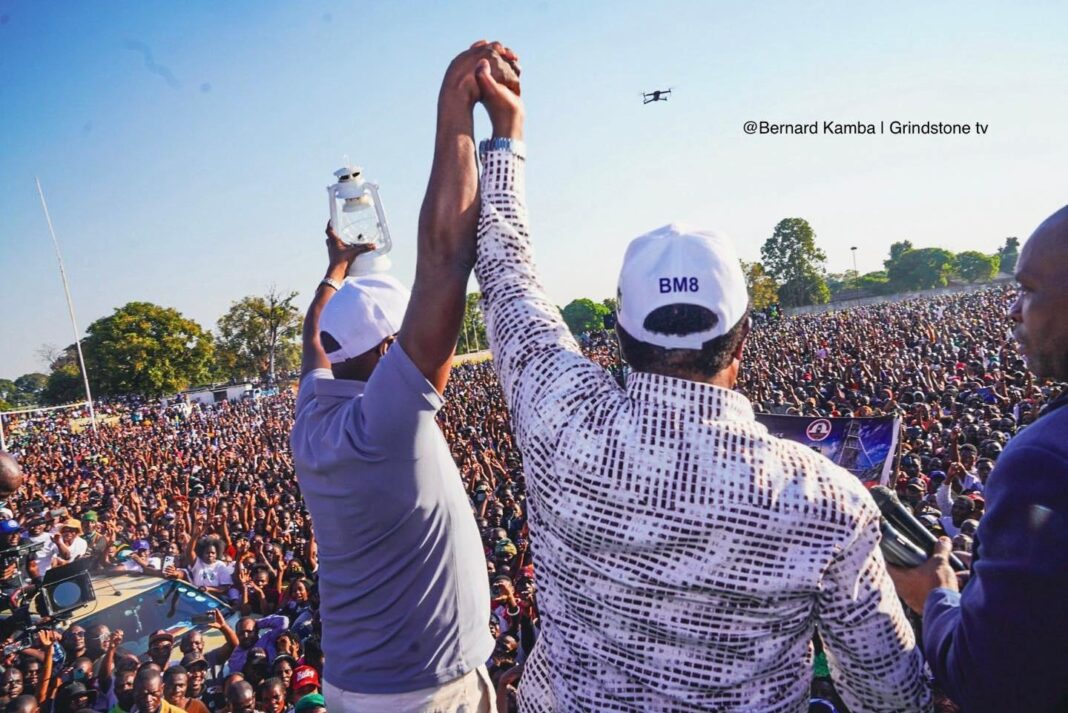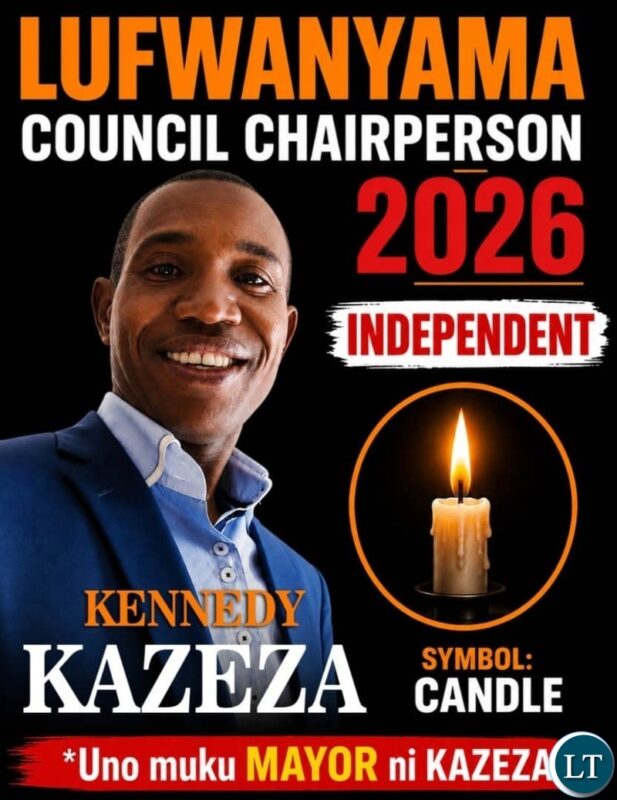
President Hakainde Hichilema recently offered an open public apology for the chaotic and violent UPND candidate adoption process. What Zambians witnessed, however, was a party in disarray despite presidential leadership. While Gary Nkombo has taken the brunt of the UPND backlash, the damage is larger than the President realizes. The small town of Lufwanyama, where a fascinating race is unfolding, serves as another example. Kennedy Kazeza, a small local businessman, launched a grassroots, on-foot campaign and is on track to pull off an upset against the incumbent UPND mayor on August 13.
Born in Kambila Village in Chief Nkana’s Lufwanyama area, Kazeza was educated as a primary school teacher at St.John’s Seminary. There, he earned a Zambia Teachers Certificate (ZATEC) alongside certificates in HIV/AIDS Counseling and Philosophical Ethics, graduating with distinctions. He went on to obtain a Bachelor of Business Administration, a Master of Commerce, and a Postgraduate Diploma in Local Government Administration and Urban Planning.
Equipped with these qualifications, he returned to his childhood home to invest in real estate and farming and set his sights on the mayoral seat.
Yet, despite his roots, Kazeza’s independent mind and authenticity led UPND to sideline him—to the disappointment of local residents. Undeterred, the community urged him to launch an independent bid. Against all odds, his campaign is gaining momentum. Kazeza has built a powerful, cross-generational movement of grassroots voters. Using the candle symbol, Kazeza is delivering a simple message—a candle exists to dispel darkness. “I am running to bring light to Lufwanyama District Council so every citizen can see what goes on.”
No doubt, President Hichilema’s recent apology spoke to his biggest vulnerability—a failure to listen. Kazeza is capitalizing on this disconnect—sitting down and listening to children, youth, men, women, and the elderly alike.
Instead of cruising mufipaso, he walks the dusty roads, knocks on doors, stops to shake ordinary people’s hands, and helps residents in their fields or sell goods by the roadside. This approach has sparked a major conversation on social media, where many are hailing him as an example of a new era of political mobilization—one that prioritizes listening over lecturing. One social media post reads:
“To be honest, I truly admire the way Mr. Kennedy Kazeza is conducting his campaign. Even without having a car, he continues to move tirelessly from one place to another, meeting people on the ground and listening to their concerns. His dedication, determination, and commitment to staying connected with the people are truly inspiring.
He is doing everything possible to ensure that he remains close to the communities, and that kind of leadership deserves recognition. His hard work and passion show that genuine leadership is not about the resources you have but about your willingness to serve the people.”
Mr. Kazeza has bypassed traditional mass rallies in favor of intimate community gatherings to share his vision. “I won’t solve these problems you are complaining about alone. I will need all you elders to surround me so that we can resolve them together,” he says in one online video.
Other clips show him sharing lighthearted moments with very underprivileged toddlers–they already know his name, or sitting quietly with an elderly woman outside her home. In another, he meets with a person with a disability who explains the challenges of moving during the rainy season due to poor roads.
“They ask you, ‘What can this kabususu—a pitiable, poverty-stricken person—give you?’” he said during a meeting with community elders. “I may not have millions or political party funding, but it is you who educated me. I will give you my heart, my love, and my knowledge so that together we can develop our land.”
This is the very leader UPND ignored. Like many rejected UPND candidates, was sidelined because the party refused to listen to the grassroots.
If Hichilema fails to secure a second term, it won’t be because of his bad policies or unmet campaign promises—people can forgive; it will be due to his inability to listen to ordinary people.
I am not sure whether Kazeza’s growing base will cast their votes for Hichilema or the opposition. For now, Kazeza is playing it smart– politically neutral– drawing support from across political parties. If he pulls off a victory, it will be a triumph for the politics of genuine connection. As a trained teacher, counselor, and local entrepreneur, Kazeza is simply building bridges that money cannot buy. Is President Hichilema’s apology going to change the tide?
Katoka Mweenda