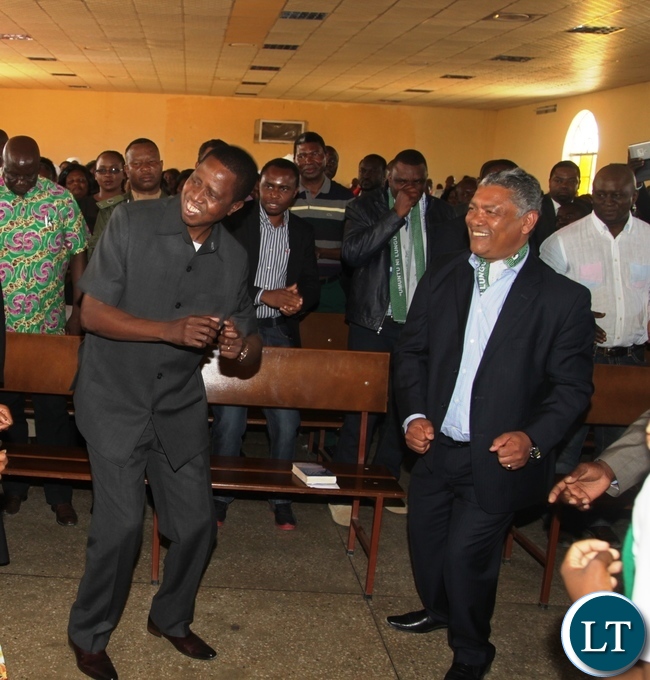
President Edgar Lungu and Agriculture Minister Given Lubinda celebrting the Lord through Dancing at Kabundi Kapisha UCZ Congregation in Chingola
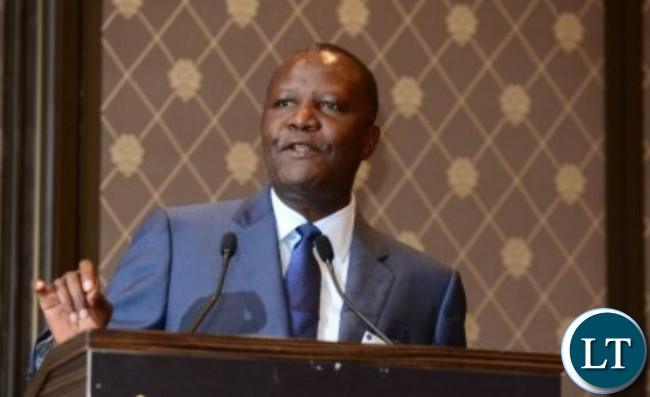
Patriotic Front Kabwata Parliamentary aspirant Given Lubinda has expressed optimism that he will return the seat on 11th August, 2016, reports Pan African Radio Journalist Hermit Hachilonde.
In an exclusive interview, Mr. Lubinda said those propagating a message that he has overstayed at the helm of Kabwata constituency, suggesting that he must pave way for fresh blood with new ideas are just wasting time and their energy because it will not work.
Mr. Lubinda won the Kabwata parliamentary seat three times and he is craving for a fourth term.
But some of his political opponents are saying fifteen years running the affairs of the constituency is too much, hence he must allow other leaders with fresh ideas to serve the people.
Mr. Lubinda has since stated that judging him based on the number of times he won elections in Kabwata constituency is outrageous.
He stressed the need to instead judge some of those political players that have lost elections several times because such a record is clear indication of failure.
”I should not be judged for winning elections three times because it will not work” He said
And Mr. Lubinda explained that he has only been a legislator under the party in Government for one term and it is imperative that he is given another chance to serve the people in the same capacity because he will use his vast experience in politics for the benefit of Kabwata residents.
“I have only been a law maker under the ruling party for one term and still want to serve” Mr. Lubinda said
Meanwhile Mr. Lubinda has appealed to the electorates to vote for him because he is now politically mature and versatile with vast his experience in parliament.
He has urged Zambians in Kabwata constituency not to replace him by a novice who does not even know the inside of parliament because it will delay developmental projects in the constituency.
“Kabwata people should not vote for a novice” he said
Felix Mutati
MMD President Felix Mutati has said that people are the most important part of any development journey and that any leader worth his sort should put people first.
Speaking during a rally in Chisamba where he went to drum up support for Chisamba aspiring candidate Naomi Mutateka and President Lungu, Mr Mutati said one of the things he learnt during the time he served as Minister under late President Mwanawasa was that it is important to put people at the center of development.
He said leadership was about hard work, discipline and sacrifice and that a leader who listens to the people would always be respected.
“…he said there is nothing indispensable like discipline, the second thing that Mwanawasa taught us was hard work and sacrifice. He also taught us that what is important is not the rule of man but the rule of law and the most important added Mr Mutati, was that we should always put people at the centre of development.”
And Mr Mutati said the MMD was too big to be swallowed by any political party.
He said the alliance with the PF was meant to allow the former ruling party to retain its identity and that the only way the party would do that was by fielding it’s own Parliamentary candidates.
He said the party had fielded quality MPs who would not only help in rebuilding the party and help in the running of the country as partners with the PF.
He also called on political party cadres to desist from engaging in violence as doing so would tarnish the image of the country which is the beacon of peace in the region.
He called on the leadership in political parties to ensure that they restrain their cadres as the children they are allowing to fight are related and that violence should not be tolerated by any well-meaning Zambians.
And Chisamba aspiring candidate Naomi Muteteka asked the people to vote for a woman MP for the first time in the history of the constituency.
Ms Muteteka who is the wife to the immediate past MP for the area called on voters to remember what the husband had done for the area when he represented them.
She said she was one of them unlike other candidates who have come from other constituencies whom she said would not understand their challenges.
MMD National Secretary Rapheal Nakacinda and other NEC members accompanied Mr Mutati to Chisamba.
Frank Bwalya addressing the news briefing
The PF- has accused the Post Newspapers of allegedly writing malicious stories against the Head of State in order to improve their newspaper sells.
PF Deputy Spokesperson Frank Bwalya says the daily tabloid wants to create curiosity in a bid to boost its sells.
Mr. Bwalya says Post Newspaper editors know that President Edgar Lungu is discharging his duties and that the tabloid’s reporters even covered him when he swore in Judges of the Court of Appeal in Lusaka today.
He says the Post Newspaper’s alleged schemes against the Head of State must be condemned with the contempt they deserve.
Mr. Bwalya says members of the public should ignore the newspaper’s negative stories against President Lungu.
He was reacting to a story carried in today’s edition of the Post Newspaper asking the whereabouts of the President.
Efforts to get a comment from Post Newspaper News Editor failed by broadcast time.
Last week, Mr Bwalya castigated the Post Newspaper for carrying a story that suggested that President Lungu had been flown abroad for medical attention.
PF Deputy Secretary General Mumbi Phiri says no amount of malice will deter President Edgar Lungu from delivering for the people.
And Mrs. Phiri says President Lungu is enjoying good health.
She says the president is next week scheduled to campaign in various parts of the country.
Mrs. Phiri was speaking in an interview with ZNBC News in Lusaka.
President Edgar Lungu has reiterated that he does not interfere with the running of the judiciary.
President Lungu said he has never at any time influencing the outcome of any court process saying the Judiciary in Zambia is independent.
He also described the judiciary in Zambia as one of the best in the world.
President Lungu was speaking at State House this afternoon when he swore in eight Court of Appeal Judges.
The Head of State He cautioned the Judges to remember to uphold the highest levels of integrity.
He said as Head of State, he will set as an example to protect and defend the integrity of the judiciary.
President Lungu observed that some opposition leader who was caught up in a leadership struggle and kept losing his legal battles has been going round that the Head of State has been predetermining the outcomes.
He has also assured the judges that government will do its best to ensure their conditions of services and office accommodation are taken care off.
President Lungu also expressed happiness that the Judiciary has taken lead in ensuring gender parity saying the new appointments to the Court of Appeal are on a 50/50 gender parity.
Those sworn in include Justice Fulgency Chisanga as Judge President to be deputised by Justice Chalwe Mchenga.
The Court of Appeals Judges include Justice Catherine Makungu, Justice Justin Chashi, Justice Flavia Chshimba, Justice Judy Mulongoti, Justice Dominic Sichinga and Justice Mubanga Kondolo.
Kagwe Mungai is a singer, songwriter and song producer who has been in the Kenyan music scene since 2012 when he released his EP “It Only Gets Better”. The EP featured songs and self -produced videos for Marry You and Oleku Cover. This cover was selected as one of the top 5 Kenyan covers that year.
He has a number of hits under his belt with the latest release being Hot This Year (released January 2016), a collaborative effort between himself and Kenyan female rapper and entrepreneur Muthoni Drummer Queen.
Recently announcing his signing to Taurus Musik, Kagwe hits the music scene with his new hits single “Doctor”
The song has major dancehall influences, while still maintaining a very African sound, with it’s strong & catchy lyrics & groovy beat. This club banger is bound to be on the top of your playlist.
The song was produced by Kagwe Mungai & mixed and mastered by Sean Peevers.
Peasant farmers could now face prosecution for saving their seeds
In July 2015, Zambia and other members of the regional body, adopted the ARIPO Plant Variety Protection (PVP) Protocol against the advice of the Zambia Alliance for Agro-ecology and Biodiversity Conservation (ZAABC) and other concerned citizens of Zambia and internationally. This will sell both food and farmers to multinational corporations such as Monsanto.
According to the Ecologist African governments, ignoring the protests of their farmers and civil society, last year agreed on an oppressive ‘plant variety protection protocol’ that will open up their countries to commercial seed monopolists, while limiting farmers rights to save, use, exchange, replant, improve, distribute and sell the seeds they have developed over countless generations.
This is a critical matter that will negatively affect national food security and small scale farmers rights and livelihoods in Zambia and the wider region.
Below is a PRess release by the Zambia Alliance for Agroecology and Biodiversity Conservation (ZAABC)
The African Regional Intellectual Property Organization (ARIPO) Arusha protocol makes it illegal for farmers to save, reuse and exchange seed amongst themselves as they have always done.
Zambia and other members of the regional body, adopted the ARIPO Plant Variety Protection (PVP) Protocol in July 2015 against the advice of the Zambia Alliance for Agro-ecology and Biodiversity Conservation (ZAABC) and other concerned citizens of Zambia and internationally.
The draft ARIPO Regulations represent a ferocious campaign against seed saving by farmers in Africa. The draft regulations require small scale farmers to pay for the seed they save and propagate on their own holding, or face fines and punishment.
Zambia and other members of ARIPO will be reviewing the draft regulations for the implementation of the ARIPO protocol from 14-17 June 2016 in Harare Zimbabwe. A significant portion of these draft regulations are targeting farmers in a manner that is unduly punitive and intent on extorting the small scale farmer to the point where the country is in danger of losing all the progress made so far where small scale farmers have contributed massively to food production including maize which is now even available to countries around us that have maize deficits.
The Regulations contain provisions requiring farmers, seed processors, and certification agencies to provide information and monitor the use of farm saved seed by farmers. Clearly these provisions are designed to intimidate and force seed processors, seed suppliers, government certification officers and even farmers’ organizations to police and spy on farmers who use farm-saved protected seed. If they do not, the regulations allow the right holder (who could be an international seed company) to take legal action and sue the member state.
Zambia already has its own suis generis PVP Act of 2007 in place. This balances plant breeder and farmers’ rights. There is no legal obligation for Zambia to adopt a different regional protocol which will then override our national Act.
Our small-scale farmers should be allowed to freely exchange with other farmers and sell to local markets their farm saved seed and propagating material.
We, the Zambia Alliance for Agroecology and Biodiversity Conservation (ZAABC), a network of civil society organizations, farmer groups and concerned individuals, call upon Government to bring this process of developing the regulations for implementing the ARIPO protocol to a halt until more background work is done in order to prevent any harm to our farmers and the national agriculture production system.
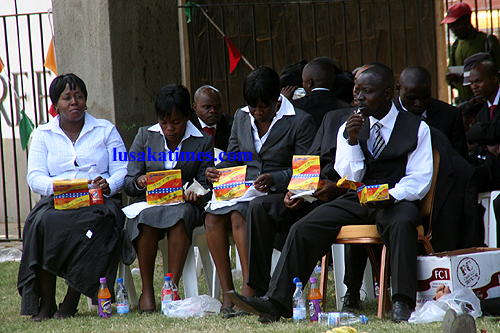
Some workers eating take away food after matching on May Day
Once a disease of the West, type 2 diabetes has now spread to every country in the world. There are now four times as many people in the world living with diabetes today than in 1980 and poor diet and a lack of exercise are largely blamed, according to a report by the World Health Organization. In Africa, the prevalence of diabetes has more than doubled in that time, which may be due to better personal incomes versus poor public spending.
While the rate of diabetes remains comparatively low in Africa, the number of people living with diabetes has jumped from 4 million in 1980, to 25 million in 2014. For one of the world’s youngest regions, that number is worrying for a number of reasons.
Since diabetes is a lifestyle disease, an increase in the disease could be a symptom of growing prosperity, as people are able to afford more processed foods. It’s also a sign of a more sedentary lifestyle as more people spend their working days sitting down.
However, Africa’s relative prosperity has not yet translated to more sound public healthcare systems. In developing countries, diabetes is an added burden to states still dealing with historical sociopolitical inequalities and weak economies. Plus, developing countries have other illnesses—biological and social—whose immediate effects have seemed more pressing than diabetes.
“Most of these countries are also burdened by communicable diseases such as HIV, tuberculosis, malaria and diarrheal diseases. Political unrest, poverty and poor leadership with substandard policy regulation and corruption, illiteracy and low education standards are rampant,” said endocrinologist Sundeep Ruder in The Conversation.
“Governments need to guide policy to create environments that are conducive to attaining health goals. Trade measures and agricultural policies need attention. The marketing of foods high in sugar, fats and salt—especially to children—requires attention.”
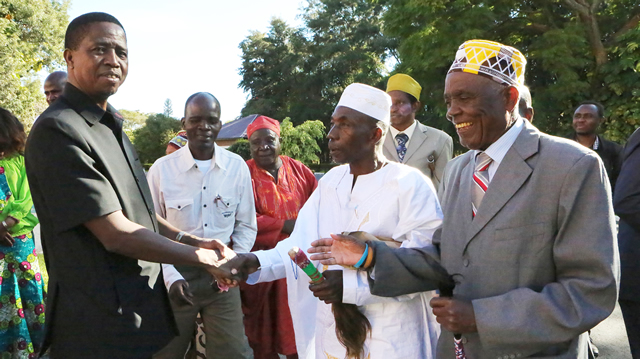
President Edgar Lungu on Saturday held a meeting with Chiefs from Luapula at State house
Government has defended the recent hike in Chief’s salaries from K4,000 to 15,000 per month with immediate effect.
Chief’s and Traditional Affairs Minister Dr Joseph Katema said in an interview that the increment is not a political gimmick to hoodwink Chiefs into influencing their subjects to vote for the PF.
Dr Katema revealed that the increment in Chief’s salaries was budgeted in the 2016 national budget.
He explained that its implementation was delayed as the Ministry of Chiefs and Traditional Affairs was waiting for the availability of funds from the Ministry of Finance.
“This increment is not outside the budget. The budget line was formulated and approved by Parliament. People ought to realise that Government doesn’t cease to function even when there are elections. We are making the disbursements now because this is when the money has been released,’ Dr Katema said.
Government has come under intense condemnation from several sectors of society over the timing of the increment in Chief’s salaries alleging that the move is aimed at inducing the traditional leadership into supporting the PF in the August elections.
The National Water Supply and Sanitation Council (NWASCO) has called on water companies on the Copperbelt to strictly adhere to regulatory guidelines and standards in the provision of water supply and sanitation services.
NWASCO just concluded a comprehensive inspection of Mulonga, Nkana and Kafubu Water and Sewerage Companies conducted from 14th to 20th May 2016 covering Mufulira, Chililabombwe, Chingola, Kitwe, Kalulushi, Chambishi, Ndola, Luanshya and Masaiti.
The inspection was aimed at checking compliance to processes and procedures in commercial, financial, procurement and human resources management departments.
The inspection revealed areas of non-compliance and issues of concern.
NWASCO has since directed the three utilities to address issues identified.This is according to a statement issued by NWASCO Head of Public Relations Rose Tembo.
Nkana Water and Sewerage Company has been directed to improve water supply to CEC Village Katanga Street, Mindolo West 2nd to 6th street, portions of Chamboli and Luangwa Townships and start billing the over 400 customers who are not being billed including those in Magum Township.Further Nkana Water should ensure that the challenges of sewage flooding in Kalulushi are eradicated.
Kafubu Water and Sewerage Company has been directed to ensure bills are distributed to all customers in Ndeke and Kariba Townships of Ndola with the view of improving the company’s revenue in line with tariff projections.
The Company should immediately improve the processing of new connections to ensure that the stipulated timeframes in the Service Level Guarantees are compiled with.
Mulonga Water and Sewerage Company has been directed to speedily address the numerous leakages across Chingola.The water company should restore supply to Kawama Township which was cut off and improve water supply in Chabanyama and Twatasha Townships in areas where supply hours were below guaranteed levels.
NWASCO further calls on customers to hold water companies accountable and ensure that complaints are resolved within time frames stipulated in the service level guarantees. All unresolved complaints should be reported to the NWASCO using the toll free line 5252.
25 young Zambian women have been selected to receive the Justina Mutale Scholarship to continue their education at institutions of higher learning around the world. The announcement was made at the Official Launch of the Justina Mutale Foundation’s Scholarship Programme, which was held at the Zambian High Commission in London, on Thursday 9th June 2016.
The event was graced by Commonwealth Deputy Secretary-General, Her Excellency Dr Josephine Ojiambo; African Union Permanent Representative to the European Union and ACP Secretariat in Brussels, Ambassador Ajay K. Bramdoe; Founder & President of the European School of Economics Professor Elio D’Anna; and Professor Chris O. Imafidon, Advisor to the British Monarchy, World Governments and World Leaders & Chair of Excellence in Education.
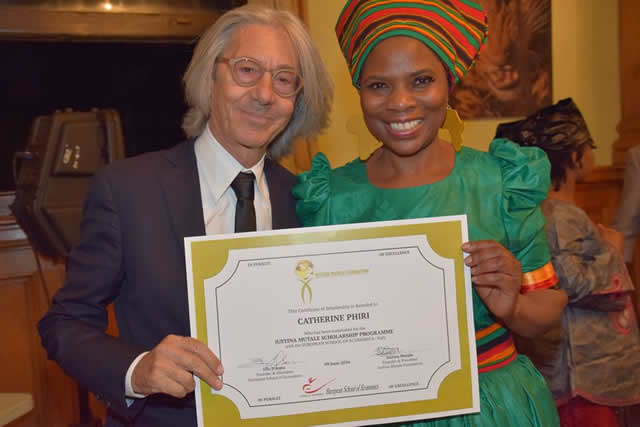
Among the 25 scholarship recipients is Zambia’s female teenage boxing champion, Catherine Phiri, who has been selected to study Sports Management at the European School of Economics in Italy. Another recipient is Chibombo-based teenage marketer, Bianca Hamweete, who will study International Business and Leadership at the same institution.
The Justina Mutale Scholarship Programme is an Africa-wide initiative which aims to provide opportunities to academically talented young African women from underprivileged backgrounds in Africa, to pursue higher education at overseas institutions of learning around the world.
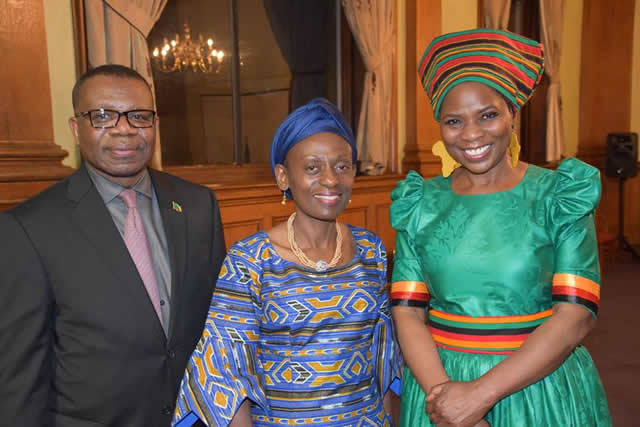
Justina Mutale with Zambian High Commissioner and Commonwealth Deputy Secretary GeneralJustina Mutale with Zambian High Commissioner and Commonwealth Deputy Secretary General
The Scholarship Programme has been set up to equip young African women with the necessary skills and competencies to help realize the aspirations of the United Nations Global Goals for Sustainable Development (SDGs), as well as those of the African Union’s Agenda 2063, in respect of achieving Gender Equality and Women’s Empowerment in all spheres of life.
“It is also our hope that the Scholarship Programme will enable young African women to take up leadership roles to effectively contribute to the development of Africa from a global perspective and to help achieve a 50-50 planet by the year 2030 and beyond” says Justina Mutale, Founder & President of the Justina Mutale Foundation.
The Justina Mutale Foundation has partnered with the European School of Economics and other prestigious institutions around the world to offer both Undergraduate and Post Graduate courses to their scholarship students, including International Business; Leadership; and STEM subjects (Science, Technology, Engineering and Mathematics).
Receiving the Scholarship Awards on behalf Catherine Phiri and Bianca Hamweete, Zambian High Commissioner to the United Kingdom, His Excellency Mr Muyeba S. Chikonde said that Zambia attaches great importance to the empowerment of women and girls.
“We all need to acknowledge that our Governments do not have all the answers, nor the requisite resources to solve the problems that our Continent faces regarding educating our youth, especially our young women and girls. Our scholarship programmes aims to give young women from Africa an opportunity of a lifetime. Cross-cultural learning and studying abroad can be transformative to one’s future and outlook on life”, said Justina Mutale
An amalgam of traditions, norms and values of a diverse people from over 70 ethnic groups make up the Zambian culture. The Soutern African country derives its name from the Zambezi River, which forms Victoria Falls (a major tourist attraction), flows into Lake Kariba and oi to the Indian Ocean. As a landlocked nation, Zambia has a small population of about 13 million, while most of its vast land is sporadically populated with a craggy topography.
The country’s diverse culture is a fascinating tale that dates back to the colonial era, when independent states came together to trade slaves, ivory and copper, in exchange for salt, jewelry and textiles. Brought together by trade, these ethnically diverse people integrated their cultures and traditions. Although to some extent the aboriginal values and customs have been watered down by westernization, most of them have been carried on from one generation to another, making Zambia home to some of the unrivaled cultures in Africa.
Music and Dance
A young Ngoni figther was a darling of the crowd during the street carnival with his enthrilling performances
Culture is so critical such that, Zambia’s post-independence development was quite dependent on it, like in many other African countries, in building a unique identity for the nation and its people. The establishment of cultural villages and private museums went a long way in endorsing the mien of arts. Part of the expression is through music and dance, which embodies the beauty and spectacle of life in Zambia; from the intricacies of the talking drums to the Kamangu drum used to announce the beginning of Malaila traditional ceremony.
The sound of the drums is customarily a call for song and dance. With the accompaniment of other traditional instruments, which despite rivalry from western ones have stood the test of time, the dance is imperative in socially bringing the people of Zambia together as one in the spirit of Africanism.
Communication
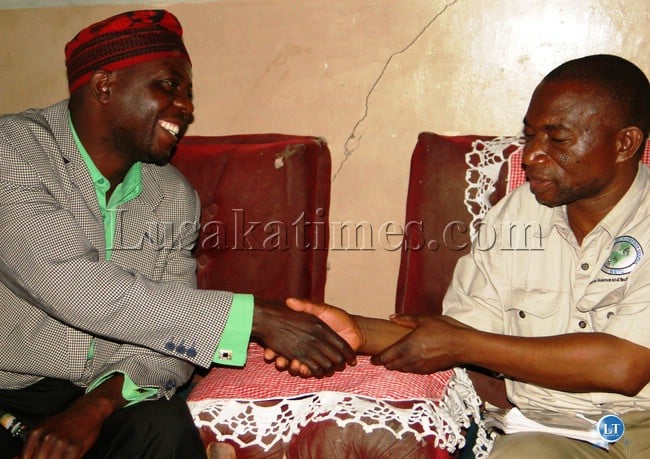
Chief Chitoshi greets Northern Province Minister Obious Chisala when called on him at his palace in Mporokoso during his familiarization tour recently. The Chief expressed disappointment at the wrangles at Senior Chief Tafuna in Mpulungu district
While English is the official language in Zambia, the country boasts over 72 local parlances with Bemba being the most spoken by more than two million Zambians in Lusaka and across the Copperbelt. Other languages include Nyanja/Chewa which is spoken across the country, Lozi- spoken along the Zambezi, Tonga which is common in the south while Lunda, Kaonde and Luvale are spoken in the west.
Greetings are considered customary in the Zambian culture, expected before the start of any conversation. The greetings are then followed by an inquiry on the other’s well being after which the parties indulge in their tête-à-tête. Proverbial communication is common even in the education system of Zambia as maxims are considered part of the oral tradition.
Food
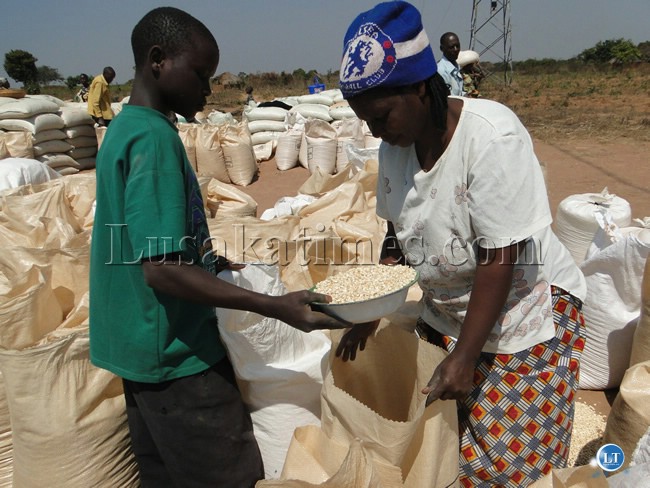
Zambia’s main staple food is nshima, made of cornmeal (maize). The cornmeal is cooked in boiling water and mixed to make a thick paste which is served with ndiyo (Relish). The food is traditionally eaten using hands. Breakfast is commonly buns served with tea or porridge. Plenty of food and traditionally brewed beer is served in ceremonies such as weddings and funerals, a factor used to bring together members of the community.
Marriage
Time to eat… A group of women going to deliver Matebeto to a would be husband
One of the most thrilling discussions of any culture, marriage is considered sacred in Zambia not only religiously but also traditionally. In line with this, some traditions do not allow people to marry outside their tribe, but a marriage union within a clan is considered taboo.
When a couple decides to marry, the groom is accompanied by a negotiator to meet with the potential bride’s family in a bid to get to know them and negotiate for a lobola (dowry). The lobola comprises cattle or other livestock, which is seen as recompense to the family for the lost services of the woman. While Christian weddings have become common in Zambia, traditional religious wedding customs are still largely practiced in both cities and rural areas, varying from the different tribes.
Such a rich and unsurpassed culture could be the game changer for the undeveloped tourism sector, which accounts for less than 3 percent of Zambia’s GDP. If well nurtured, the cultural perspective has the capability of increasing tenfold the visitor numbers in Zambia that remain steadily at approximately half a million per year.
Apart from the regal Victoria Falls, Zambia offers a natural taste of life with innumerable pristine resources. Offering and sharing its consummate indigenous culture is a huge step towards awakening the sleeping giant that is Zambia’s Tourism sector.
The highly-anticipated television event Roots, the four-part, eight-hour series by History channel based on the best-selling novel by Alex Haley is expected to debut this Wednesday at 20:30 hours before repeating next Sunday on Lifetime.
MultiChoice announced in a press statement that it has opened the History Channel to all DStv Compact and Compact Plus Subscribers from June 13 – July 11.
And to go with that is Roots, which was developed by History and produced by A+E Studios. Roots recounts the journey of one family’s will to survive, endure, and ultimately carry on their legacy despite enormous hardship and inhumanity. “During this four week open-window History will broadcast new and exclusive shows, along with top-rated return titles that Compact subscribers will not have had access to previously,”reads a statement by MultiChoice Africa.
Roots will certainly be eagerly anticipated, both on History and Lifetime. “Nearly 40 years ago, I had the privilege to be a part of an epic television event that started an important conversation in America,” says LeVar Burton, co-executive producer and the actor who played the lead role of Kunta Kinte in the original 1977 version. “I am incredibly proud to be a part of this new retelling and start the dialogue again, at a time when it is needed more than ever.”
Spanning multiple generations, the lineage begins with young Kunta Kinte, who is captured in his homeland of The Gambia and sold into slavery. Throughout the series, the family continues to face adversity that reveals powerful truths about the universal resilience of the human spirit.
Starring in the series are Academy Award winners Forest Whitaker (Fiddler) and Anna Paquin (Nancy Holt); Academy Award nominee and Emmy Award winner Laurence Fishburne (Alex Haley); Golden Globe Award winning and Emmy Award nominated actor Jonathan Rhys Meyers (Tom Lea); Tony Award winner Anika Noni Rose (Kizzy); Grammy Award winner Tip “T.I.” Harris (Cyrus); Emayatzy Corinealdi (Belle); Matthew Goode (Dr William Waller); Mekhi Phifer (Jerusalem); and James Purefoy (John Waller).
The series also introduces Regé-Jean Page (Chicken George) and Malachi Kirby (Kunta Kinte), originally played by LeVar Burton who is co-executive producer in the new Roots.
CHILUFYA TAYALI xecutive Director The Zambian Voice
I don’t know where my grade twelve certificate is, but certainly I know about the independence of the Electoral Commission and tender procedures as stated in the Act. But I wonder if Dr. Simutanyi knows about these basics.
I am usually very disappointed of with when I hear Dr. Simutanyi going wayward on political issues in spite of him being a Political scientist.
This morning I heard Dr. Simutanyi calling ECZ as politically compromised and going in an election when ECZ’s integrity is in shambles.
Dr. Simutanyi cited the issue of printing ballot papers in Dubai as one of his basis to judge the ECZ so harshly.
I am not being biased in anyway but I stand to defend the independence of the ECZ and the tender procedures.
I have always insisted that, if ECZ has flaunted the constitution or tender procedures I would be first to just on them like I did on the FRA issues and others. But this time around ECZ has not done anything wrong to warrant a learned political scientist to call them politically compromised and lacking integrity.
If Dr. Simutanyi had substantive evidence, which is what is required in any science, he would be justified, but Dr. Simutanyi, the defender of facts, has resorted to being speculative and suspicious like a witch political doctor.
Therefore, I think it is Dr. Simutanyi who is politically compromised, other than ECZ.
It would be good to advise Dr. Simutanyi to be factual since his opinion, based on the title that precedes his name, is highly respected by the citizens. The failure of providing evidence by Dr. Simutanyi, erodes and compromises his Title and that of other impeccable Doctors of facts like Dr. Kambwili.
Dr. Simutanyi should also realise the potential of his careless remarks on ECZ owing to the fact that, this election is so tight and could easily degenerate into political violence if careless statement continue to be planted in the minds of the innocent citizens who believe Doctors of facts.
If Dr. Simutanyi has political interest, he would do better to outline them and woo people on his side instead of issuing such speculative dangerous statements.