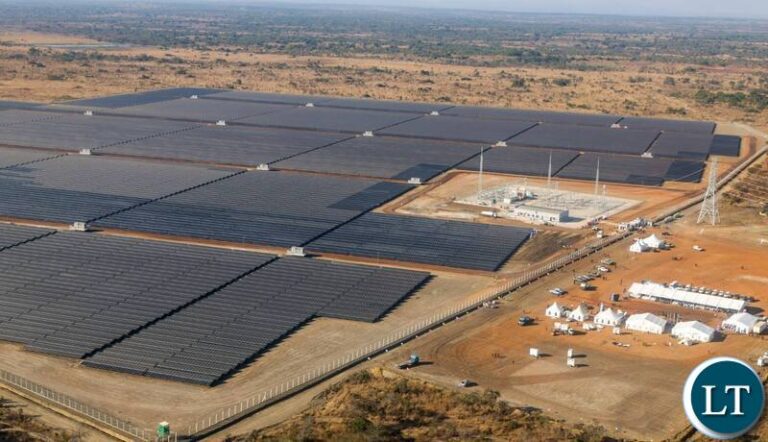
The 22 megawatt solar power plant at the Natural Resources Development College (NRDC), is expected to strengthen Zambia’s electricity supply and accelerate the country’s transition towards renewable energy.
The solar plant, developed by Kiyona Energy Limited in partnership with NRDC, was commissioned on March 24, 2026, at a total cost of 17.5 million United States Dollars.
Speaking when a media team led by the Presidential Delivery Unit, paid a courtesy call on him before touring the facility, NRDC College Principal, Melon Mulamfu, praised Government for allowing the college to partner with Kiyona Energy Limited and ZESCO Limited in establishing the solar plant under the Presidential Solar Initiative.
Mr Mulamfu said the project is in line with Cabinet Office Circular Number 13 of 2024, which directed public institutions to adopt solar power systems to help mitigate the country’s electricity deficit and diversify the national energy mix.
“This is a huge energy investment for the agriculture sector and national food security at large,” Mr Mulamfu said.
He explained that apart from the 20 megawatts being injected into the national grid, an additional two megawatts have been dedicated to powering operations at the college.
Mr Mulamfu explained that reliable and sustainable energy will significantly improve the institution’s ability to deliver practical agricultural training through enhanced irrigation systems, modern laboratories, research facilities and agro-processing units essential for preparing students for real-world agricultural challenges.
“Reliable and sustainable energy will significantly enhance the college’s capacity to deliver practical, hands-on agricultural training,” he said.
Mr Mulamfu further said the project will strengthen NRDC’s role as a centre of excellence in climate-smart agriculture by promoting irrigation farming and renewable energy applications in agriculture.
He said the knowledge and skills acquired by students at the institution will ultimately benefit farming communities across the country and contribute to increased agricultural productivity and improved food security.
And Kiyona Energy Limited Head of Projects, Peter Sakala, said the plant is currently injecting 22 megawatts of electricity into the national grid and is capable of supplying power to approximately 15,000 households.
“The number of solar panels that we have here is 35,420 and they are rated at 650 watts each panel,” Mr Sakala said.
Mr Sakala disclosed that the project was completed within six months from land identification, procurement and construction, adding that about 150 Zambians were employed during the construction phase while 25 workers have since been retained for operations and maintenance.
He further thanked Government and President Hakainde Hichilema for creating an enabling environment that has encouraged investment in renewable energy projects across the country.
Mr Sakala said reforms allowing independent power producers easier access to the national grid, coupled with faster approval processes, have motivated more private sector participation in solar energy generation.
He also revealed that Kiyona Energy Limited is developing additional solar projects in Kaoma, Shangombo, Mbala, Mwense and Lusaka as part of efforts to contribute to the Presidential target of generating 1,000 megawatts of solar power.