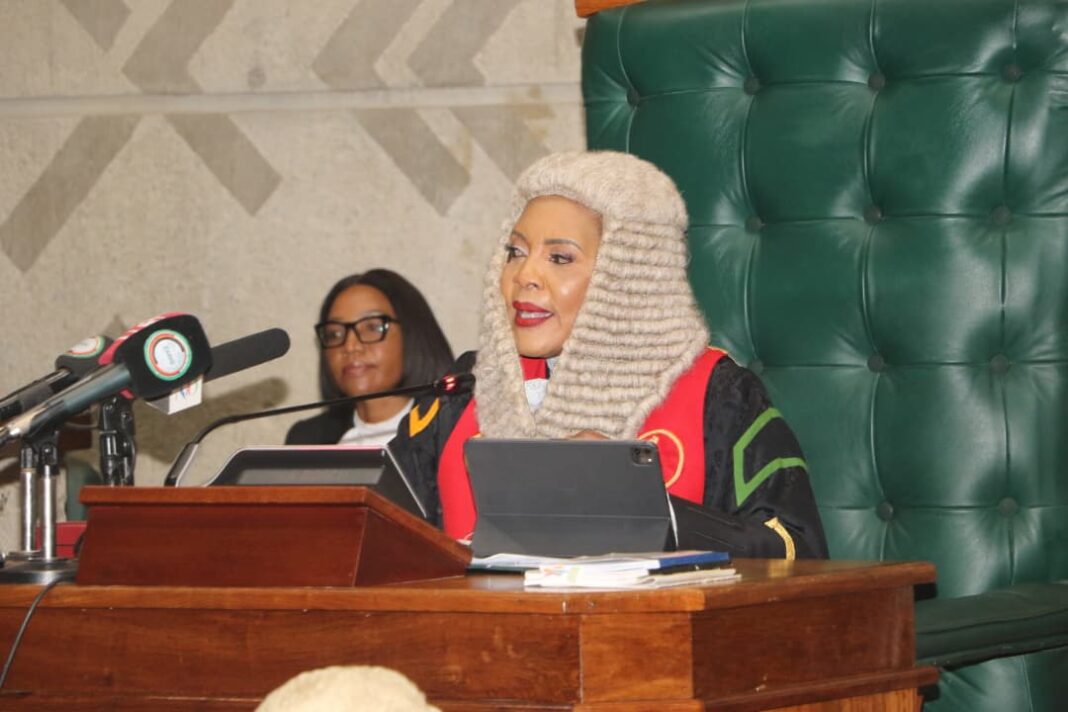
International law expert Professor Cephas Lumina has accused Speaker of the National Assembly Nelly Mutti of undermining the credibility of Parliament during the passage of Constitution Amendment Bill No. 7, saying her conduct eroded public confidence in the legislature and compromised the principles of neutrality expected of the presiding office.
Prof Lumina said the manner in which parliamentary proceedings were conducted during debate and voting on Bill 7 raised serious concerns about adherence to established rules and conventions governing constitutional amendments. He argued that the Speaker’s handling of procedural objections, time allocation, and control of debate created an impression that Parliament was not operating as an impartial forum during a process with far-reaching constitutional consequences.
According to Prof Lumina, the Speaker occupies a critical position in Zambia’s democratic architecture and is expected to rise above partisan considerations, particularly when presiding over constitutional matters. He said constitutional amendments demand heightened procedural integrity because they affect the balance of power, electoral arrangements, and governance structures for generations.
He said any perception that the presiding officer tilted the process in favour of one side risks delegitimising the outcome, regardless of whether the numerical thresholds required for passage were met. In his view, Parliament’s authority is derived not only from constitutional mandate but also from public trust in the fairness and transparency of its proceedings.
Bill 7 was passed by the National Assembly after an intense and polarising debate that divided lawmakers, political parties, civil society organisations, and sections of the Church. The Bill introduces changes to Zambia’s constitutional framework, including provisions for increasing the number of constituencies and altering electoral and governance arrangements. It has since been assented to by the President and is now law.
Supporters of the amendments argue that the reforms are necessary to address representation gaps caused by population growth and to modernise governance systems. However, critics maintain that the process was rushed, insufficiently consultative, and managed in a manner that constrained meaningful debate.
Prof Lumina said the Speaker’s responsibility during such proceedings is to ensure that all sides are afforded a fair opportunity to be heard and that parliamentary rules are applied consistently. He argued that rulings perceived to favour one political outcome undermine Parliament’s institutional credibility and weaken democratic norms.
He further warned that procedural shortcuts or heavy-handed control of debate in constitutional matters can set dangerous precedents for future legislatures. In his view, the long-term cost of eroding parliamentary integrity far outweighs any short-term political gains secured through procedural advantage.
The legal scholar said concerns about the conduct of the Bill 7 process extend beyond partisan politics and speak to broader issues of democratic governance and institutional independence. He noted that Parliament is a cornerstone of Zambia’s constitutional order and must be seen to function independently of the Executive and partisan pressures.
Criticism of the Speaker’s role has been echoed by opposition political parties and civil society groups, who have questioned whether the legislative process met the standards required for constitutional reform. Some have argued that the atmosphere in the House during the Bill’s passage discouraged dissenting voices and narrowed the scope for substantive engagement.
Prof Lumina said restoring confidence in Parliament requires reaffirming the principles of neutrality, procedural fairness, and respect for dissenting views. He warned that failure to address concerns arising from the Bill 7 process risks deepening public scepticism about democratic institutions.
He said while constitutional reform is sometimes necessary, the legitimacy of such reforms depends as much on the process as on the substance. In his assessment, Parliament’s handling of Bill 7 will remain a reference point in debates about democratic accountability and the role of the Speaker in safeguarding institutional integrity.