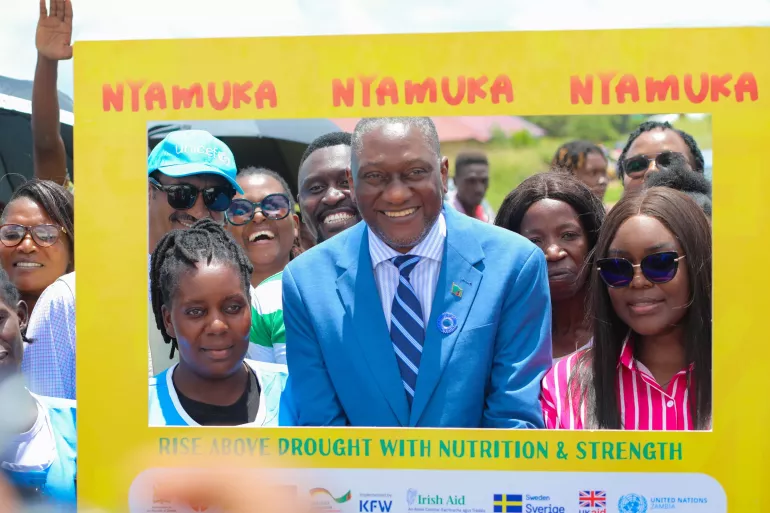
The Government through the Vice President’s Office has officially launched the joint 2026 National Food and Nutrition Security Policy Implementation Plan, alongside the Stunting Reduction Strategy aimed at combating malnutrition in all its forms and unlocking the full potential of every Zambian citizen.
In a speech read on her behalf by Secretary to the Cabinet, Patrick Kangwa, Vice President Mutale Nalumango says the launch marks a significant milestone in the country’s journey towards sustainable human development.
Mrs Nalumango added that with government’s renewed focus on multisectoral collaboration, local agricultural diversity, and resilient households, the initiative aims to reduce stunting rates from 32% to 15% by 2030.
The Vice President highlighted that the policy is a bold step that underscores the nation’s commitment to human capital development, economic growth, and sustainable development.
She expressed that the government recognises that malnutrition is not merely a health issue but a social, economic, and developmental challenge that affects the entire nation.
“This joint launch signifies a renewed commitment to safeguarding the well-being of Zambia’s people and investing in the nation’s future.
Let us work together to avoid duplication, maximise impact, and promote behavioral change through effective communication,” Mrs Nalumango stated.
The Vice President highlighted the key strategic pillars being addressed in the policy as eliminating the triple burden of malnutrition, promoting local agricultural diversity, securing sustainable, and resilient household nutrition.
“By anchoring food and nutrition security within the Vice President’s office, we are creating a unified mechanism to drive progress and ensure that all ministries contribute meaningfully toward our shared goals,” the Vice President affirmed.
And National Food and Nutrition Commission (NFNC) Deputy Chairperson for the Permanent Secretaries Coordinating Committee, Lillian Kapusana assured stakeholders that the committee will continue to provide strategic oversight and leadership to ensure effective implementation of the policy.
Ms Kapusana, who is also the Permanent Secretary for Administration in the Office of the Vice President, highlighted that the just launched 2026 policy is a replacement of the 2006 nutrition policy.
Representing the Nutrition cooperating partners in Zambia, United Nations (UN), Resident Coordinator Beatrice Mutali commended the government for its steadfast commitment to improve food and nutrition security, citing that the launched policy demonstrates the country’s political will at the highest level.
Ms Mutali expressed that with the President Hakainde Hichilema personally championing nutrition through the School Meals Programme, as well as the establishment of the council of ministers on food and nutrition security which is chaired by the Vice President exemplifies its importance.
Ms Mutali noted that while significant progress has been made in the reduction of stunting by 3 percent, it still remains a challenge.
DMMU National Coordinator Norman Chipakupaku emphasised that the frameworks launched were produced under wide consultation at various levels aimed at enhancing nutrition across the country through coordinating structures.
In her vote of thanks NFNC Executive Director, Muntanga Kapengele recognised the collaborative efforts toward national nutrition and food security, by the Food and Nutrition Coordinating Committee of Permanent Secretaries for its key role in guiding policy formulation, as well as review of the policy.
Meanwhile, Public Private Dialogue Forum (PPDU) Deputy Director General Jacqueline Chishimba said food and nutrition security is not a government responsibility alone but requires concerted efforts particularly from the private sector.
While the Head of Presidential Delivery Unit (PDU) Kusobile Kamwambi represented by her Deputy Jones Shimbela assured that her institution will ensure that the policy is well tracked and monitored to ensure effective acceleration and implementation of the policy.
In his closing remarks, Ministry of Health Permanent Secretary for Technical services Kennedy Lishimpi, highlighted that malnutrition is not only a health issue but a matter of national security requiring a holistic approach.